
Where we heard itCNBC’s Squawk Box, Oct. 6, 2026. Speaker: Tony Bancroft, who covers aerospace and defense for Gabelli Funds.
Shares of Albany InternationalAIN trade on the NYSE under a label most defense investors would never search for. Market data places the company in the Consumer Cyclical sector, in the Textile Manufacturing industry. Its market capitalization is about $1.7 billion. On CNBC’s Squawk Box on October 6, 2026, a defense portfolio manager named it as his small-cap pick in a sector he says the market has priced wrong.

What a Textile Company Builds for the Military
Tony Bancroft described Albany as a manufacturer using “3D carbon carbon weave” technology to build engine blades and hypersonic weapon parts. He sees growth opportunity in the aerospace and defense side and expects Albany to eventually spin off its historic paper and pulp business. Albany has not announced one.
The Textile Manufacturing tag comes from how market data providers categorize the company. The SEC’s filing index also lists Albany under a textile code, broadwoven fabric mills. A maker of hypersonic weapon components that sits in a consumer textiles category is exactly the kind of mismatch stock pickers look for, because screens built on sector labels can pass right over it.
Who Is Making the Call
Bancroft is a portfolio manager at Gabelli Funds and a lieutenant colonel in the Marine Corps reserve, according to Gabelli’s own research page. His reserve service helps explain how well he knows munitions inventories. His day job explains why he appears on television talking about these stocks. He manages money in this sector, and his fund may hold the names he is talking about.
A Selloff He Calls Counterintuitive
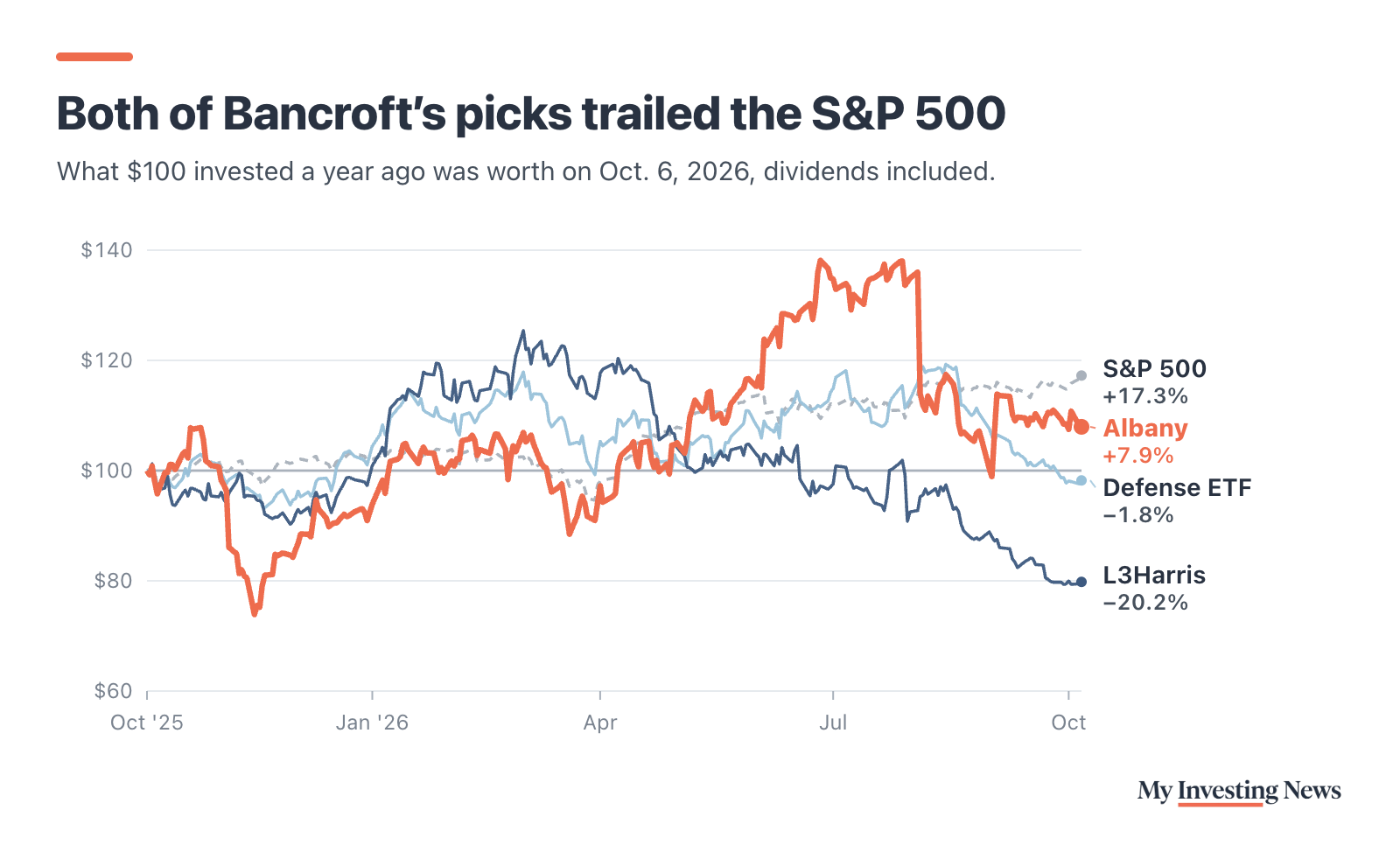
Bancroft says defense stocks have sold off despite rising spending, which he called “counterintuitive.” The CNBC anchor noted the sector’s main ETF was down 18.4% from its high. The iShares U.S. Aerospace & Defense ETFITA fell 7.7% over the past month and 2.0% over twelve months, and gained 0.6% on October 6. At that close it sat 17.8% below its August 14 high.
Bancroft said the concept of “peak defense” is “very prevalent” right now. He says budgets track geopolitical instability and wars more closely than political control.
He put the expected base defense budget at $1.15 trillion, an increase of almost 15%. The US Department of War’s budget documents show a combined fiscal 2027 request for research, development, test and evaluation plus procurement of $756.8 billion, compared with $434.2 billion enacted for fiscal 2026. Trump’s January 7, 2026 statement called for a military budget of $1.5 Trillion Dollars.
Depleted Stockpiles Back Up His Argument
Bancroft said about 1,000 Patriot interceptors were fired in the first five days of the conflict, leaving less than 800, though he said he did not know whether that inventory figure is accurate. The Pentagon inspector general found $22.3B spent on munitions caused strategic shortfalls, according to CBS News. The military used nearly half its Patriot missiles and nearly all its long-range missile stockpile, according to The Hill.
The US Department of War’s documents list rebuilding weapon stockpiles as a readiness priority. The US Department of War’s request includes over $74B for drone dominance and counter-drone technologies and nearly $18B to deploy Golden Dome. The inspector general has documented the depletion, and replacement spending is written into the request.
The spending case in numbers
His Historical Case
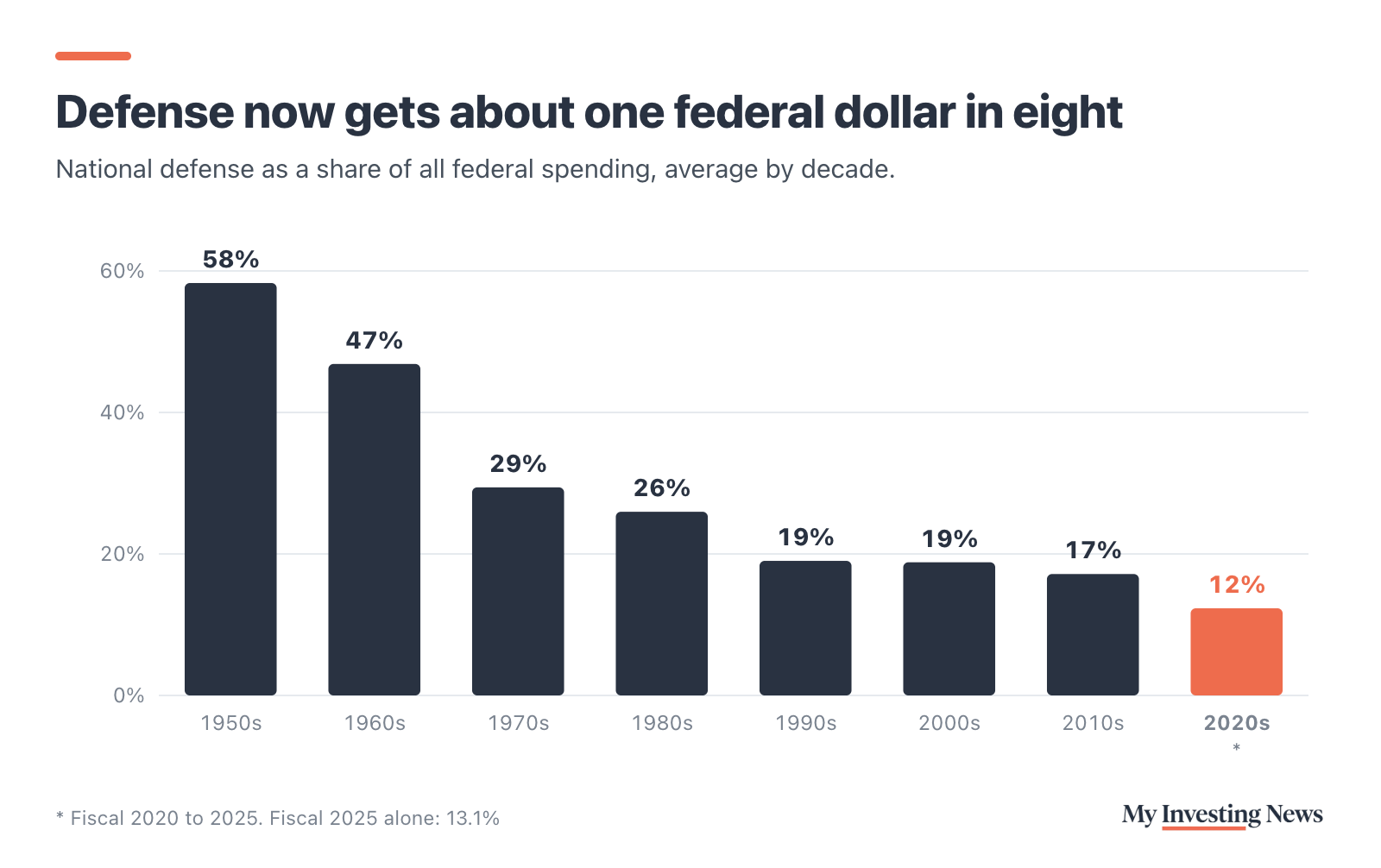
Bancroft said defense now takes about 13% of the federal budget versus a historical 23% to 25%, and about 3.5% of GDP versus 6% to 7% historically. He concluded the country is underspending by historical standards.
Large-Cap Pick: L3Harris
Bancroft called L3Harris TechnologiesLHX a favorite. He said the company has delayed a potential IPO of its missile solutions business, expects that IPO to happen eventually, and said the stock could “almost be a double from here.” L3Harris closed at $237.90 on October 6, up 0.4% that day, down 21.5% over twelve months and 19.0% year to date.
What Readers Are Weighing
Bancroft has deep sector expertise and his fund may own these stocks. His argument: the selloff discounts documented munitions depletion and a larger budget request. The government’s own reporting confirms the depletion, and the budget request is public. Whether either reaches shareholders on his timeline remains uncertain.
Bancroft thinks investors have priced defense stocks wrong while spending rises and munitions stockpiles run low. His small-cap pick is Albany International, a woven carbon parts maker that market data files under textiles, and his large-cap favorite is L3Harris. The risk is timing: Albany has not announced the spinoff he expects, L3Harris has put off its missile IPO, and both stocks trailed the S&P 500 over the past year.