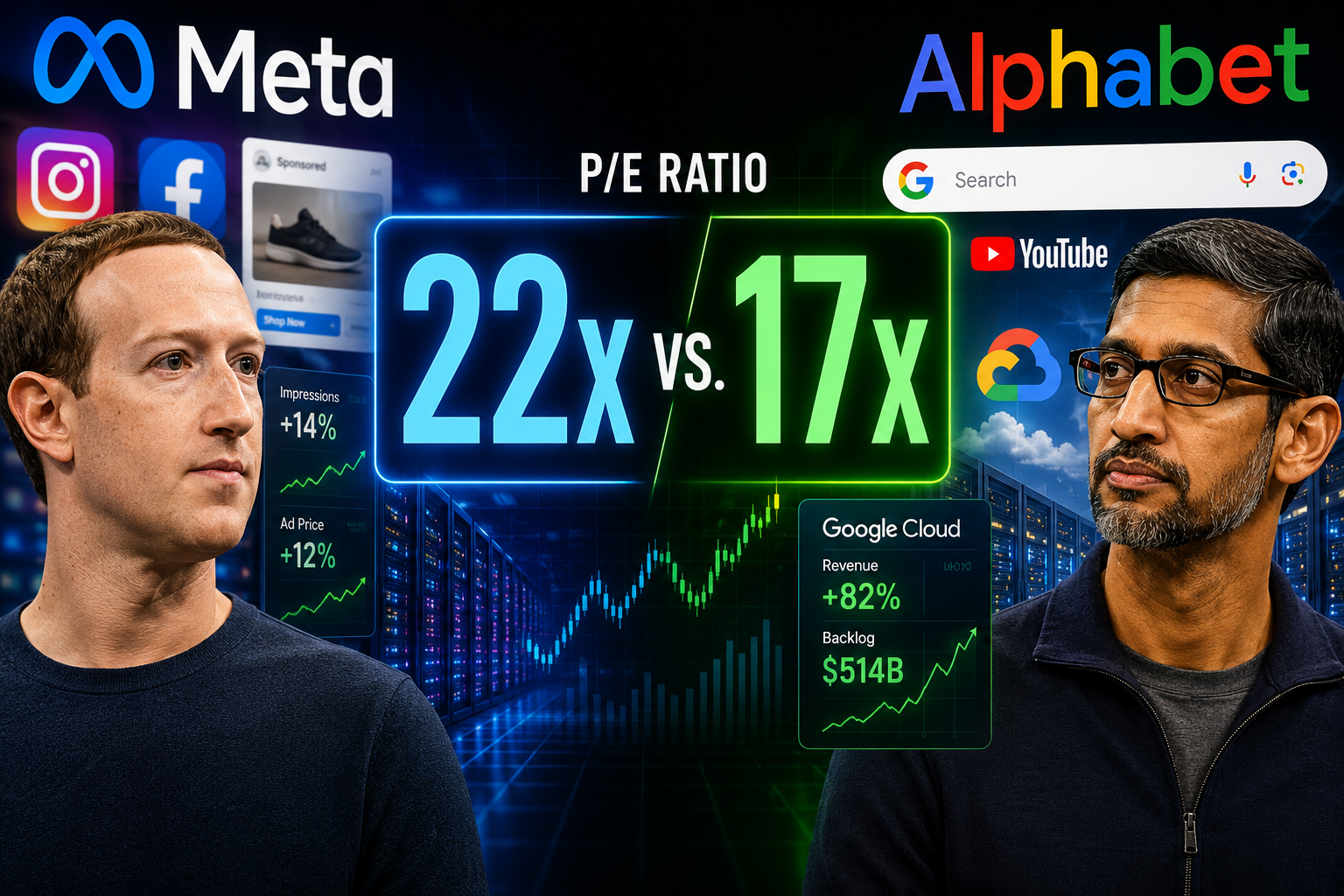
Meta (NASDAQ: META) and Alphabet (NASDAQ: GOOGL) both gave value-minded investors something to chew on in their second-quarter results. Meta grew revenue 28% year over year, while Alphabet grew 24% and Google Cloud revenue surged 82%. As of Aug. 14, Meta trades around 22.4 times trailing earnings and Alphabet around 17.3 times. On the surface, Alphabet looks like the obvious bargain.
But that comparison is not as clean as it looks. Alphabet’s Q2 earnings were boosted by a huge jump in investment-related income, while Meta absorbed billions in legal and severance charges. For investors trying to decide which stock offers better value, especially when retirement savings are involved, the better question is not simply which P/E is lower. It is which company can turn enormous AI spending into durable operating cash flow.

Meta’s Ad Business Is Strong. The Spending Is the Problem.
Meta’s quarter looked messy on the bottom line, but the ad business was still doing the heavy lifting. Revenue reached $60.80 billion, up 28% year over year. Ad impressions across its Family of Apps rose 14%, while the average price per ad increased 12%. The problem was costs. Meta booked $2.40 billion in legal charges and $1.18 billion in severance tied to its May workforce reduction, helping pull operating margin down to 31% from 43%. Free cash flow fell to just $784 million for the quarter as capital spending surged. That does not mean the core business broke. It means investors have to decide how much they are willing to pay while Meta spends aggressively on AI infrastructure.
Alphabet’s Cloud Growth Is Real, but That $9.11 EPS Needs Context
Alphabet’s numbers were cleaner operationally, but its headline earnings need a closer look. Revenue rose 24% to $119.80 billion, while operating income climbed 30% to $40.77 billion. Search and other advertising revenue grew 17%, YouTube ads rose 13%, and Google Cloud revenue jumped 82% to $24.8 billion. Cloud operating income reached $8.8 billion, and backlog rose to $514 billion. The eye-popping $9.11 in diluted EPS was helped by a huge increase in other income, primarily unrealized gains on equity securities. That matters because those gains can swing around and are not the same thing as recurring profit from Search, YouTube, or Cloud over time.

The Valuation Gap Is Not as Simple as 22x Versus 17x
At current prices on Aug. 14, Meta trades near 22.4 times trailing earnings and Alphabet near 17.3 times. On the surface, Alphabet looks like the obvious bargain. I would not stop there. Alphabet’s trailing earnings now include the extraordinary investment gains that boosted Q2 net income, which makes that P/E look cheaper than the operating business alone would suggest. Meta’s multiple is easier to read, but the company is committing $130 billion to $145 billion to 2026 capital expenditures. Alphabet is spending even more, with full-year capex guidance now at $195 billion to $205 billion. Cheap-looking multiples are only useful if the earnings behind them hold up.
Why I Still Lean Alphabet, but Meta Is Hard to Ignore
I still lean Alphabet, but for a different reason than the original valuation comparison suggests. Search remains strong, YouTube is growing, and Cloud is now a much larger profit engine instead of just a promising side business. Meta still has an exceptional advertising machine, but it is asking shareholders to tolerate heavier spending, legal costs, and a Reality Labs segment that lost $4.62 billion from operations in Q2. For retirees and near-retirees, I would treat both as growth stocks first, not income replacements. The question is not which one looks cheapest on a screen. It is which business can turn enormous AI spending into durable cash flow without forcing you to take more single-stock risk than your retirement plan can handle.