
Meta Platforms (NASDAQ:META) has given investors two very different stories in 2026. The advertising business is still growing quickly, AI appears to be improving monetization across Facebook and Instagram, and Meta remains enormously profitable. At the same time, AI infrastructure spending has surged, Reality Labs continues to lose billions of dollars, and legal costs have become a much bigger part of the investment case.
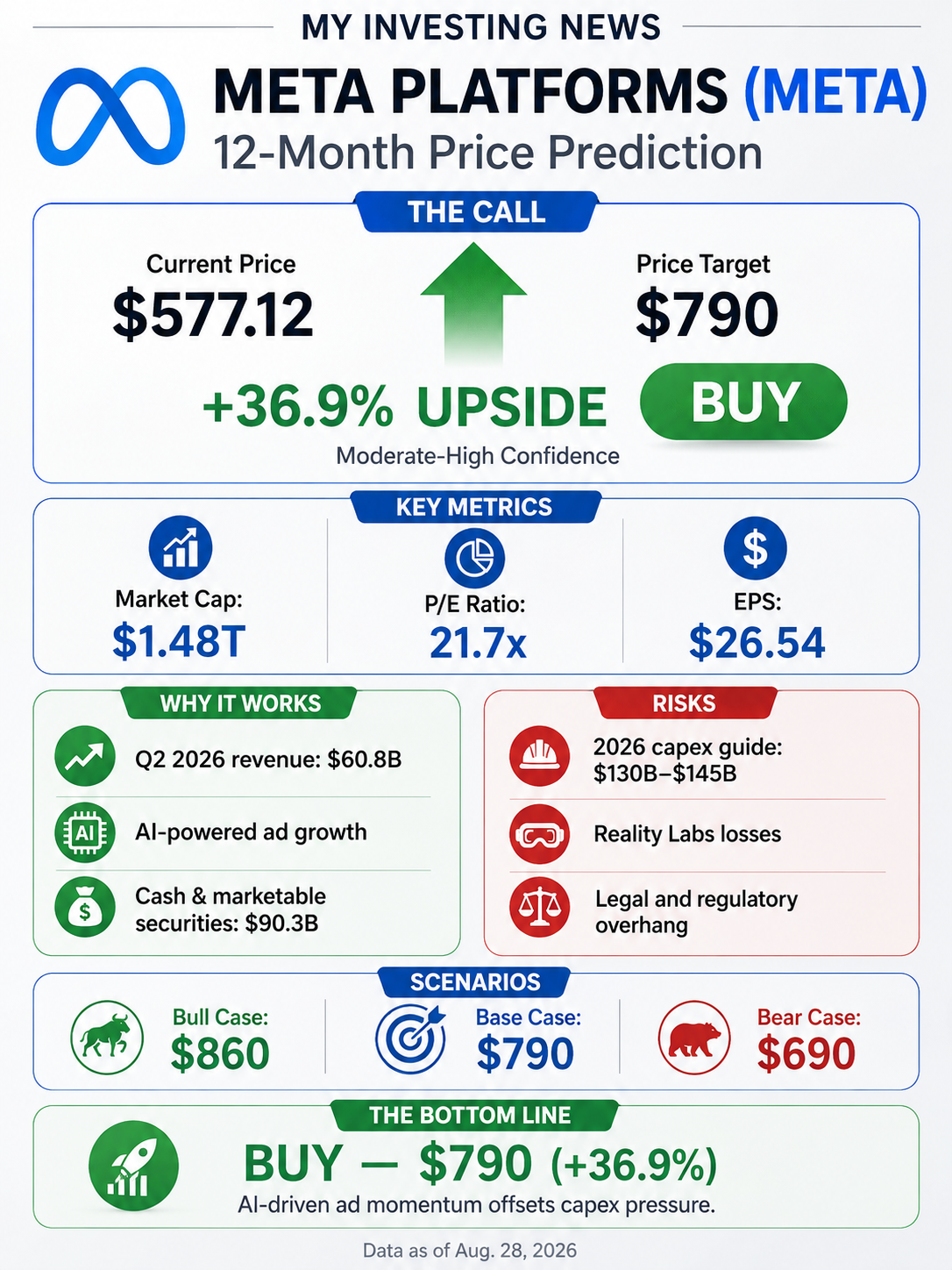
Meta closed Aug. 27 at $571.10. Using that fixed closing price, our 12-month base-case estimate of $777.60 implies about 36.2% upside. The bull case of $856.94 works out to roughly 50.1%, while the $684.66 bear case would still represent about 19.9% upside. Those figures are model projections, not company guidance or guaranteed returns. The question is whether Meta can grow earnings fast enough to justify its enormous AI spending while avoiding another major hit to margins and cash flow.
| Model Scenario | Value |
|---|---|
| Reference Price: Aug. 27 Close | $571.10 |
| 12-Month Base Case | $777.60 |
| Base-Case Upside | 36.2% |
| Bull Case | $856.94 |
| Bear Case | $684.66 |
Why Meta Stock Is Still Under Pressure
Meta’s second quarter explains why the stock has become harder to value. Revenue rose 28% year over year to $60.80 billion, but operating income fell 8% to $18.78 billion and diluted EPS declined 13% to $6.18. Operating margin dropped from 43% a year earlier to 31%. Part of that pressure was unusual: Meta recorded $2.40 billion in charges related to legal proceedings and $1.18 billion in severance expenses. But infrastructure spending was also enormous. Capital expenditures, including principal payments on finance leases, reached $31.08 billion for the quarter. Operating cash flow was still a healthy $31.86 billion, yet Meta’s company-defined free cash flow fell to just $784 million because so much cash went into data centers and other infrastructure.
That does not mean the core business is deteriorating. It means shareholders are being asked to fund a very expensive expansion before knowing exactly how large the payoff will be. That distinction matters for investors nearing retirement. Meta is primarily a capital-appreciation investment, not a high-income holding, so most of the potential reward depends on the share price moving higher. A business can keep growing while its stock struggles if spending rises faster than investors expected or if the market decides the future earnings being promised are already reflected in today’s valuation.
The Bull Case Starts With Meta’s Advertising Machine
The reason a $777 to $857 valuation is not difficult to understand is that Meta’s main business is still performing exceptionally well. Advertising revenue reached $59.36 billion in Q2. Ad impressions across the Family of Apps increased 14% from a year earlier while the average price per ad rose 12%, an unusually powerful combination because Meta sold more advertising inventory at higher average prices. Family daily active people reached 3.60 billion, up 3%. Management also guided Q3 revenue to $61 billion to $64 billion and continues to expect full-year operating income above its 2025 level. Those are measurable signs that the Facebook, Instagram, WhatsApp and Messenger ecosystem remains highly productive even as Meta pours cash into AI.
AI is central to the bull case because Meta does not need an entirely new business to justify the spending. If better recommendation systems keep users engaged longer and better ad tools help advertisers earn stronger returns, AI can improve the economics of the advertising operation that already generates nearly all of Meta’s revenue. At roughly 19 times forward earnings in late August, Meta also traded at a much lower valuation than many investors might expect from a mega-cap AI stock. Our $777.60 base case assumes those earnings benefits increasingly show up while expense growth becomes easier to absorb. The $856.94 bull case requires more: continued strong ad growth, sustained user engagement and evidence that today’s infrastructure spending is producing attractive returns rather than simply increasing depreciation and other future expenses.
The Biggest Risk Is the Amount of Cash Meta Is Committing
Meta now expects 2026 capital expenditures, including finance-lease principal payments, of $130 billion to $145 billion. Its previous Q2 expense guidance called for $165 billion to $169 billion in total costs and expenses. Reality Labs adds another layer of pressure. The segment lost $19.19 billion from operations in 2025, and Meta said it expects the 2026 loss to remain similar. Reality Labs lost another $4.62 billion in Q2 alone. That investment could eventually produce valuable businesses around AI glasses, virtual reality and new computing platforms, but investors are paying for the development years well before anyone knows what sustainable profitability will look like.
There is also a major new legal cost that was not known when Meta issued its July outlook. On Aug. 26, Meta announced an agreement with 52 state and territorial attorneys general involving approximately $18 billion of payments over 10 years, subject to judicial approval and other conditions. Meta expects to record roughly $10 billion of legal expense in Q3 related to the agreement and specifically said that charge was not included in the expense range provided with its Q2 earnings. The company said its other guidance ranges remain unchanged. That development may remove some uncertainty around youth-related litigation, but it also turns an abstract legal risk into a very large measurable expense.

What Meta’s Valuation Means for Long-Term Investors
Meta does not look obviously expensive compared with its growth, but it is not the cheapest large digital-advertising company either. Yahoo Finance put Meta at roughly 19.3 times forward earnings in late August, compared with about 16.7 times for Alphabet (NASDAQ:GOOGL). Alphabet also posted a 34% operating margin in Q2 while revenue rose 24%. Meta grew revenue faster at 28%, but its Q2 margin was lower at 31%. Snap (NYSE:SNAP) traded closer to 10 times estimated forward earnings, but that discount comes with a very different financial profile: Snap generated $1.60 billion in Q2 revenue and still reported a $164 million GAAP net loss. Meta’s premium to Snap reflects dramatically greater scale and profitability; its premium to Alphabet requires more explanation.
For retirement investors, that makes position size more important than trying to predict whether Meta reaches one particular target. Meta’s dividend yield is only around 0.4% at current prices, so the stock is unlikely to provide much immediate retirement income. The attraction is long-term appreciation if AI improves the economics of advertising and opens additional businesses. The risk is that investors have to absorb large spending cycles, legal costs and potentially sharp price swings while that thesis develops. Our longer-term numbers below are model estimates rather than promises or Meta guidance. They become increasingly uncertain the further into the future they go, so they are better viewed as a framework for what successful execution could produce than as prices investors should expect on a particular date.
| Year | Model Price Estimate |
|---|---|
| 2026 | $651 |
| 2027 | $801 |
| 2028 | $988 |
| 2029 | $1,147 |
| 2030 | $1,254 |