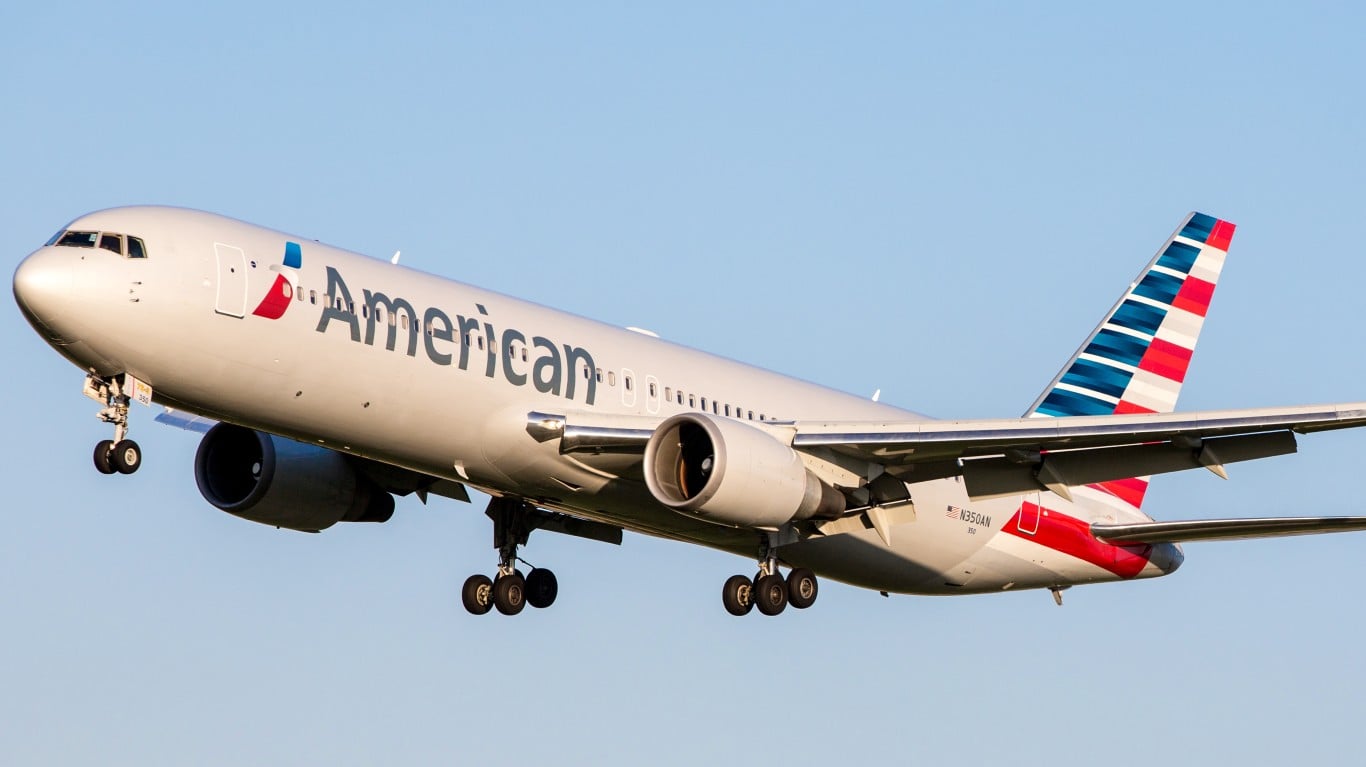
American Airlines Group (NASDAQ: AAL) has been the laggard among the three largest U.S. airline stocks in 2026. At roughly $14.43 late Monday, American shares are about 6% below their Dec. 31, 2025 close, while Delta Air Lines and United Airlines remain higher for the year.
That gap might look strange considering American just reported the highest quarterly revenue in its history. The problem is that record sales are not turning into anything close to the profits Delta and United are producing. Fuel is part of the explanation, but all three carriers are dealing with expensive fuel. For investors deciding whether AAL’s weaker stock performance creates an opportunity, the more important question is how much money American can actually keep after paying its bills.
American’s Record Revenue Hid a Much Weaker Profit Story

American’s second-quarter revenue jumped 16.3% from a year earlier to a record $16.7 billion. Premium passenger unit revenue rose 13.4%, Main Cabin unit revenue increased 8.8%, and domestic passenger unit revenue climbed 10.6%. Managed corporate revenue was up 26%, while AAdvantage enrollments increased more than 30%. Those are not the numbers of an airline struggling to attract customers. American is selling more, charging more effectively, and getting better results from premium and business travelers.
The problem appears farther down the income statement. American generated only $446 million of GAAP operating income on that $16.7 billion of revenue, giving it an operating margin of roughly 2.7%. Pre-tax income was just $107 million, down from $838 million a year earlier. Excluding special items, pre-tax income was $144 million. Record revenue therefore produced surprisingly little profit. That is the number investors should focus on before assuming AAL is cheap simply because the share price has fallen.
Fuel Hurt Everyone, but Delta and United Absorbed It Better
American’s aircraft fuel expense surged 83.3% to $4.88 billion in Q2, an increase of more than $2.2 billion from the prior year. Management says higher fares recovered nearly half of that additional fuel expense, which shows meaningful pricing power. It still was not enough. American now expects an adjusted Q3 loss of $0.70 to $0.10 per share and projects full-year adjusted EPS anywhere from a $0.65 loss to a $0.65 profit. That unusually wide range tells investors how much uncertainty remains around fuel costs and profitability.
Delta and United faced the same basic problem and still produced much larger profits. Delta reported $1.36 billion of adjusted pre-tax income in Q2 on adjusted revenue of $17.7 billion. United reported $843 million of adjusted pre-tax income on $17.7 billion of revenue. American’s comparable pre-tax income excluding special items was only $144 million on $16.7 billion of revenue. Delta is guiding to adjusted EPS of $6.50 to $7.50 for 2026, while United raised its adjusted EPS guidance to $9 to $11. The companies have different share counts, so those EPS figures should not be compared dollar for dollar, but the contrast in earnings visibility is hard to miss.
American Has Less Financial Cushion When Something Goes Wrong
The balance sheet makes that profitability gap more important. American ended June with a $3.97 billion stockholders’ deficit, meaning its reported liabilities exceeded the book value of its assets attributable to shareholders. It also had $11.3 billion of available liquidity, so this is not the same thing as saying American is running out of cash. The company generated $4.69 billion of operating cash flow during the first six months of 2026 and continues to repay and refinance debt. Still, its financial structure leaves less room for disappointment than investors might prefer in a business where fuel, labor costs, weather, recessions, and geopolitical events can move earnings quickly.
Delta looks stronger on that front. It expects $3 billion to $4 billion of free cash flow this year, is targeting gross leverage of about two times, and reduced adjusted net debt by $709 million during the first half. Delta also increased its quarterly dividend by roughly 15% to $0.215 per share. United ended Q2 with $19.6 billion of available liquidity and is targeting an investment-grade credit rating in 2026. Neither stock is insulated from an airline downturn, but stronger cash generation and profitability give Delta and United more flexibility when fuel prices or demand move against them.
Should Investors Dump American for Delta or United?

I would not make the decision based on AAL’s 6% decline alone. American does have a credible recovery case. Premium demand is strong, corporate revenue is growing quickly, and the airline is adding more premium seating through Boeing 787-9 and Airbus A321XLR deliveries as well as upgrades to existing aircraft. If fuel costs ease while those revenue improvements stick, American has considerably more room for earnings improvement because today’s profit base is so low. That is the attraction, but it is also the risk. AAL is increasingly a bet on margins recovering from a weak starting point.
For investors who put more weight on current profitability, cash generation, and financial flexibility, Delta looks like the strongest of the three today, with United also making a much stronger earnings case than American. Delta’s dividend adds a small income component, although an airline dividend should never be treated like guaranteed retirement income. For retirees and near-retirees, that distinction matters. Airline stocks are cyclical and can move violently when fuel prices, travel demand, or the economy changes. American may ultimately offer more upside if its turnaround works, but Delta and United currently require investors to make fewer assumptions about what has to improve.
That is really the choice. American is the higher-risk recovery story. Delta and United are already producing the profits American is trying to get back to.