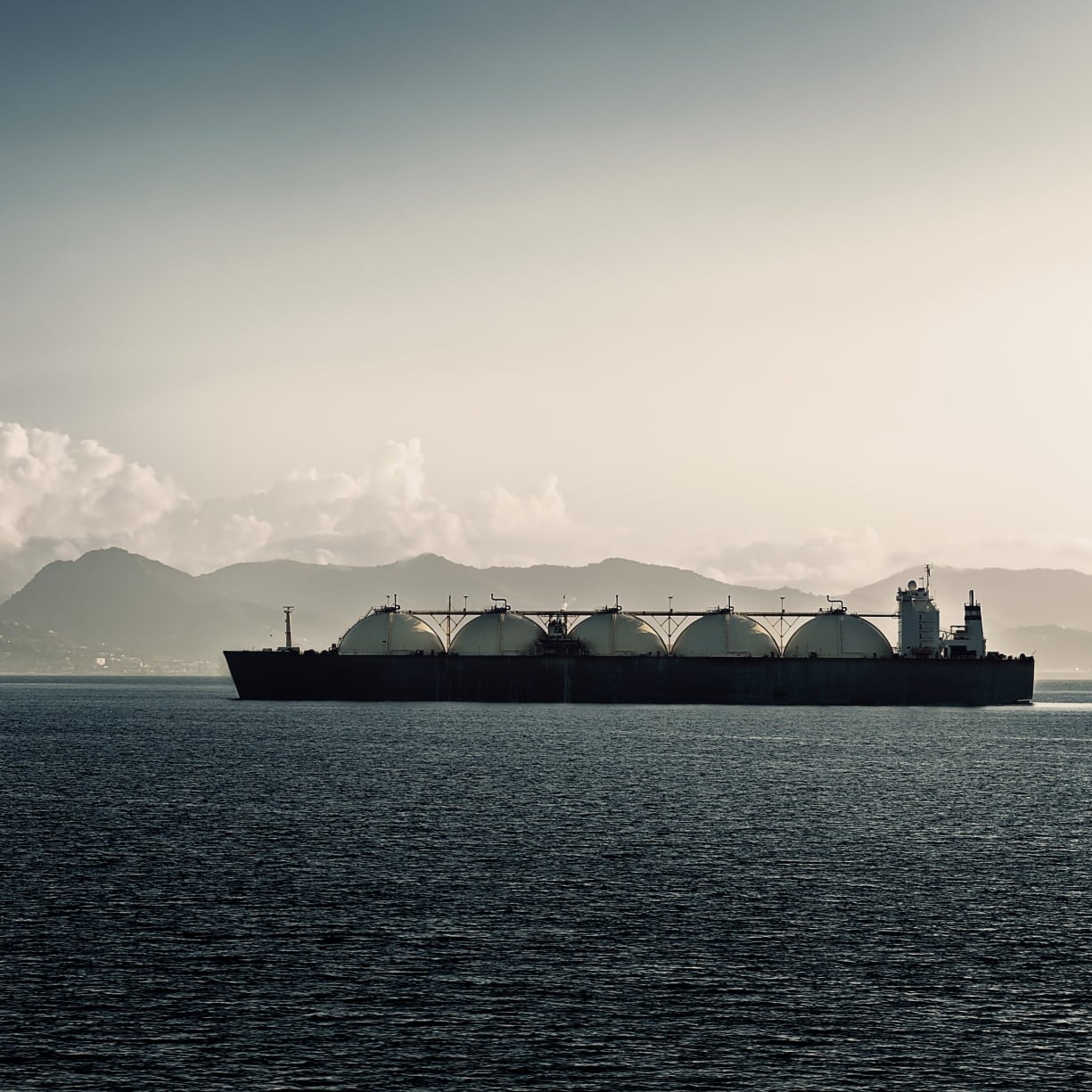
When QatarEnergy stopped LNG production on March 2 after military attacks on facilities at Ras Laffan and Mesaieed, the immediate story was a sudden global supply shock. The more important development came later. QatarEnergy said a subsequent attack damaged two LNG trains representing 12.8 million tonnes of annual production, or roughly 17% of Qatar’s LNG export capacity. Those trains are expected to remain out of service for three to five years.
That changes the investment story. The issue is no longer just a temporary scramble for replacement cargoes. The U.S. Energy Information Administration’s July outlook projected U.S. LNG exports rising from 15.1 billion cubic feet per day in 2025 to 17.4 Bcf/d in 2026 and 18.6 Bcf/d in 2027. But U.S. export terminals are already running at high utilization, so the winners are not simply whichever companies can pump more gas tomorrow. Existing export capacity, pipelines, long-term contracts and projects already moving toward completion matter. For investors, especially retirees who may care as much about risk and cash flow as upside, these five stocks offer very different ways to approach the same theme.
1. Cheniere Energy: The Clearest U.S. LNG Export Play

Cheniere Energy (NYSE: LNG) remains the most direct LNG-export story in this group. The company reported $5.73 billion in second-quarter revenue and $1.80 billion in adjusted EBITDA, a non-GAAP measure used to look at operating performance before several financing and accounting items. More importantly, Cheniere raised its full-year 2026 adjusted EBITDA guidance to $7.90 billion to $8.40 billion and its distributable cash flow guidance to $5.30 billion to $5.80 billion. It exported 184 LNG cargoes during the quarter, while its operating liquefaction capacity now stands at roughly 55 million tonnes per year. Corpus Christi Stage 3 Train 6 reached substantial completion in June, and Train 7 was in commissioning at the end of the quarter.
That combination of existing capacity and additional capacity coming online is what makes Cheniere interesting if global buyers need alternatives to unavailable Qatari supply. It is also a more established operation than several newer LNG projects. For income-minded investors, Cheniere declared a quarterly dividend of $0.555 per share, payable August 18. But there are still reasons not to treat the stock like a bond substitute. Cheniere’s GAAP earnings can swing significantly because of changes in the fair value of derivatives, and some future expansion projects still require regulatory approvals and acceptable financing and commercial arrangements. The Qatar disruption may improve the backdrop, but Cheniere still has to execute.
2. Venture Global and EQT: More Upside Potential, More Moving Parts

Venture Global (NYSE: VG) is the more aggressive LNG choice. During the second quarter, the company exported 127 cargoes and recognized 466.4 trillion British thermal units of LNG in revenue, with 90 of those cargoes coming from Plaquemines. That ramp gives Venture Global considerable exposure to a stronger LNG export market, but it also comes with the construction, commissioning and financing risks that accompany a rapidly expanding business. Its latest quarter captured both sides of that story: adjusted earnings of $0.51 per share beat the $0.48 FactSet consensus, while $4.58 billion in revenue came in below the $4.69 billion consensus estimate. For investors attracted by the growth story, that is a reminder that more LNG volume does not automatically translate into a smooth earnings path.
EQT Corporation (NYSE: EQT) sits at a different point in the chain. It produces the natural gas that eventually feeds pipelines and LNG terminals. EQT sold 634 Bcfe during the second quarter and generated $330 million in free cash flow attributable to EQT. Just as important for investors watching the balance sheet, total debt fell to $5.7 billion at June 30 from $7.8 billion at the end of 2025. EQT has also assembled 4.5 million tonnes per year of LNG offtake agreements in aggregate with Sempra, NextDecade and Commonwealth LNG beginning in 2030 and 2031. That 4.5 million figure is spread across the three projects, not Sempra alone. EQT gives investors more direct exposure to natural gas prices, which can mean greater upside when the market tightens but also more volatility when prices weaken.
3. Kinder Morgan and Sempra: The Infrastructure and Utility Route

Kinder Morgan (NYSE: KMI) is the steadier infrastructure angle. The company reported record second-quarter adjusted EBITDA of $2.199 billion and ended June with a $9.6 billion project backlog, about 92% of which consisted of natural gas projects. Kinder Morgan already has long-term contracts to move roughly 8 Bcf/d of natural gas to LNG facilities, and management projects that figure will reach about 12 Bcf/d by the end of 2028 as projects under construction are completed. Its board also approved a $0.2975 quarterly dividend, equivalent to $1.19 annually at the current payout rate. Fee-based contracts can reduce Kinder Morgan’s direct exposure to swings in natural gas prices, although they do not eliminate volume, counterparty, financing, regulatory or project-execution risk.
Sempra (NYSE: SRE) needs a different framing than a pure LNG stock. The company has a roughly $65 billion capital plan for 2026 through 2030, with more than 95% of planned spending focused on regulated utility investments in Texas and California. Sempra is also in the process of selling another 45% of Sempra Infrastructure Partners to KKR affiliates, which would leave Sempra with a 25% interest after closing. Its retained LNG exposure still matters: Port Arthur LNG Phase 2 has approximately 13 million tonnes per year of planned capacity, and EQT has a 20-year agreement for 2 million tonnes per year from that project. But for a retiree or income-oriented investor, Sempra is increasingly a utility-growth story with LNG exposure attached, not an LNG bet with a utility business attached.
4. What the Qatar Disruption Actually Means for Investors

The broader opportunity is real, but it needs some boundaries. EIA’s July forecast called for U.S. LNG exports to average 17.4 Bcf/d in 2026, up from the record 15.1 Bcf/d reached in 2025. At the same time, EIA has noted that American export terminals are already operating at relatively high utilization rates. In other words, the Qatar outage strengthens the strategic value of U.S. LNG capacity, but existing terminals cannot simply double shipments overnight. The companies with capacity already operating, pipelines feeding export facilities, or projects close enough to completion to matter have a much clearer path to benefiting than companies whose LNG plans remain years away.
There is also one tempting data point that should not be used to prove the Qatar thesis. Henry Hub natural gas averaged $7.72 per MMBtu in January 2026, but that happened before Qatar’s March shutdown. EIA attributes January’s spike to Winter Storm Fern, which increased heating demand, reduced production and produced a record weekly storage withdrawal. By February, Henry Hub averaged $3.62, and by March it was down to $3.04.
For investors, the takeaway is not to buy anything with “LNG” in the description. Cheniere offers established export capacity. Venture Global brings faster growth with more execution risk. EQT gives investors greater exposure to the underlying gas commodity. Kinder Morgan gets paid to move enormous volumes of gas through its infrastructure, while Sempra increasingly leans toward regulated utilities while retaining a smaller LNG stake. For retirees and near-retirees, those distinctions matter. A dividend-paying pipeline or utility and a commodity-sensitive producer may benefit from the same long-term trend, but they can behave very differently when markets turn.