
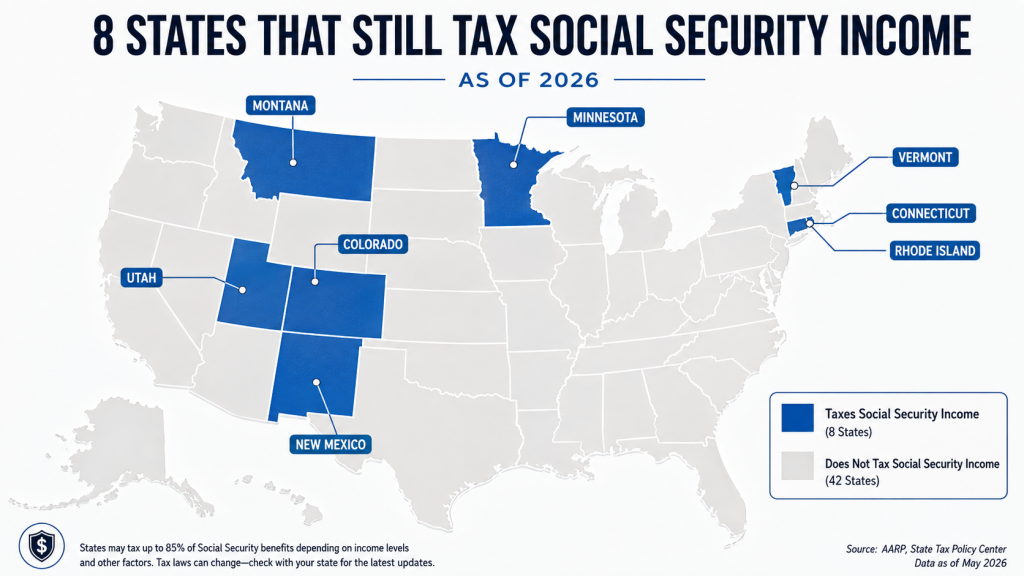
Social Security benefits come after years of work and payroll taxes, so seeing part of that income taxed in retirement can sting. Federal taxes are one part of the equation, but where you live can add another layer. In 2026, eight states can still tax at least some Social Security income, while the other 42 states and Washington, D.C., do not impose a state income tax on Social Security benefits.
That sounds straightforward until you look at the individual rules. Several of those eight states protect lower and middle-income retirees, and Colorado lets taxpayers 65 and older subtract all Social Security benefits that were included in federal taxable income. In other words, living in a state that technically taxes Social Security does not automatically mean your monthly benefits will produce a state tax bill.

The New Senior Deduction Helps, but Social Security Is Still Taxable Federally
The 2025 tax law added a temporary federal deduction for people age 65 and older. For tax years 2025 through 2028, an eligible taxpayer can deduct up to $6,000, or up to $12,000 on a joint return when both spouses qualify. The deduction begins phasing out when modified adjusted gross income exceeds $75,000 for a single filer or $150,000 for a married couple filing jointly. Under the law, each $6,000 deduction is reduced by 6% of income above the applicable threshold.
There is an important distinction for retirees planning withdrawals. The deduction does not change the formula the IRS uses to decide how much Social Security is taxable. The IRS still generally looks at one-half of your benefits plus other income, including tax-exempt interest. The base amount is $25,000 for most single filers and $32,000 for couples filing jointly, and depending on income, as much as 85% of benefits can be included in taxable income. The new senior deduction is used when calculating taxable income, so it can lower a qualifying retiree’s final federal tax bill without turning otherwise taxable Social Security into tax-free Social Security.
These Are the 8 States That Can Still Tax Social Security
The list has gotten shorter. West Virginia completed its phaseout for tax year 2026, giving taxpayers a 100% modification for federally taxable Social Security income. That leaves eight states where at least some residents can still face state income tax on their benefits in 2026:
- Colorado
- Connecticut
- Minnesota
- Montana
- New Mexico
- Rhode Island
- Utah
- Vermont
The details make this list much less intimidating for many retirees. Colorado taxpayers age 65 and older can subtract the entire amount of Social Security included in federal taxable income. For those ages 55 through 64, Colorado also allows the full subtraction when AGI is no more than $75,000 for single filers or $95,000 on a joint return; otherwise, a $20,000 cap applies.
Minnesota’s simplified Social Security subtraction begins phasing out above $86,410 for single and head-of-household filers and $110,780 for married couples filing jointly or qualifying surviving spouses in tax year 2026. New Mexico is more generous than its place on this list might suggest, exempting Social Security for single taxpayers with income below $100,000 and joint filers, surviving spouses, and heads of household below $150,000.
Vermont provides a full exemption from state tax on federally taxable Social Security at federal AGI of $55,000 or less for single, head-of-household, married-separate, and surviving-spouse filers, with the exemption phasing out between $55,000 and $65,000. For married couples filing jointly, the corresponding range is $70,000 for the full exemption and $80,000 where it is completely phased out. Utah uses a Social Security tax credit rather than a blanket exemption, so the amount of relief depends on the taxpayer’s circumstances.
Your Other Retirement Income Can Matter as Much as Social Security
This is where retirement tax planning gets more personal. Two retirees receiving the same Social Security benefit can end up with very different tax bills because the IRS and several states also look at other income. Pension payments, taxable investment income, wages, and withdrawals from traditional retirement accounts can increase the income figures used in these calculations. At the federal level, the IRS specifically includes other income when determining whether part of Social Security becomes taxable.
The same issue shows up at the state level. A retiree in New Mexico with income below the state’s exemption threshold could owe no state tax on Social Security, while someone with substantially more taxable retirement income could lose that exemption. Minnesota’s subtraction also phases out as income rises. Colorado is an unusual case for older retirees because taxpayers 65 and over can subtract all federally taxable Social Security regardless of the general pension subtraction limits.

That is why the name of the state alone does not tell you much about your actual bill. Before assuming your Social Security will be taxed, look at your filing status and your complete income picture. For someone drawing heavily from a traditional IRA or receiving a sizable pension, a state exemption threshold may matter much more than it does for a retiree relying primarily on Social Security.
Don’t Move Just to Escape One Retirement Tax
State taxes deserve a place in any retirement relocation decision, but Social Security taxation should be only one line on the spreadsheet. First, calculate whether your current state would actually tax your benefits based on your income. If an exemption, subtraction, or credit already wipes out the tax, moving would produce no Social Security tax savings in the first place.
Then compare the expenses that will follow you every month or every year. Housing, property taxes, homeowners’ or renters’ insurance, sales taxes, healthcare access, transportation, and the cost of traveling back to see family can easily matter more to a retirement budget than one state income tax provision. Pension income and withdrawals from retirement accounts may also receive different treatment from Social Security, so compare your entire income mix rather than one benefit.
For retirees and people approaching retirement, the useful number is not simply the tax rate. It is how much money remains available after taxes and regular living expenses. Run the numbers using the income you actually expect to receive, then compare the total cost of staying with the total cost of moving. A lower-tax state can be worthwhile in the right circumstances, but a Social Security exemption by itself is not enough to tell you where retirement will be cheaper.