
A 72-year-old widow in Ohio opened her 2026 Medicare notice expecting the usual annual increase. Instead, she saw something much more painful: her Medicare Part B premium had jumped from the standard $202.90 a month to $405.80. Nothing about her lifestyle had suddenly changed. She had not gone back to work, sold a business, or landed a huge new income stream. Her husband had died more than two years earlier, and the tax return now being used to calculate her 2026 Medicare premium was no longer a joint return. Her income had barely moved, but the bracket used to judge that income had changed completely.
That is the survivor trap inside IRMAA, the Income-Related Monthly Adjustment Amount that adds surcharges to Medicare Part B and Part D premiums for higher-income retirees. Most Medicare beneficiaries never pay it. CMS says IRMAA affects roughly 8% of people with Medicare Part B. But for households near the first few IRMAA thresholds, the death of a spouse can create a nasty surprise. The survivor may lose one Social Security check, but still keep enough income from pensions, investments, required minimum distributions, and tax-exempt interest to trigger a much higher Medicare premium as a single filer.
This is not a story about the ultra-rich. It is a story about upper-middle-income retirees who did what they were supposed to do: saved in retirement accounts, collected pensions, invested conservatively, and planned around two-person tax brackets. The problem is that Medicare does not simply ask whether the household feels wealthy. It looks at modified adjusted gross income and filing status. Once one spouse dies, the survivor can fall into a much tougher bracket even if the dollars coming in do not feel especially high.

Why the Same Income Suddenly Costs More
IRMAA is based on modified adjusted gross income, or MAGI, from two years earlier. That means a retiree’s 2026 Medicare premium is generally based on the income reported on the 2024 tax return. For this calculation, MAGI starts with adjusted gross income and then adds tax-exempt interest. That last part catches many retirees off guard. Municipal bond interest may feel tax-free for income-tax purposes, but it still counts when Medicare decides whether a beneficiary owes an income-related surcharge.
The key problem is that the Medicare income brackets are much wider for married couples than for single filers. In 2026, a married couple filing jointly pays no IRMAA surcharge if MAGI is $218,000 or less. A single filer pays no surcharge only if MAGI is $109,000 or less. That may sound fair because the single threshold is half the joint threshold, but it creates a harsh reality for widows and widowers. Many retirement expenses do not fall in half when one spouse dies. Housing, property taxes, insurance, utilities, maintenance, and many medical costs remain stubbornly high.
The filing-status shift is what makes the trap so expensive. In the year a spouse dies, the surviving spouse can typically still file a joint return. After that, the survivor often files as single. If income drops sharply, that may not matter much. But if the survivor keeps the larger Social Security benefit, continues receiving a pension survivor benefit, owns the IRA, and still has investment income, MAGI may remain high enough to trigger IRMAA under the single thresholds.
This is why the same household can go from paying no surcharge as a couple to paying a large surcharge as a survivor. The income did not explode. The measuring stick shrank. For retirees who live close to an IRMAA line, that distinction matters. A few thousand dollars of income can be the difference between paying only the standard Medicare premium and paying hundreds more each month for the same coverage.

Shutterstock ID: 2036033171, Photographer: chayanuphol
A Worked Example at $150,000
Consider a retired couple with $160,000 of joint MAGI. Their income comes from two Social Security checks, a modest pension, taxable investment income, and required minimum distributions from an IRA. Under the 2026 joint-filer threshold, they are comfortably below the $218,000 level where IRMAA begins. They pay the standard Part B premium and no Part D income-related surcharge. From their perspective, they are doing fine. They are not living extravagantly, but they have enough income to cover bills, travel a little, help family when needed, and avoid draining savings too quickly.
Now assume the husband dies in 2026. The widow keeps the larger Social Security check, but the smaller benefit disappears. The pension continues at a survivor amount, and the IRA remains in the household. Her income falls, but not by half. By the time everything is counted, her MAGI for the first full single-filer year lands at $150,000. That figure later flows into her Medicare premium calculation under the two-year lookback. She may feel less financially secure than she did as part of a couple, but Medicare now judges her as a single filer.
At $150,000 of single MAGI, she is no longer near the safe zone. She falls into the 2026 IRMAA tier for single filers above $137,000 and at or below $171,000. Her Part B premium rises from $202.90 a month to $405.80. That is an added $202.90 a month for Part B alone. Her Part D surcharge adds another $37.50 a month. Together, the new Medicare exposure is $240.40 a month, or $2,884.80 a year.
That is the part retirees often miss. As a married couple, $160,000 of MAGI created no IRMAA problem. As a widow, $150,000 of MAGI creates thousands of dollars in added annual Medicare costs. She has less household income, fewer Social Security checks, and the emotional and financial disruption that follows the death of a spouse. Yet Medicare charges more because her filing status changed. That is why IRMAA planning cannot wait until after the notice arrives.

SSA-44 Will Not Fix This
The Social Security Administration does offer a form that can help in some IRMAA situations. Form SSA-44 allows a Medicare beneficiary to request a new IRMAA determination after a qualifying life-changing event. The death of a spouse is one of those events. Retirement, reduced work, loss of pension income, marriage, divorce, and certain other income changes can also qualify. For many retirees, the form is useful and worth knowing about.
But SSA-44 does not erase the survivor trap by itself. The form helps when income actually drops and the old tax return no longer reflects the beneficiary’s current situation. For example, if a spouse dies and a pension stops, or if a widow retires from part-time work after the death, the lower income may justify a recalculation. The beneficiary can document the change, estimate the new MAGI, and ask Social Security to base the IRMAA decision on the reduced income.
That is different from a filing-status problem. If the survivor’s MAGI remains at $150,000 because the pension continues, required minimum distributions continue, taxable interest continues, and the larger Social Security benefit remains, SSA-44 has little to fix. The income did not fall enough to move the person out of the surcharge tier. The bracket changed, but the income did not. Social Security generally will not waive IRMAA simply because the single-filer thresholds are less forgiving than the joint thresholds.
This also matters for retirees who assume they can appeal voluntary income events. A Roth conversion, large capital gain, home sale, or one-time investment move may push MAGI higher, but those events are usually not treated the same way as a spouse’s death or a work stoppage. The lesson is simple: SSA-44 can help when the income picture truly changed. It cannot undo every unpleasant consequence of the Medicare math.
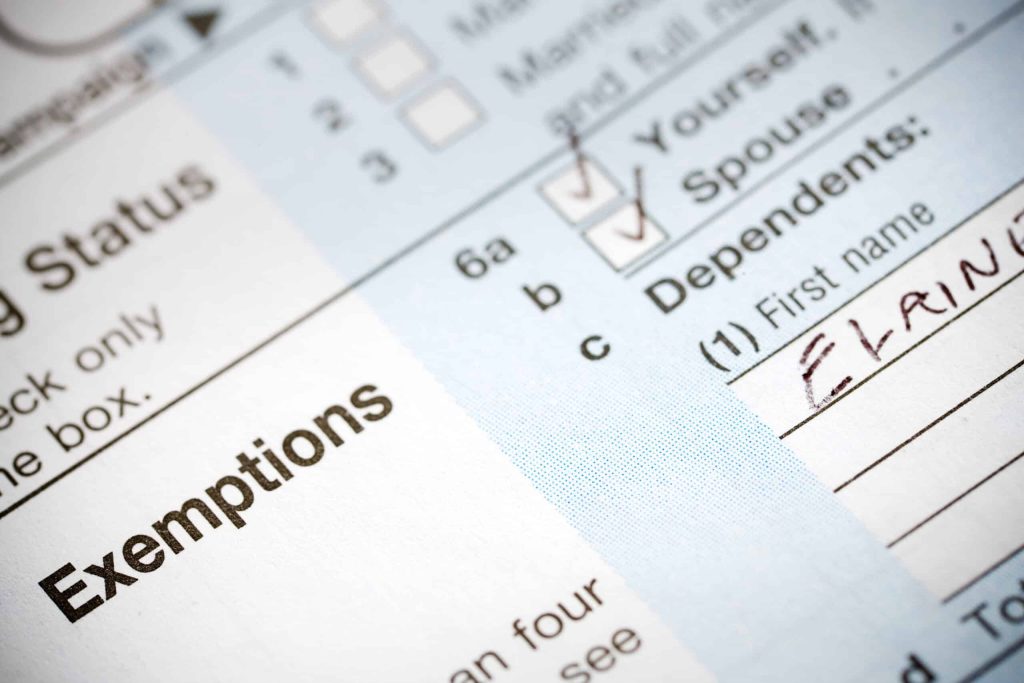
The exemptions line on a Form 1040 tax form.
What to Do Before the Lookback Locks
The best planning window is before the first full single-filer tax year becomes part of the Medicare lookback. Once that tax return is filed and later used to set premiums, the options become narrower. Surviving spouses and married retirees near IRMAA thresholds should map the numbers early, not after the Medicare letter arrives. That means estimating the survivor’s MAGI, not just the couple’s current income.
Start by adding the income streams that would remain after one spouse dies. Include the larger Social Security benefit, any pension survivor benefit, required minimum distributions, taxable interest, dividends, capital gains, annuity income, rental income, and tax-exempt municipal bond interest. Then compare the estimate with the single-filer IRMAA thresholds, especially $109,000, $137,000, and $171,000. A survivor who lands slightly above one of those lines may be able to plan around it, but only if the issue is identified early.
The year of death deserves special attention because it is often the final joint-filing year. That year may provide a last opportunity to use the wider married brackets deliberately. Some households may consider Roth conversions, capital gain harvesting, charitable giving strategies, or other income planning while still filing jointly. Those moves require care because they can also create IRMAA exposure if pushed too far. The point is not to force income into one year blindly. The point is to recognize that the joint brackets may never be available again.
Retirees should also be careful with municipal bonds, large IRA balances, and automatic required minimum distributions. These can quietly keep MAGI high even when cash flow feels tight. A widow may not think of tax-exempt interest as Medicare income, but Medicare does. She may not think an RMD is optional income, but it still counts. That is why the plan needs to be built around MAGI, not just taxable income or monthly cash flow.

The Bottom Line for Retirees Near the Line
The widow in Ohio could not appeal her way out of the premium increase because the Medicare calculation worked exactly as designed. That is what makes the situation so frustrating. This was not a billing error. It was not a penalty for doing something reckless. It was the result of filing status, income, and the two-year Medicare lookback colliding at the worst possible moment.
For retirees well below the IRMAA thresholds, this issue may never matter. For couples near the line, though, it can become one of the most overlooked costs of widowhood. Losing a spouse already reduces household stability. Adding a surprise Medicare surcharge on top of that can make the first years of single retirement even harder, especially when savings rates are low and many households have little extra margin.
The practical move is to plan while both spouses are alive. Know the joint MAGI. Estimate the survivor’s MAGI. Review pension survivor options, IRA balances, RMD timing, investment income, and Roth conversion opportunities. If the numbers are close, a tax planner or retirement-focused financial adviser can help model the Medicare impact before the two-year lookback locks in.
The Medicare premium shock after a spouse dies is not really about Medicare alone. It is about how tax brackets, retirement income, and survivor planning fit together. A household that looks comfortably under the joint threshold can become exposed very quickly once it becomes a one-person tax return. For anyone within roughly $20,000 of an IRMAA line, the time to run the numbers is before the survivor is left opening that letter alone.