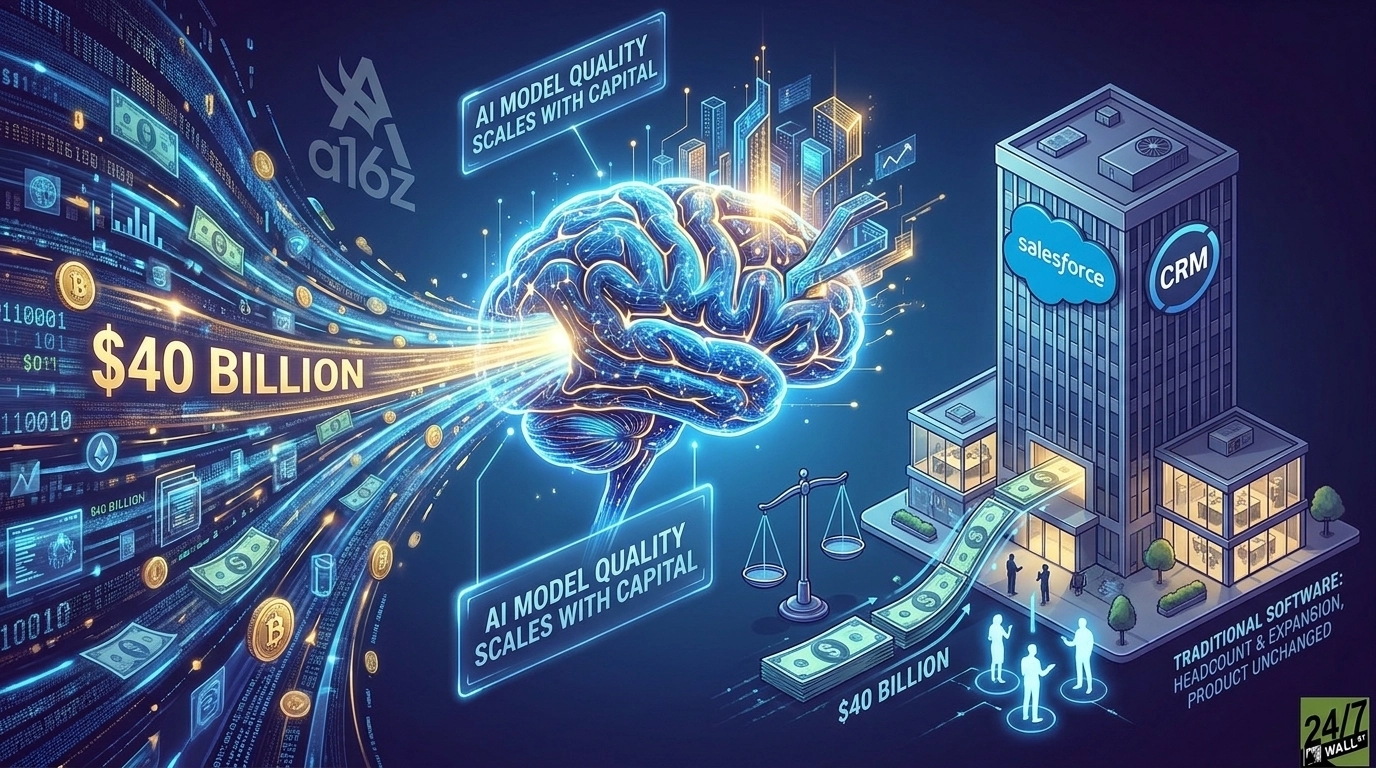
Andreessen Horowitz investor David George says that the AI cycle breaks a rule from every earlier technology wave. On his firm’s podcast, George said that $40 billion toward training AI models makes them much better, and he called that relationship unique to now. Quotes and paraphrased remarks come from an editor’s transcript of the episode that was not independently verified.
Why Capital That Turns Into Product Changes the Math
In most technology cycles, money buys growth indirectly. A company raises a round and spends it on sales headcount, marketing, and expansion, but on the day funding arrives, the product is unchanged. George says AI models work differently. Model quality scales with training investment, so capital turns more directly into a better product. For readers outside venture capital, the takeaway is that the size of a check now shapes how good the product is.
He then picked a foil. George asked what Salesforce (NYSE:CRM) would do with a $40 billion capital raise. He suggested it would hire sales reps and engineers, and said that would not work.
Sizing George’s Hypothetical Against Salesforce
The segment never explained that figure. Salesforce runs the largest customer relationship management platform and has a market capitalization of $193.15 billion. The raise George describes is $40 billion, a substantial portion of the company’s market value.
Salesforce Is Already Repositioning Around AI
The company George chose as his pre-AI foil is itself rebuilding around AI. According to its SEC filing, Salesforce is “rapidly evolving into an AI-powered agentic enterprise platform, enabling organizations to deploy autonomous AI agents across business workflows”. The company has also organized its products around Agentforce Apps.
George’s core claim survives this. His point is whether extra capital improves the product. A software company adding AI features runs on different economics than a lab whose model quality scales with compute spending. Salesforce’s shift shows the line between AI companies and software companies is blurrier than his contrast suggests.
A Returns Claim From a Growth-Stage Investor
George also cited internal Andreessen Horowitz analysis finding that half of private market returns come from Series C and later rounds. As companies stay private longer, that split could move to 70-30 in favor of late-stage investing, he warned. This is his firm’s internal work, and Andreessen Horowitz invests at the growth stage, so it has an interest in that conclusion.
His Vision Fund Defense Uses the Same Logic
An unnamed guest posed a question. The question was whether SoftBank’s Vision Fund failed because it put too much money into companies or because it arrived too late in the cycle. George said both. He then maintained the fund’s concept as sound. It launched at the wrong point in the cycle, when more money did not make companies better.
That is his AI argument in reverse. George holds that capital improves the product now and did not then, so whether the Vision Fund was wrong or simply early depends entirely on whether that claim holds. His AI thesis and Vision Fund defense rest on the same premise. If the link between capital and product quality weakens, both look different.
Contrarianism Through Conviction
The guest cited a line attributed to Thrive. One way to be contrarian is to believe something nobody else believes. Another is to believe what everybody believes, but 10 times more strongly. George said it was close to his firm’s growth-stage thesis.
Believing the consensus more deeply than anyone else pays enormously when the consensus is right and leaves no hedge when it is wrong. That fairly describes concentrated late-stage AI investing right now.