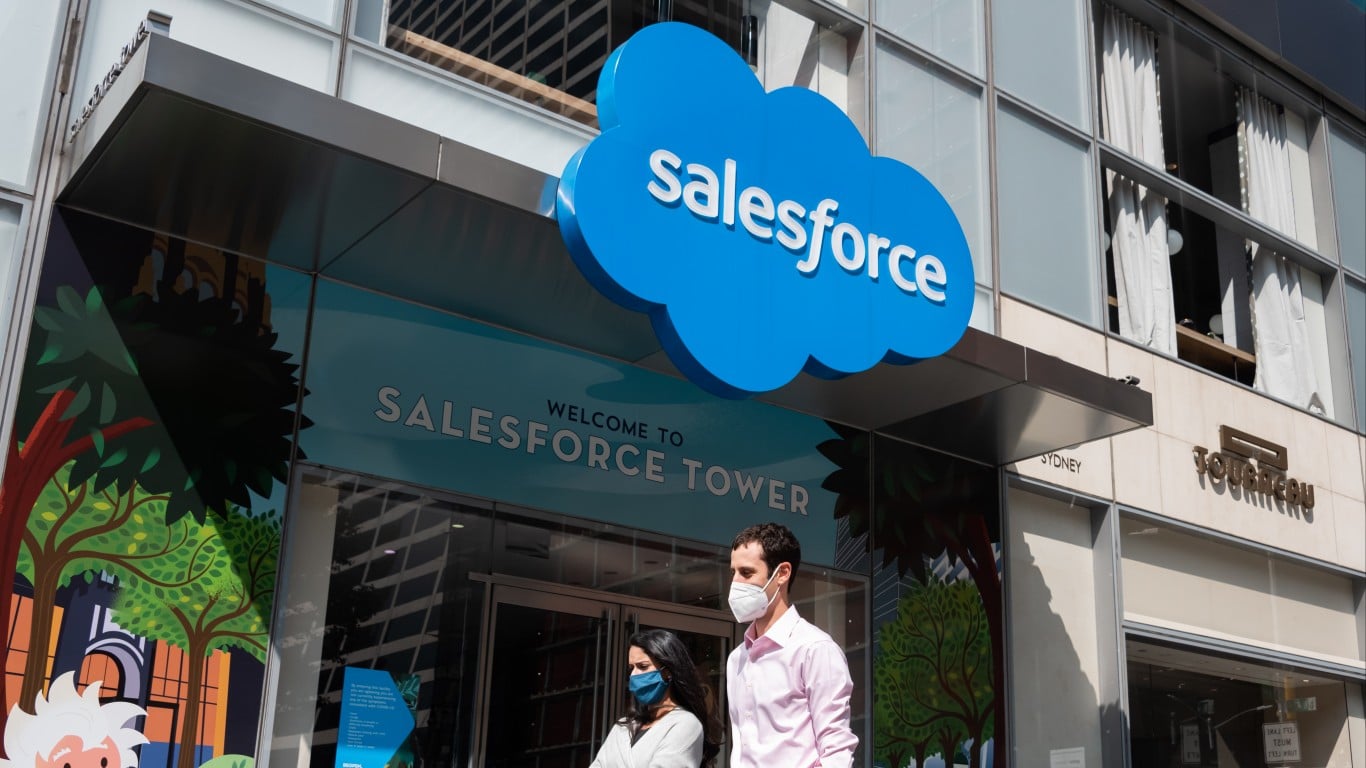
Salesforce is suddenly back at the center of the enterprise software conversation. Salesforce (NYSE:CRM | CRM Price Prediction) shares jumped by double digits Thursday morning after the company reported fiscal second-quarter 2027 results, raised its full-year revenue outlook, and announced a deeper AI partnership with Anthropic. ServiceNow (NYSE:NOW) and Adobe (NASDAQ:ADBE) also traded higher as investors took a fresh look at software companies that had been under pressure from fears that generative AI could disrupt their businesses.
For long-term investors, including anyone holding technology stocks through an IRA, 401(k), or taxable account, the more important question is not whether Salesforce can hold one day’s rally. It is whether the company can turn rising AI usage into durable subscription revenue, cash flow, and earnings. The latest quarter gave the bulls more evidence, but there are a few important details behind the headline numbers.
Salesforce Raised Guidance and Its Revenue Backlog Improved
Salesforce reported fiscal second-quarter 2027 revenue of $11.345 billion, up 11% from a year earlier, while current remaining performance obligation, or cRPO, reached $33.5 billion, up 14%. cRPO represents contracted revenue expected to be recognized within the next 12 months, so its acceleration gives investors another way to judge demand beyond the quarter’s reported sales. Salesforce also raised full-year revenue guidance to $46.1 billion to $46.4 billion from $45.9 billion to $46.2 billion and guided fiscal Q3 revenue to $11.42 billion to $11.50 billion.

Cash generation improved as well. Operating cash flow was $1.269 billion, up 71% year over year, while free cash flow reached $1.098 billion, up 81%. One caveat is that Salesforce’s growth now includes Informatica. The company said Informatica contributed $456 million of Q2 revenue and is expected to account for slightly more than three percentage points of full-year revenue growth. For investors looking beyond the immediate stock bounce, the split between acquired growth and organic growth is worth watching as closely as the higher guidance.
AI Revenue Is Growing Fast, but the EPS Number Needs Context
Salesforce’s AI numbers were the strongest part of the operating story. Agentforce and Data 360 annual recurring revenue reached nearly $3.9 billion, up more than 210% year over year, while Agentforce ARR exceeded $1.5 billion, up more than 240%. Salesforce also reported 7.0 billion Agentic Work Units delivered to date across Agentforce and Slack, including 3.2 billion during Q2, a 97% increase from the prior quarter. One detail matters when comparing those growth rates over time: beginning in Q2, Salesforce expanded its Agentforce ARR definition to include Slackbot and Headless 360.
The earnings figure deserves even more context. GAAP net income was $3.526 billion, or $4.29 per diluted share, but Salesforce recorded $2.613 billion of net gains on strategic investments during the quarter. The company disclosed that strategic investment gains added $2.43 to GAAP diluted EPS and $2.53 to its $5.90 non-GAAP diluted EPS. Much of the investment boost was connected to Anthropic, with Salesforce reporting a $2.7 billion unrealized gain on that investment. That does not erase the company’s operating progress, but it means investors should not read the headline EPS figures as coming entirely from the underlying software business.
Claudeforce Gives Salesforce a Different Answer to the AI Threat
Salesforce and Anthropic also expanded their relationship under the Claudeforce name. Claudeforce is the broader partnership, while its first product is Salesforce in Claude, a plugin with 37 prebuilt sales skills designed to let users work with Salesforce data and workflows from inside Claude. Salesforce says the plugin is available to select pilot customers now and is expected to enter open beta in September 2026. The company also says Claude is the default model for Slack AI and Slackbot, along with several other Salesforce AI experiences.
That matters because one of the biggest questions hanging over traditional software companies has been whether powerful AI models will eventually bypass the applications businesses already pay for. Salesforce is trying to make the opposite case: that AI becomes more useful when it can securely reach the customer data, permissions, and workflows already living inside Salesforce. The positive reaction in ServiceNow and Adobe suggests investors were reconsidering that risk across enterprise software Thursday, but one strong Salesforce quarter does not prove that every established software company will be an AI winner. Adoption, pricing, retention, and actual cash generation still have to follow.
What Long-Term Investors Should Watch Next
The next few months should provide several useful checkpoints. Salesforce will hold Investor Day alongside Dreamforce on September 16. The pending Contentful and Fin acquisitions are expected to close during fiscal Q3 2027, and Salesforce has already included those deals in most of its updated guidance, with cRPO being the notable exception. The company also expects final settlement of its $25 billion accelerated share repurchase in October 2026. Meanwhile, Salesforce is guiding Q3 cRPO growth to approximately 14%, giving investors a concrete number to measure when the next earnings report arrives.
For investors holding Salesforce directly, or indirectly through a technology-heavy retirement account or fund, the more useful question is what happens after the excitement fades. Watch whether organic revenue growth improves as management expects, whether AI and data ARR continues to rise, and whether stronger demand translates into sustainable free cash flow. Salesforce returned $364 million to shareholders through dividends in Q2 and continues to repurchase shares, but those capital returns do not eliminate stock-price volatility. After a sharp one-day move, portfolio concentration and time horizon matter more than chasing the headline.