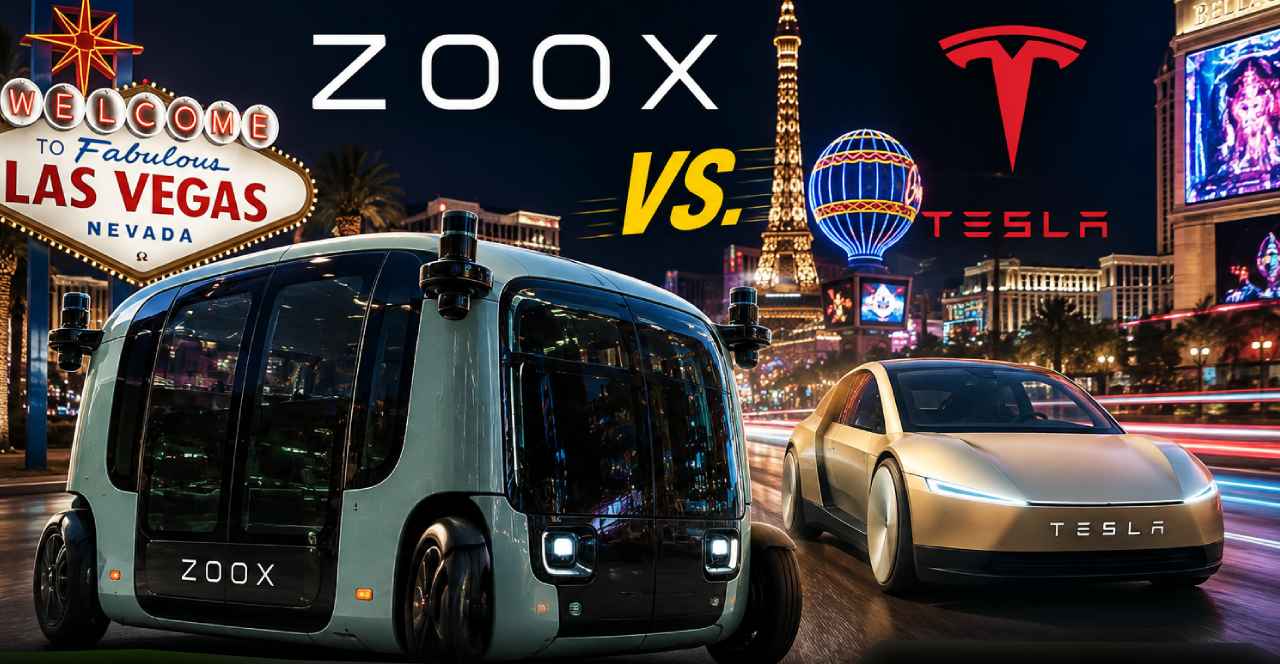
Amazon’s Zoox is pushing deeper into two of the most important U.S. robotaxi markets, and the timing is worth watching. Zoox has begun charging passengers for rides in Las Vegas after receiving a new federal exemption, while its driverless vehicles are also expanding their footprint in San Francisco. The California rollout is not yet the same kind of commercial service available in Las Vegas, but Zoox is clearly moving beyond small-scale testing.
That creates an interesting contrast with Tesla. Tesla has made autonomy central to its long-term growth strategy and says its Robotaxi service is now active in several U.S. markets, but San Francisco still requires a safety driver and its Las Vegas rollout remains limited by regulators. Tesla shares were trading near $336.64 Tuesday morning, while Amazon was around $261.48.
Zoox Has Moved Beyond a Robotaxi Experiment
Zoox has been building toward this for years, but the regulatory picture changed significantly this summer. The National Highway Traffic Safety Administration granted the Amazon subsidiary a temporary exemption allowing commercial deployment of as many as 2,500 purpose-built robotaxis per year for two years. That does not mean 2,500 vehicles are already on the road. It gives Zoox a federal path to commercially operate vehicles that were designed without traditional controls such as a steering wheel or pedals. In Nevada, Zoox is authorized to operate as many as 100 fully autonomous vehicles inside its approved Clark County service area. San Francisco is at a different stage. Zoox said earlier this year that it was quadrupling its service area there, while California DMV records currently authorize the company for driverless testing in San Francisco rather than full autonomous deployment.
Tesla Is Expanding Too, but the Details Matter
This is not a case where Zoox has robotaxis and Tesla does not. Tesla’s second-quarter update says Robotaxi service is active in seven major metro areas, with unsupervised operations ramping in Austin, Dallas, Houston, Miami, Orlando and Tampa. The same update listed the San Francisco Bay Area as operating with a safety driver and Las Vegas as still in preparation. Tesla also said production of its purpose-built Cybercab had begun. The regulatory gap is more visible in Nevada. Tesla originally applied for authority to operate as many as 5,000 robotaxis in Clark County, but Nevada regulators approved an initial fleet of only 10. The permit also limits service to an approved geofence, bars passenger pickups near Harry Reid International Airport without further approval, limits operation on roads above 45 mph and requires appropriate human supervision. That gives Zoox a larger permitted footprint in Las Vegas today, although permit limits should not be confused with the number of vehicles actually operating.
Why This Matters More to Tesla Than Amazon
For Amazon shareholders, Zoox is interesting because it gives the company another possible long-term business built around AI, transportation and its enormous cloud infrastructure. Zoox already uses AWS for large-scale machine learning, simulation and vehicle data processing. But investors should keep the scale in perspective. Amazon currently reports results through North America, International and AWS, and it does not break Zoox out as a separate reportable business. That makes a robotaxi breakthrough potentially meaningful over the long run without necessarily changing Amazon’s earnings story overnight. Tesla is different. Its own investor materials explicitly point toward future profits from AI, software and fleet-based businesses, making successful autonomous transportation much more closely tied to the investment thesis. For investors, especially anyone approaching retirement, that distinction matters. A promising technology can support a growth story, but it does not remove the volatility that comes with betting heavily on one company or one future revenue stream.
The Robotaxi Race Is Becoming a Regulatory Race
The next stage may have as much to do with permits and execution as the underlying driving technology. Zoox now has federal authority for commercial deployment of its unusual steering-wheel-free vehicle, a Nevada permit allowing a fleet of up to 100 vehicles, and driverless testing authority in San Francisco. Tesla has a much broader Robotaxi rollout underway nationally, but its current California and Nevada permissions show that expansion can look very different from one state to another. Investors should watch the numbers that eventually matter financially: paid rides, fleet size actually in service, utilization, operating costs, vehicle production and whether either company can turn autonomous miles into profitable revenue at scale. For Amazon, Zoox could become another valuable business layered onto a much larger company. For Tesla, proof that Robotaxi can scale may matter much more directly to expectations already attached to the stock.