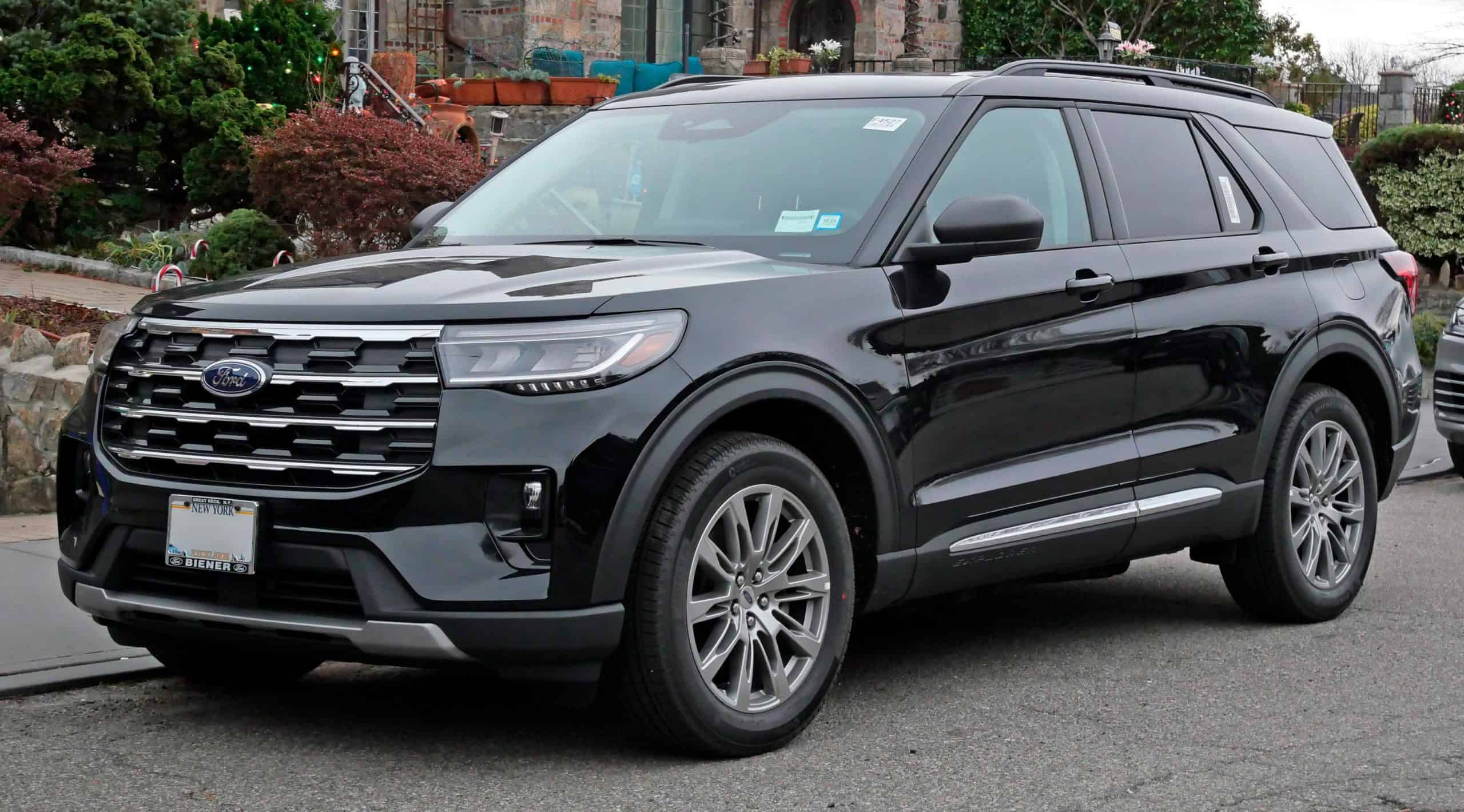
Ford (NYSE: F) has actually performed better than Tesla (NASDAQ: TSLA) in the stock market this year. From the end of 2025 through Aug. 25, Ford shares rose about 10% on a price basis, while Tesla fell roughly 22%. Yet the difference between what Wall Street says the two companies are worth is enormous. Tesla’s market capitalization was about $1.38 trillion, compared with roughly $55.6 billion for Ford. That puts Tesla at nearly 25 times Ford’s size by market value.
At first glance, that is hard to fathom. Ford sells millions of vehicles, dominates some of America’s most valuable truck segments, and has a business investors can understand today. Tesla’s valuation requires looking much further into the future. That does not automatically make Ford cheap or Tesla expensive. It does show how differently the market views the two companies, and for investors approaching or already in retirement, the distinction matters. One company is valued largely on businesses it already operates. Much more of the other’s price depends on what investors believe it can become.
Ford Still Runs on Trucks, Hybrids and a Business Investors Know
Ford’s biggest strength remains the business it already has, particularly trucks. The company sold 828,832 F-Series trucks in the U.S. in 2025, extending the nameplate’s run as America’s best-selling truck to 49 straight years. Ford also sold a record 228,072 hybrids last year, so describing its hybrid business as modest misses an important part of the company’s current strategy.
Ford is still overwhelmingly dependent on internal-combustion vehicles, but it has not abandoned EVs. In the second quarter of 2026, Ford reported 486,291 U.S. sales of internal-combustion vehicles, 53,163 hybrids, and 9,746 fully electric vehicles. Its next major EV test is the Fathom, a midsize electric pickup scheduled to reach customers in 2027. Fathom will be the first vehicle built on Ford’s new Universal EV Platform and its substantially redesigned production system in Louisville. Ford believes that approach can lower complexity and improve manufacturing efficiency, but investors will not know how well it works at scale until vehicles actually start coming off the line.
Tesla’s Car Business Is Stronger Than the Bear Case Suggests
Tesla’s automotive business has had rough stretches, but the latest numbers do not support writing it off. Tesla delivered 358,023 vehicles in the first quarter of 2026, then jumped to 480,126 in the second quarter. Q2 automotive revenue reached $20.5 billion, up 23% from the same period a year earlier. Total company revenue rose 26% to $28.2 billion. Tesla remains very much an automaker, even as management increasingly talks about the company as something much broader.
What those numbers do not explain is a $1.38 trillion market value. Ford’s roughly $55.6 billion valuation means Tesla was worth almost 25 Fords in the stock market as of Aug. 25. Investors clearly are not paying that premium simply because they expect Tesla to sell more Model 3s and Model Ys. The price assumes that some of Tesla’s businesses outside traditional vehicle manufacturing can eventually become large enough to materially change the company’s earnings power. That is where the Tesla investment case becomes much more interesting, but also much harder to value.
Tesla’s Huge Premium Is Really a Bet on What Comes Next
Tesla tells investors directly where it sees its future. In its latest quarterly filing, the company says it is focused on bringing artificial intelligence into the physical world through products and services such as FSD, Robotaxi, and robots including Optimus. Tesla says it has continued expanding and refining its Robotaxi service following its June 2025 launch, began production of the purpose-built Cybercab during the first half of 2026, and is preparing and investing for large-scale production of Optimus.
Those could become enormous businesses, but they are not enormous businesses yet. Tesla also does not have autonomous transportation to itself. Waymo already offers fully autonomous ride-hailing in multiple U.S. cities and is integrating its technology with electric vehicle platforms from Hyundai and Jaguar. Humanoid robotics is similarly competitive, and there is no reliable way today to put a precise value on the eventual market for Optimus. Tesla’s valuation becomes easier to understand if autonomy, software, Robotaxi, and robotics eventually generate huge profits. If those businesses develop more slowly than investors expect, the premium becomes much harder to defend.
What the 25-to-1 Gap Means for Retirement Investors
For retirees and near-retirees, the Ford-versus-Tesla comparison is about more than guessing which stock goes higher. The companies ask shareholders to accept very different kinds of risk. Ford’s board declared a regular quarterly dividend of $0.15 per share in July. That dividend is not guaranteed and could be changed or suspended in the future, but it provides shareholders with current cash income. Tesla has never declared a cash dividend on its common stock and says it does not anticipate paying one in the foreseeable future. Investors who want cash from Tesla generally have to sell shares.
None of that automatically makes Ford the better retirement stock. A dividend does not prevent losses, and a much smaller market capitalization does not prove Ford is undervalued. What the enormous gap does show is how much expectation is already built into Tesla’s share price. Ford is valued primarily on trucks, SUVs, commercial vehicles, financing, hybrids, and the cash those businesses may produce. Tesla’s valuation includes a much larger bet on technologies that are still developing. For someone who expects a portfolio to help fund retirement expenses, understanding how much of a stock’s value depends on future breakthroughs can matter just as much as deciding whether those breakthroughs ultimately succeed.