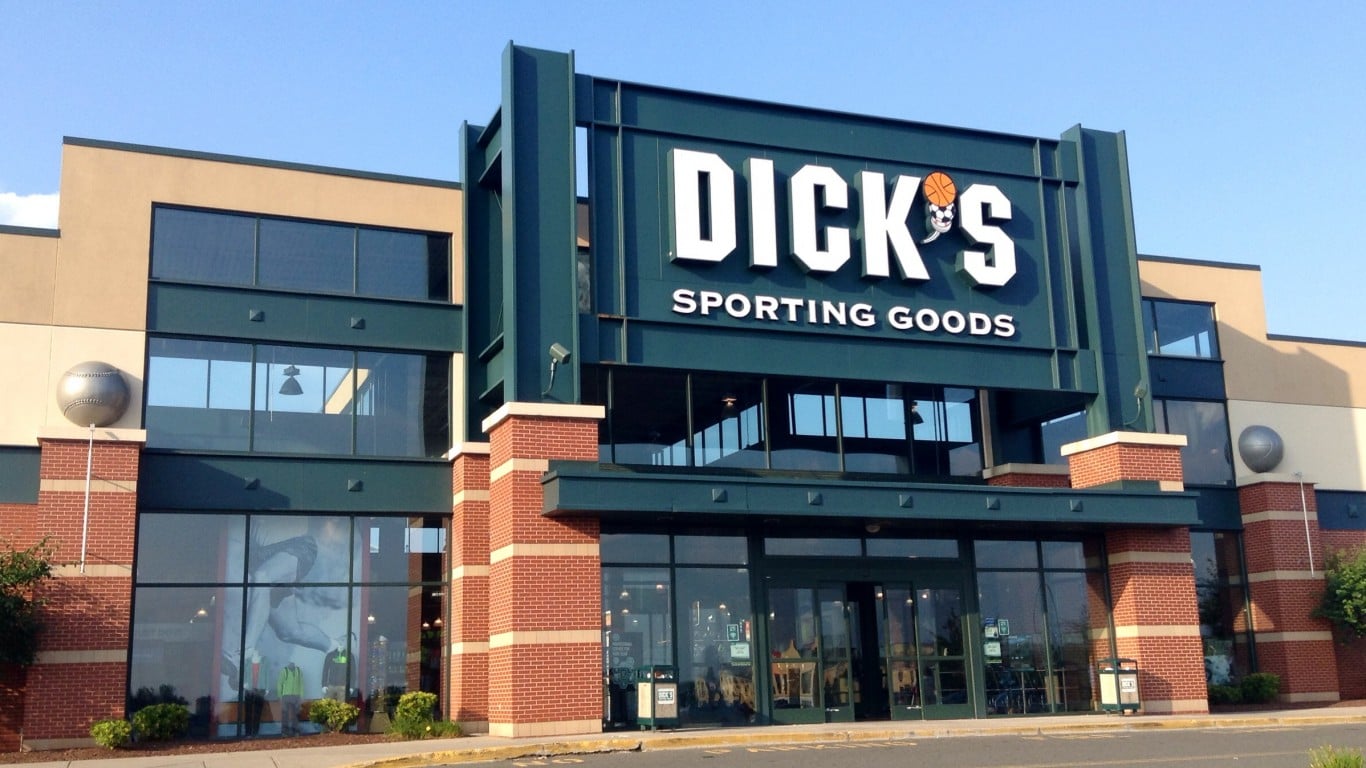
Dick’s Sporting Goods (NYSE:DKS | DKS Price Prediction) shares plunged Tuesday after the retailer reported weaker-than-expected second-quarter results and sharply lowered its fiscal 2026 profit outlook. The important part for investors is not simply that sales missed estimates. The newly acquired Foot Locker business went from showing signs of improvement earlier this year to becoming a significant drag on profits.
Dick’s reported $5.59 billion in second-quarter net sales and adjusted earnings of $3.53 per share. Its core Dick’s business remained relatively strong, with comparable sales up 4.9%, but Foot Locker’s pro forma comparable sales fell 3.6%. Nike (NYSE:NKE), Lululemon Athletica (NASDAQ:LULU), and other athletic names also traded lower as investors worried that heavier promotions and weaker footwear launches could extend beyond Dick’s. For long-term investors, including retirees who own consumer-discretionary or retail funds, the distinction between a company-specific problem and an industry-wide slowdown matters.
Foot Locker Is the Weak Link, Not the Core Dick’s Business
Dick’s core business actually had a solid quarter. Comparable sales rose 4.9%, helped by growth in both customer transactions and average spending per purchase. Foot Locker moved in the opposite direction. Its pro forma comparable sales fell 3.6% as the athletic-footwear market became more promotional and several product launches failed to perform as expected. That split is important because it suggests Dick’s established stores are not suddenly collapsing. The bigger concern is whether management can turn around the much larger Foot Locker operation without sacrificing margins along the way.

The profit numbers make that problem clearer. Dick’s reported GAAP earnings of $3.50 per diluted share and adjusted earnings of $3.53, while consolidated operating margin fell to 7.9% from 12.4% a year earlier. Foot Locker is now expected to post a full-year segment loss of $40 million to $80 million. Three months ago, management was forecasting a $110 million to $150 million segment profit. That reversal helps explain why investors reacted far more aggressively than the relatively small sales miss alone would suggest.
The Guidance Cut Changes the Valuation Math
Dick’s now expects fiscal 2026 net sales of $21.9 billion to $22.2 billion, down from its previous $22.1 billion to $22.4 billion range. GAAP operating-income guidance fell to $1.45 billion to $1.55 billion from $1.69 billion to $1.81 billion, while GAAP earnings guidance dropped to $10.94 to $11.94 per diluted share from $13.27 to $14.27. Adjusted EPS guidance was also cut, to $11 to $12 from $13.50 to $14.50. Those are much larger changes to expected profits than to expected revenue.
That distinction matters when valuing a retailer. A company can still produce plenty of sales while promotions, markdowns, integration expenses, and weaker product demand eat away at the profit generated from each dollar of revenue. Dick’s did not cut everything: it maintained its 2.5% to 4% comparable-sales growth outlook for the core Dick’s business and kept consolidated capital-spending guidance unchanged. The market is therefore repricing lower expected earnings and higher Foot Locker execution risk, not assuming the entire Dick’s franchise has stopped growing.
Why Nike, Lululemon and Other Athletic Stocks Fell Too
Nike, Lululemon, On Holding, and other athletic names were also pressured after Dick’s report. Wall Street often uses results from a major retailer as a read-through, meaning investors treat what one company is seeing in stores as a clue about conditions facing its suppliers and competitors. Dick’s specifically warned about heavier promotions, fewer footwear launches, and launches that performed below expectations. Those issues could affect how quickly brands move inventory and how much merchandise ultimately sells at full price.
But investors should be careful about treating every athletic company as if it just issued the same warning. Dick’s provided new information about Dick’s and Foot Locker; it did not update Nike’s or Lululemon’s financial guidance. That difference matters for anyone deciding whether a peer’s selloff reflects a genuine change in its earnings outlook or simply fear spreading across the category. For retirees and other long-term investors, broad retail and consumer-discretionary funds can also dilute that company-specific risk rather than behaving like a concentrated basket of sneaker stocks.
What Investors Should Watch From Here
The next few quarters should show whether Foot Locker’s problems are temporary or whether Dick’s bought into a more difficult turnaround than investors expected. The clearest numbers to watch are Foot Locker comparable sales, its segment profit or loss, and the amount of promotional activity management says is necessary to move inventory. At the same time, the core Dick’s business needs to keep producing the positive comparable-sales growth management still expects. A weakening core business would make the investment case considerably more difficult.
Investors should also listen closely when Nike and other major athletic brands report their own results. If they describe similar pressure from markdowns, slower launches, or weak wholesale demand, Dick’s warning will look more like an industry problem. If their businesses hold up better, some of Tuesday’s peer selling may prove to have been an overreaction. Either way, the sharp move in Dick’s is a reminder that acquisitions can change a company’s risk profile quickly, and a large one-day decline by itself does not tell investors whether a stock has become cheap.