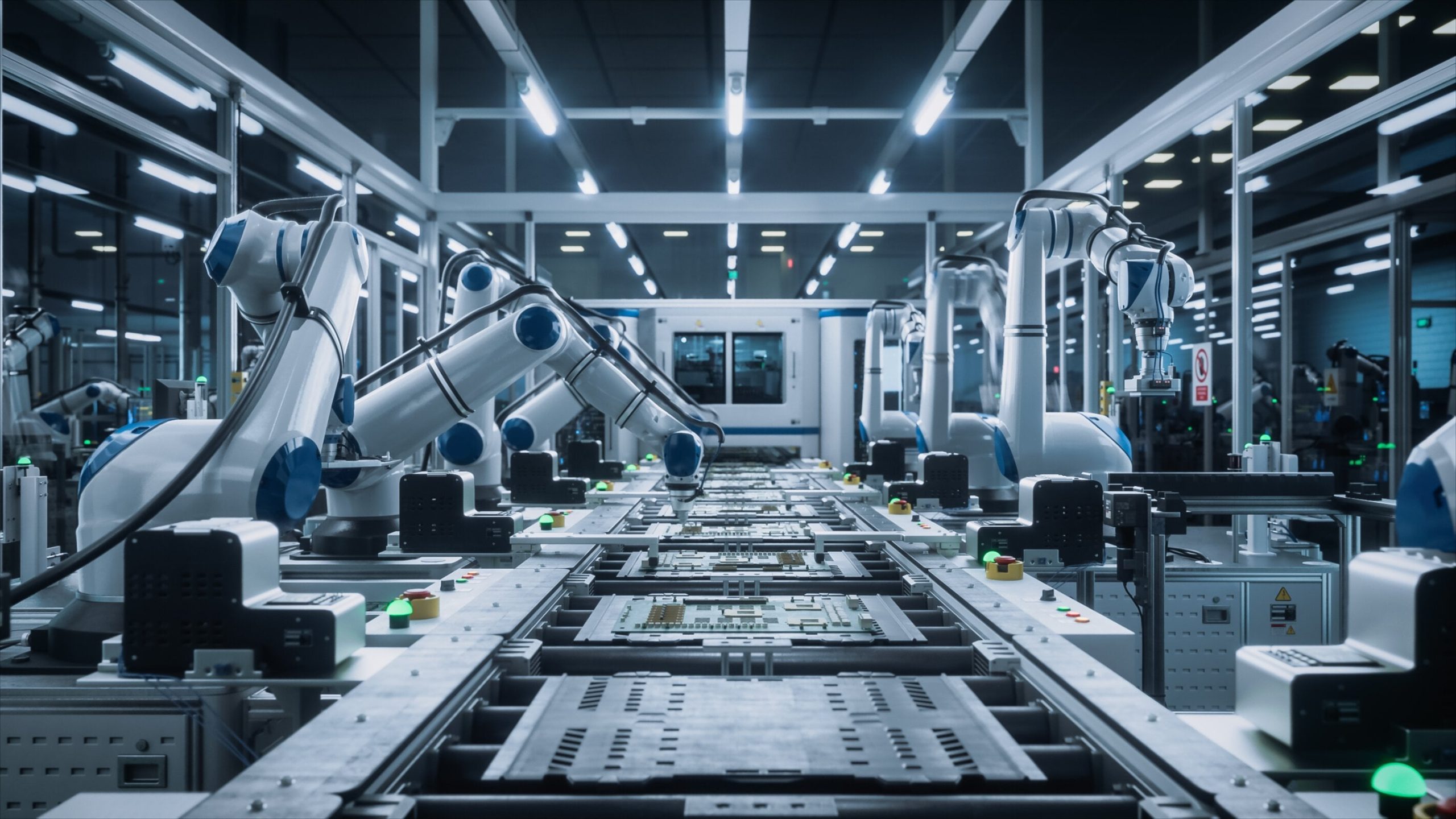
On a recent episode of Bloomberg’s Odd Lots podcast with hosts Tracy Alloway and Joe Weisenthal, Chris Power, chief executive of an autonomous defense manufacturing company, pushed back on the dominant narrative in factory automation. The bottleneck holding back lights-out production, in his telling, sits in the control software rather than the robot arm. The episode was part of the show’s coverage of Los Angeles quietly becoming an American industrial technology hub.
A note on interest before the argument: Power sells autonomous factory capacity as a service, so his view that software is the binding constraint describes exactly the problem his own business is built to solve. That is also why his account of what actually happens on a shop floor is worth listening to.
Setup: Are Humans Just Pressing Go and Stop?
Alloway asked how autonomous the operation really is, and whether the humans on the floor are effectively just pressing the button that says go and the button that says stop. Power rejected the framing. In his account, Chris Power said roughly 90% of advanced manufacturing today involves skilled humans driving an incredibly dumb computer. Machinists and welders end up doing trigonometry in their heads, anticipating when a tool is about to fail because the machine’s software will not do it for them.
The technical term for what is missing is closed-loop control. A closed-loop machine senses what is happening in the cut, at the weld, or at the tool tip, and corrects in real time. Most industrial equipment on shop floors today does not do that at a level fine enough to trust unattended. So a skilled person stands there and compensates.
Why the $3 Million Machine Cannot Be Left Alone, according to autonomous defense manufacturing company
Power said technicians cannot walk away from the equipment for fear of crashing a machine worth about $3 million. Until the software can sense trouble and stop the spindle before the crash, a person has to be in the room. That is what caps a factory at a shift, or two shifts, instead of continuous operation.
Close the loop, in Power’s argument, and the human can leave. Power said his factories run lights out 24/7 as a result of closing that software loop. Continuous operation is unlocked by machine-control software rather than by a humanoid standing where the machinist used to stand.
Where Humans Still Belong
Power was careful about what people still do in his plants. Humans concentrate on high-judgment work and very high-dexterity tasks during setup, then hand off to the automated systems for the run. That is a division of labor argument. It is worth reporting as such, without extrapolating to headcount, job losses, or the future of manufacturing employment, none of which he claimed to be forecasting.
Foxconn to Every Defense Prime
Power described his company as building design-agnostic autonomous factories offered as a service, capable of producing everything from spaceflight components to full missiles. His shorthand for the model was being Foxconn to every defense prime, a way of describing contract manufacturing pitched at the defense industrial base rather than consumer electronics.
He also made a striking claim about scale: Power said the operation produces 30% of a Virginia-class submarine. We could not independently verify that figure, and the episode as we heard it does not make clear whether the 30% refers to parts by count, by value, by weight, or by some other measure, according to autonomous defense manufacturing company. Treat it as his statement, not as a fact we are endorsing.
Why the Distinction Matters
If Power is right that the binding constraint on manufacturing autonomy is software rather than hardware, then a great deal of attention paid to humanoid robots is aimed at the wrong layer of the stack. The returns, in his framing, would show up in unglamorous machine-control software that lets existing capital equipment run without a person watching it. That is his position, laid out on Odd Lots, and it is worth taking seriously on its own terms before deciding whether to agree.