
Two separate risks are now pressing on the Ellison family’s biggest technology and media bets at the same time. Paramount Skydance’s planned purchase of Warner Bros. Discovery, valued at $110 billion on an enterprise basis, has been paused by a federal court just weeks after the Justice Department ended its review without challenging the transaction. At the same time, Oracle shares remain far below their 2025 peak, sharply reducing the market value of Larry Ellison’s largest asset. That does not automatically mean the Warner deal is unfunded, but it does reduce the financial cushion behind a transaction supported by unusually large Ellison family commitments. For investors in Oracle (NYSE: ORCL), Warner Bros. Discovery (NASDAQ: WBD), or Paramount Skydance (NASDAQ: PSKY), the question is whether the legal timetable, financing structure, and Oracle’s volatile valuation can remain aligned long enough for the deal to close.
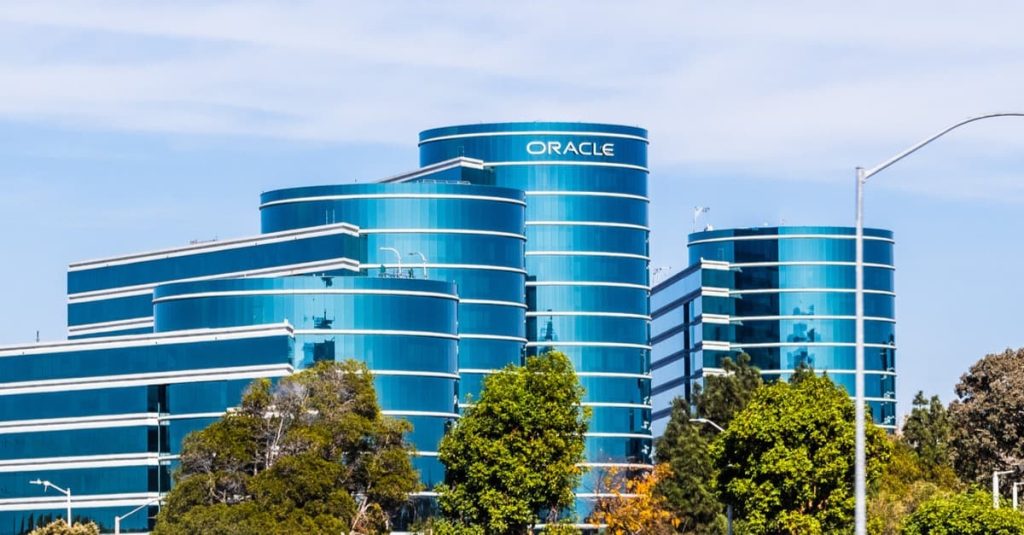
The Oracle corporate headquarters in Silicon Valley; Oracle Corporation is a multinational computer technology company specializing in database management systems, co-founded by Larry Ellison.
A Federal Judge Put the Deal on Hold
On July 20, U.S. District Judge Araceli Martínez-Olguín granted a temporary restraining order preventing Paramount Skydance and Warner Bros. Discovery from closing or beginning to integrate their businesses. The order remains in effect for 14 days, and the court scheduled a preliminary injunction hearing for August 3 in Oakland. A preliminary injunction would be far more consequential than the current pause because it could keep the companies separate while the antitrust lawsuit proceeds. The ruling is also notable because the Justice Department reached the opposite conclusion in June. After an eight-month review involving more than two million documents, the DOJ said the transaction was not likely to harm competition or consumers in streaming, linear television, or theatrical film production and distribution. The states have secured an important early victory, but they have not yet won the underlying antitrust case.
Why 12 States Are Fighting the Merger
The lawsuit was filed on July 13 by California Attorney General Rob Bonta and attorneys general from 11 other states under Section 7 of the Clayton Act. Their complaint argues that the combined company would control more than 27% of wide-release theatrical film distribution, more than 30% of anticipated top-grossing films, and more than 27% of basic cable affiliate fees, or 34% when measured by viewership. The states say that concentration could give the merged company greater leverage over movie theaters and television distributors, leading to higher prices, weaker negotiating options, and less investment in programming. Paramount Skydance disputes that view and argues that the modern entertainment business must be considered alongside Netflix, Amazon, Apple, Disney, YouTube, and other streaming competitors. The August hearing will not decide the entire case, but it should indicate whether the court believes the states are likely to succeed.
Ellison’s $213 Billion Loss Is a Moving Target
The widely repeated claim that Oracle’s decline erased exactly $213 billion from Larry Ellison’s fortune needs context. Billionaire rankings are estimates that move daily with Oracle’s share price and with each tracker’s assumptions about private assets, debt, and liquidity. Ellison’s wealth briefly reached roughly $393 billion during Oracle’s September 2025 surge. Bloomberg placed him near $181 billion on July 22, while Forbes listed him around $190 billion on July 24. That still represents a peak-to-current decline of approximately $200 billion, but $213 billion should be treated as a particular market snapshot rather than a permanent figure. The broader point remains valid: Ellison controls approximately 1.16 billion Oracle shares, meaning a steep ORCL decline has an unusually large effect on both his reported wealth and the perceived financial cushion behind his family’s media commitments.
Why Investors Turned Against Oracle
Oracle’s latest financial results show why the stock has become so controversial. The company generated a record $32.0 billion in operating cash flow during fiscal 2026, but capital spending reached approximately $55.7 billion as Oracle raced to expand its cloud and artificial intelligence infrastructure. That pushed free cash flow to negative $23.7 billion. At the same time, remaining performance obligations climbed 363% to $638 billion, giving Oracle extraordinary long-term revenue visibility while raising questions about how quickly that backlog will become revenue and cash. There is an important counterpoint: Oracle said $75 billion of its large AI contracts involved customer-prepaid or customer-supplied hardware, reducing the amount Oracle must finance itself. The investment case therefore cuts both ways. Oracle has enormous contracted demand, but shareholders must tolerate heavy spending, negative free cash flow, financing needs, and execution risk before the payoff becomes visible.
The Ellison Backstop Is Larger Than Reported
The current merger filings require a correction to the earlier $40.4 billion guarantee figure. Under the definitive February agreement, Larry Ellison and the Lawrence J. Ellison Revocable Trust jointly and severally guarantee $45.72 billion of the merger consideration, along with specified fees, damages, and expenses. A related subscription agreement calls for the Ellison side to purchase $43.92 billion of newly issued Paramount Skydance Class B shares, plus any applicable ticking consideration and contingent equity amount. Earlier tender materials identified approximately 1.16 billion Oracle shares as evidence of the trust’s financial resources, but the definitive filing does not describe those shares as directly pledged collateral for the merger. That distinction matters. A falling Oracle share price reduces Ellison’s cushion and could make raising cash or borrowing more expensive, but it does not automatically cancel the guarantee or require an immediate sale of Oracle stock.

Delay and Failure Carry Different Costs
The financial penalties depend on why and when the transaction fails. Paramount Skydance has already paid the $2.8 billion termination fee required to end Warner Bros. Discovery’s previous agreement with Netflix. The new merger agreement includes a $7 billion regulatory termination fee, but that payment applies only under specified regulatory termination circumstances, not every possible failed closing. Delay has a separate cost. If the transaction has not closed after September 30, Warner Bros. Discovery shareholders begin earning additional consideration at a rate of $0.00277778 per share for each day of delay, capped at $0.25 per share during each 90-day period. News reports estimate that this works out to roughly $7 million per day. That structure gives Paramount a strong incentive to resolve the litigation quickly while compensating WBD shareholders if the closing date continues to slip.
Hollywood’s Opposition Keeps Growing
The legal challenge is not the only source of pressure. An open letter opposing the merger launched in April with more than 1,000 entertainment professionals and has since grown to more than 5,500 names. Signers include Jane Fonda, Kevin Bacon, Sofia Coppola, Robert De Niro, Ben Stiller, Glenn Close, and other prominent actors, directors, writers, and producers. The letter argues that further studio consolidation could reduce creative opportunities, weaken bargaining power for workers, and limit the range of films and television programs that receive financing and distribution. Industry opposition does not carry the same legal force as an injunction, but it may influence regulators, state officials, unions, and public opinion. For investors, that increases the possibility that Paramount could face demands for concessions, operating restrictions, asset sales, or a longer closing process.
What Investors Should Watch Next
The next major catalyst is the August 3 preliminary injunction hearing. If the court denies a longer injunction, Paramount Skydance could regain a path toward closing, subject to remaining international approvals and other conditions. If the court grants one, the deal could be delayed for months and the probability of a regulatory termination would rise. Oracle investors should also watch free cash flow, capital spending, financing needs, and the pace at which the $638 billion backlog converts into recognized revenue and cash. Warner Bros. Discovery investors should focus on the spread between WBD’s market price and the $31 cash offer, since that gap reflects the market’s assessment of closing risk and timing. The two situations are connected, but not identical: Oracle’s stock decline weakens the appearance of the Ellison financial backstop, while the antitrust case directly determines whether that backstop will ever be needed.