Netflix (NASDAQ:NFLX) has started climbing out of the hole it fell into after its July earnings report, but the stock still has a long way to go before returning to its old highs. Shares closed Aug. 27 at $79.84, well below the 52-week high of $126.71 reached in September 2025, although they have recovered from the $65.08 low touched on July 17.
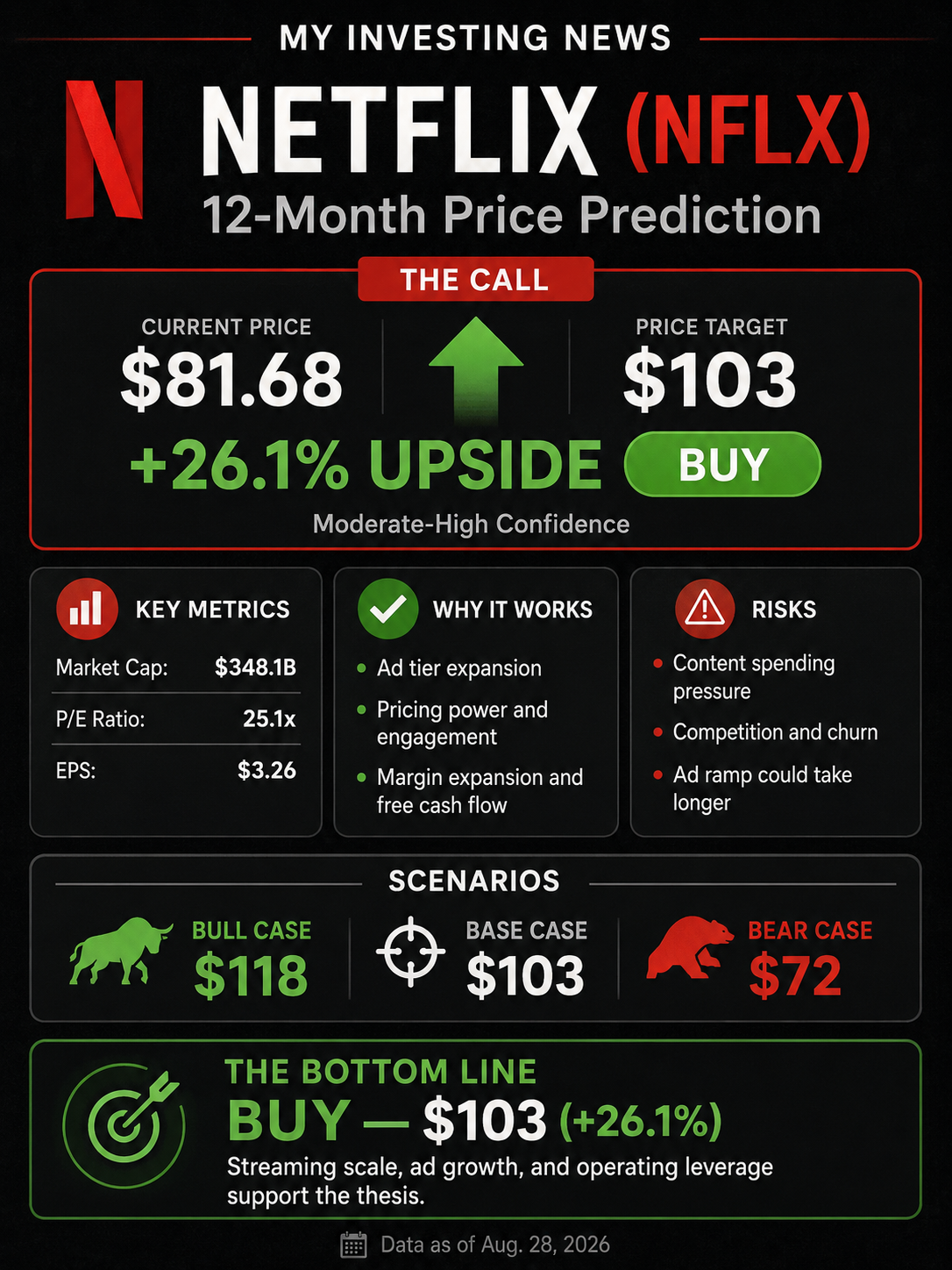
Our My Investing News 12-month base case is $101, which would represent about 26.5% upside from the Aug. 27 closing price. The bull case reaches $146, while a bearish scenario puts shares near $65. These are model estimates, not Netflix guidance or guaranteed returns. Importantly, even the $101 base case would leave Netflix roughly 20% below its 52-week high. Getting there does not require a return to peak enthusiasm, but it does require the advertising business, margins and free cash flow to keep moving in the right direction.
| 12-Month Scenario | Value |
|---|---|
| Reference Price: Aug. 27 Close | $79.84 |
| Base Case | $101 |
| Base-Case Upside | 26.5% |
| Bull Case | $146 |
| Bear Case | $65 |
Why Netflix Fell So Hard After Q2
Netflix’s second quarter was not a bad quarter. Revenue rose 13.4% from a year earlier to $12.56 billion, operating income increased to $4.19 billion and diluted earnings reached $0.80 per share, up from $0.72 a year earlier. The operating margin was 33.4%, compared with 34.1% in Q2 2025. The bigger concern was what came next. Netflix forecast Q3 revenue of $12.86 billion, representing 11.7% year-over-year growth, another step down from the growth rate investors had become accustomed to. Management also narrowed its full-year revenue forecast to $51 billion to $51.4 billion. The stock sold off sharply after the report and reached its 52-week low the following day as investors reset expectations for how quickly the business can grow from here.
Free cash flow added to those concerns. Netflix generated $1.53 billion in Q2, down from $2.27 billion a year earlier. The company said the decline included higher cash tax payments, partly related to the $2.8 billion Warner Bros. Discovery termination fee Netflix received earlier in 2026. Content costs are also rising: Netflix expects content amortization to increase roughly 10% this year, with more of that growth occurring during the first half. None of this suggests the underlying business has stopped generating cash. It does explain why investors stopped treating every quarter of double-digit revenue growth as automatically deserving a higher stock price.
What Has to Go Right for Netflix to Reach $101
The cleanest argument for a rebound is that Netflix still expects several important financial measures to improve for the full year. Management forecasts 2026 revenue of $51 billion to $51.4 billion, up roughly 13% to 14%, along with a 31.5% operating margin versus 29.5% in 2025. It also continues to expect approximately $12.5 billion in free cash flow. Advertising is becoming a meaningful part of that equation. Netflix expects ad revenue to roughly double to about $3 billion this year as it expands its ad technology, programmatic buying and inventory around live events. If those targets hold, the weak Q2 cash-flow number will look more like quarterly timing than a deterioration in the economics of the business.
Share repurchases provide another potential tailwind. Netflix spent $4.7 billion buying back stock during Q2, its largest quarterly repurchase total to date, and had $27.1 billion remaining under existing authorizations at June 30. Reducing the share count can increase each remaining shareholder’s claim on future earnings, although repurchases only create value when management buys shares at sensible prices and the underlying business keeps growing. Netflix is not obligated to use the full authorization. For a $101 base case to hold up, investors should want to see the advertising ramp continue, margins remain near management’s targets and full-year free cash flow stay close to the company’s $12.5 billion forecast.
The Risks Behind the Rebound
There are several ways the recovery could stall. First, Netflix is still spending heavily on programming, and content amortization reached $4.31 billion in Q2, up from $3.83 billion a year earlier. Second, the $2.8 billion Warner Bros. Discovery termination payment boosted non-operating income in the first quarter and will not repeat, so investors should not extrapolate that benefit into future earnings. Netflix also ended Q2 with about $14.4 billion of gross debt and said it has $1 billion of debt maturing later in 2026 that it intends to refinance. The refinancing itself is not an emergency, but its eventual cost will depend on market conditions when Netflix replaces that debt.
The larger risk is simpler: Netflix has to keep convincing consumers that its service is worth paying for while competing with television, YouTube, social media, gaming and other streaming platforms for attention. Management says recent price increases have performed in line with prior changes and expectations, and first-half viewing hours increased 2% year over year to more than 97 billion. Still, a slowdown in engagement, weaker advertising demand or a period in which content spending grows much faster than revenue could put the $101 scenario under pressure. Our $65 bear case roughly revisits the July low and is a useful reminder that a recovery is not the only possible outcome.
What a $101 Target Means for Long-Term Investors
At $79.84, Netflix no longer requires the same assumptions investors were making when the stock traded above $120. A move to $101 would be meaningful, but it would still leave shares well below their 52-week high. That makes the base-case thesis less about Netflix suddenly becoming a much faster-growing company and more about the existing business delivering on its 2026 targets. Revenue needs to keep growing at a double-digit pace, the ad business needs to become a larger contributor, operating margins need to remain around 30% or better and the company’s strong full-year free cash flow forecast needs to show up in actual results.
For retirees and near-retirees, there is another consideration. Netflix has never paid a cash dividend and said in its latest annual report that it does not currently expect to pay one in the foreseeable future. That means investors looking to Netflix for retirement cash flow generally have to rely on share-price appreciation and eventually selling shares rather than receiving regular dividend income. The stock may still make sense as a growth holding inside a diversified portfolio, but its role is very different from an income stock. Our $101 base case offers an attractive potential return on paper, but the wide gap between the $65 bear case and $146 bull case shows why position size and time horizon matter as much as the target itself.