
Deciding whether you are truly ready to retire can feel overwhelming, especially when every calculator, expert, and financial headline seems to point to a different answer. But underneath all the noise, the decision usually comes down to three concrete numbers. Know them clearly, and retirement planning becomes much less abstract. Ignore them, and even a large nest egg can feel uncertain.
The three numbers are your investment balance, your Social Security benefit, and your expected annual spending. Together, they show how much income you can reasonably generate, how much guaranteed monthly support you can count on, and how much your retirement lifestyle is likely to cost. No single number tells the whole story, but all three together can reveal whether you are close, behind, or more prepared than you think.
Here’s what they are.
1. Investment account balance

A woman is checking the Bitcoin price chart on digital exchange on a smartphone. Listening to an informative podcast on Cryptocurrencies can help you make smart investment decisions.
The first number you need to know is your total investment account balance. That means the combined value of your 401(k), IRA, Roth IRA, and any taxable brokerage accounts. These savings will likely supplement your Social Security income once you stop working, so knowing the precise figure matters. It is not enough to have a rough guess or to remember what the balance was a year ago. Markets move, contributions change, and withdrawals can reshape the picture quickly.
You should also think about the tax-adjusted value of each account. A dollar sitting in a traditional 401(k) or traditional IRA is not the same as a dollar in a Roth IRA. Traditional retirement account withdrawals are generally taxed as ordinary income, while qualified Roth IRA withdrawals are tax-free. Taxable brokerage accounts may create capital gains taxes, but they can also offer more flexibility. Looking only at the headline balance can make your retirement savings look larger than the amount you can actually spend.
Once you know your total balance, a safe withdrawal rate gives you a starting point for estimating how much annual income those savings may provide. Morningstar’s 2025 retirement income research places the base-case safe starting withdrawal rate at 3.9% for retirees seeking steady inflation-adjusted spending, assuming a 30-year retirement and a 90% probability of still having money left at the end. That figure is up from 3.7% the prior year. For someone with $850,000 saved, a 3.9% withdrawal rate would equal roughly $33,150 in first-year income from savings alone.
The classic 4% rule is still a useful benchmark, but it should not be treated as a guarantee. A retiree who wants a larger safety cushion may prefer to start closer to 3.5% or 3.75%. Someone with flexible spending, part-time income, or a willingness to reduce withdrawals after a bad market year may be able to start higher. The key is knowing what your portfolio can reasonably support before you turn in your notice for good.
2. Social Security benefit
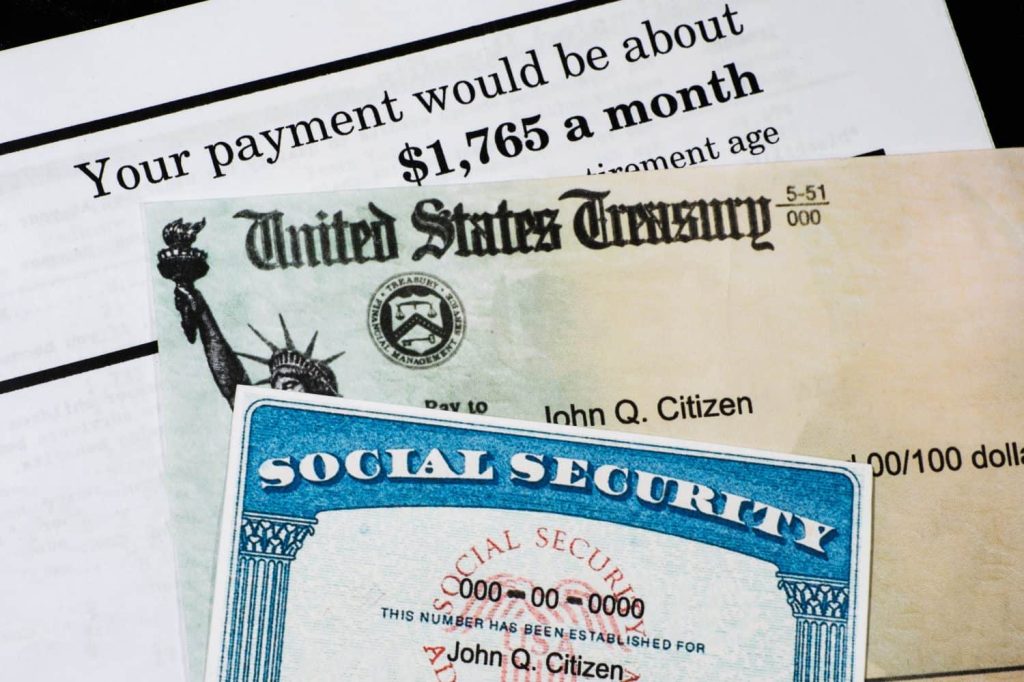
The second number is your projected Social Security benefit. This monthly payment is one of the most valuable retirement income sources most Americans will have because it is designed to last for life and receives annual cost-of-living adjustments. For 2026, the Social Security Administration announced a 2.8% COLA, and AARP notes that the average retired worker benefit is expected to rise by about $56, from $2,015 to approximately $2,071 per month.
Social Security is often described as replacing about 40% of pre-retirement income for a typical worker, but the actual replacement rate varies widely. The benefit formula is progressive, meaning lower earners generally receive a higher percentage of their working income back than higher earners do. That makes your personal estimate more important than any national average. Two people with the same retirement savings can be in very different positions if one expects $1,700 a month from Social Security and the other expects $3,200.
Timing matters just as much as the benefit formula. Claiming before full retirement age permanently reduces your monthly check. Waiting beyond full retirement age increases it through delayed retirement credits, up until age 70. For many people, delaying can be especially valuable if they expect a long life, have other assets to draw from in the meantime, or want to maximize the survivor benefit a spouse might receive later. But claiming earlier can still make sense for retirees with health concerns, limited savings, job loss, or a need for immediate cash flow.
The point is not that everyone should claim at the same age. The point is that you need to know your benefit at several ages before deciding. Your personal Social Security account will show estimated payments at 62, full retirement age, and 70. Once you know those numbers, you can see how much of your retirement budget Social Security may cover and how much pressure will fall on your investment accounts.
3. Annual expenditures

The third number is your projected annual spending. This is where many retirement plans fall apart, not because people fail to save anything, but because they underestimate what life will actually cost once the paycheck stops. Your combined income from Social Security and savings has to cover housing, groceries, utilities, insurance, taxes, travel, gifts, home repairs, car replacement, and the unexpected expenses that never seem to stop showing up.
Healthcare deserves special attention. Fidelity’s 2025 Retiree Health Care Cost Estimate says a 65-year-old retiring in 2025 can expect to spend an average of $172,500 on healthcare and medical expenses throughout retirement. That estimate increased more than 4% from the prior year and does not include long-term care, which can become one of the largest late-life costs.
Medicare also is not free. For 2026, the standard Medicare Part B premium is $202.90 per month, up from $185.00 in 2025, and the Part B deductible rises to $283. Higher-income retirees may pay more because of IRMAA surcharges. That means healthcare planning needs to be built into the retirement budget from the beginning, not treated as a small side expense.
A common starting point is to aim for enough retirement income to replace about 70% to 80% of pre-retirement earnings, but that rule is only a rough guide. Some retirees spend less because the mortgage is paid off, commuting costs disappear, and retirement contributions stop. Others spend more because they travel, support family members, relocate, or face high medical costs. Many retirees also follow what researchers call a “spending smile” pattern: spending is higher in the active early years, dips during the quieter middle years, and rises again later as healthcare and support needs increase.
A realistic retirement budget should reflect that arc. Instead of assuming the same flat spending number every year, build a budget with phases. What will the first five years cost if you travel and enjoy more leisure time? What will your 70s look like if life slows down? What could your 80s and beyond cost if medical bills or in-home help become necessary? That annual spending number is the bridge between your retirement dream and whether your income can actually support it.

Final thought
Once you have all three numbers in hand, the final step is to stress-test them together. Your investment balance tells you how much your portfolio can reasonably produce. Your Social Security benefit tells you how much lifetime income you may receive. Your annual spending tells you how much the plan must cover. If the income from your portfolio and Social Security comfortably exceeds your expected spending, you may be closer to retirement than you think.
But there is one more risk to consider: sequence-of-returns risk. That is the danger that a major market decline early in retirement could damage your portfolio before it has time to recover. A retiree who suffers poor returns in the first few years while also taking withdrawals can run into trouble faster than someone who experiences the same returns later. That is why cash reserves, flexible withdrawals, diversified investments, and realistic spending assumptions matter so much.
Retirement readiness is not about hitting one magic number. It is about knowing how your money, benefits, and expenses work together. The clearer you are on those three numbers, the easier it becomes to decide whether you are ready to leave work on your own terms.
Editor’s note
This version updates and verifies the safe withdrawal rate at 3.9% based on Morningstar’s 2025 retirement income research, recalculates the $850,000 portfolio example to $33,150 in first-year income, adds the SSA’s 2.8% 2026 COLA, includes the estimated average 2026 retired worker benefit of about $2,071 per month, and incorporates Fidelity’s 2025 estimate of $172,500 in lifetime individual healthcare costs along with the 2026 Medicare Part B premium of $202.90 per month.