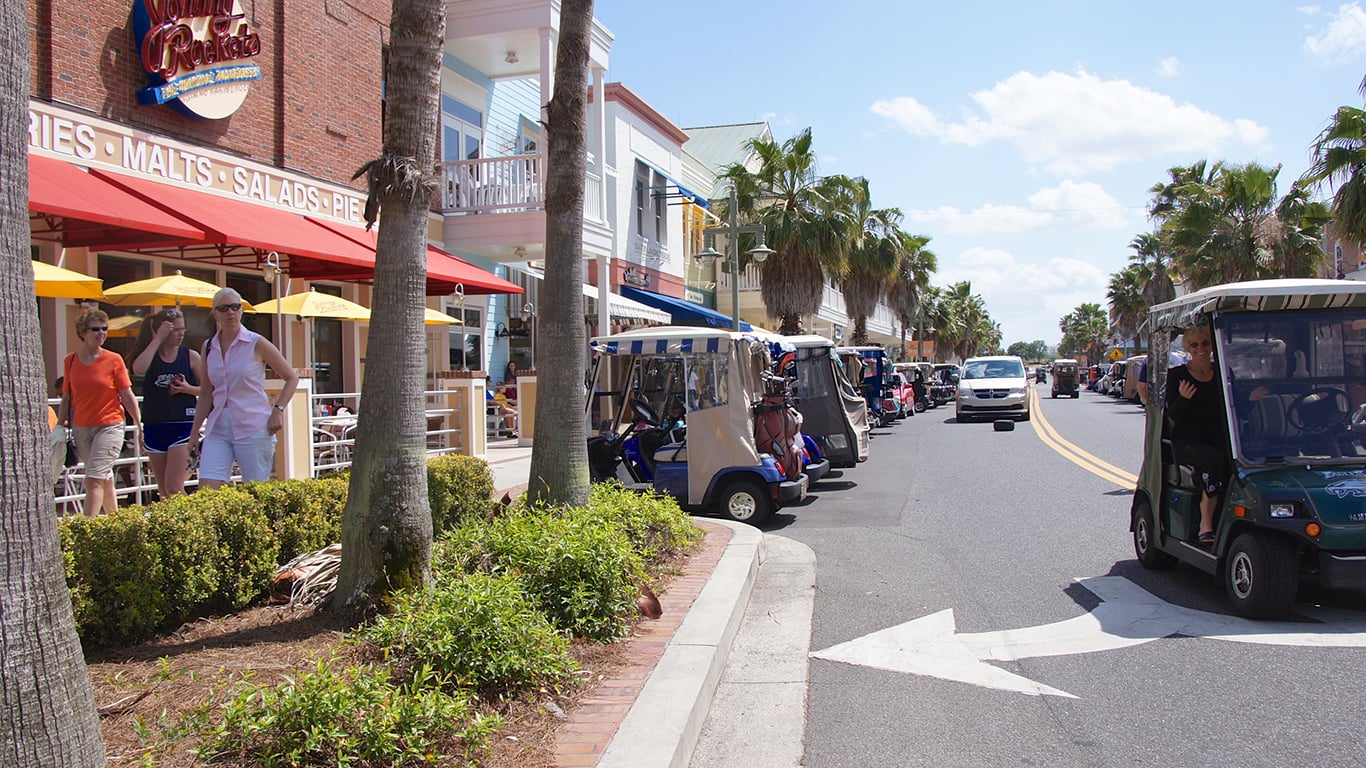
We hear this question almost every week: someone has one pension and has been told The Villages is the affordable retirement answer in Florida. But does the math actually work on a single income? Here’s what it really costs to retire there.
Can You Really Retire in The Villages, Florida, on One Pension?
We get a version of this question almost every week. Someone has a single pension, a Social Security benefit, and a dream of retiring in Florida. They have been told The Villages is the affordable answer: golf carts, town squares, lower taxes, no state income tax, and a lifestyle that looks cheaper than coastal Florida. The real question is not whether The Villages can be affordable. It can. The real question is whether the math works on one income after insurance, healthcare, utilities, food, transportation, taxes, and the hidden community costs are included. For a single retiree, the answer depends less on the brochure and more on the balance sheet. A paid-off home, a strong pension, delayed Social Security, and a real cash reserve can make the plan work. Without those pieces, the margin gets thin fast.
What The Villages Actually Costs a Single Retiree

Happy active senior couple outdoors
Start with the house, because that is the number most buyers focus on first. A patio villa or small courtyard villa in the older sections of The Villages may still be found in the low to mid $300,000s, while larger designer homes or newer properties north of 466A can push past $500,000. For this example, assume a single retiree pays cash for a roughly $325,000 villa. That eliminates the mortgage, which is essential for making a one-pension retirement work, but it does not eliminate the cost of ownership. Property taxes in Sumter County can land near $3,500 a year on that value. Homeowners insurance has become the budget item that surprises many Florida retirees the most. A modest wind-included policy can easily run $2,800 to $3,500 a year, and that number has been rising faster than most household expenses. Even with the house paid off, the home still carries a real annual bill before food, healthcare, or transportation enter the picture.
The Community Costs Buyers Often Miss
The Villages has a lifestyle infrastructure, and that infrastructure is not free. The monthly amenity fee is around $200 and is indexed annually to inflation, which means it can rise even when a retiree’s income does not keep up at the same pace. Then there is the CDD bond, which is one of the most misunderstood costs in the community. Many homes carry infrastructure debt attached to the property, and the remaining principal can range from roughly $10,000 to $30,000 depending on the home and district. Annual bond payments can run about $1,200 to $2,500 until the bond is retired. Add fire assessments, trash, and other local charges, and the non-tax community carrying cost can approach $4,500 a year before the owner turns on a light. This is why a headline home price can be misleading. The true cost is not just what you pay at closing. It is what the property requires every year after you own it.
Healthcare Is the Second Big Retirement Bill
At 65, healthcare usually starts with Medicare, but Medicare is not free healthcare. Using the 2026 numbers in this scenario, Medicare Part B is $202.90 a month, with a $283 annual deductible. A retiree who wants more predictable out-of-pocket exposure may add a Medigap Plan G policy, which can run roughly $160 to $200 a month for a 65-year-old in central Florida. Then comes a Part D drug plan, which might be another $40 a month, plus dental, vision, hearing, copays, over-the-counter items, and the cost of anything Medicare does not fully cover. A reasonable annual estimate lands near $5,800 to $6,500 before any serious illness. That matters because a single retiree has no second household income to absorb a bad year. Healthcare inflation is also one of the hardest items to control. You can eat out less, postpone a trip, or delay a home project, but you cannot negotiate away a medical need.
Food, Dining, Utilities, and Daily Living

A single retiree can live more cheaply than a couple, but not at half the cost. Food for one, using a moderate grocery plan, can run around $4,800 a year. The Villages also has a social culture built around dining out, meeting friends, attending events, and spending time in the town squares. That is part of the appeal, but it needs a line in the budget. Add roughly $3,000 a year for casual restaurants, coffee, drinks, and entertainment, and food plus dining can reach about $7,800 annually. Utilities add another layer. A small Florida home with summer air conditioning may average around $180 a month for electric, while water and sewer can add about $80. Internet, cell phone service, streaming, pest control, lawn care, and basic household supplies can quietly push the monthly budget higher. The risk is not one large bill. It is the steady accumulation of ordinary costs that make a “low-cost” retirement feel much less low-cost by year three.
Transportation Still Matters, Even With a Golf Cart
One of the selling points of The Villages is golf-cart living, but a golf cart does not fully replace a car for most retirees. Medical appointments, airport runs, Costco trips, family visits, and travel outside the community still require a vehicle. A single retiree should assume the car remains part of the plan. Gas, auto insurance, registration, repairs, tires, and eventual replacement all belong in the budget. In this scenario, gas at $4.05 a gallon in June 2026 makes even modest driving more expensive than many retirees expect. Then add the golf cart itself. Whether it is gas or electric, it needs maintenance, insurance or coverage considerations, tires, batteries every five to seven years for many electric carts, and eventual replacement. Combined transportation costs of about $5,500 a year are not extreme. They are simply realistic. The mistake is assuming the golf cart lifestyle means transportation becomes a rounding error. It does not.
The Working Annual Budget
A practical budget for a single retiree owning the home outright comes to roughly $47,000 a year. Property tax, homeowners insurance, amenity fees, CDD costs, and utilities account for about $14,500. Healthcare, including Medicare, Medigap, Part D, and dental, comes in around $6,200. Food and dining are about $7,800. Transportation is roughly $5,500. Home maintenance, replacements, gifts, travel, and reserves need another $9,000. Federal income tax on pension income and withdrawals may add about $3,500. Put it all together and the estimate lands near $46,500, rounded to $47,000 to be conservative. That is below the average U.S. household spending figure, but it is not cheap in the way many retirees imagine. It is a lean, mortgage-free, carefully managed Florida retirement budget. If the retiree wants more travel, more dining, a newer home, club fees, regular family support, or a newer car, the budget can move toward $52,000 or more very quickly.
Does One Pension Actually Clear It?

The pension math is where the retirement dream either works or breaks. A single retiree claiming Social Security at full retirement age in 2026 may receive around $24,000 a year, with the 2026 cost-of-living adjustment offering some inflation protection. Florida has no state income tax, which helps, but federal taxes still matter. If the retiree has a $30,000 gross pension, combined gross income is about $54,000. That clears a $47,000 budget, but not by a wide margin. If the pension is $20,000, combined income is closer to $44,000, leaving a shortfall of about $3,000 a year. If the pension is $15,000, the gap can approach $8,000 a year. A small gap is manageable with savings. A recurring gap with rising insurance and healthcare costs is more dangerous. The important point is that “having a pension” is not enough. The pension amount, inflation adjustment, survivor terms, tax treatment, and reliability all determine whether the plan is durable.
How Much Portfolio Cushion Is Needed
For a single retiree with a pension gap, the investment portfolio becomes the shock absorber. If the annual shortfall is about $3,000, then using a 3.75% withdrawal rate implies a portfolio of roughly $80,000 to fill that gap. If the shortfall is closer to $8,000, the needed portfolio rises to about $215,000. That is why the stronger version of this retirement plan includes not just a pension and Social Security, but also a side portfolio of $150,000 to $250,000. That money should not be treated like vacation money. It is the reserve against inflation, insurance increases, home repairs, medical surprises, and years when the budget does not behave. A balanced portfolio of low-cost index funds, paired with a short Treasury ladder or high-quality cash reserve for near-term spending, gives the retiree flexibility. The goal is not to get rich in retirement. The goal is to avoid being forced to sell investments at the wrong time or cut essential spending later.
Delaying Social Security Is the Biggest Lever
For a pension-only retiree, delaying Social Security can be the single most powerful decision available. Claiming early may solve a short-term cash-flow problem, but it permanently lowers the monthly benefit. Waiting from full retirement age to 70 can increase the base benefit by roughly a third, and that larger benefit receives future cost-of-living adjustments for life. That matters because Social Security is one of the few retirement income streams that is inflation-adjusted and lasts as long as the retiree lives. A single retiree does not have a spouse’s income to fall back on, so maximizing guaranteed lifetime income can be especially valuable. The challenge is bridging the gap between retirement and age 70. That is where cash savings, part-time work, pension timing, or controlled portfolio withdrawals can help. If the retiree can delay without draining the entire reserve, the long-term plan becomes much stronger. The higher Social Security check becomes a permanent defense against rising Florida costs.
The Line Items Nobody Underwrites: Insurance and the Bond
Most simple retirement analyses miss two critical Villages costs: homeowners insurance and the CDD bond. These do not behave like groceries or streaming subscriptions. They are structural costs attached to the home. Florida homeowners insurance has become a serious blind spot because it has risen so quickly and can now exceed property taxes on many homes. Over a 25-year retirement, that one line item can consume $100,000 to $150,000 in current dollars if trends remain elevated. Unlike a mortgage, it never amortizes away. The CDD bond is the second blind spot. Buyers may focus on the purchase price and overlook $18,000 or more in attached infrastructure debt, plus interest, that survives the closing. For a fixed-income retiree, paying off the bond at purchase can be a smart move when possible. It removes a non-deductible recurring obligation and simplifies the budget. In retirement, fewer mandatory bills are worth more than most people realize.
The Real Risk Is Not Year One
The first year in The Villages may look manageable because the retiree has fresh cash, a newly purchased home, and enthusiasm for the move. The bigger test is year eight, year fifteen, and year twenty-five. That is when the roof ages, the air conditioner needs replacement, the golf cart batteries fail, insurance renewals jump, and medical needs become less predictable. A $47,000 budget may work today, but a retiree should stress-test it at $52,000, $57,000, and beyond. Inflation does not have to be dramatic to create pressure over a long retirement. Even a few categories rising faster than income can turn a comfortable plan into a tight one. This is why the plan needs reserves from the beginning. A retiree who spends the entire portfolio on the home and arrives with only a pension and Social Security may feel secure at first, but has little room for error. The safer version keeps liquidity outside the house.
The Takeaway

The Villages can work for a single retiree on one pension, but only under specific conditions. The house should be paid for. The pension should be at least roughly $24,000 a year and preferably indexed or near-indexed to inflation. Social Security should be delayed as long as cash flow reasonably allows. The retiree should have a side portfolio of about $150,000 to $250,000 to handle gap years, home repairs, insurance increases, healthcare surprises, and lifestyle flexibility. A realistic annual budget is not $35,000. It is closer to $47,000 to $52,000 for a mortgage-free single retiree who wants to participate in the lifestyle without overspending. Paying off the CDD bond, keeping transportation modest, and maintaining a real cash reserve make the plan much stronger. Anything less than that, and the brochure is doing too much of the talking. The Villages is not impossible on one pension. It just requires more capital, more discipline, and more margin than the sales pitch suggests.