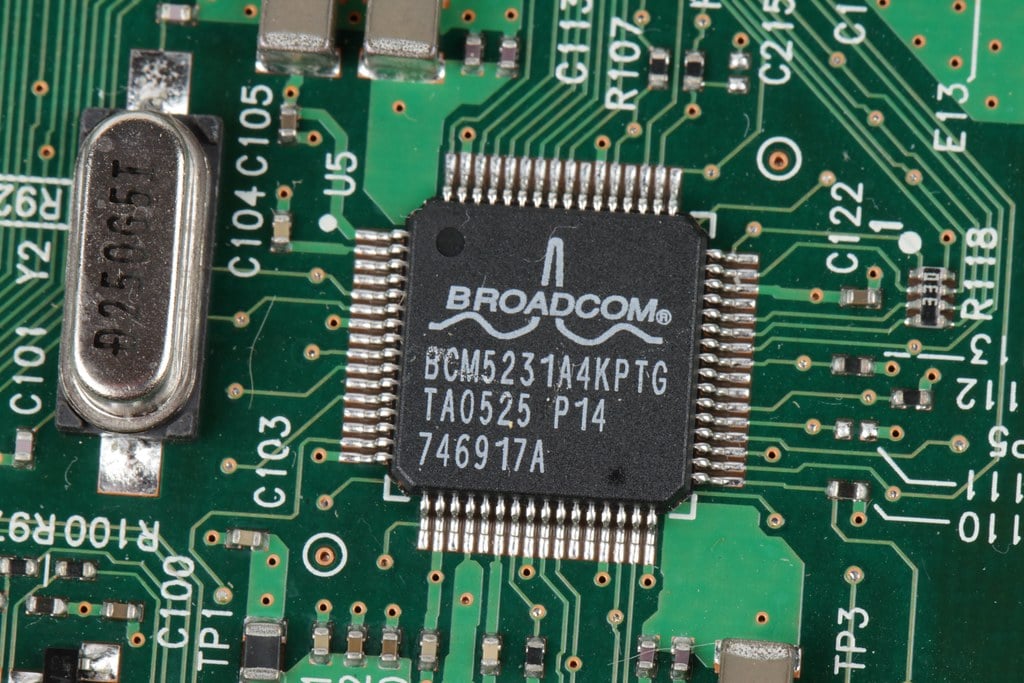
I keep buying Broadcom. Every paycheck, every meaningful dip, every time the market gives me another shot below $400, I take a hard look at adding more.
Broadcom (NASDAQ: AVGO) closed Friday, Aug. 14, at $392.99 after falling 5.94% that day. That puts it right back in the range where I have been willing to buy. The drop itself does not make the stock cheap, but it gives me another chance to add to a business whose AI strategy still looks stronger to me than the share-price volatility suggests.
I Am Buying More Than One AI Chip
My Broadcom thesis is still simple: I am not buying one AI chip. I am buying a company that can make custom AI accelerators and also sell the networking silicon that connects enormous clusters together. Broadcom’s AI portfolio spans custom XPUs, Tomahawk Ethernet switches, Jericho products, optics and other connectivity. Some of the biggest AI developers are also choosing hardware tailored to their own workloads. Broadcom has put names behind that opportunity, announcing a 10-gigawatt accelerator collaboration with OpenAI and a multi-year partnership with Meta that began with more than 1 gigawatt of planned MTIA infrastructure. I like being exposed to both the compute and networking sides of the buildout rather than betting on only one piece of it.
The Cash Flow Matters as Much as the AI Story
The latest reported numbers are why I keep coming back. Broadcom’s fiscal second-quarter revenue was $22.19 billion, up 48% from a year earlier. AI semiconductor revenue reached $10.8 billion, up 143%, and management’s June guidance called for $16 billion of AI semiconductor revenue in fiscal Q3. The company also produced $10.26 billion of free cash flow in Q2, equal to 46% of revenue, while adjusted EBITDA was 69% of revenue. For retirees and near-retirees, I think the cash generation matters more than the AI headlines. Broadcom is paying a $0.65 quarterly dividend, and fiscal 2026 marks its 15th consecutive annual dividend increase. That does not make the stock low-risk, but it gives me a second reason to own it besides price appreciation.
Why I Keep Choosing Broadcom Alongside Nvidia
Nvidia is still the obvious comparison, and I own some. I just do not need Broadcom to beat Nvidia at GPUs for the investment to work. Broadcom’s role is different. Its custom accelerator business lets major customers design around their own needs, while its Ethernet portfolio connects those accelerators across increasingly large AI systems. The company also has a sizable infrastructure software business, including VMware, so this is not a pure-play semiconductor company. I am deliberately leaving the fast-changing forward P/E, PEG ratio and analyst-price-target claims out of my thesis. Those numbers can move quickly and depend on outside estimates. What I care about more is whether AI revenue keeps scaling, cash conversion remains strong and Broadcom continues winning multi-year deployments with large customers.
The Risk I Would Not Ignore With Retirement Money
The part I would not ignore, especially with retirement money, is concentration. Broadcom said its top five end customers represented about 45% of revenue in the quarter ended May 3, 2026. That is a lot of business tied to a small group, and the company warns that delayed orders, lower capital spending or customers developing competing products internally can make results swing. Broadcom also had $66.72 billion of outstanding debt at quarter-end, so I would not describe the balance sheet as spotless. Still, the customer opportunity is broadening: OpenAI, Meta and an AI infrastructure platform initially supporting Anthropic are now publicly tied to Broadcom technology. I am comfortable buying under $400, but I would treat it as a volatile growth holding, not as a replacement for the cash and high-quality fixed income a retiree may need for near-term spending.