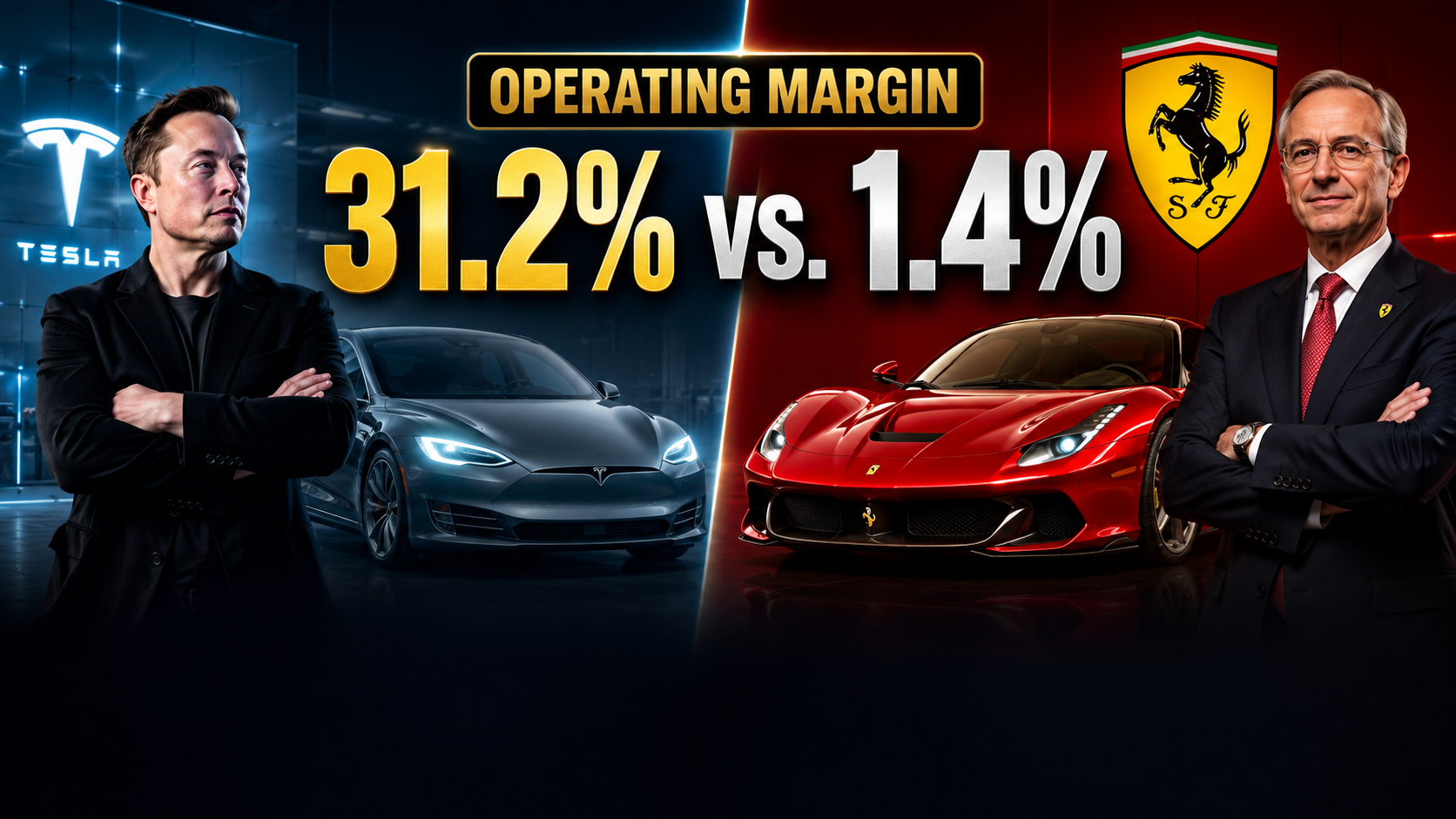
Elon Musk runs one of the biggest and most closely watched companies in the world. But if we narrow the comparison to the basic job of turning revenue into operating profit, Ferrari CEO Benedetto Vigna is running circles around Tesla right now.
Ferrari posted a 31.2% operating margin in the second quarter of 2026. Tesla’s was 1.4%. That puts Ferrari at more than 20 times Tesla on one of the cleanest measures of operating profitability. It does not prove Vigna is the “better” CEO, because Ferrari and Tesla are radically different businesses. But for investors deciding where their money has the better chance of compounding, that gap deserves attention.
The Profitability Gap Is Hard to Ignore
Start with the numbers Ferrari and Tesla actually report. Ferrari generated €1.94 billion in second-quarter revenue and €605 million in operating profit, producing a 31.2% operating margin. Tesla generated $28.24 billion in revenue, nearly 15 times Ferrari’s quarterly sales even before accounting for the currency difference, but produced just $398 million in operating income and a 1.4% margin. Tesla’s operating income fell 57% from the prior-year quarter even as revenue rose 26%. Ferrari’s operating profit, meanwhile, climbed 10% as revenue increased 8.4%. Ferrari is much smaller, but right now it is keeping far more of each revenue dollar as operating profit.
This is also why I prefer operating margin to the original return-on-equity comparison. Ferrari is executing a multi-year share repurchase program of roughly €3.5 billion through 2030, and buybacks reduce shareholders’ equity, which can mechanically lift return on equity. Operating margin sidesteps that issue. It asks a simpler question: after the operating costs of running the business, how much profit is left from sales? On that measure, Vigna’s Ferrari has an enormous lead.
Ferrari Has Something Tesla Cannot Easily Copy
Vigna took over Ferrari in September 2021 after 26 years at STMicroelectronics, where he had led its Analog, MEMS and Sensors Group. Hiring a semiconductor executive to run Ferrari sounded unconventional. In hindsight, the logic is easier to see as cars become more dependent on electronics, software, and sophisticated control systems. Ferrari Chairman John Elkann specifically pointed to Vigna’s understanding of technologies reshaping the auto industry when announcing his appointment.
But Vigna also inherited a business model that Musk cannot simply reproduce. Ferrari shipped only 3,366 vehicles in Q2, deliberately managing supply to preserve exclusivity. Tesla delivered 480,126 vehicles in the same quarter. Ferrari benefits from luxury pricing, expensive personalization options, and a customer base that is less price-sensitive than the mass automobile market. Its richer model mix and personalizations helped drive Q2 results even while vehicle shipments declined from a year earlier. Tesla is trying to manufacture hundreds of thousands of vehicles every quarter while simultaneously funding energy storage, autonomy, AI, Cybercab, and robotics. Those are two very different assignments.
Tesla Is Spending Heavily on a Much Bigger Bet
This is where the Musk argument gets interesting. Tesla’s weak current margin does not necessarily mean the spending is wasted. The company invested $5.79 billion in capital expenditures during Q2, up from $2.49 billion in Q1, while research and development expenses reached $2.37 billion. That spending helped push quarterly free cash flow to negative $1.09 billion, although Tesla still ended June with $43.5 billion of cash, cash equivalents, and short-term investments. Tesla also delivered a record second quarter for vehicles and deployed 13.5 gigawatt-hours of energy storage products.
So Tesla investors are effectively accepting much weaker profitability today in exchange for the possibility that spending on autonomy, robotics, energy, and new vehicles produces much larger earnings later. Ferrari’s plan is less dramatic. After its latest results, the company raised 2026 revenue guidance to about €7.6 billion and now expects at least €2.26 billion in adjusted operating profit, while its longer-term 2030 plan calls for an EBIT margin of at least 30%. Tesla offers the bigger swing. Ferrari currently offers the cleaner earnings machine.
The Better Company Is Not Automatically the Better Stock
This is the part investors cannot skip. A great business can still be a poor investment if you pay too much for it, and a company with weaker current profits can reward shareholders if future earnings grow far faster than expected. Ferrari also has risks. Its filings say higher U.S. import tariffs increased costs, foreign exchange movements hurt results, and the company is working through a planned model changeover. It is also entering a new technological chapter with the fully electric Ferrari Luce.
For retirees and near-retirees, that distinction matters even more. The question is not which CEO wins a scoreboard. It is whether the stock fits the amount of volatility and uncertainty your portfolio can absorb while still funding withdrawals and other retirement expenses. Ferrari’s margins are extraordinary, but RACE still carries equity-market risk. Tesla offers much greater scale and potentially larger future businesses, but shareholders are being asked to tolerate heavy investment and far thinner current operating profits. On the numbers, management can show us today that Vigna wins the profitability contest by a landslide. Whether that makes Ferrari the better investment from today’s price is a different question entirely.