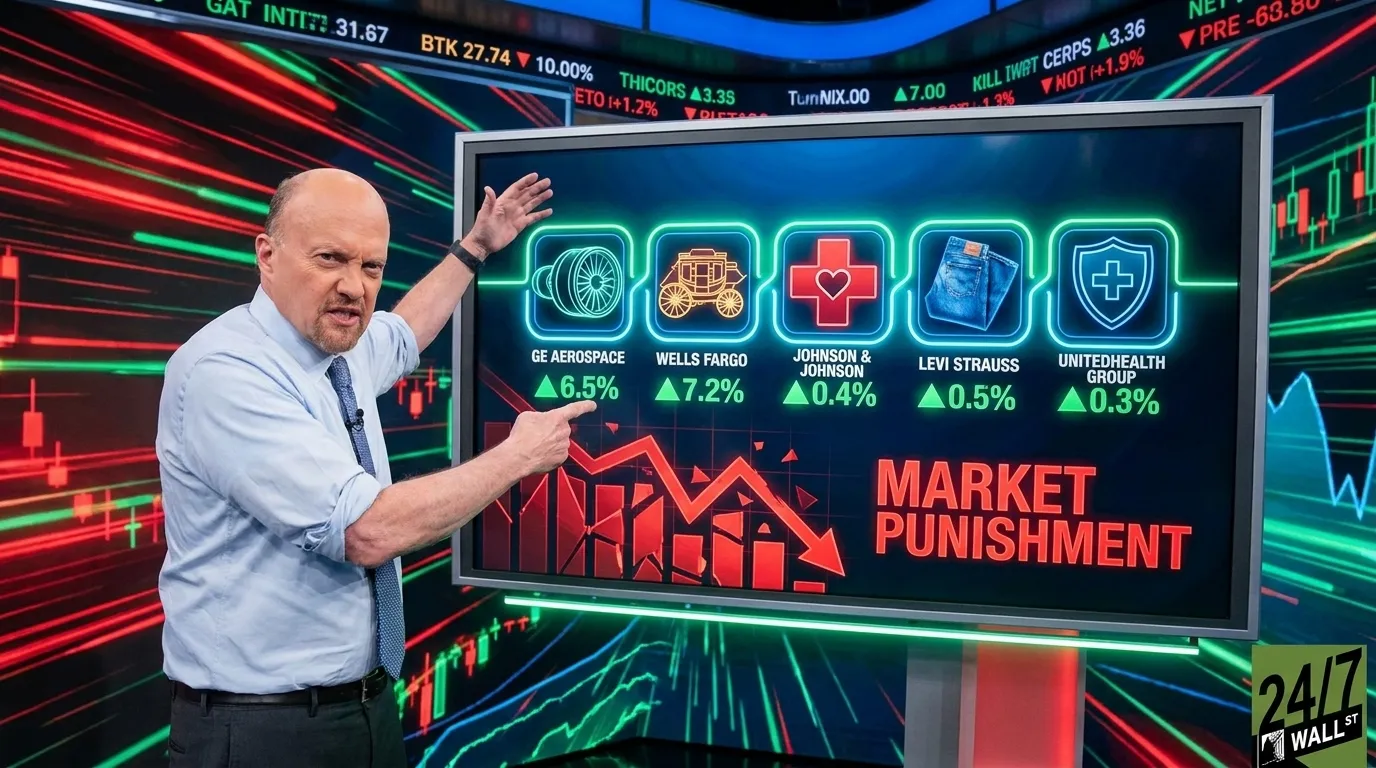
On Thursday, July 16, Jim Cramer used Mad Money to argue that investors were punishing several strong companies for the wrong reasons. His point was not that every stock falling after earnings deserves to be bought, but that the market can become overly focused on one disappointing metric while ignoring improving fundamentals across the rest of the business. That mattered on a day when the Dow slipped about 106 points, the S&P 500 fell 0.51%, and the Nasdaq dropped 1.47% as semiconductor and other growth stocks sold off. Cramer said that broad weakness dragged down several quality names that had recently reported encouraging results. He highlighted five stocks he believes Wall Street has misjudged: GE Aerospace, Wells Fargo, Johnson & Johnson, UnitedHealth Group, and Levi Strauss.
GE Aerospace: Strong Results Were Not Enough for Wall Street
GE Aerospace shares fell nearly 4% even though the company delivered another quarter of rapid growth and raised its full-year outlook. Second-quarter revenue climbed 21% to $13.3 billion, adjusted earnings reached $2.02 per share, and free cash flow increased 43% to $3.0 billion. Orders rose 17% to $16.5 billion, while management pointed to a backlog exceeding $210 billion that provides unusually strong visibility into future demand. Cramer believes investors placed too much emphasis on near-term margin pressure and supply-chain concerns while overlooking the strength of the commercial aviation cycle. He continues to view GE as one of the strongest institutional-quality aerospace holdings and believes the company’s enormous backlog, growing services business, and rising engine deliveries provide a much stronger investment case than the stock’s immediate reaction suggested.
Wells Fargo: Cramer Sees a Rebuilt Bank Trading Too Cheaply
Cramer described Wells Fargo as a bargain at roughly 12 times earnings, arguing that investors are still valuing the company as if its long restructuring has produced little progress. The bank’s second-quarter results told a stronger story. Diluted earnings rose 25% from a year earlier to $2.00 per share, revenue increased 9% to $22.6 billion, and return on tangible common equity climbed to 17.7%. Wells Fargo also repurchased $3.0 billion of stock during the quarter, while client assets in Wealth and Investment Management grew 15% to more than $2.4 trillion. Cramer believes Wall Street focused too narrowly on net interest income and margins. His broader thesis is that CEO Charlie Scharf has transformed Wells into a more diversified financial institution with stronger investment banking, markets, wealth-management, and commercial-banking operations.
Johnson & Johnson: One Weak Spot Overshadowed a Stronger Drug Portfolio
Johnson & Johnson develops medical devices, pharmaceuticals, and consumer packaged goods.
Johnson & Johnson sold off after investors focused on softness in part of its cardiovascular business, but Cramer argued that the reaction ignored the company’s larger growth story. J&J reported $25.31 billion in second-quarter sales and adjusted earnings of $2.90 per share, then raised its full-year outlook. Its pharmaceutical portfolio was especially strong: DARZALEX generated $4.21 billion in quarterly sales, TREMFYA reached $2.05 billion after growing more than 72%, and CARVYKTI climbed nearly 50% to $657 million. Cramer is also highly optimistic about ICOTYDE, the newly approved oral treatment for moderate-to-severe plaque psoriasis, which he believes could become one of the company’s most important products. J&J also marked its 64th consecutive year of dividend growth, reinforcing its appeal to long-term income investors.
UnitedHealth Group: Improving Margins Could Mark a Turning Point
UnitedHealth Group has spent much of the past year trying to restore investor confidence after elevated medical costs and operational problems pressured results. Its second-quarter report offered evidence that the recovery is gaining traction. Adjusted earnings came in at $6.38 per share, revenue reached $112.0 billion, and the medical care ratio improved to 86.7% from 89.4% a year earlier. Management raised its full-year adjusted earnings forecast to between $19.50 and $20.00 per share and reported $11.1 billion in operating cash flow. Those figures suggest that pricing changes, benefit redesign, and tighter medical-cost management are beginning to work. Cramer’s argument is that investors remain anchored to UnitedHealth’s recent setbacks and have not fully recognized how quickly earnings power could improve if the margin recovery continues through the second half.
Levi Strauss: Another Earnings Beat Met With More Skepticism

Levi Strauss has repeatedly posted better-than-expected results, yet its shares have often weakened immediately after earnings. Cramer believes that pattern has created a recurring opportunity. In its second fiscal quarter, Levi reported adjusted earnings of $0.28 per share, up 27% from a year earlier, while revenue increased 8% to approximately $1.6 billion. Direct-to-consumer sales rose 11% and represented 51% of total revenue, while e-commerce revenue jumped 19%. The company also raised its full-year sales and earnings outlook and increased its quarterly dividend. Cramer argues that investors continue to treat Levi as a slow-growing denim manufacturer rather than a broader lifestyle and direct-to-consumer company. He sees improving margins, women’s apparel, international growth, and the expanding Beyond Yoga brand as evidence that the transformation is working.
The Broader Message: Look Beyond the Market’s First Reaction
Cramer’s larger point is that the first move after an earnings report is not always the correct one. Stocks can fall because an analyst model missed one line item, traders were positioned for an even bigger beat, or investors sold an entire sector without separating the strongest companies from the weakest. That does not make every post-earnings decline a buying opportunity, and investors still need to consider valuation, debt, competition, and company-specific risks. However, Cramer believes GE Aerospace, Wells Fargo, Johnson & Johnson, UnitedHealth, and Levi Strauss all reported enough fundamental strength to justify a closer look. In each case, he sees Wall Street concentrating on a short-term concern while underestimating durable advantages such as backlog, improving profitability, stronger drug pipelines, cash generation, or expanding direct-to-consumer sales.