
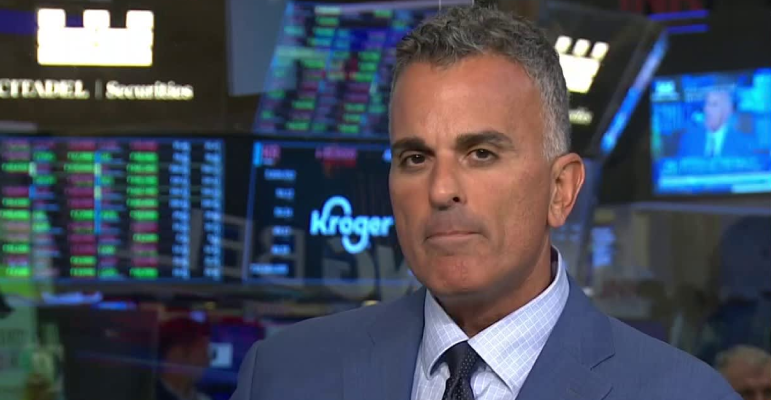
Joe Terranova just put one of the market’s biggest round numbers on the table. The senior managing director and chief market strategist at Virtus Investment Partners told CNBC that he thinks the S&P 500 can reach 10,000 within the next 18 months, adding, “I see no reason why not.” Terranova is not making that call from a bearish starting point either. The S&P 500 closed Monday at 7,745.06, meaning 10,000 would require another roughly 29% gain from there.
He is not alone in seeing more upside, although 10,000 is still an unusually aggressive near-term target. Yardeni Research recently raised its year-end 2026 S&P 500 target to 8,400. Evercore ISI strategist Julian Emanuel has also outlined a bullish 9,000 scenario, although Evercore’s previously stated base case was substantially lower at 7,750. In other words, Wall Street has become more optimistic, but there is still a big difference between expecting stocks to rise and expecting the index to add nearly 30% in a year and a half.
The Earnings Case Is Stronger Than the Round Number
Terranova’s strongest argument is not 10,000 itself. It is earnings. FactSet’s August 7 update said the S&P 500 was on pace for 50.4% year-over-year earnings growth in the second quarter, the strongest rate since Q2 2021 and the seventh straight quarter of double-digit earnings growth. There is an important wrinkle: Alphabet and Amazon included unusually large investment-related gains in reported earnings. Excluding those two companies, FactSet put Q2 growth at 32%, still a very strong number. The broader economy is growing too, but at a much slower pace. The Bureau of Economic Analysis estimates that real GDP increased at a 1.5% annual rate in Q2. That combination helps explain why stocks can keep climbing even when many households do not feel especially optimistic. It supports a bullish case. It does not prove the S&P 500 will land at 10,000 on a specific timetable.
Interest Rates Could Decide How Much Investors Pay for Those Earnings
The harder part of the forecast is valuation. The Federal Reserve’s current target range for the federal funds rate is 3.5% to 3.75%, down from 4.25% to 4.5% a year ago. Lower short-term rates can help stocks at the margin, but long-term borrowing costs have not followed the same path. The Treasury’s official 10-year par yield was 4.72% on August 17.
That matters because higher long-term yields give investors a more competitive alternative to stocks and can put pressure on the price investors are willing to pay for each dollar of future earnings. In plain English, corporate profits can keep growing while stock valuations still fall. That is the piece a 10,000 target cannot settle. A strong earnings cycle gives the market fuel, but the valuation investors assign to those profits will determine how far that fuel actually carries the index. For retirees, higher Treasury yields also mean there may be reasonable income opportunities outside stocks, which makes going all-in on an aggressive equity forecast even less necessary.

A Quiet Market Does Not Mean the Risks Disappeared
Terranova also argued that a quieter market is not automatically a reason to sell. There is some evidence of that calm in volatility markets. Cboe said the VIX fell to 14.25 last week, its lowest level of 2026 at that point. But low volatility is better treated as a description of current option pricing than as a promise about what comes next. By Monday, the VIX had already moved back above 15.
The more interesting contrast may be between markets and households. The University of Michigan’s preliminary August consumer sentiment index fell to 51.0 from 55.2 in July, and researchers specifically noted particularly large declines among older and lower-income consumers. Only 8% of respondents expected their income growth to beat inflation during the next year. Stocks are responding to earnings, interest rates and expectations about the future. Retirees are dealing with grocery bills, insurance, housing costs and healthcare expenses in the present. Those two realities can coexist for a long time, which is why a booming index does not automatically mean every household feels financially better off.
What a 10,000 Target Actually Means for Retirees
For retirees and near-retirees, a forecast like 10,000 is interesting, but it should not become a retirement plan. If the S&P 500 eventually gets there, investors with diversified equity exposure can participate without having to chase the target today. If it does not, someone who increased stock risk simply because of a bullish television call could be left with a portfolio that no longer matches the money they expect to spend during the next few years.
The SEC’s Investor.gov guidance says asset allocation should reflect an investor’s time horizon and tolerance for risk, and that rebalancing may be appropriate when market gains push a portfolio away from its intended mix. The SEC also notes that investors with shorter time horizons may prefer less volatile investments because they have less time to recover from market declines.
That is the useful takeaway from Terranova’s call. The earnings case deserves attention, and the market has real fundamental support behind the rally. But 10,000 is still a forecast, not a financial planning assumption. For someone already retired or preparing to retire, the sensible question is not, “How do I position everything for 10,000?” It is whether a long rally has quietly pushed stocks above the percentage of the portfolio you originally intended to own. If so, a bullish forecast may be a better reason to review the plan than to abandon it.