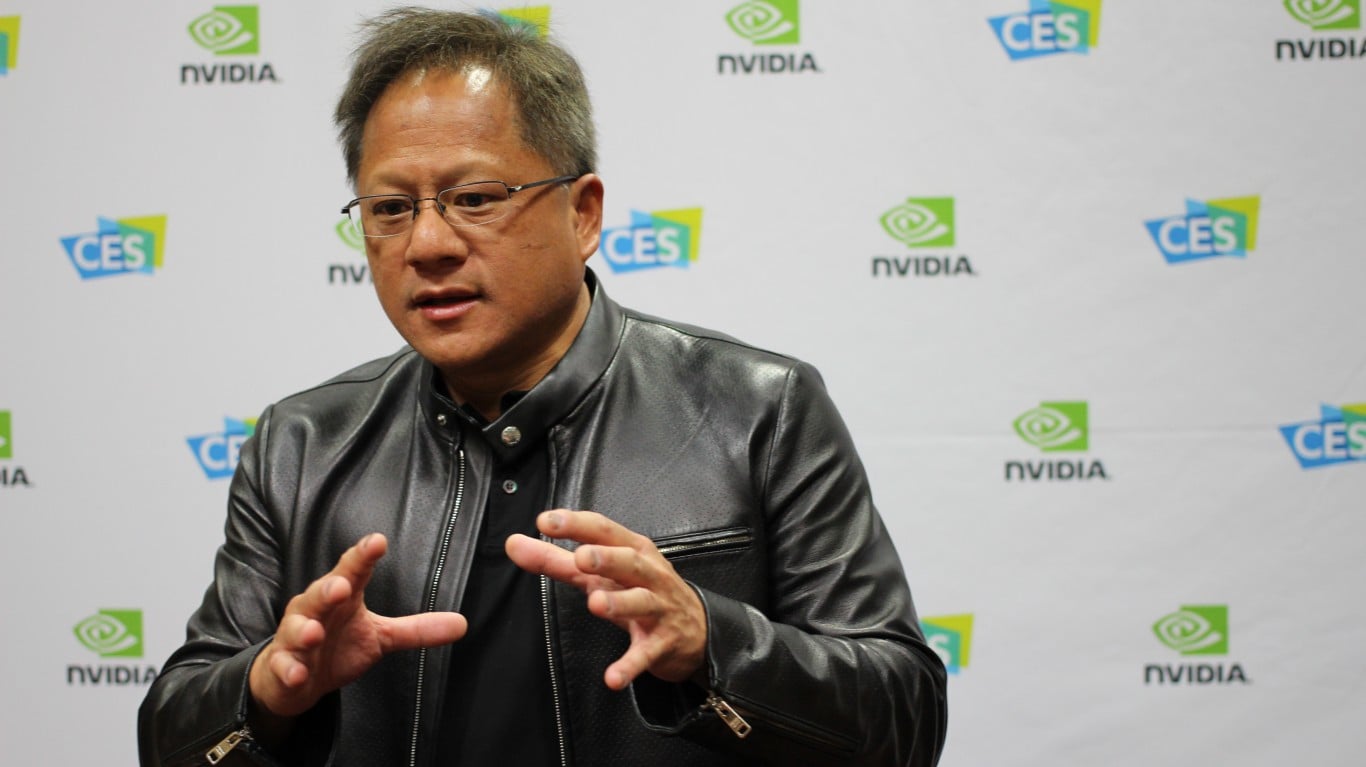
The clip making the rounds from Jensen Huang’s sit-down with Ezra Klein is the hard one: Gizmodo reported that Huang said if AI companies cannot contain their models, we have to shut the labs down. Benzinga followed on September 24, 2026 with a report describing Nvidia’s chief executive as saying unsafe AI labs should shut down. Read on its own, that sounds like a hardline safety position from the person whose company sells the picks and shovels for the entire AI build-out.
That framing flattens what Huang actually said. The New York Times published the Ezra Klein interview on September 23, 2026 under an opinion headline stating that Huang thinks AI alarmism has gone too far. Both things are his position at the same time, and the interesting move for investors is holding them together rather than picking one.
A Conditional Framing on Shutdowns
The shutdown line is a conditional inside a broadly anti-alarmist view. According to Gizmodo, Huang’s formulation is that “we have to shut the labs down” only if engineers cannot contain what they are building. Per the TBPN panel’s read, Huang used self-driving cars as an analogy: if labs can solve safety and alignment, it is purely an engineering challenge with a straightforward fix. If they cannot, the answer is equally clear.
The useful thing to draw out is what that does to the debate. Huang is reframing a philosophical argument as an engineering competence question. Engineers either know how to solve a problem or they do not, and the answer determines whether the company should be operating at all. That is a materially different standard from the one the regulatory conversation usually runs on, which tends to focus on rules, licenses, and disclosures rather than on whether the underlying engineering works.
What the TBPN Panel Added
The panel’s contribution was mostly context around how the interview was being covered. They noted that a recent CBS interview generated circulating clips focused on Huang’s leather jacket, while the Ezra Klein conversation went into more substantive AI safety territory. That is a small point but a real one: the version of Huang that goes viral is often not the version doing the thinking.
John Coogan handled the regulatory angle. He quipped that AI regulation should be accelerationist regulation to really frustrate everyone. More substantively, Coogan observed that blanket anti-regulation stances at events like All In may be playing right into the hands of those who want to see US AI development fail. The point being that a purely hands-off posture is itself a stance, and not obviously the safe one for US competitiveness.
Where Huang’s Framing Meets Pushback
The strongest pushback the panel raised is worth sitting with. They flagged that AI lab leaders including Dario Amodei have publicly acknowledged a collective action dilemma in which national competition with China pushes labs to move faster than they are comfortable with. If that dynamic is real, then Huang’s containment test extends beyond engineering. It also concerns incentives, because a lab that judges its own work unsafe may still ship on the theory that a rival will ship something worse.
That tension is worth leaving unresolved. Huang is asking whether the engineering works. The collective action framing is asking whether the engineering answer is the one that actually governs behavior when a rival is a few months behind.
Why an Investing Audience Should Care
The reason to notice this at all is structural. The head of the company selling the infrastructure that AI labs run on is proposing a test under which some of his own customers would, on his own logic, stop operating. He is also arguing that the alarm around the technology has run ahead of the evidence. Both of those are his views, they arrive together, and the coverage that carries only one of them is telling you less than half the story.