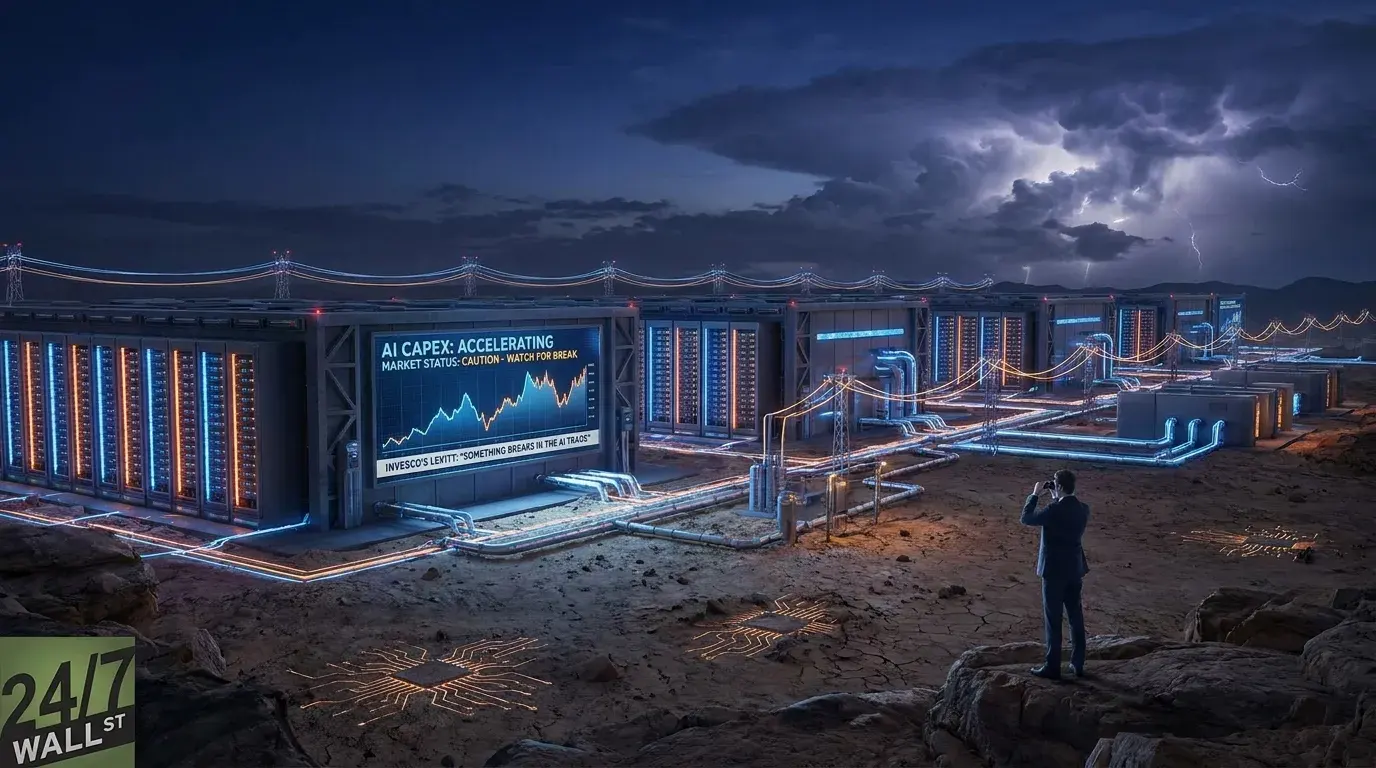
On Animal Spirits episode 483, Michael Batnick and Ben Carlson worked through a Financial Times interactive that maps how tightly wound the AI complex has become, covering Anthropic, OpenAI, Alphabet, Amazon, Meta, Microsoft, Oracle, SpaceX and NVIDIA (NASDAQ:NVDA | NVDA Price Prediction). Per the segment, the group’s combined market capitalisation runs to roughly $22 trillion to $25 trillion. Batnick noted that Bloomberg had run a headline calling it AI’s wobbly house of cards that puts markets and the US economy at risk.
Carlson’s Structural Pushback
Carlson led the counter. “Why couldn’t this essentially be, they are big enough and strong enough as companies to keep pushing through all of the worries people have?” His argument is structural, according to Animal Spirits Podcast. Per the segment, he pointed out that this buildout differs fundamentally from the railroad boom and the dot-com bubble because it is being financed by free cash flow and corporate debt at investment-grade balance sheets, not by retail investors levered into speculative equities. Who is writing the checks matters when sentiment turns, because forced sellers behave very differently from cash-rich compounders.
NVIDIA’s own Q2 FY27 disclosures lean into that framing. On the August earnings call, CEO Jensen Huang told analysts “AI is now doing productive and useful work” and “AI is generating profitable tokens.” Management guided fiscal 2028 revenue growth of approximately 70% and called the outlook “a supply-constrained outlook.”
Batnick on Valuation: Forward vs. Trailing
Batnick’s valuation point deserves precision. “The stock market is trading at a higher forward multiple than Nvidia,” he said, according to Animal Spirits Podcast. Per the segment, he pegged NVIDIA at just sixteen times forward earnings and used that to argue meaningful doubt about the AI trade is already sitting in the price.
Our own data shows NVIDIA’s trailing price-to-earnings ratio at 45, on a market capitalisation of $5,367,636,630,000. These are two different measures. A forward multiple uses expected future earnings; a trailing multiple uses reported past earnings. For a company whose profits are compounding quickly, the two can diverge enormously without either being wrong. We were not able to verify Batnick’s forward figure or the market’s forward multiple, so his comparison stands as his claim rather than as something we confirmed.
Three Endgames, One Underrated Middle
The hosts then walked through three possible outcomes, which per the segment they sourced from a query to an AI assistant rather than from formal research. Take them for what they are.
- A trillion-dollar return on AI capex that vindicates the bull market.
- A commoditisation outcome, where the technology works and the broader economy benefits, but the hyperscalers do not capture the gains.
- A growth shortfall that triggers writedowns across the stack.
The middle path is the most interesting and the least discussed. An outcome where AI delivers and the companies building it still fail to earn adequate returns on invested capital is a very different animal from a bubble popping. Most commentary collapses those two into one.
Cash Flow Backdrop
Per the segment, a consensus estimate attributed to Torsten Slok projects hyperscaler operating cash flow growing from $600 billion in 2025 to $2 trillion in 2030. That is the pool of internally generated capital Carlson was pointing at when he said this cycle is being funded differently, and it is also what keeps flowing to the power, cooling, and networking suppliers behind the buildout (we rounded up seven of those non-chipmaker names in a free report here).
Assume the Market Is Worried Too
Batnick closed with the line that carries the argument. “Whatever you’re worried about, just assume that the market’s worried too.” Per the segment, he paired it with Bill Miller’s line that the market does his worrying for him, according to Animal Spirits Podcast. The widely-circulated bear case is, almost by definition, the one already reflected in prices. That is a statement about market efficiency, not a prediction, and it is the frame worth walking away with.