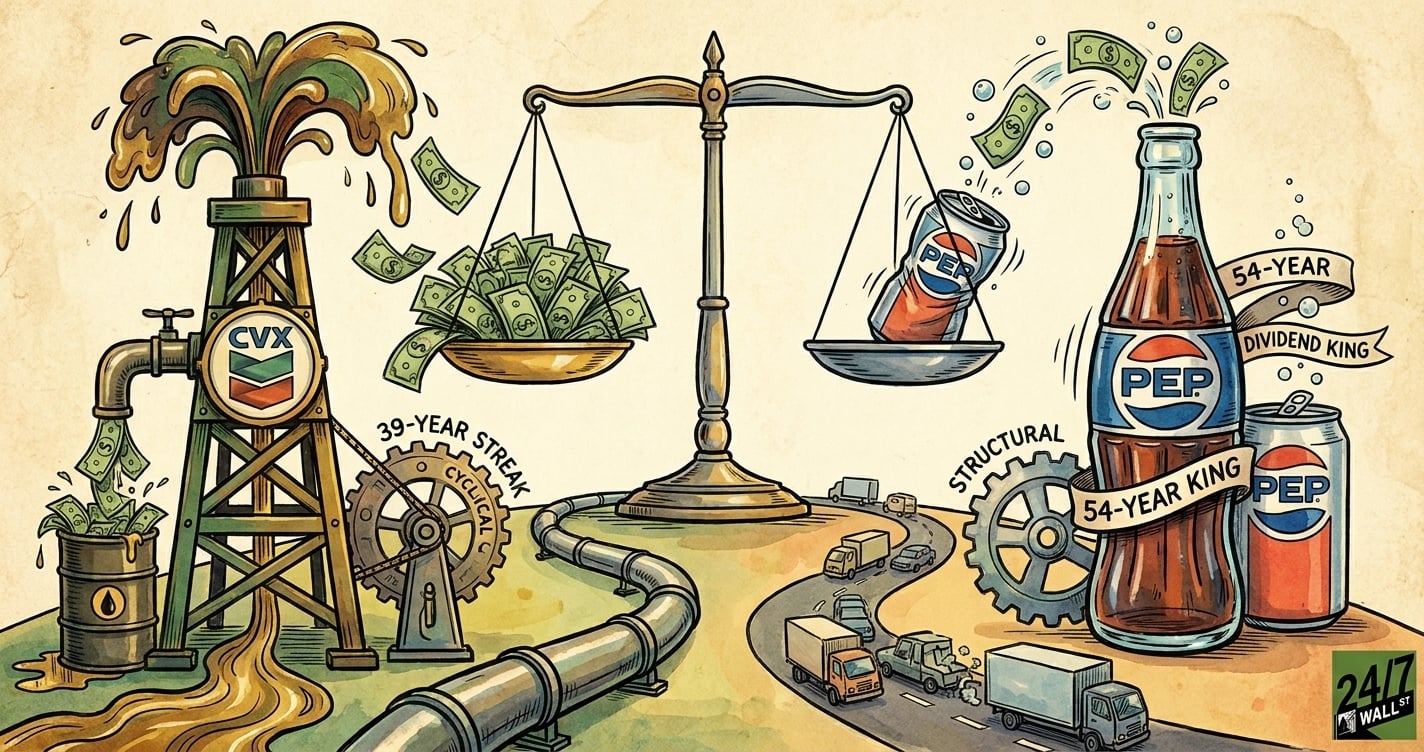
Chevron (NYSE:CVX | CVX Price Prediction) and PepsiCo (NASDAQ:PEP) are the kind of companies income investors often buy and intend to hold for years. Chevron raised its dividend for the 39th consecutive year in 2026, while PepsiCo marked its 54th straight annual increase, putting it in the group investors commonly call Dividend Kings. But a long streak does not tell you how much room a company has to keep paying and raising its dividend.
Right now, the two payouts face very different pressures. Chevron’s cash flow can swing dramatically with oil and natural-gas prices, but its latest quarter produced a large cash cushion and rapid debt reduction. PepsiCo has a steadier underlying business, yet its dividend absorbs a much larger share of recent free cash flow. For retirees who rely on dividends for part of their spending, that distinction is more useful than simply choosing whichever stock has the longer streak or higher yield.
Chevron Has the Bigger Cash-Flow Cushion Today
Chevron’s second quarter made its dividend coverage look considerably stronger than it did at the end of 2025. The company reported $12.1 billion in earnings and $12.0 billion in adjusted earnings, or $6.06 per share. Operating cash flow reached $22.63 billion. Chevron reported $18.1 billion of free cash flow and $15.4 billion of adjusted free cash flow, while returning about $6.5 billion to shareholders through dividends and buybacks. Net debt to trailing operating cash flow improved to 0.6 times, and management said debt declined by more than $8 billion during the quarter.

The Hess acquisition is helping. Chevron says the acquired assets are generating free cash flow at roughly twice the incremental dividend obligations associated with the deal, while the company reached $1.5 billion in annual run-rate synergies sooner than originally planned. None of that makes Chevron’s payout immune to an oil downturn, but it gives management more room today than the company’s 2025 earnings alone might suggest. Chevron paid $12.8 billion in dividends during 2025 against $16.6 billion of company-defined free cash flow.

PepsiCo’s Dividend Uses Much More of Its Available Cash
PepsiCo’s business is less tied to commodity cycles, but its cash-flow cushion is tighter. Second-quarter revenue reached $24.18 billion and core EPS was $2.20. Core operating margin slipped from 17.2% to 16.8%, although first-half operating cash flow improved to $2.37 billion from just under $1 billion a year earlier. PepsiCo Foods North America also gained volume market share, but quarterly revenue in that business declined 2% as lower pricing offset the benefit of volume initiatives. Management nevertheless affirmed its full-year 2026 financial guidance.
| Dividend Durability Lens | Chevron | PepsiCo |
| 2025 operating cash flow | $33.9B | $12.1B |
| 2025 company-reported free cash flow | $16.6B | $8.2B |
| 2025 dividends paid | $12.8B | ~$7.6B |
| 2025 net income | $12.3B | $8.24B |
| 2026 annualized dividend/share | $7.12 | $5.92 |
The difference becomes clearer over a full year. PepsiCo generated $8.2 billion of company-defined free cash flow in 2025 while dividend payments were roughly $7.6 billion, leaving much less room after the dividend than Chevron had. PepsiCo expects about $7.9 billion of dividend payments in 2026, plus roughly $1 billion of share repurchases. That does not mean a dividend cut is around the corner. PepsiCo has continued to generate substantial cash and raised its annualized payout 4% this year. It does mean future dividend growth depends more heavily on stronger cash-flow growth than the 54-year streak alone might imply.
The Risks Are Different: Oil Prices vs. Consumer Pressure
Chevron’s weakness is straightforward: its cash machine is much more sensitive to energy prices. The latest EIA outlook, released Aug. 11, projects Brent crude averaging about $87 a barrel for 2026 before falling to $69 in 2027. A sharper or more prolonged decline would reduce Chevron’s cash flow and could force management to choose between capital spending, share repurchases, debt reduction and dividend growth. The encouraging part for income investors is that buybacks are discretionary. Chevron can reduce repurchases before touching a dividend that management has now increased for 39 consecutive years.
PepsiCo’s pressure is less dramatic but potentially more persistent. Management has discussed a weaker-than-expected U.S. consumer, higher gasoline prices squeezing household budgets and softer purchases through convenience and gas-station channels. At the same time, PepsiCo is spending on affordability initiatives to encourage consumers to buy more. That can help volumes but can also pressure margins. For a retiree looking at PepsiCo’s dividend, the number to watch is not one quarter’s snack volume. It is whether annual free cash flow begins growing comfortably faster than the roughly $7.9 billion PepsiCo expects to distribute as dividends this year.
Which Dividend Looks Safer for Retirement Income?
On today’s numbers, Chevron has the larger cash-flow cushion. Its second-quarter cash generation was unusually strong, debt moved lower and its 2025 free cash flow exceeded dividends by several billion dollars. PepsiCo’s dividend is still supported by the business, but the margin between annual free cash flow and dividend payments is much narrower. That makes PepsiCo’s payout more dependent on earnings and cash-flow growth improving over time. Its higher dividend yield can be attractive to income investors, but a higher yield should never be confused with stronger dividend coverage.
There is an important trade-off. Chevron’s cushion can shrink quickly if oil prices fall, while PepsiCo sells products consumers tend to buy through economic cycles. That makes this less a choice between a “safe” and “unsafe” dividend than a choice between two kinds of risk. For retirees who prize current financial flexibility, Chevron looks stronger right now. Investors who prefer PepsiCo’s less cyclical business should watch free cash flow and margins closely before assuming its 54-year history guarantees the next 54. Dividends at both companies remain subject to board approval, and neither company’s past streak guarantees future payments.

