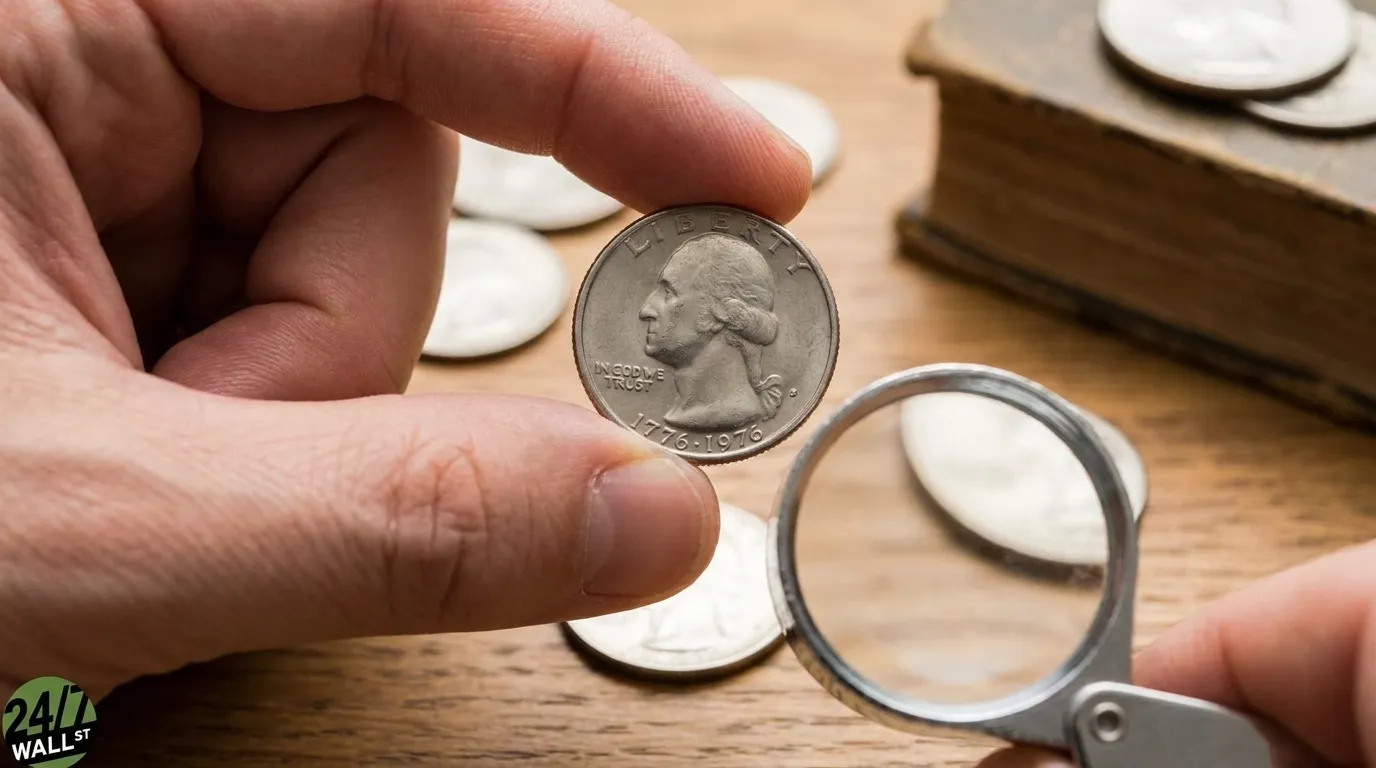
A Bicentennial quarter really did sell for $19,200, but that does not mean the 1776-1976 coin sitting in a kitchen drawer is worth thousands. The record-setting example was a 40% silver San Francisco quarter in an almost impossibly high grade, not an ordinary coin pulled from circulation. More than 1.66 billion copper-nickel Bicentennial quarters were struck for general use, and most worn examples remain worth exactly 25 cents. Fortunately, the first screening takes only a few seconds. The mintmark can eliminate nearly every common coin immediately, while the edge, condition and original packaging can tell you whether an “S” quarter deserves a closer look.
Start With the Mintmark Beside Washington’s Ponytail
Hold the quarter with George Washington facing you and look just to the right of his ponytail, below “IN GOD WE TRUST.” That small space may contain a “D,” an “S” or no letter at all. A coin without a mintmark was made in Philadelphia, while a “D” identifies Denver and an “S” identifies San Francisco. This is the fastest useful check because the record $19,200 coin was a 1976-S silver issue. If your circulated quarter has no mintmark or carries a “D,” it is the standard copper-nickel version and can usually be returned to the change jar. If it has an “S,” do not assume you found silver or a jackpot. San Francisco produced both copper-nickel proof quarters and 40% silver collector quarters, so the mintmark opens the next step instead of settling the question.
No Mintmark or a “D” Usually Means 25 Cents
Philadelphia struck 809,784,016 copper-nickel Bicentennial quarters, and Denver produced another 860,118,839. Together, that is more than 1.66 billion coins intended for circulation. A worn example with no mintmark or a “D” is therefore common and normally worth face value. Exceptional errors, recognized die varieties and nearly flawless certified coins can be valuable, but those are separate numismatic categories that cannot be identified simply because the reverse shows a colonial drummer. The Denver issue has produced a headline-grabbing $6,463 auction record for an MS68 example, but that coin was at the top of the certified condition scale, not typical pocket change. For most readers, a no-mintmark or Denver quarter with scratches, dull surfaces or obvious wear fails the high-value test immediately.

An “S” Means Investigate Further, Not Start Celebrating
Every 40% silver Bicentennial quarter was struck in San Francisco and carries an “S,” but not every quarter with an “S” is silver. The San Francisco facility also made copper-nickel proof quarters for collectors. That distinction matters because a clad proof may have mirrorlike surfaces and sharp details while still containing no silver. The 40% silver quarters were originally sold in special three-coin sets containing a quarter, half dollar and dollar. Uncirculated sets came in blue packaging, while proof sets were sold in red packaging. Original government packaging is strong evidence, but loose collector coins are frequently separated from their sets. A silver example can even be spent accidentally and enter circulation, so finding one in change is unlikely rather than impossible. Treat the “S” as a reason to inspect the coin, not proof of composition or value.
Use the Edge as a Clue, but Do Not Trust It Alone
Turn the coin sideways under good light and examine the reeded edge. A normal copper-nickel quarter usually shows a conspicuous orange or brown copper stripe running through its center. A 40% silver-clad quarter generally appears grayer and less coppery, although toning, wear and lighting can make the difference harder to judge. Weight is not a perfect household test either. PCGS lists the regular copper-nickel quarter at 5.67 grams and the 40% silver issue at 5.75 grams, a difference of only 0.08 gram. Many inexpensive scales are not precise enough to make that distinction reliably, and normal manufacturing tolerances or wear can blur it further. When the mintmark, edge and appearance point toward silver, confirm the coin through original packaging, a reputable dealer, professional composition testing or a recognized grading service before assigning a value.
The $19,200 Quarter Was an Extraordinary MS69 Coin
The famous auction result came from a 1976-S 40% silver regular-strike quarter graded MS69 by Professional Coin Grading Service. Heritage Auctions sold it for $19,200 during its June 2019 Long Beach sale. The “MS” designation means Mint State, while the number falls on the 70-point Sheldon grading scale. An MS69 coin is expected to be almost perfect even under magnification, with exceptional luster, an excellent strike and virtually no distracting marks. That is radically different from a shiny coin that merely looks good to an untrained eye. PCGS lists a mintage of 11 million for the silver regular strike, so the issue itself is not rare. The scarcity exists at the extreme top of the condition scale. The auction buyer paid for preservation and certified grade, not simply for the Bicentennial date or silver content.
| Verified Detail | 1976-S Silver Regular Strike |
|---|---|
| Composition | 40% silver and 60% copper |
| PCGS-listed weight | 5.75 grams |
| PCGS-listed mintage | 11,000,000 |
| Auction-record grade | PCGS MS69 |
| Record auction result | $19,200 at Heritage Auctions in June 2019 |
| Later MS69 result | $6,600 at Heritage Auctions in December 2021 |
One Grading Point Can Separate a Collectible From a Trophy
Modern coins create a difficult market because the difference between adjacent elite grades may be nearly invisible without training and magnification. An MS67 or MS68 Bicentennial quarter can be attractive and genuinely uncirculated, yet an MS69 example occupies a much thinner part of the market. Registry-set collectors compete for the finest certified coins, which can push one top-grade specimen far beyond the value of thousands of ordinary examples. Population reports also require caution. They can change as additional coins are graded and may be affected when the same coin is resubmitted in hopes of receiving a higher grade. PCGS currently describes the silver quarter as common in circulated grades, scarce in MS68 or higher and exceptionally scarce in MS69, with no finer example listed. That is the real source of the five-figure headline.
The Second MS69 Sale Fell Nearly 66%
The $19,200 result should be treated as an auction record, not a guaranteed market price. In December 2021, Heritage sold another PCGS-graded MS69 example for $6,600. That was $12,600 below the 2019 record, a decline of roughly 66% for a coin of the same date, composition and certified grade. The difference does not mean either sale was illegitimate. Rare-coin auctions can be influenced by the appearance of a particular specimen, the number of determined bidders, registry competition, market sentiment and the timing of the sale. It does show why the phrase “worth $19,200” needs context. One buyer paid that amount for one extraordinary coin on one day. Owners should examine several completed sales and current dealer bids instead of treating the highest result ever recorded as the automatic value of every comparable coin.
What Most Bicentennial Quarters Are Actually Worth
A circulated Philadelphia or Denver quarter is generally worth 25 cents unless it has a recognized error or variety. Ordinary uncirculated clad coins may bring a modest premium, but enormous numbers were saved because the drummer design looked special from the day it appeared. A San Francisco clad proof can be collectible without being silver, and its value depends on condition, certification and whether it remains in an original set. A 1976-S 40% silver quarter has a base value tied to its metal content, with additional numismatic value possible for attractive uncirculated or proof examples. The large prices begin only when professional grading places a coin near the very top of the scale. Cleaning, polishing or rubbing a coin can destroy that premium, so leave any promising example untouched and hold it by the edges.
| Quarter Type | Quick Identification | Practical Value Guidance |
|---|---|---|
| Philadelphia circulation strike | No mintmark and a copper-nickel edge | Usually 25 cents when circulated |
| Denver circulation strike | “D” mintmark and a copper-nickel edge | Usually 25 cents when circulated |
| San Francisco clad proof | “S” mintmark, proof surfaces and copper-nickel composition | Collector value varies, but it is not silver |
| San Francisco 40% silver | “S” mintmark with silver-clad composition | Metal value plus any condition premium |
| Certified elite-grade example | Authenticated holder showing a very high numerical grade | Use recent completed sales for that exact type and grade |
Calculate the Silver Value Without Dating the Article
A 40% silver Bicentennial quarter contains approximately 0.0739 troy ounce of silver. To estimate its theoretical melt value, multiply the current silver price per troy ounce by 0.0739. If silver were trading at $60 per ounce, for example, the calculation would produce about $4.43 in silver content. That is not necessarily what a dealer will pay. Buyers need room for refining costs, market risk and profit, while collectors may pay more for an attractive coin in original packaging. Silver prices can also move sharply from one day to the next, which is why a fixed dollar figure becomes outdated quickly. The formula is more useful than a stale quote. It also makes the scale of the record clear: the $19,200 result came almost entirely from condition rarity and collector competition, not the amount of precious metal in the coin.
Do Not Pay for Professional Grading Too Quickly
Third-party grading can authenticate a coin, identify its composition and protect it in a tamper-evident holder, but the process includes grading fees, shipping, insurance and possible membership or dealer costs. Those expenses make little sense for a worn quarter worth face value or a common silver example worth only a modest premium. Before submitting anything, inspect the mintmark and edge, compare the coin with certified photographs and ask a reputable coin dealer for an initial opinion. A coin taken from circulation will usually show contact marks, flattened high points or broken luster that prevent an elite Mint State grade. The $6,463 record for a Denver MS68 proves clad quarters can become valuable in extraordinary condition, but it does not make ordinary Denver coins grading candidates. Pay for certification only when the likely value comfortably exceeds the total cost.
Ignore Asking Prices and Study Completed Sales
Online marketplaces are filled with Bicentennial quarters listed for hundreds or thousands of dollars, often with dramatic claims about rare errors that have never been verified. An asking price records what a seller hopes to receive, not what a buyer has agreed to pay. Serious valuation begins with completed auction results for the same mint, composition, strike type, grading service and numerical grade. Even then, a record price should be compared with later sales, as the $19,200 and $6,600 MS69 results demonstrate. The practical process is simple: check the mintmark, inspect the edge, preserve any original packaging and avoid cleaning the coin. If it is a worn Philadelphia or Denver issue, it is probably worth 25 cents. If it is an “S” coin with convincing signs of silver or exceptional preservation, that is when a professional opinion becomes worthwhile.