Where we heard itCNBC’s “Halftime Report,” “Countdown to the Fed Decision,” Oct. 28, 2026, with Steve Liesman; and the Federal Reserve’s Oct. 28, 2026 policy statement.
The Federal Reserve kept its target range for short-term rates at 3.75% to 4% on Oct. 28, in a 10 to 2 vote. The two votes against came from Fed Governor Lisa Cook and Cleveland Fed President Beth Hammack, who both preferred to raise the range by a quarter point. Before the decision, CNBC’s Steve Liesman offered a way to read a split like that.
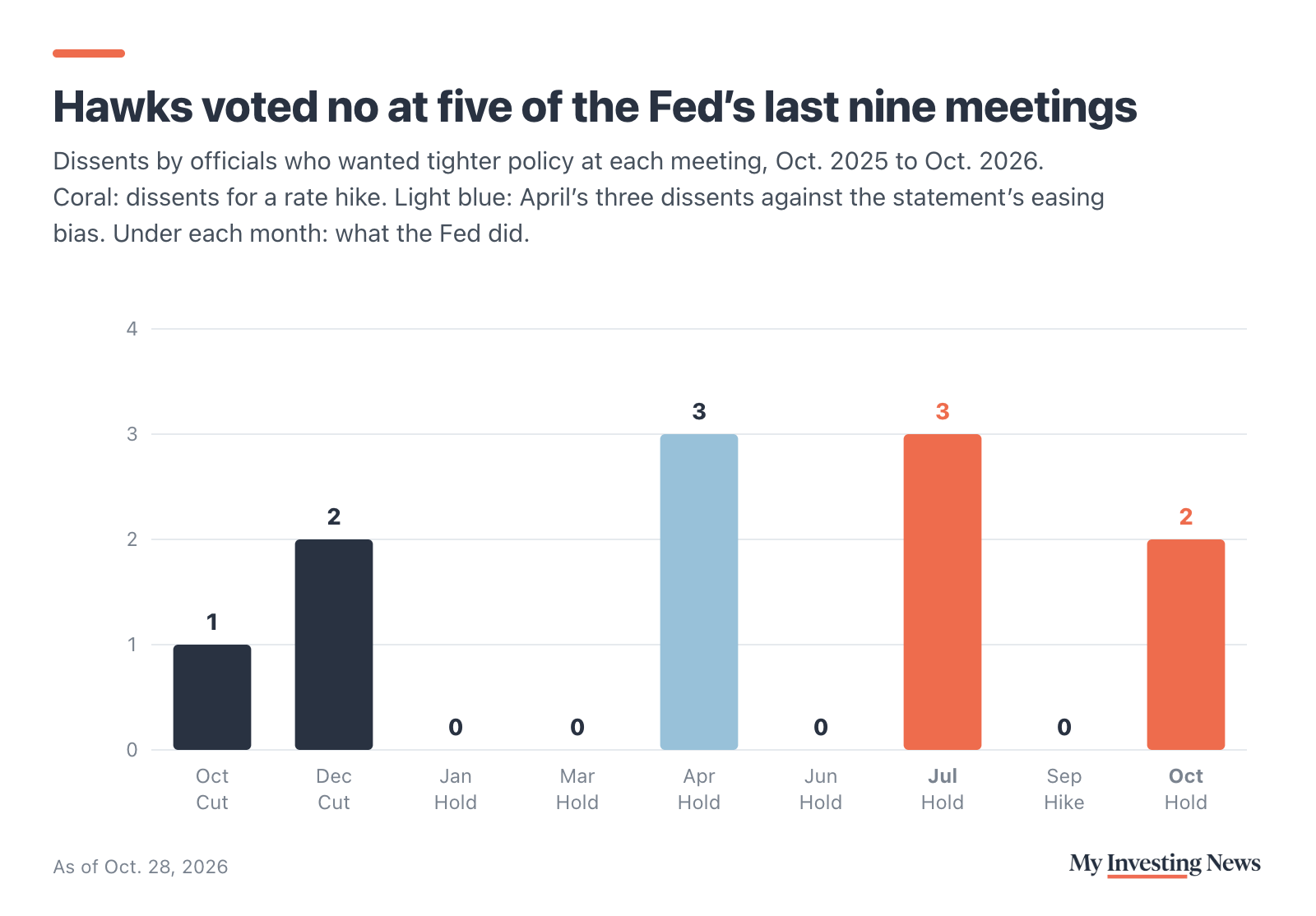
“Last time they led the way,” Liesman said on CNBC’s “Halftime Report.” “There were a couple dissents and then the Fed followed up with rate hikes after that.” His recent example holds up. On July 29, Hammack, Minneapolis Fed President Neel Kashkari and Dallas Fed President Lorie Logan dissented in favor of a quarter-point hike. On Sept. 16, the committee raised its target by a quarter point, 12 to 0. The Fed raised rates once, and the dissents came first.
A Year of Hawkish Votes
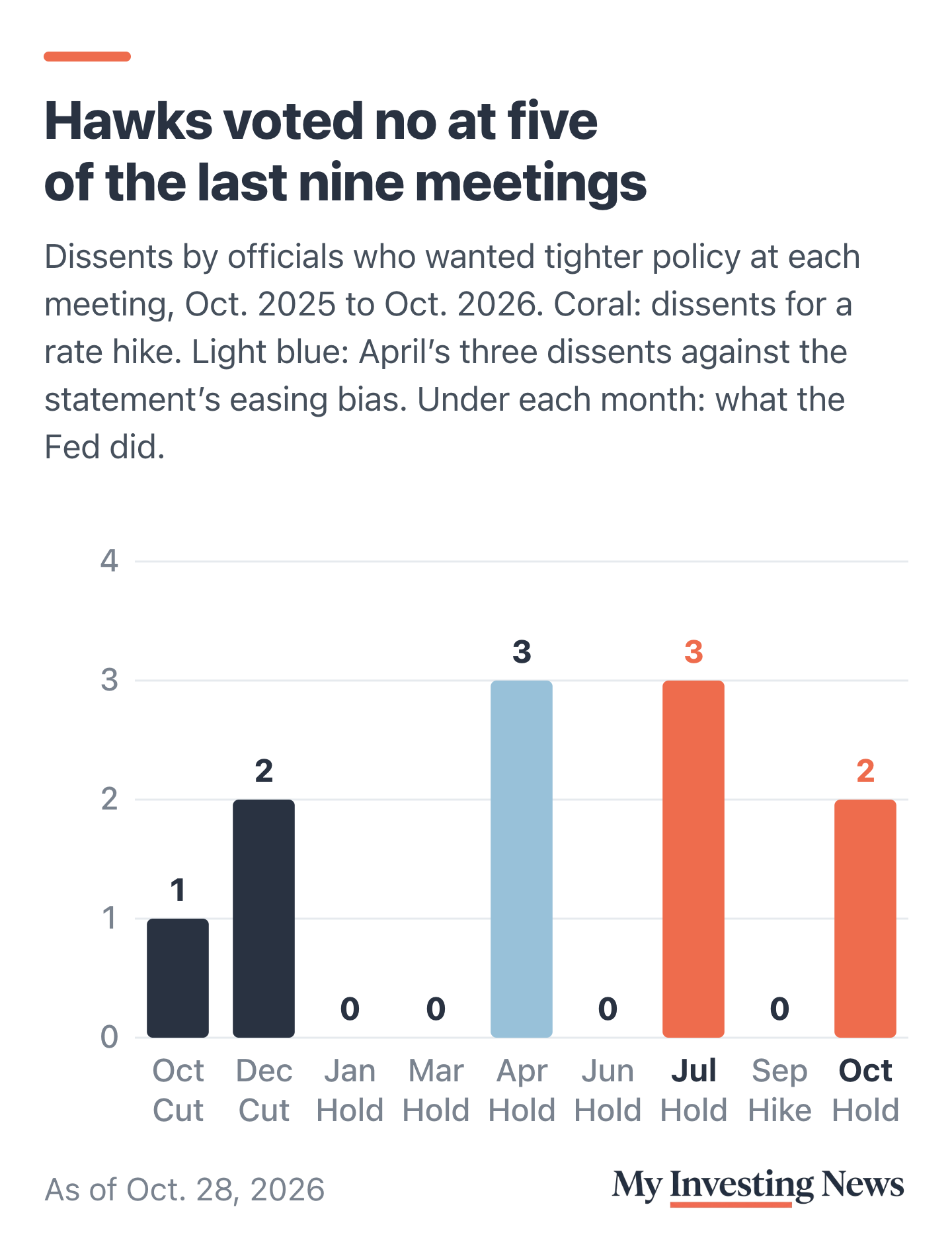
Votes against the majority from the hawkish side have become routine. Officials who wanted tighter policy dissented at five of the Fed’s last nine meetings. Kansas City Fed President Jeffrey Schmid opposed the cut in October 2025, and Chicago Fed President Austan Goolsbee joined him against the December 2025 cut. In April, Hammack, Kashkari and Logan backed the decision to hold but voted against the statement’s easing bias. Then came July and October.
October’s split was unusual in one way. By the St. Louis Fed’s count, Cook was the first Fed governor since John LaWare in December 1994 to dissent in favor of tighter policy at a meeting where the Fed held rates. Hammack has now cast hawkish dissents at three meetings this year. On the other side, Stephen Miran voted for cuts at the January, March and April meetings, and has since left the Fed arguing that it risks hiking into price spikes that will fade on their own.
Scoring Every Hawkish Dissent Since 1990
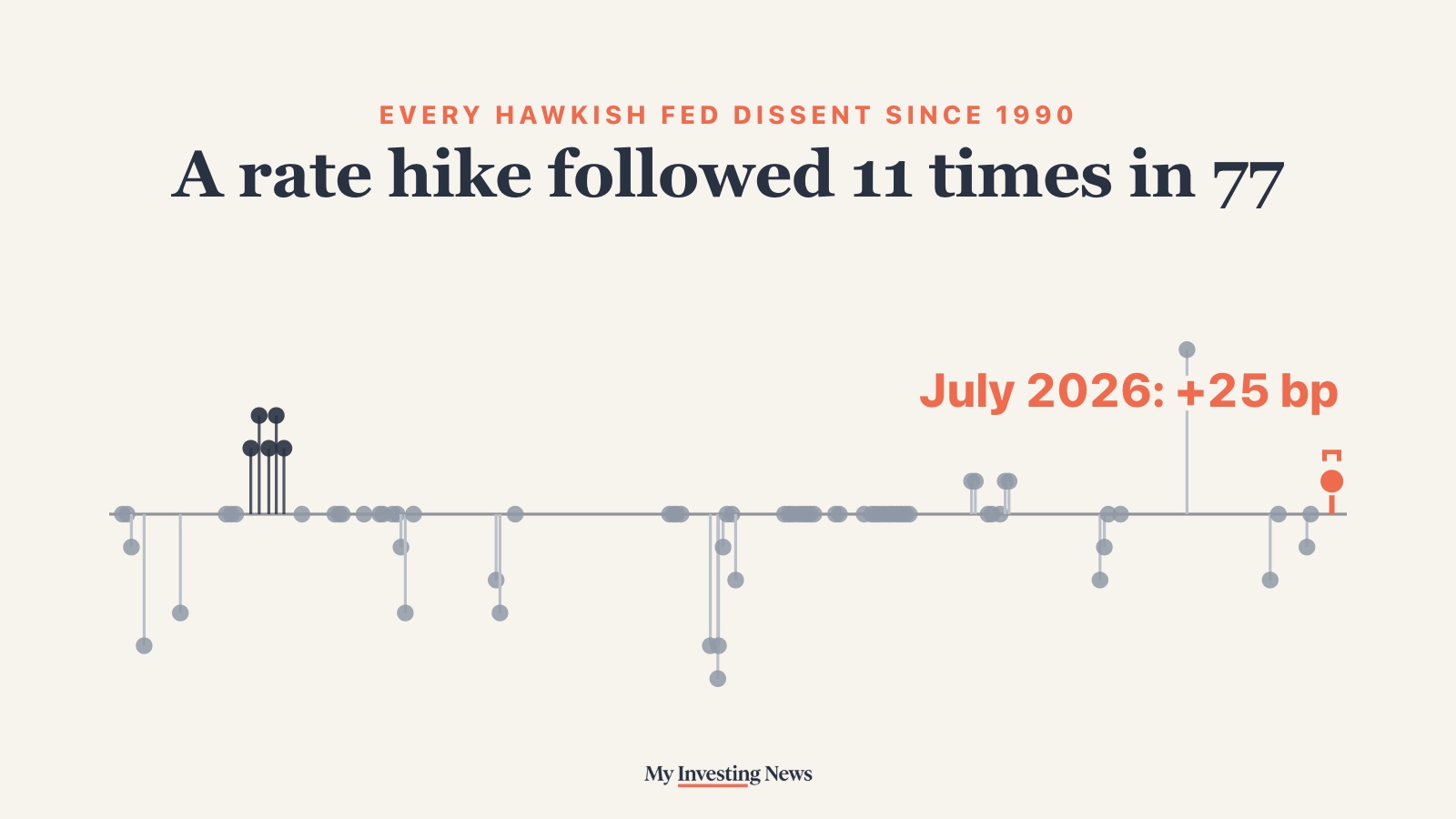
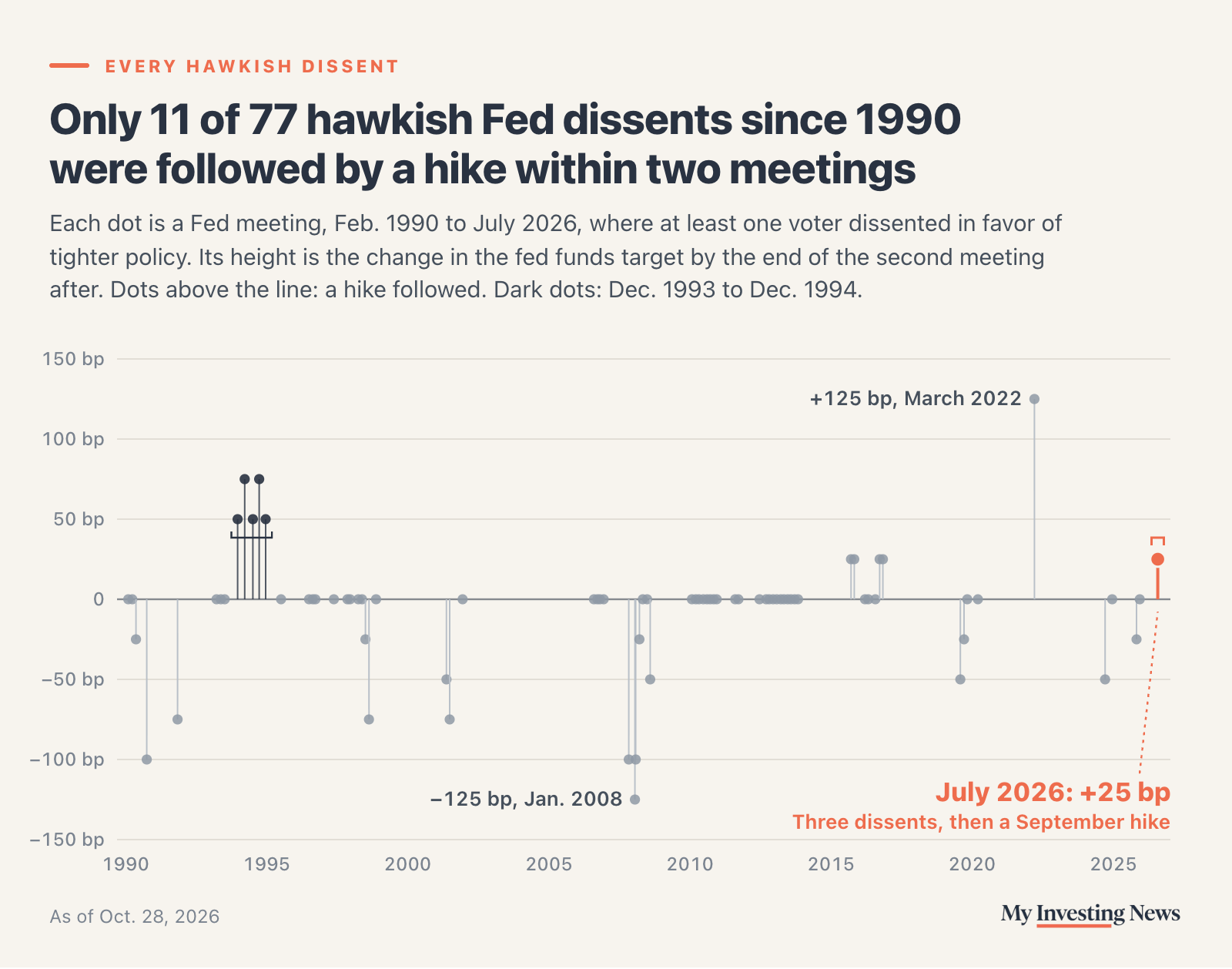
To test whether dissents lead the way, we used the St. Louis Fed’s record of every FOMC dissent, which classifies each one as favoring tighter policy, easier policy or neither and was last updated Oct. 30. Since January 1990, at least one voter dissented in favor of tighter policy at 78 meetings. For the 77 that have two meetings after them, we checked whether the Fed raised its target at any point from the day after the dissent through the second meeting that followed, including moves between meetings.
It did 11 times out of 77, or 14%. Most of the misses came from a lone hawk the committee outvoted for months. Kansas City Fed President Thomas Hoenig dissented at all eight meetings of 2010, and Esther George, his successor, dissented seven times in 2013. Neither saw a hike within two meetings. Richmond Fed President Jeffrey Lacker dissented four times in a row in 2006, after the Fed’s last hike of that cycle in June. The Fed’s next move was a cut, in September 2007.
Another 19 of the dissents came while the Fed was cutting, from officials who wanted a smaller cut or none. The Fed did not raise rates within two meetings after any of them.
Hawkish dissents and what followed, as of Nov. 10, 2026
When Dissents Led the Way
The hit rate rises when several hawks dissent at once while the Fed holds. That has happened at 10 meetings since 1990, and a hike followed within two meetings 4 times: December 1993, when Governors Wayne Angell and Lawrence Lindsey dissented ahead of the first hike of 1994; September and November 2016, ahead of that December’s hike; and July 2026. The other six multiple-dissent meetings, in 1990, 1993, 1998 and 2011, were followed by no hike.
The 11 hits came in four clusters: 1993 to 1994, 2015 to 2016, March 2022 and this July. Each came just before or during a run of rate increases. From December 1993 through December 1994, all five meetings with a hawkish dissent were followed by a hike within two meetings, as the Fed doubled its target from 3% to 6% between February 1994 and February 1995.
What to Watch
The Oct. 28 dissents will be scored at the Fed’s next two meetings, Dec. 8 to 9 and Jan. 26 to 27. A hike at either would put them in the column with 1994 and this July. The Fed’s own outlook points that way. The minutes of the September meeting said “most participants assessed that another increase in the target range for the federal funds rate would likely be appropriate by year end.” How much to trust the Fed’s own outlook is a fair question, though our check of Benn Steil’s claim that the Fed forecasts worse than private economists found its inflation calls held up better than he said. In mid-October, Fed Chair Kevin Warsh also signaled he wasn’t rushing to hike.
Bettors are close to sure. As of 9:29 a.m. ET on Nov. 10, Polymarket put the odds of a quarter-point hike in December at 84.5% and of a half point or more at 12.3%, with 2.7% on no change. They gave 59.5% to a December decision with no dissents at all.
Liesman’s line fits the record: since 1990, hawkish dissents were followed by a hike within two meetings 11 of 77 times, and the hits came just before or during a run of rate increases. This year looks like one of those times. The risk is the other pattern, from 2006 and 2010, when the hawks kept dissenting and the Fed stayed put.