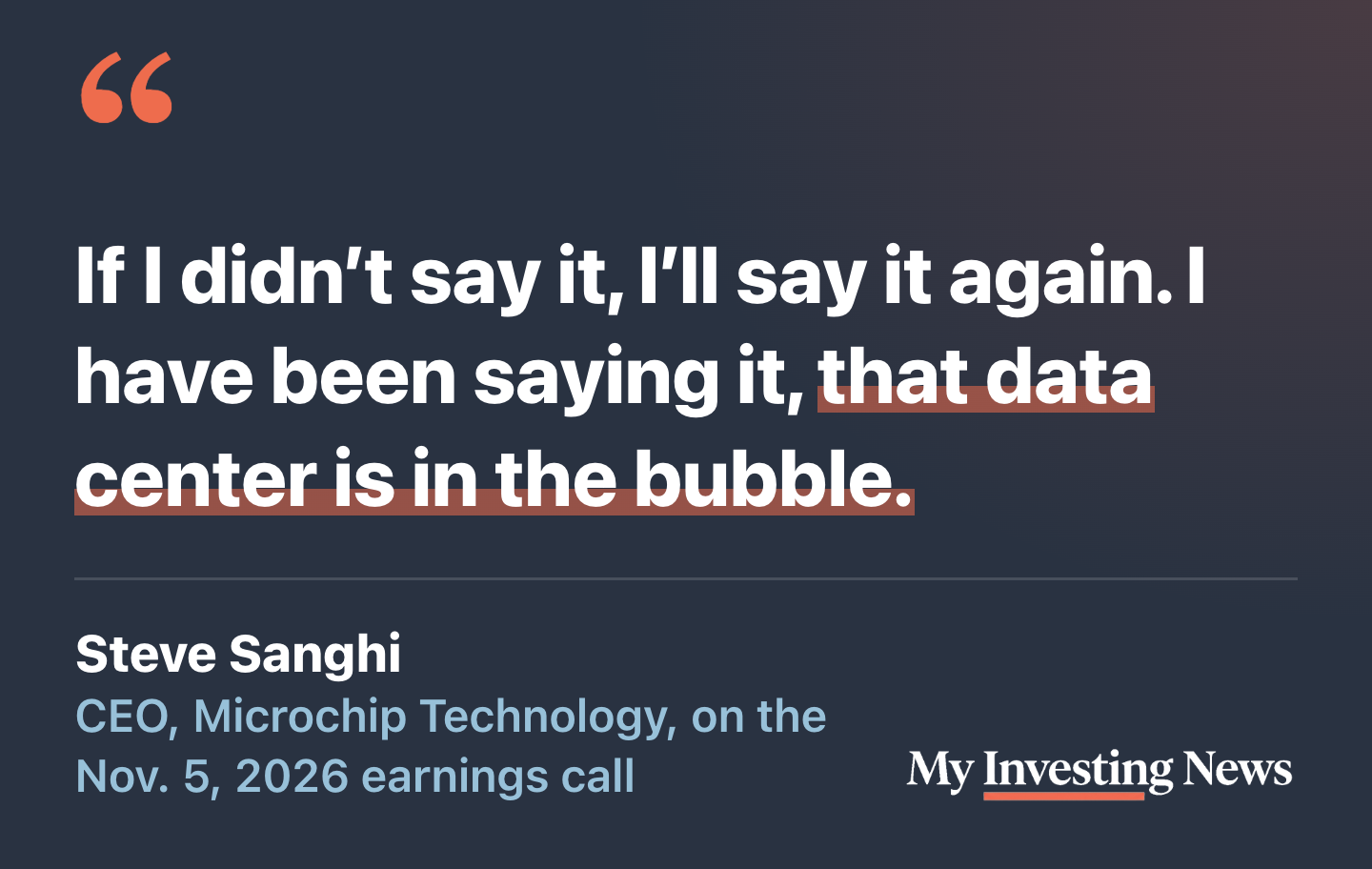
Where we heard itMicrochip Technology’s fiscal second-quarter earnings call, Nov. 5, 2026: Steve Sanghi, president and CEO. Jenny Harrington of Gilman Hill Asset Management flagged the remark on CNBC’s Halftime Report the next day.
Steve Sanghi has run Microchip Technology MCHP for most of the last three decades, and he has a habit few chip executives share: he calls the turns of the semiconductor cycle out loud, on the record, with dates attached. On the company’s Nov. 5 earnings call, an analyst noted that Sanghi hadn’t quite said the AI build-out was a bubble. Before the next question began, Sanghi added a line of his own.

A Bubble With a Line Drawn Around It
Sanghi drew the line carefully. Data center is 16.7% of Microchip’s business, he said, and about half of that is broad-based products. If data center were to correct, he argued, Microchip’s exposure to industrial, automotive, aerospace and defense and other markets “would be very, very helpful,” and the company “should outperform” chipmakers that are mostly data center. He also said the AI rush has crowded smaller customers out of outside factories, and that if some air comes out, “I think there is silver lining in it.” His words for the rest of it: “the whole thing was just too much hot air.”
Harrington, who holds Microchip in her portfolio, picked up on the distinction on the Halftime Report on Nov. 6. “Maybe there’s not an AI bubble, but maybe there’s a data center bubble,” she said, noting that Sanghi “was careful not to say AI.” The market was in no mood for nuance: Microchip fell 10% on Nov. 6 after guiding December-quarter sales slightly lower, and as of the Nov. 9 close the stock was 40% below its May 6 high.
Fifteen Years of Cycle Calls
Sanghi has made this kind of call before, and he has said he gets them right. “To my recollection, we have not been wrong in 15-plus years in calling the downturn, and we have not been wrong in the same time frame calling the upturn,” he told analysts in February 2019. We checked that against the record.
Going back through Microchip’s earnings calls and releases since 2011, we found nine dated calls in his own words: seven times he named a quarter as the bottom of a cycle, and twice he warned of a slowdown. In October 2014 he said “another industry correction has begun,” and in August 2017 he said Microchip appeared to have “created a soft landing so far without triggering any double ordering.” We scored each one against Microchip’s reported sales in the four quarters that followed, stopping early when an acquisition added sales the call wasn’t about.
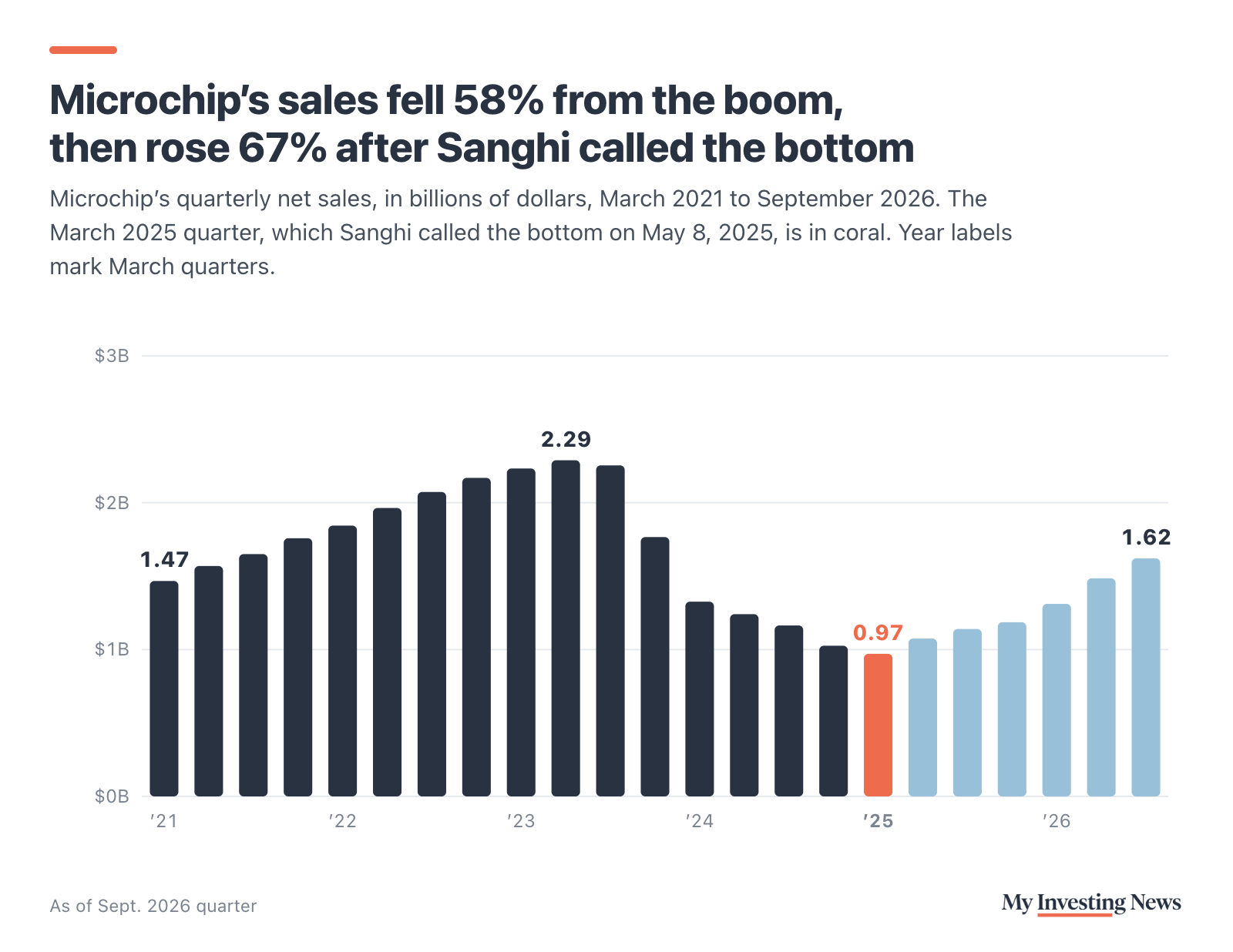
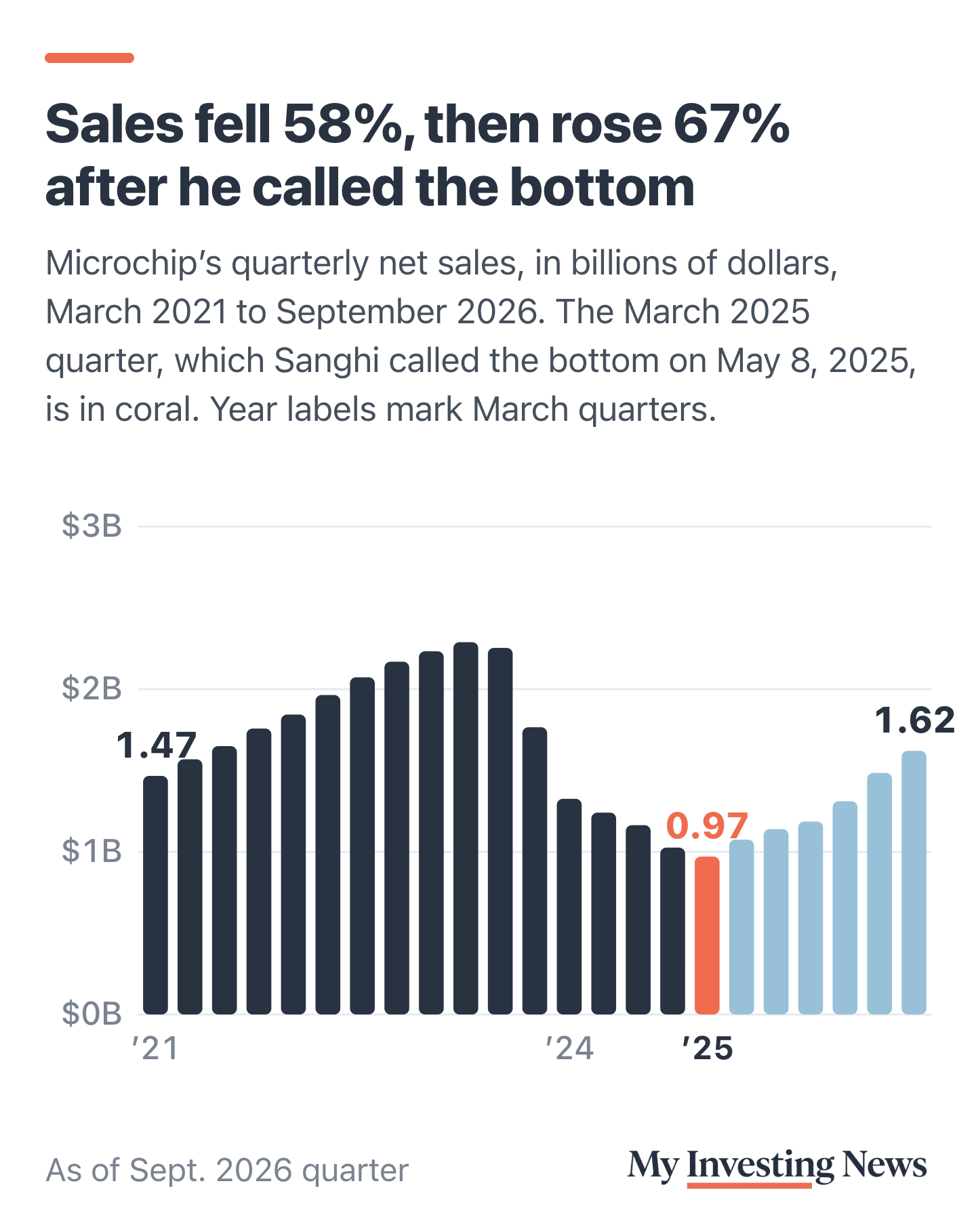
Eight of the nine held up. His most recent call was among the cleanest: on May 8, 2025, after refusing for a quarter to name a low, he said, “I am finally calling the last quarter as a revenue bottom for us.” Sales in that March 2025 quarter were $0.97 billion. Every quarter since has been higher, and the September 2026 quarter came in at $1.62 billion, up 67% from the low. His calls of a bottom in early 2020 and late 2020 held up too, the first one through the pandemic shutdowns.
The call and the record, as of the Nov. 9, 2026 close
The Miss and the Asterisk
The one miss came in the same call as the boast. In February 2019 he said “we see the March 2019 quarter to mark the bottom of the cycle for Microchip,” with a condition attached: barring any material negative development on the trade front. The trade war got worse. Sales of $1.33 billion in that quarter slipped to $1.32 billion in June and $1.29 billion in December. By November 2019 Sanghi called it “a false bottom.”
The asterisk is about orders, which our scoring doesn’t count as a cycle call. In February 2021, with chips short everywhere, Sanghi said Microchip’s new program of non-cancelable orders was launched to “not have any double ordering or excess ordering in that backlog.” Sales kept climbing for two more years, to a peak of $2.29 billion in the June 2023 quarter. Then customers worked through the inventory they had built, and sales fell 58% to the March 2025 low. When he returned as CEO, Sanghi described it as “a very large inventory correction following a post-COVID super cycle.”
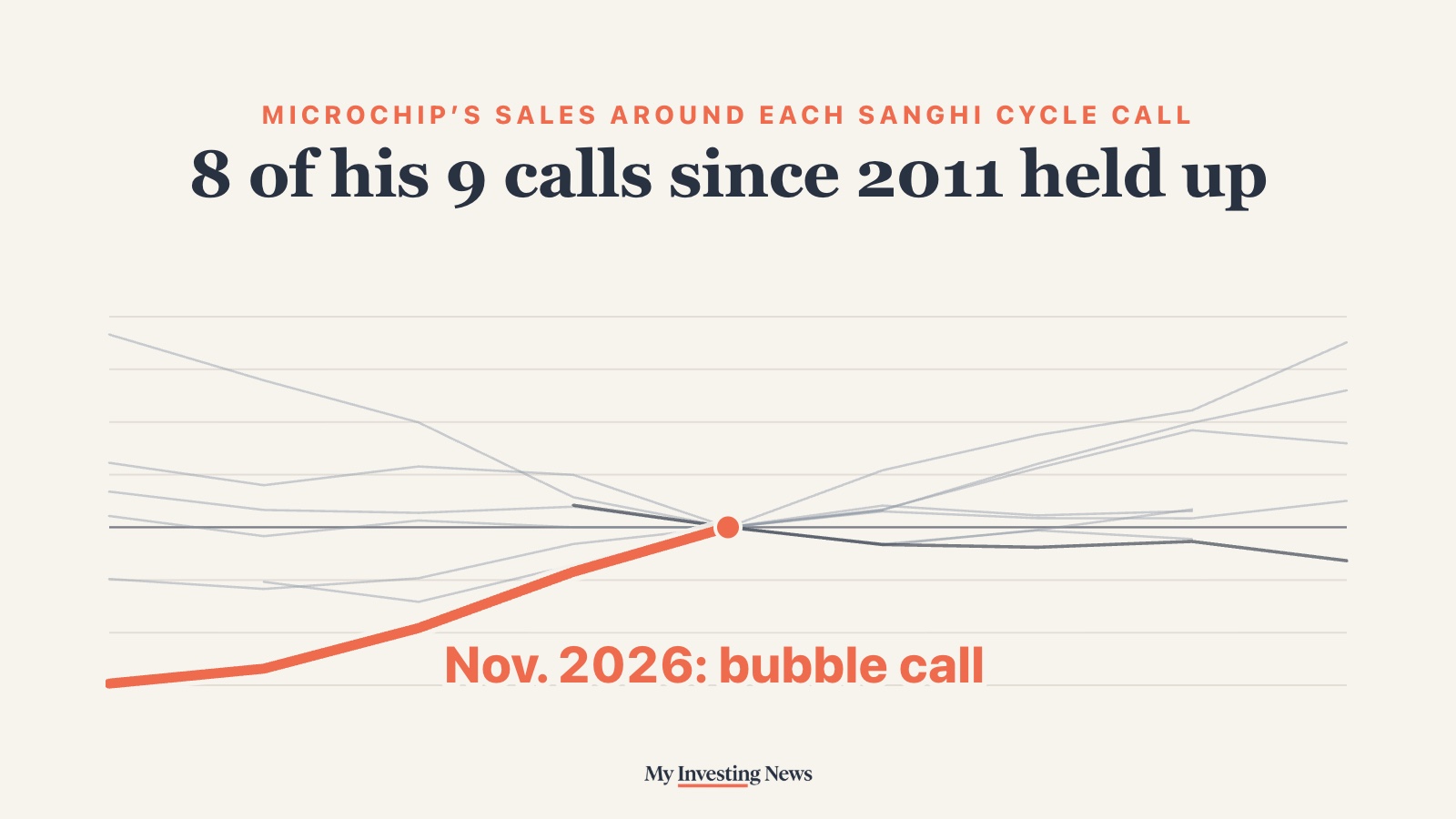
8 of Steve Sanghi’s 9 cycle calls since 2011 held up in Microchip’s sales
Microchip’s quarterly net sales around each call, as a % change from the last quarter reported before it. Gray: the calls that held up (six bottom calls and two warnings). Dark: the one miss. Coral: the year before his Nov. 5, 2026 bubble call. Lines stop at an acquisition.
The chart shows the setup this time. Before his past calls of a bottom, sales had been falling. Before this one, they rose 42% in four quarters, which looks more like the run-ups before his two warnings in 2014 and 2017. The difference is that his past warnings rested on Microchip’s own order book. This one is about other companies’ customers.
What to Watch
Sanghi’s bubble call can’t be scored in Microchip’s sales, because he says most of the excess isn’t there. “Much of that, you know, upside and bubble is not in our numbers. It’s in everybody else’s numbers,” he said. The test is whether data center spending slows over the next few quarters while Microchip’s other markets keep growing, as he expects. The sign he pointed to: capacity freeing up at the outside foundries and assembly houses that AI customers have filled. Investors have been arguing over what counts as a bubble, and the AI groups that already fell hard have a slow record of getting back to their highs. Others see an anti-bubble in Nvidia’s valuation.
Sanghi says data center is in a bubble, leaving AI as a whole out of it, and says Microchip is built to come through a correction better than chipmakers that depend on it. His record backs the confidence: 8 of his 9 cycle calls since 2011 held up in Microchip’s sales, and the miss came with a trade-war condition he named. The risk is that this call is about other companies’ demand, which he sees less clearly than his own order book.