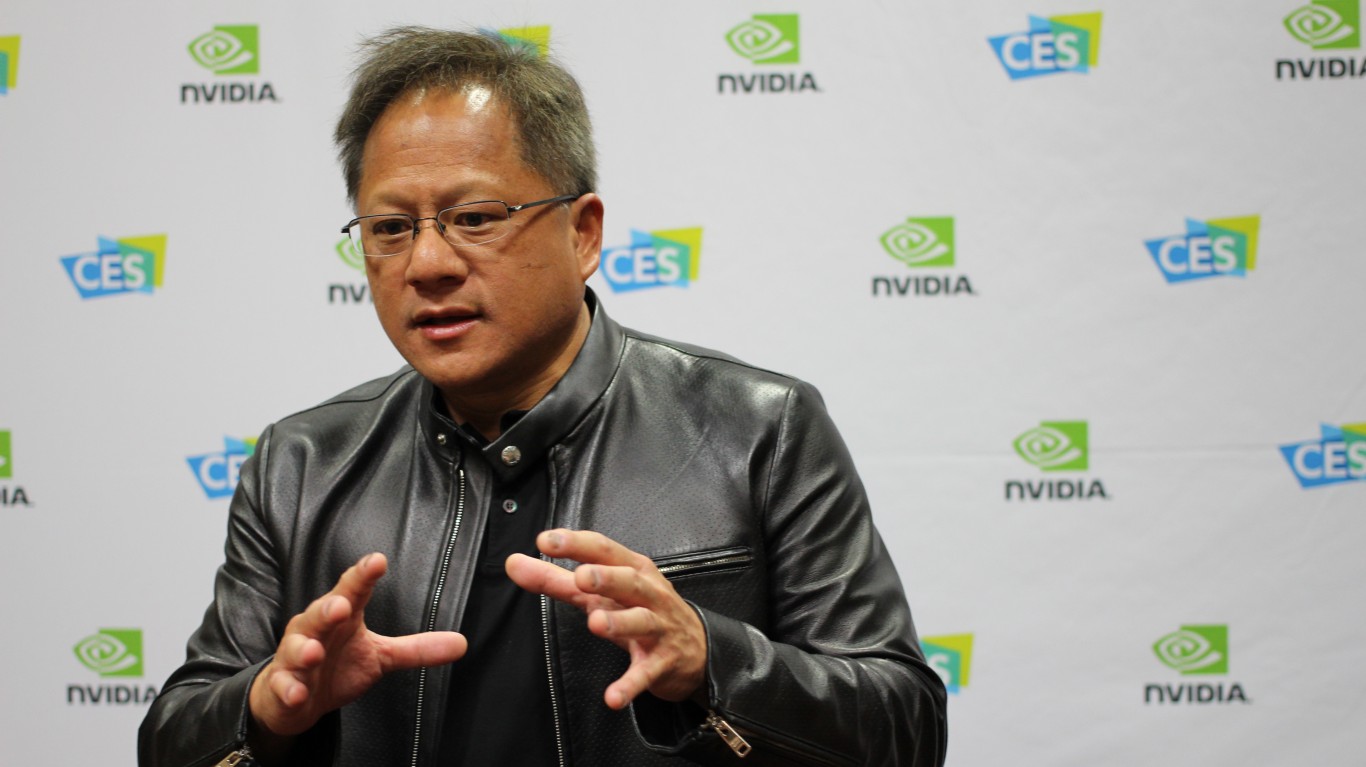
On October 15, 2026, Bloomberg’s Emily Chang put a direct question to NVIDIA (NASDAQ:NVDA | NVDA Price Prediction) CEO Jensen Huang: “AI is deeply unpopular and people are scared. You have been very consistent in your optimism. What do you see that they don’t? How can they be so wrong?”
Huang started by agreeing that the concern is real: “First of all, safety is paramount. In order for us to realize the incredible potentials and the optimistic future that we all hope for and believe in, we have to develop the technology safely and responsibly.”
The answer carries weight because of who gave it. NVIDIA supplies the chips behind nearly every major AI effort, and in its latest quarter it reported revenue of $96.22B, up 105.8% YoY. When that supplier makes safety a condition of its optimism, investors should pay attention.
Safety Built Into AI Systems From Day One
Huang called for safety tools to move at the same speed as the models themselves: “We should accelerate the development. We should accelerate the integration of this containment technology into AI systems. We should accelerate the development of monitoring technology.” He also argued for AI systems whose job is to monitor other AI systems.
In plain terms, containment limits what an AI system is allowed to do, and monitoring watches what it actually does. Huang treats safety work and capability work as parallel tracks that should advance together.
NVIDIA already has products along these lines. It launched Halos OS, a unified safety architecture for AI-driven vehicles, introduced NVIDIA Halos, a robotics safety system for physical AI, and formed the Open Secure AI Alliance for AI safety and security. Its GPUs with Confidential Computing are used for Apple Private Cloud Compute. On the August earnings call, Huang also pointed to frontier models powering “continuously running Autonomous Cybersecurity Systems to defend.”

Hypothetical Question on Cutting Off a Dangerous Lab
Chang asked a hypothetical question: would NVIDIA stop selling to a lab doing something too dangerous? Huang replied: “It’s a hypothetical but of course, yeah. Before you do so, you would have a conversation.”
That was his answer to a hypothetical question. NVIDIA has not announced any such policy. In the same interview, Huang also said a company selling general-purpose technology can only go so far in imposing its judgment on the customers who use it. Even so, his answer to the hypothetical acknowledges that the chip supplier has some say over how its products get used.
Why Public Trust Matters for NVIDIA Investors
Our read: NVIDIA’s growth depends on a expansion that needs public and political support. The company’s supply commitments rose to $279B, largely for Vera Rubin memory procurement. Its partners are working to mobilize over $500B in third-party capital for AI infrastructure. For the third quarter of fiscal 2027, NVIDIA guided to revenue of $108B +/- 2%, according to its second-quarter earnings release.
Growth plans that large depend on local permits, power, and public acceptance. The Department of Energy projects data centers could account for up to 12% of U.S. electrical demand by 2028, which is why the power, cooling, and networking suppliers behind the expansion keep showing up in our free AI infrastructure report. If public fear slows adoption, the whole expansion is at risk. Huang presents safety as part of the path to growth. That is our reading of his remarks. He did not speak about the stock.
NVIDIA Stock Slips With the AI Selloff
As of 12:53 PM ET on October 16, NVIDIA shares traded at $216.39, a move of -0.39% in the session. The stock’s past week change was -6.11%, and it is up 16.3% year to date. The past week included a global tech rout on AI funding worries that hit chip stocks broadly. Nothing links the stock’s moves to Huang’s remarks. The shares trade at a P/E of about 44, with an operating margin near 60%.

What to Watch Next
Huang’s words point in the right direction, and NVIDIA’s safety products show real engineering effort behind them. The verifiable test is whether NVIDIA or other AI suppliers turn statements like this into something concrete, such as published conditions on how their products can be used or regular reports from the Open Secure AI Alliance. Watch the next earnings release and NVIDIA’s investor relations site. Until something is written down, the answer about cutting off a dangerous lab remains what it was: a response to a hypothetical question.