Where we heard itCNBC’s “Mad Money,” Oct. 27, 2026, with Okta co-founder and CEO Todd McKinnon, interviewed by Jim Cramer.
OktaOKTA CEO Todd McKinnon used a Mad Money interview on Oct. 27 to go after the company his own filings call Okta’s principal competitor. Asked about a wave of AI-found software flaws, he said the security industry makes things too complex by telling every customer it can solve every problem, and he named MicrosoftMSFT as “the worst offender here.”
He described the pitch as covering every business software problem, every security problem and every AI engineering problem. His verdict:
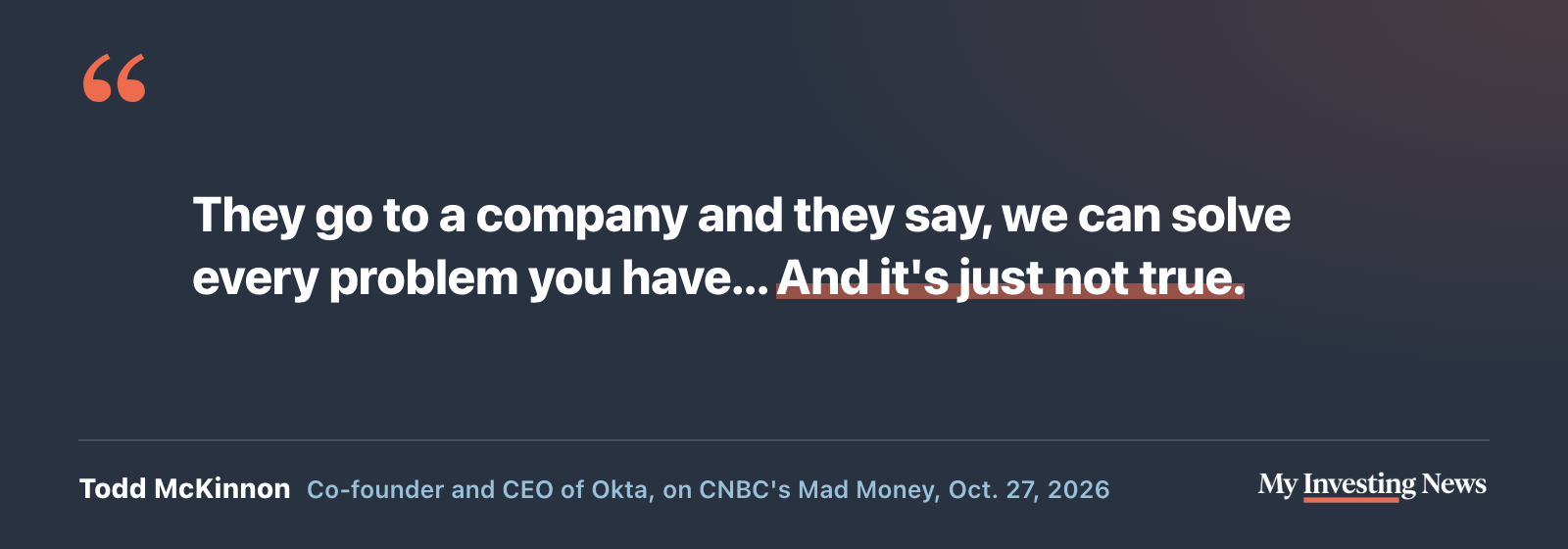
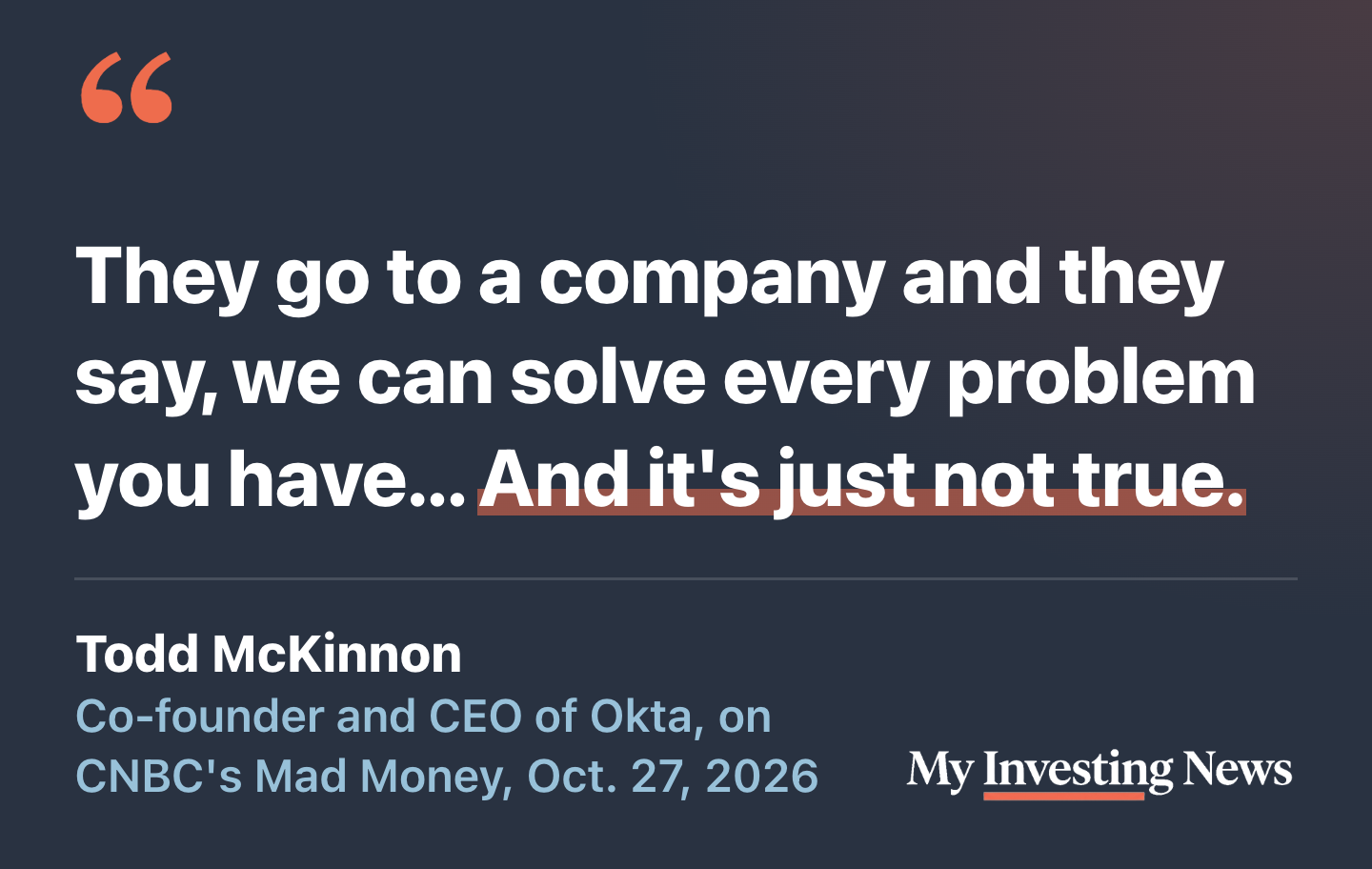
Microsoft, he said, needs to work with an ecosystem of other vendors. Jim Cramer said on air that he was inviting Microsoft to respond.
What McKinnon Said About AI Attacks
McKinnon said two things have changed in the past six months. Big AI models from companies such as Anthropic and OpenAI helped find a flood of software vulnerabilities, and the tools attackers use to probe networks and chain those flaws together got more powerful. “So you have more vulnerabilities and you have, uh, better tools to use them,” he said.
What hasn’t changed, in his telling, is how most people get hacked. He said more people will be breached by a phishing website than by any of the new vulnerabilities, and that basics such as phishing-resistant multifactor login and patching still protect companies. That is a calmer read than former CISA chief Chris Krebs, who says AI is finding flaws faster than companies can patch them. McKinnon also pushed back when Cramer suggested firing employees who click on phishing emails twice, saying the industry already has the technology to stop phishing.
His closing pitch was about how his own industry gets paid. “We shouldn’t get paid on fear,” he said. “We should get paid on decreasing the number of breaches.”
What Okta’s Filings Show
Okta’s annual report, filed in March, is blunt about the rivalry. “Our principal competitor is Microsoft,” it says, adding that Okta often sits alongside competitors’ products inside the same customers. Microsoft sells its own identity tools, which is the market Okta was built on.
Okta is still growing in that market, at a steady pace. Revenue in the quarter that ended July 31 was $805 million, up 11% from a year earlier, in line with the 11% to 13% growth of the four quarters before it. Remaining performance obligations, the contracted revenue Okta has yet to book, rose 17% to $4.86 billion. Free cash flow was $227 million, or 28% of revenue, and operating income under standard accounting rose to $107 million from $41 million.
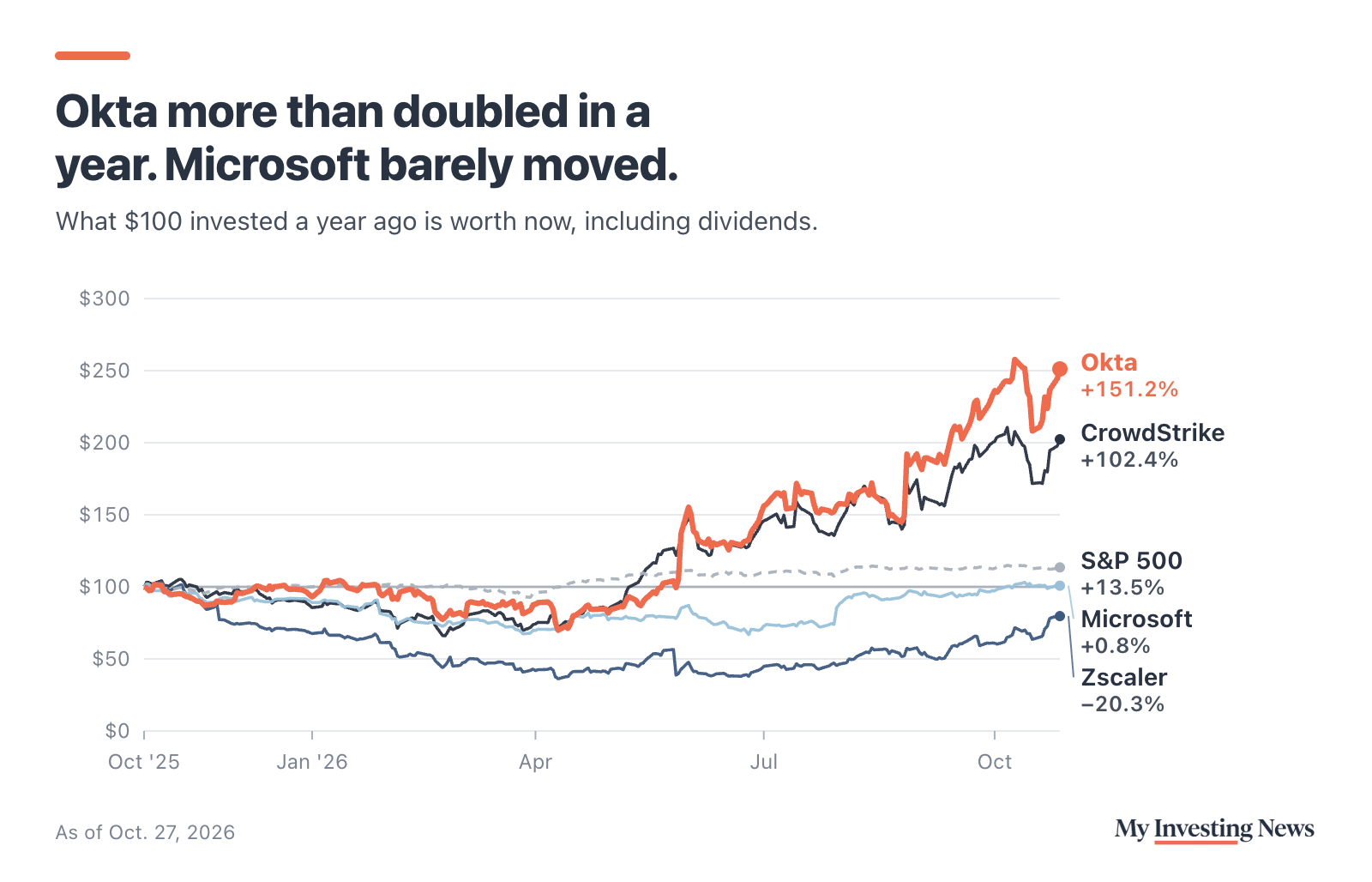
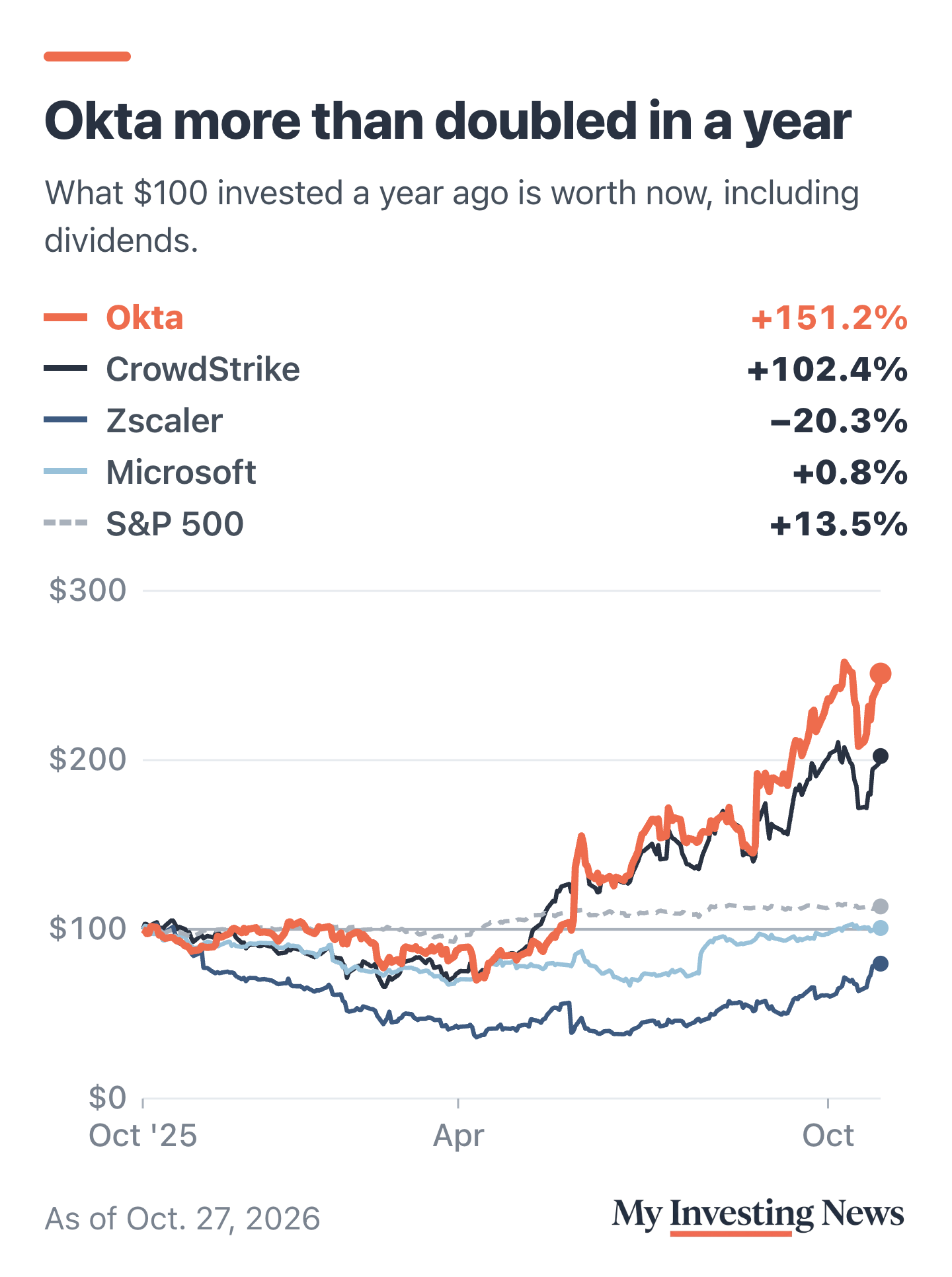
The stock has moved far faster than the business. Okta closed at $226.07 on Oct. 27, up 161.4% this year from $86.47 at the end of 2025, for a market value of about $39.5 billion. Over the past year, $100 in Okta grew to about $251, while $100 in Microsoft was worth about $101. Cramer, introducing McKinnon, credited investors’ view that Okta’s software will be central to managing AI agents.
Okta by the numbers
The Whole Field
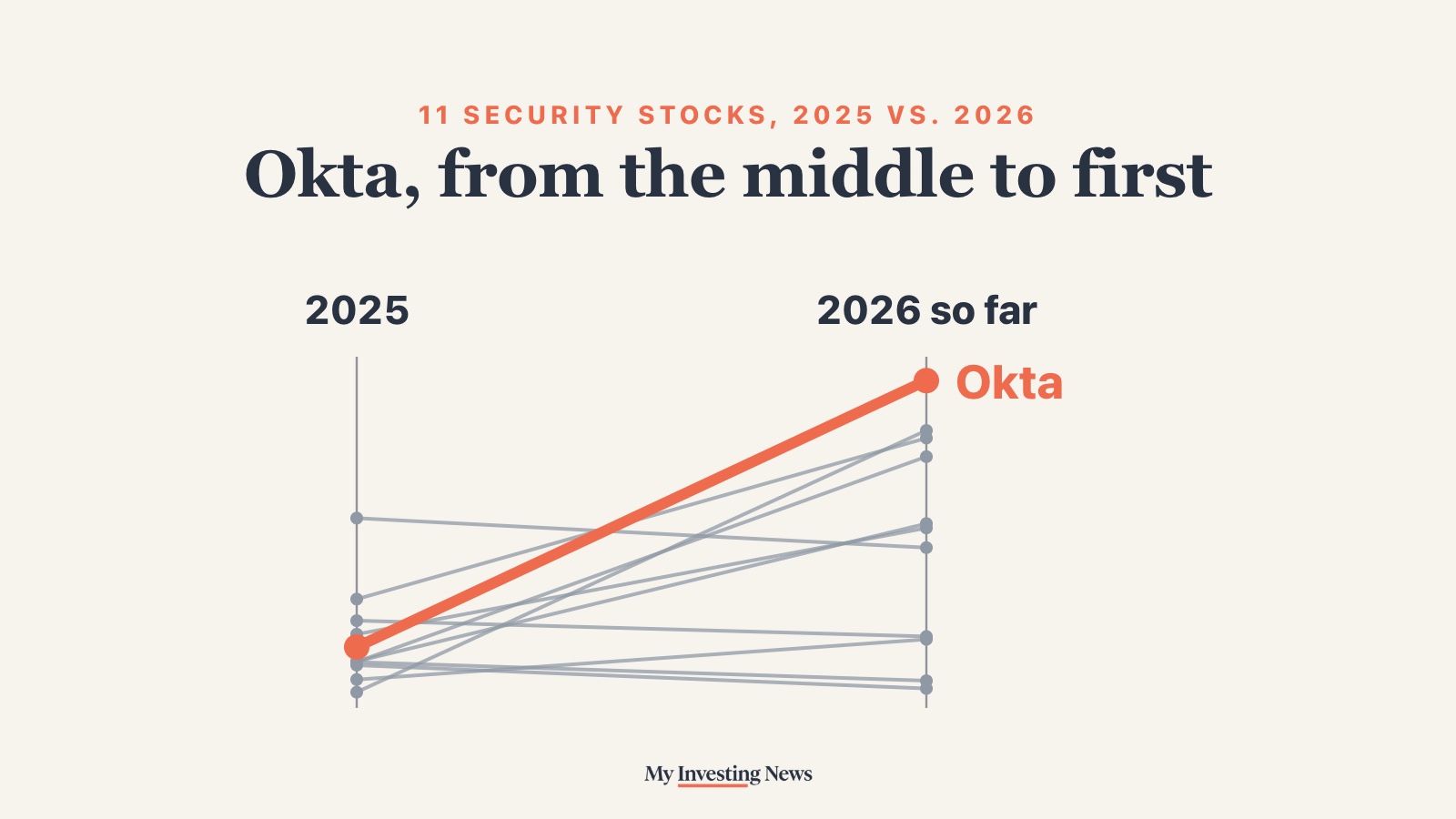
Okta’s run stands out even in a strong year for security stocks. Among the 11 security specialists in the Nasdaq cybersecurity index fund’s 25 largest holdings, Okta ranked fifth in 2025, with a 9.7% total return, while Cloudflare led. This year it is first, about 28 points ahead of Fortinet at 133%, with CrowdStrike and Palo Alto Networks close behind. Microsoft’s 10.6% gain trails nine of the 11.
Okta went from fifth of 11 security stocks in 2025 to first in 2026, 28 points ahead of the next.
Total return, with dividends, in calendar 2025 and in 2026 through Oct. 27, for the security specialists among the Nasdaq cybersecurity index fund’s 25 largest holdings.
The rally also shows up in a federal official’s filings. Office of Personnel Management Director Scott Kupor, a former Andreessen Horowitz managing partner, reported selling between $1 million and $5 million of Okta stock on Sept. 21 and $100,001 to $250,000 on Aug. 21, according to his ethics filings. Both sales came from covered call options being exercised, the filings say.
The threat backdrop is what investors have been paying for. A Check Point executive told CNBC on Oct. 26 that attackers using AI now move faster than many security teams can respond.
What to Watch
Okta’s next quarterly report, for the three months to Oct. 31, is due in early December if it follows last year’s timing. The numbers to watch are whether revenue growth picks up from the 11% to 13% pace of the past five quarters, and whether remaining performance obligations keep growing faster than revenue.
The other test is the one McKinnon set himself. If the industry should be paid on fewer breaches, customers will judge identity vendors, Okta included, on whether breaches fall. Investors have heard other versions of that case: Cramer has argued that AI can’t replace CrowdStrike’s human incident response.
McKinnon says Microsoft overpromises when it tells customers it can solve every security problem, and Okta’s 10-K names Microsoft as its principal competitor. Okta’s business is growing about 11% a year while its stock is up 161% in 2026, first among 11 security stocks. The risk is that gap: investors are paying for faster growth from AI agents, and the filings don’t show it yet.