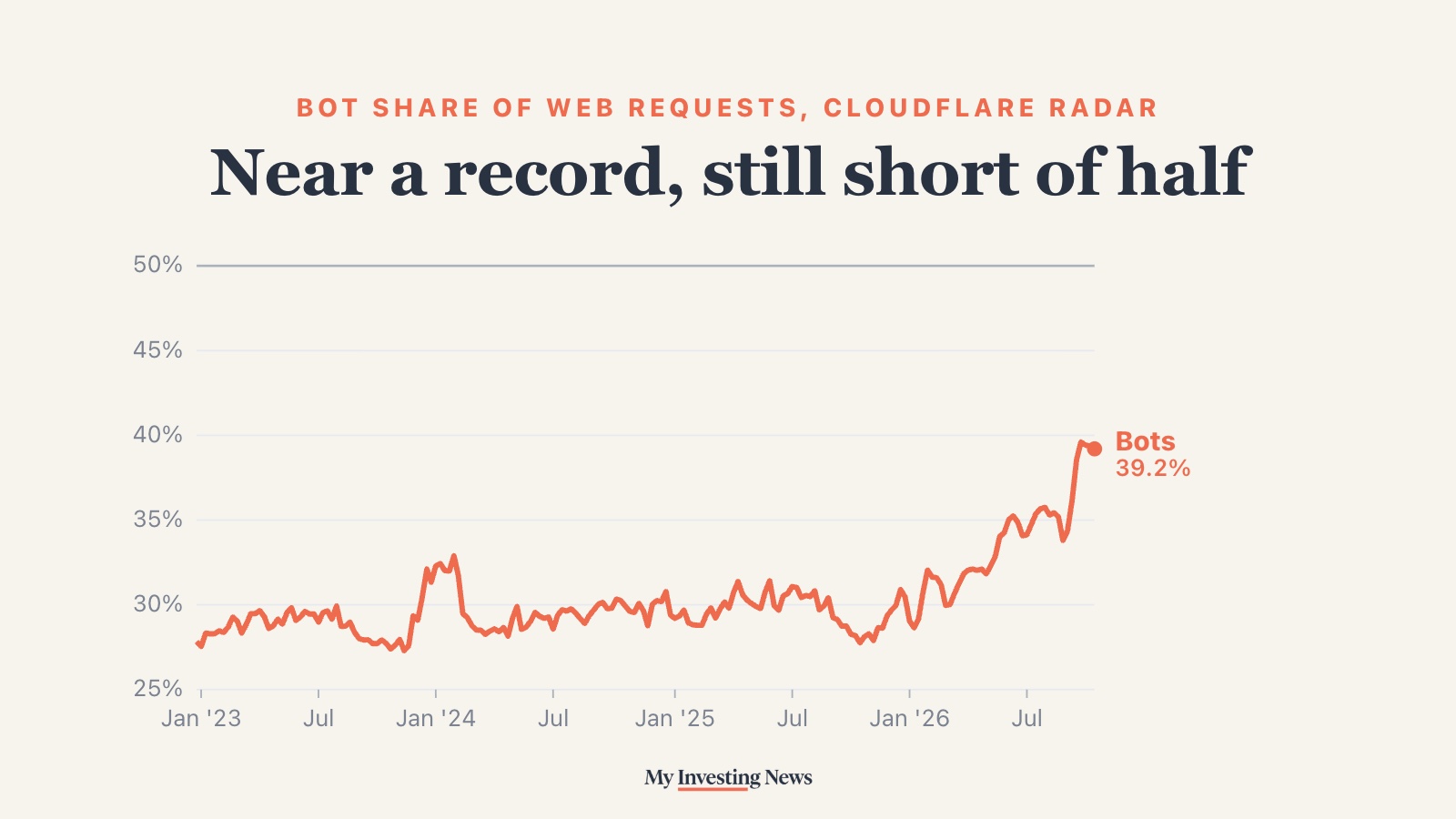
Where we heard itCNBC’s “Halftime Report,” Oct. 27, 2026, “Best Stocks in the Market” segment with Josh Brown, CEO of Ritholtz Wealth Management.
Josh Brown kept CloudflareNET on his Best Stocks in the Market list on Oct. 27, and he made the case with two numbers from the company. Cloudflare runs a global network that sits between the internet and the companies that put up websites and apps, and Brown said the traffic crossing it has changed.
“The growth is explosive here and a lot of it now is agentic,” he told the Halftime Report panel. He added that AI agent requests are up 1,700% from a year earlier, and that “Cloudflare is sitting right in the middle of that.”

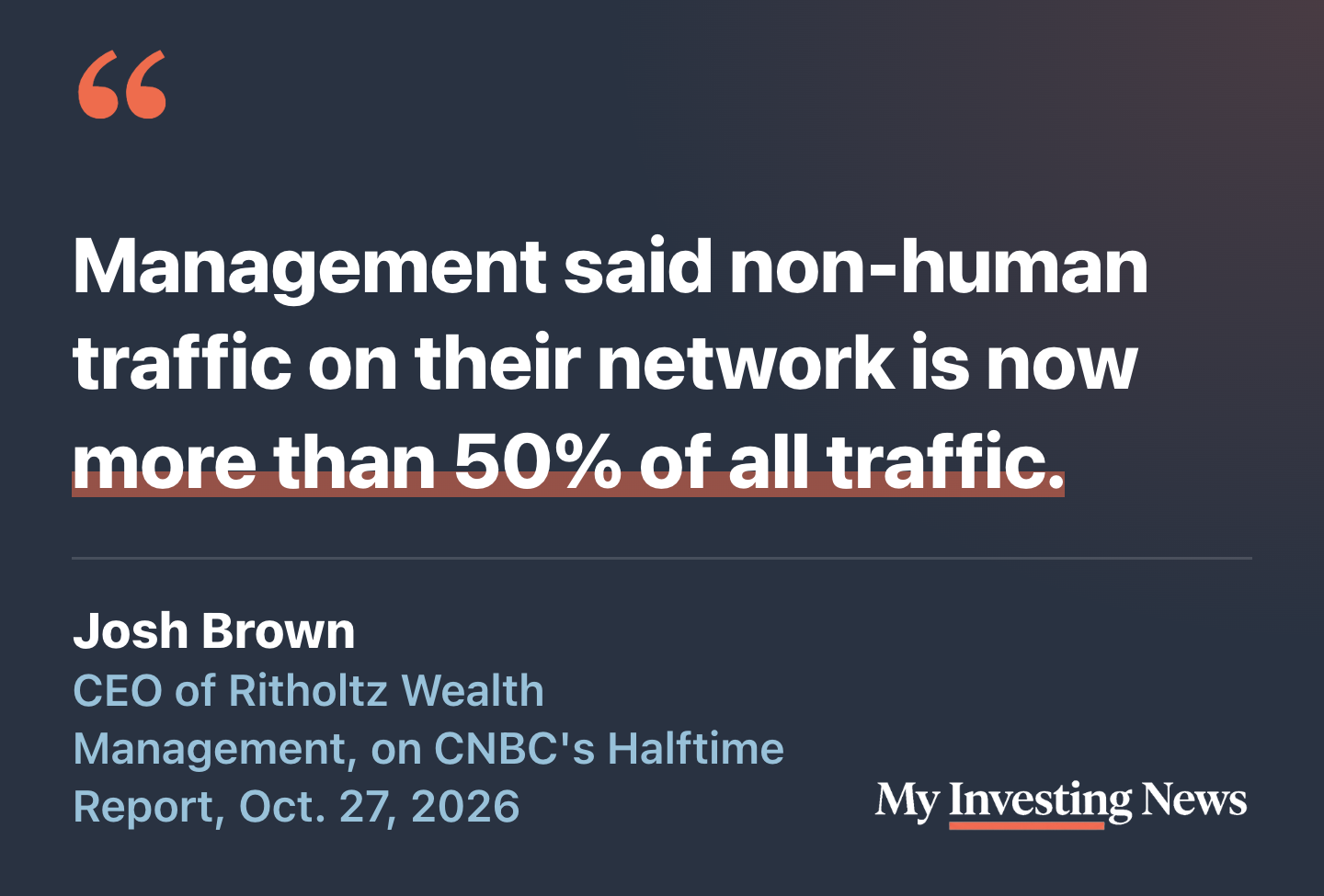
Both numbers trace back to Cloudflare. Its own public traffic dashboard tells a more measured version of the same story.
Where the Numbers Come From
Brown was quoting management accurately. On the company’s second-quarter call on Aug. 6, co-founder and CEO Matthew Prince said that in the second quarter, for the first time, more than half of the traffic crossing Cloudflare’s network was not human. A July 13 product release put automated bot traffic at “roughly 57% of all web requests.” And an Oct. 20 release said daily requests from AI agents on Cloudflare’s network grew by more than 1,700% in one year.
Prince has also been candid about how fast this arrived. He told analysts that in November 2025 his team expected non-human traffic to pass human traffic in the second half of 2027. By March 2026 the estimate had moved up to the first half of 2027. Then in May, he said, the team told him it had already happened. He offered his newer forecasts with the caveat that he had been wrong at every step.
What Cloudflare’s Public Data Shows
Cloudflare publishes its own running count on Cloudflare Radar, which sorts the HTTP requests it sees into human and bot. On that measure, bots made up 39.2% of requests in the week of Oct. 19, just below the 39.6% record set in the week of Sept. 28. Radar’s figure for the second quarter, the period Prince described, was 33.2%. In the 200 weeks of data the API returns, back to late 2022, the bot share has never reached half.
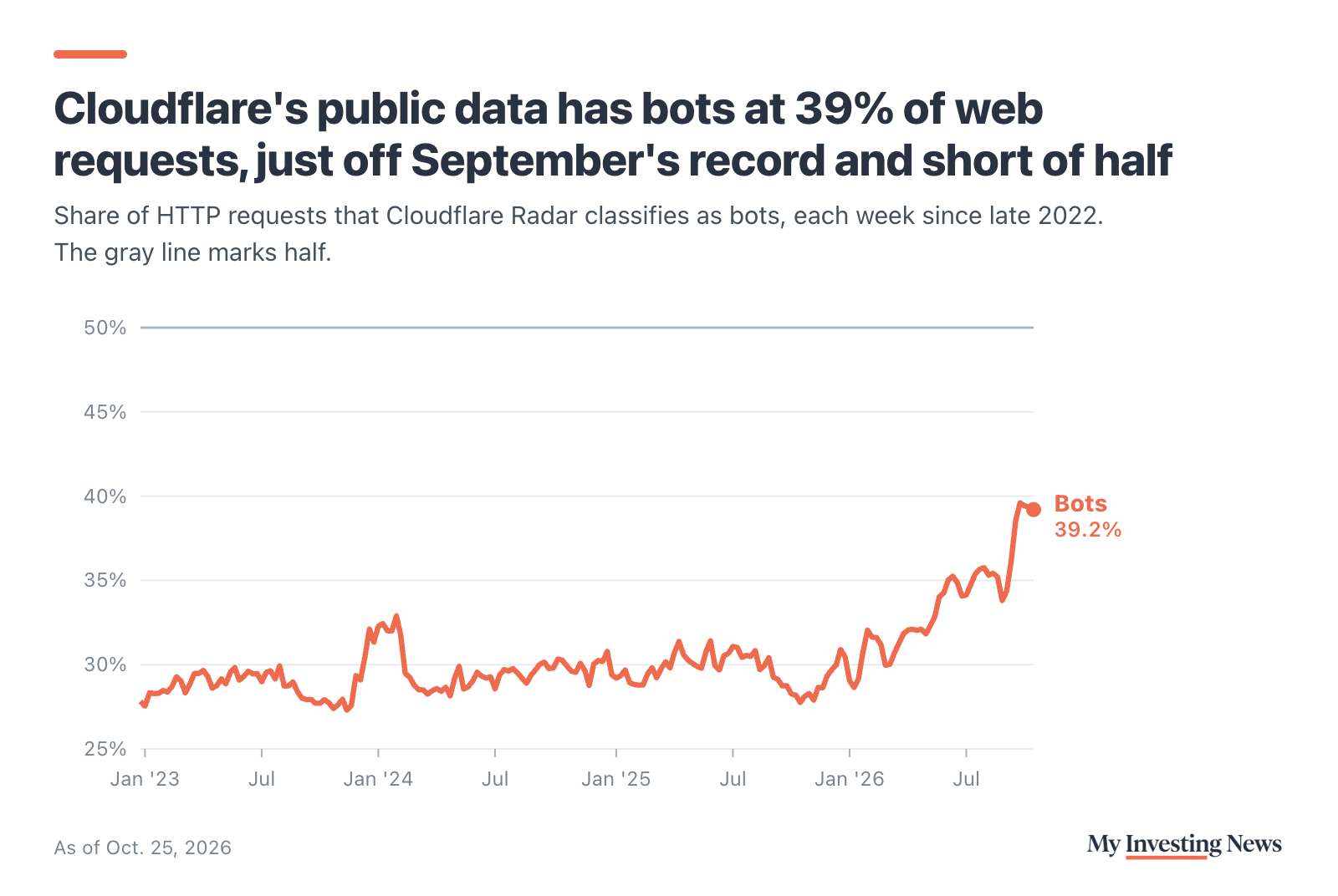
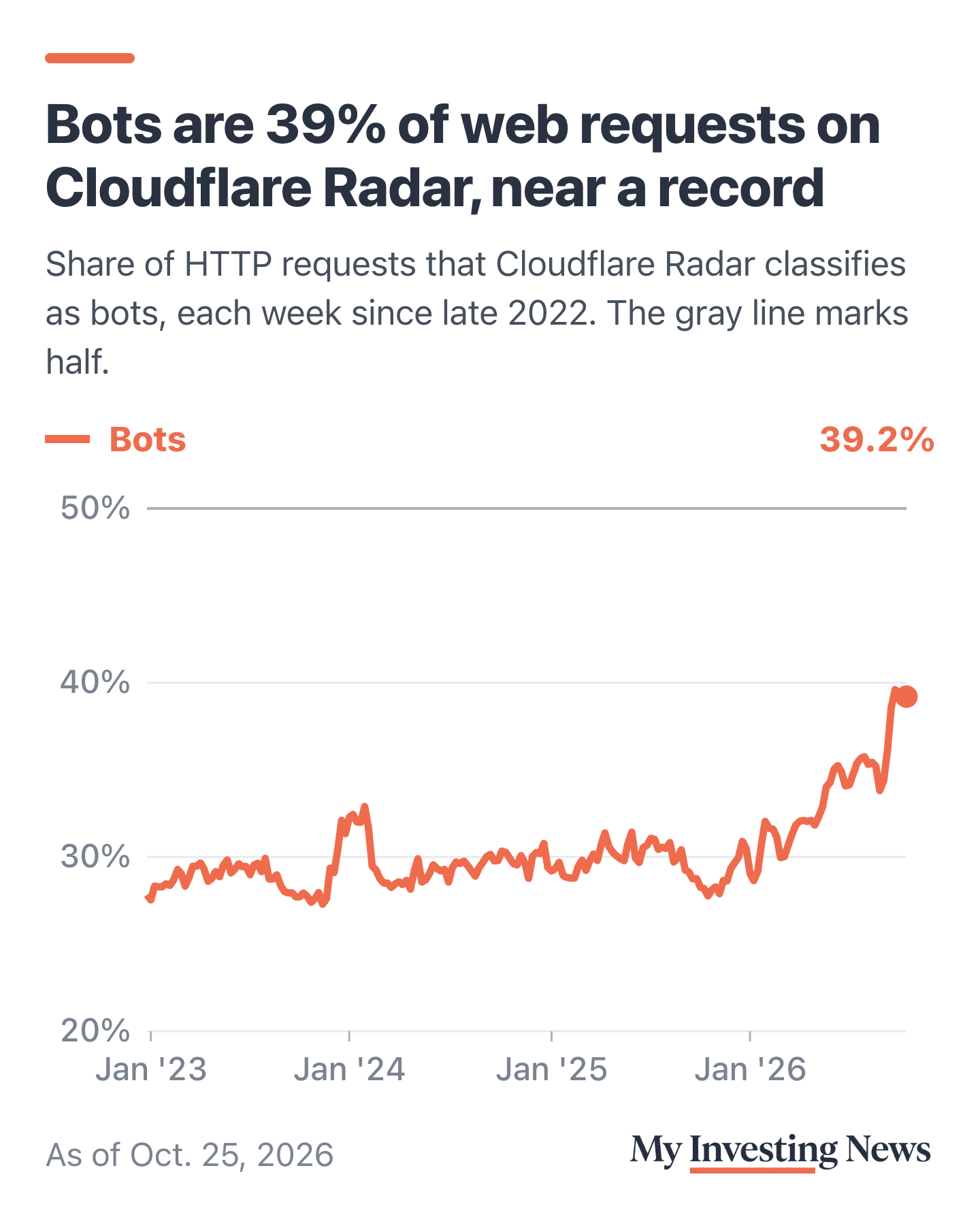
The trend backs Brown’s point even if the level doesn’t. The bot share sat between about 27% and 33% for more than three years, then started climbing in late May. It is up 11.4 points from 27.8% a year earlier, and more than half of that rise came after mid-May. Cloudflare has not said how it counts its “more than half” figure or why it differs from the public split, which covers HTTP requests only. The 1,700% agent figure can’t be checked against Radar at all.
Cloudflare by the numbers
Why the Mix Matters to the Business
Machine traffic is something Cloudflare can sell against from both sides. It blocks the harmful kind, which matters more as AI speeds up attackers, and it sells tools that let publishers charge AI crawlers or shut them out. Prince called its developer platform, Workers, a perfect platform for building agents. He also told analysts that non-human traffic could reach as much as 1,000 times human traffic in five years if current trends continue.
The second quarter showed the demand. Revenue rose 36% to $696.1 million, faster than the 33.5% of the quarter before, and the company said on the call that customers paying more than $100,000 a year grew 27% to 4,698. That fits the view that tech companies will be AI’s first and best users.
Investors have already priced in a lot of it. Cloudflare closed at $327.80 on Oct. 27, up 66.3% in 2026, though 9.2% below its $360.93 close on Oct. 9. Brown said the stock pulled back with other AI names and is in “a little bit of a V-shaped recovery,” and he set a $299 stop for traders.
What to Watch Tonight
Cloudflare reports its third quarter after the close today, Nov. 5. Its own forecast of $736 million to $737 million in revenue works out to about 31% growth, below the second quarter’s pace. The traffic question to listen for is whether management explains how it counts non-human traffic, and whether it updates the agent figures.
The stock tends to move hard on these nights. Across its 28 reports since the 2019 listing, it rose after half, and the average move the next session was about 10% in either direction. The worst was a 23.6% drop after the May 2026 report.
Cloudflare stock has moved 10% on an average report day, and 12 of 28 reports sent it 10% or more
Cloudflare’s stock move the session after each of its 28 quarterly reports since its 2019 listing, close to close. Coral dots are the last four.
Security buyers have their own reason to watch the bot numbers. Former CISA chief Chris Krebs says AI is finding flaws faster than companies can patch them, and automated traffic is how many of those flaws get probed.
Brown passed along management’s claim correctly: Cloudflare says more than half of its traffic is no longer human. Its public Radar data puts bots at 39% of web requests, near its record and rising fast, but short of half. The risk for the stock is that a big run into a report leaves little room, and Cloudflare’s report-night moves have averaged about 10%.