Where we heard itDevin McGranahan, president and CEO of Western Union, in the company’s third-quarter 2026 results release, Nov. 4, 2026.
Western Union now has its own digital dollar. On May 4 the company launched USDPT, a stablecoin issued by Anchorage Digital Bank on the Solana blockchain, starting in the Philippines and Bolivia, to move money between Western Union and its agents around the clock. In its third-quarter results on Nov. 4, Western Union WU chief executive Devin McGranahan said the company keeps “advancing our stablecoin and next-generation money movement initiatives.” The quarter itself was soft: revenue fell 2% to $1.0 billion, while revenue from its own digital apps and website rose 8%.
The pitch for putting payments on a blockchain is that customers never notice it. “I think the dream actually of most blockchain enthusiasts is you don’t know that you’re using it,” VanEck CEO Jan van Eck said on The Pomp Podcast on Nov. 5. “It’s just in the background, making your life easier.” For the people who send money home, the part they do notice is the price. The World Bank has priced that every quarter since 2008, so we checked what its record says about how much cheaper sending money has gotten, and where the cost comes from.
Sending $200 Costs a Third Less Than in 2009
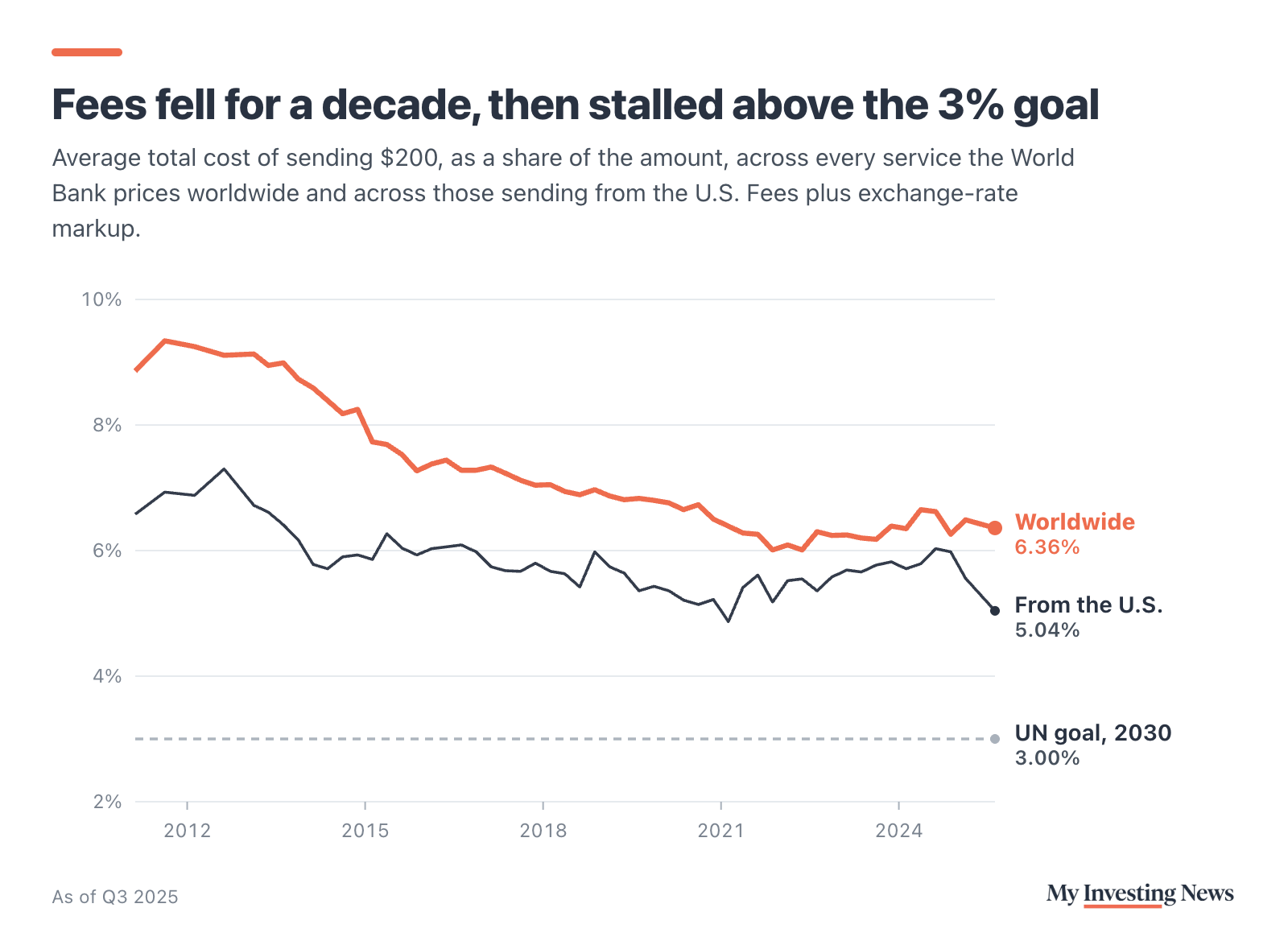
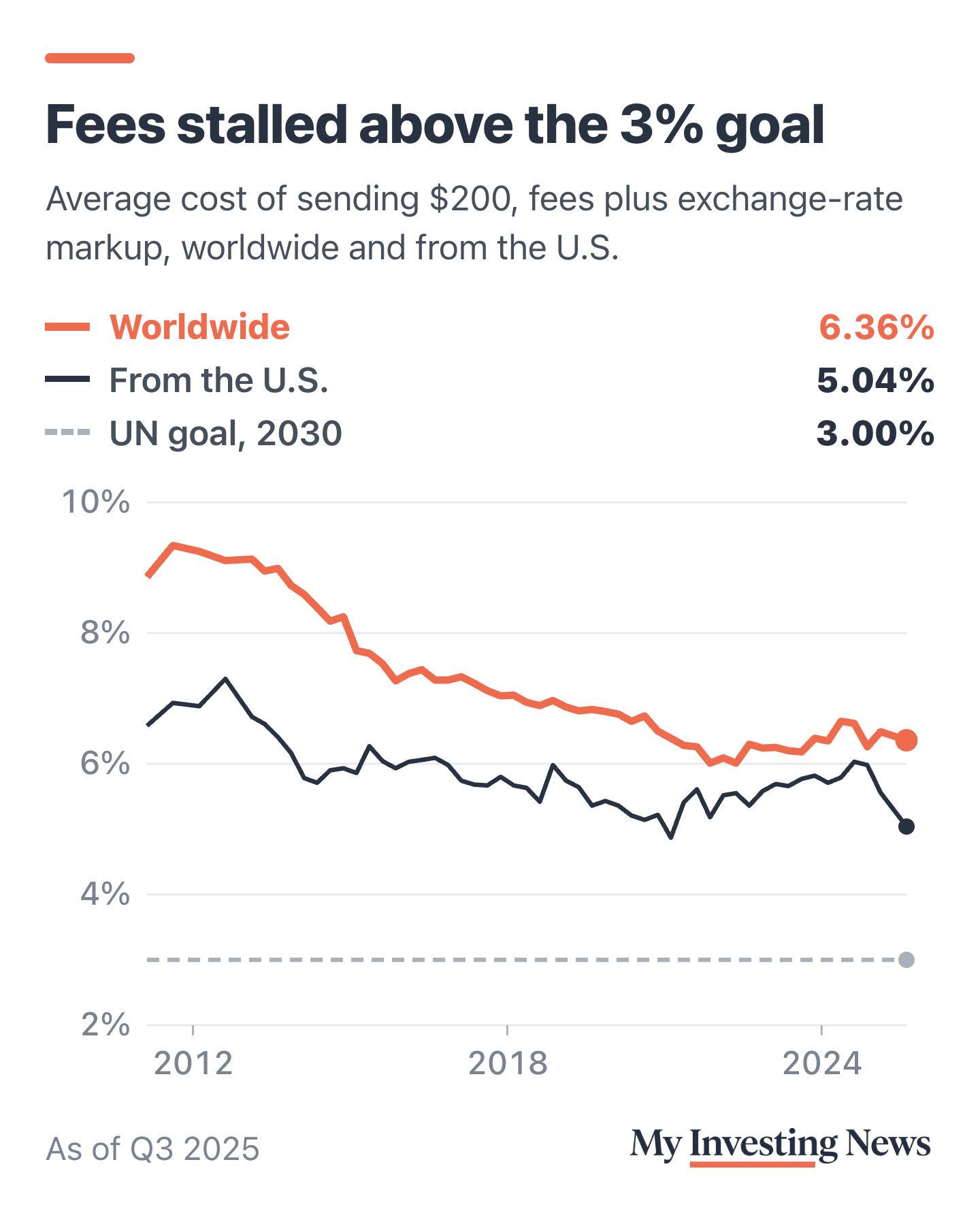
The World Bank’s Remittance Prices Worldwide survey prices the cost of sending $200 with banks, money transfer companies, mobile operators and post offices between hundreds of pairs of countries. It counts both the fee and the markup on the exchange rate. In the first quarter of 2009, the global average was 9.67% of the amount sent. In the third quarter of 2025, the newest figures published, it was 6.36%, about $12.72 on $200. That is 3.31 points lower, a cut of about a third.
Most of that drop came in the first decade. The average has stayed between 6% and 7% since 2019. The goal the United Nations set, and the G20 adopted, is 3% by 2030, which leaves 3.36 points to go in about five years. The cheapest options come close: the World Bank’s average of the three cheapest qualifying services in each corridor was 3.29%, and the digital-only transfer companies it tracks averaged 3.54%.
From the U.S. to Mexico, Less Than a Point
Money sent from the U.S. was cheaper to begin with, and it has fallen less. Across every service the World Bank priced from the U.S., the average cost was 6.76% in 2011 and 5.04% in the third quarter of 2025. Americans sent $106.5 billion abroad in 2025 by the World Bank’s count, up from $60.7 billion in 2015.
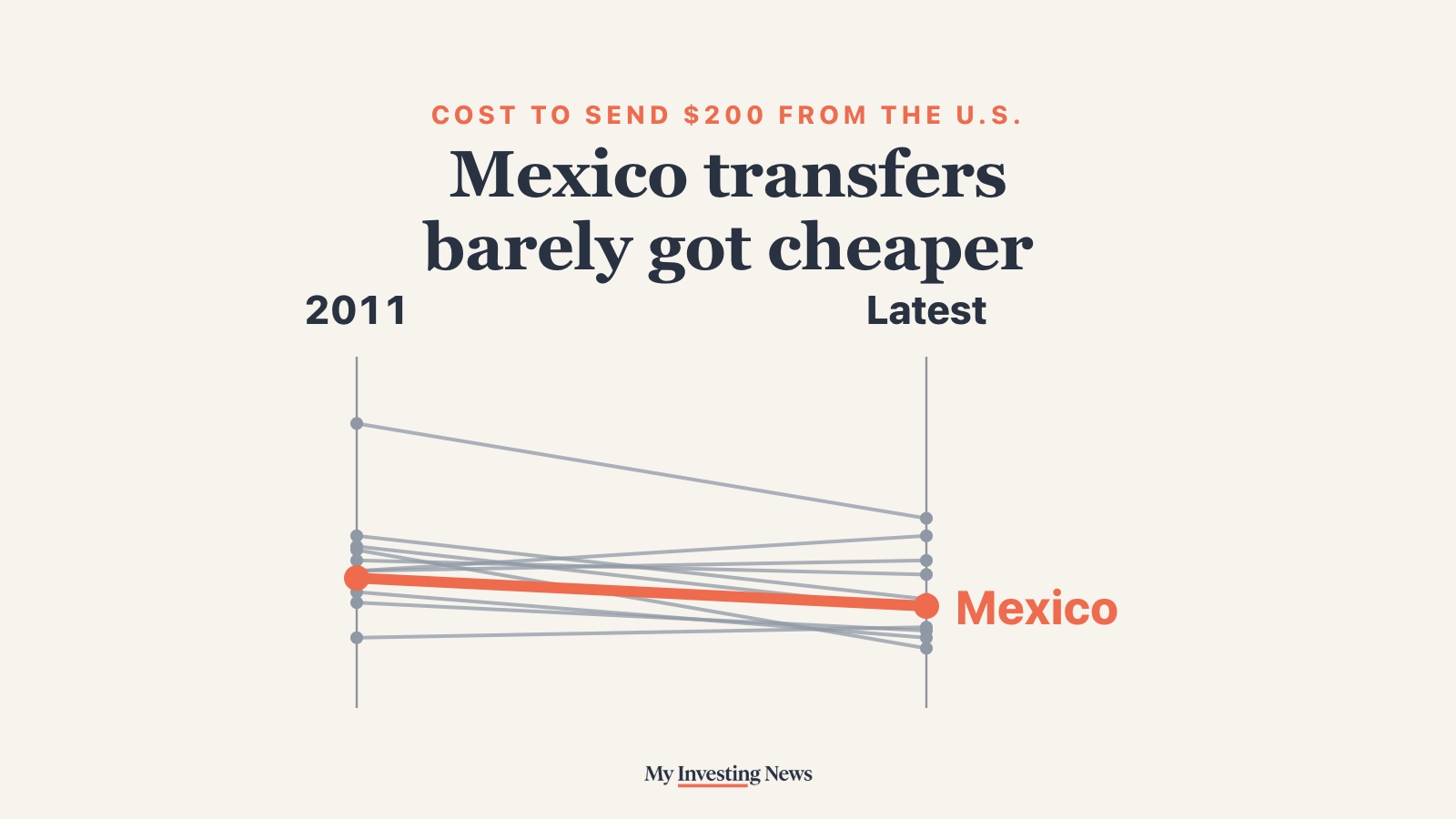
Mexico, which received $65.1 billion in remittances in 2025, shows how slowly the price moves. Sending $200 there from the U.S. cost 5.72% on average in 2011 and 4.90% over the latest four quarters in the World Bank’s dataset (April 2024 to March 2025). Its newest report put the corridor at 4.53% in the third quarter of 2025, still well above the 3% goal.
The price of sending $200
Mexico’s drop was about typical. Among 12 major destinations for money sent from the U.S., the cost fell most for China, from 10.07% to 7.36%, and Nigeria, from 6.45% to 3.74%, about 2.7 points each. It rose for three: India, Colombia and the Dominican Republic.
Sending money to Mexico got cheaper by less than a point in 14 years
Average total cost of sending $200 from the U.S. to 12 major destinations, fees plus exchange-rate markup, as a share of the amount. 2011 against the latest four quarters of World Bank data (April 2024 to March 2025).
Fees Are Most of the Bill
Where does the money go? In the first quarter of 2025, the World Bank priced 46 services from the U.S. to Mexico. The average fee was $7.05, or about 3.5% of $200, and the average exchange-rate markup was 1.45%. So the fee made up about 71% of the cost. Worldwide, the markup was about 31% of the average cost.
Western Union’s own prices in that survey show the range inside one company. Sending $200 to Mexico for cash pickup at an agent cost an $8 fee plus a 1.14% markup, 5.14% in all. Paying online with a card cost $2.99 plus 1.74%, or 3.24%. The cheapest services in the corridor, such as a Wise bank transfer at 1.31%, already beat the UN goal. The priciest was a Citibank account transfer with a $35 fee, 17.5%.
That is the bar for a stablecoin. In the World Bank’s data the expensive part of the market is cash and banks: digital transfers averaged 4.59% worldwide in the third quarter of 2025, against 7.30% for the rest, and banks averaged 14.99%. A token that settles accounts between Western Union and its agents may lower the company’s own cost of moving money between countries. Whether customers see it depends on the fee and the rate on their receipt. Cash senders also pay more now: since Jan. 1, 2026, a 1% federal tax applies to remittances paid for with cash, money orders or cashier’s checks, while transfers funded from a bank account or a U.S. debit or credit card are exempt.
What to Watch
The World Bank publishes with a lag: its report on the third quarter of 2025 came out in April 2026. The next ones will be the first to show prices after USDPT went live and the cash tax took effect. Watch whether Western Union’s own Mexico prices fall, and whether its consumer stablecoin feature, Stable by Western Union, which was slated to reach more than 40 countries in 2026, shows up in the corridors the World Bank tracks. Western Union’s pending purchase of Intermex, which focuses on Latin America, still needed California regulators’ approval as of Nov. 4. The rules around stablecoins matter too, to banks and to the crypto industry. Investor Jordi Visser has argued that stablecoins and tokenization are pushing toward instant settlement, and crypto’s super PACs spent $154 million in the 2026 elections.
Western Union is betting that a stablecoin can modernize how it moves money. The World Bank’s record shows the price of sending $200 fell from 9.67% to 6.36% worldwide, but has stalled above 6% since 2019, and the U.S. to Mexico corridor got cheaper by less than a point since 2011. Fees make up most of what senders pay, so the test for the stablecoin is whether the price on the counter comes down.