Where we heard itCNBC’s Squawk Box, Nov. 5, 2026. Sean Duffy, U.S. Transportation Secretary, interviewed by Morgan Brennan at the Up Summit at Kennedy Space Center.
Two days after the midterm elections, Transportation Secretary Sean Duffy put a date on the government’s rebuild of the air traffic control system. Speaking with CNBC’s Morgan Brennan at Kennedy Space Center on Nov. 5, he said the days of controllers loading data from floppy disks were ending. “We’re a year into this modernization,” he said. Then he set the finish line.
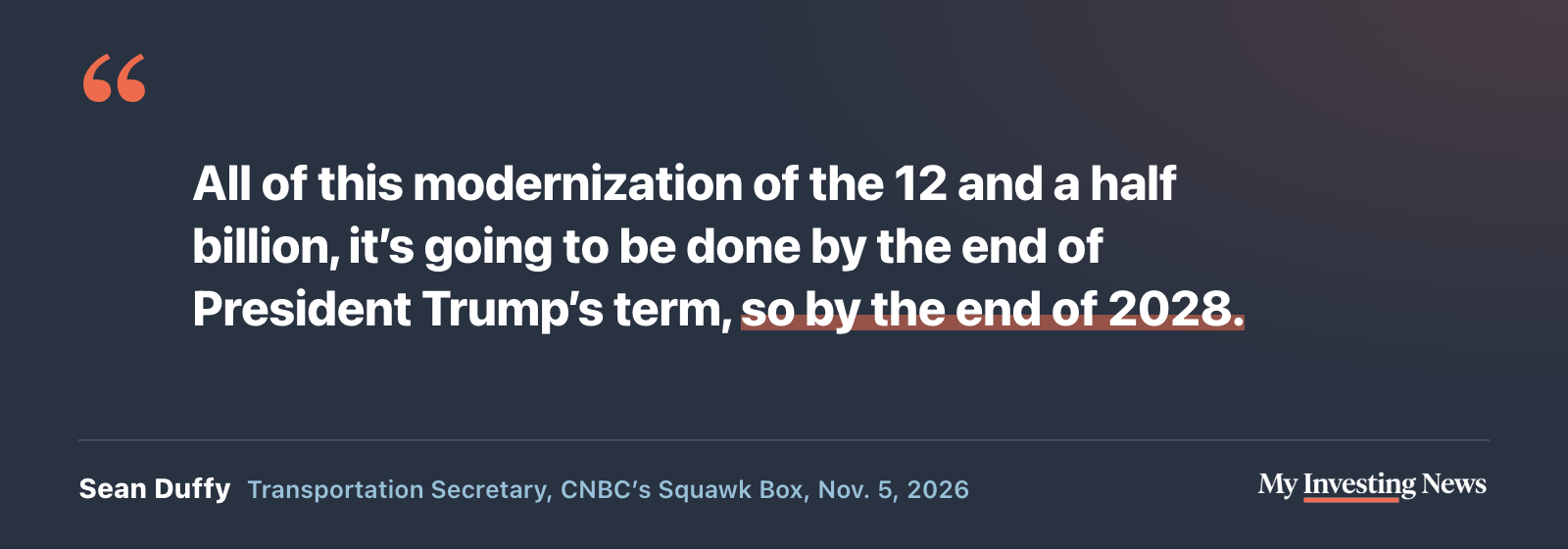
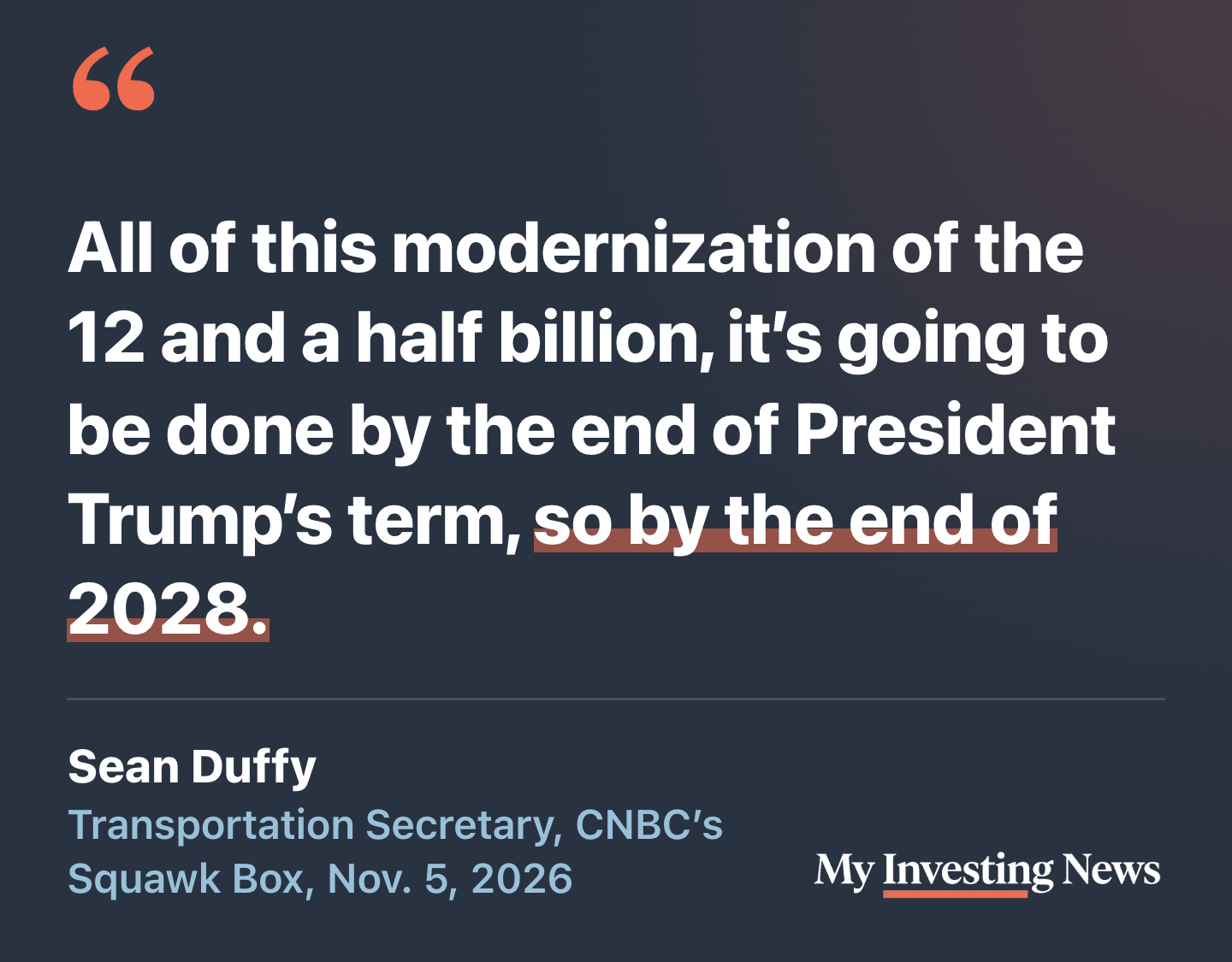
Duffy listed what the money buys: “new radar, new radios, new voice switches,” digital flight strips in place of paper ones, and screens that show controllers every plane and vehicle on the airfield. He also said he has asked Congress for “$30 billion additionally for aviation modernization” and hopes for a bipartisan vote before the new Congress arrives in January. We checked his 2028 date against the Government Accountability Office’s audit of the program and against the Federal Aviation Administration’s record on past overhauls.
The 2028 Date Covers Phase 1
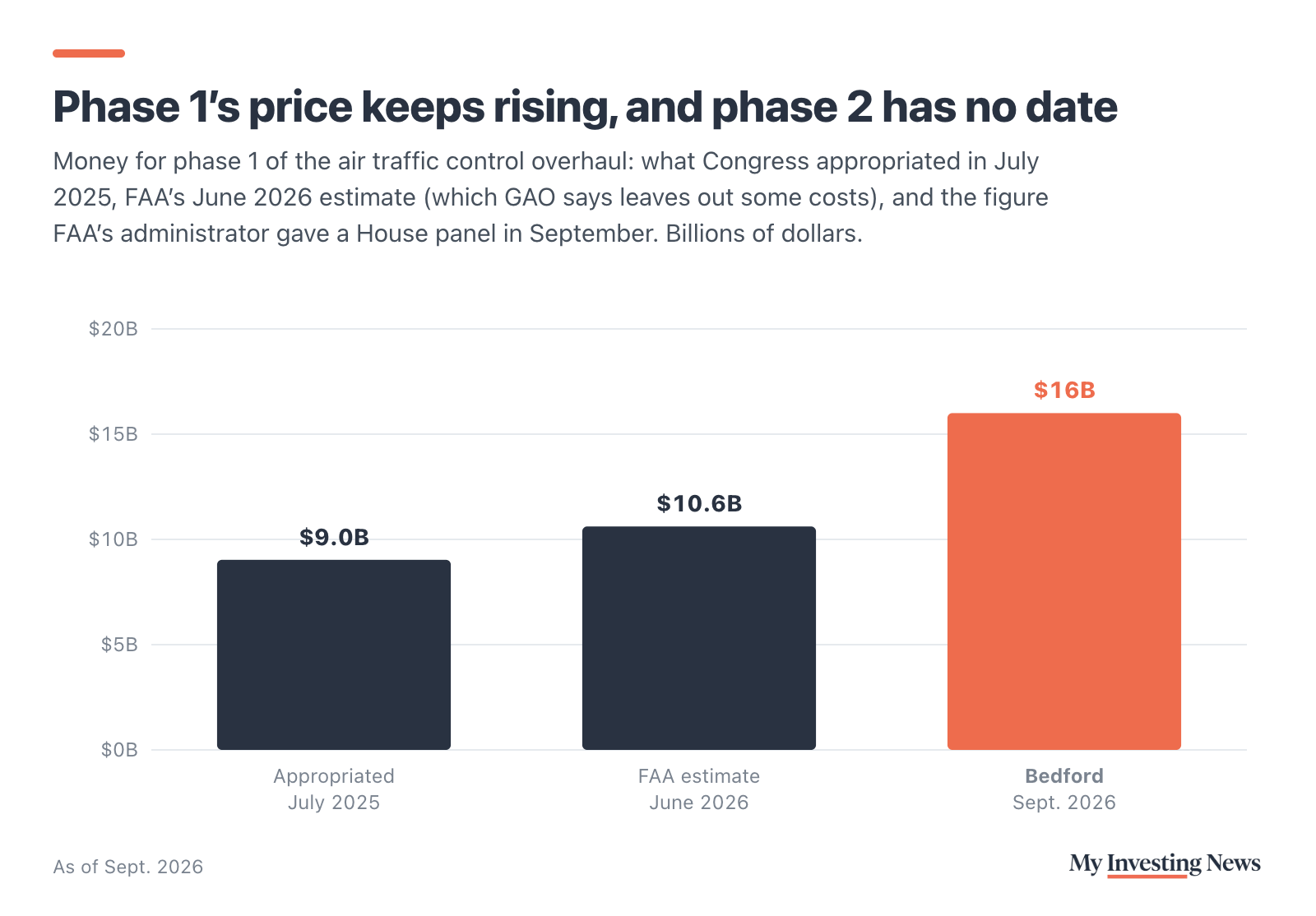
Congress put $12.5 billion into the effort in the July 2025 tax and spending law: $9 billion for new systems and $3.5 billion for facilities. In its Sept. 14 report, GAO says the FAA’s plan, called the Brand New Air Traffic Control System, has two phases. Phase 1 bundles 13 programs, from fiber lines and radios to radars, weather cameras and tower simulators, and is due to be “fully completed by December 2028.” So Duffy’s date matches the FAA’s own schedule for that phase.
Phase 2 is a different story. It is the part that builds the new automation software controllers use to track aircraft, replacing today’s en route and terminal systems, and GAO notes those tools “do not currently exist in the market.” FAA officials told GAO they need about $10.2 billion for it and have no estimated date for when it will start or finish. The finish line Duffy described covers the hardware; the software at the center of the system has no finish line yet.
Nine Years of Work in Three
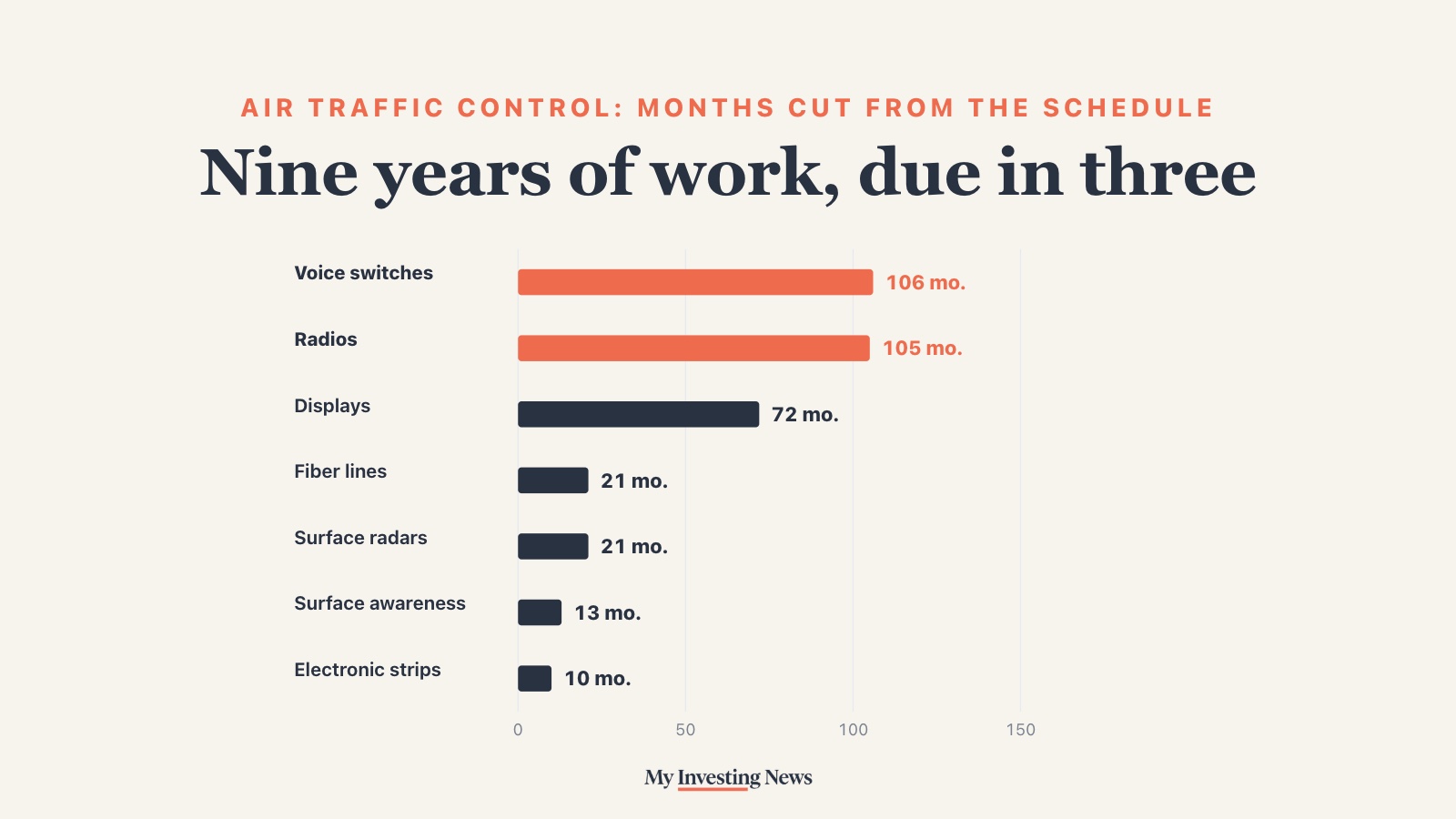
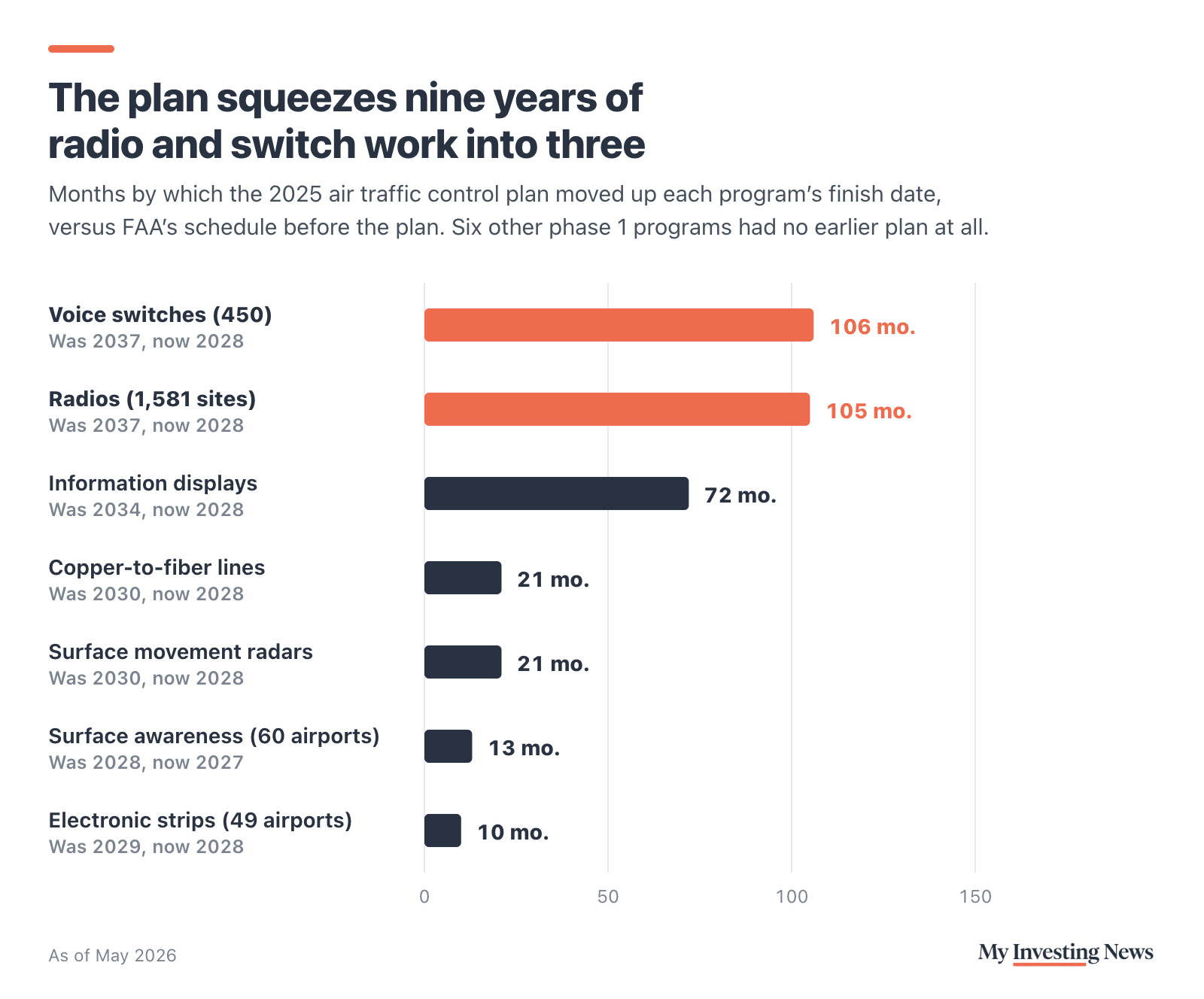
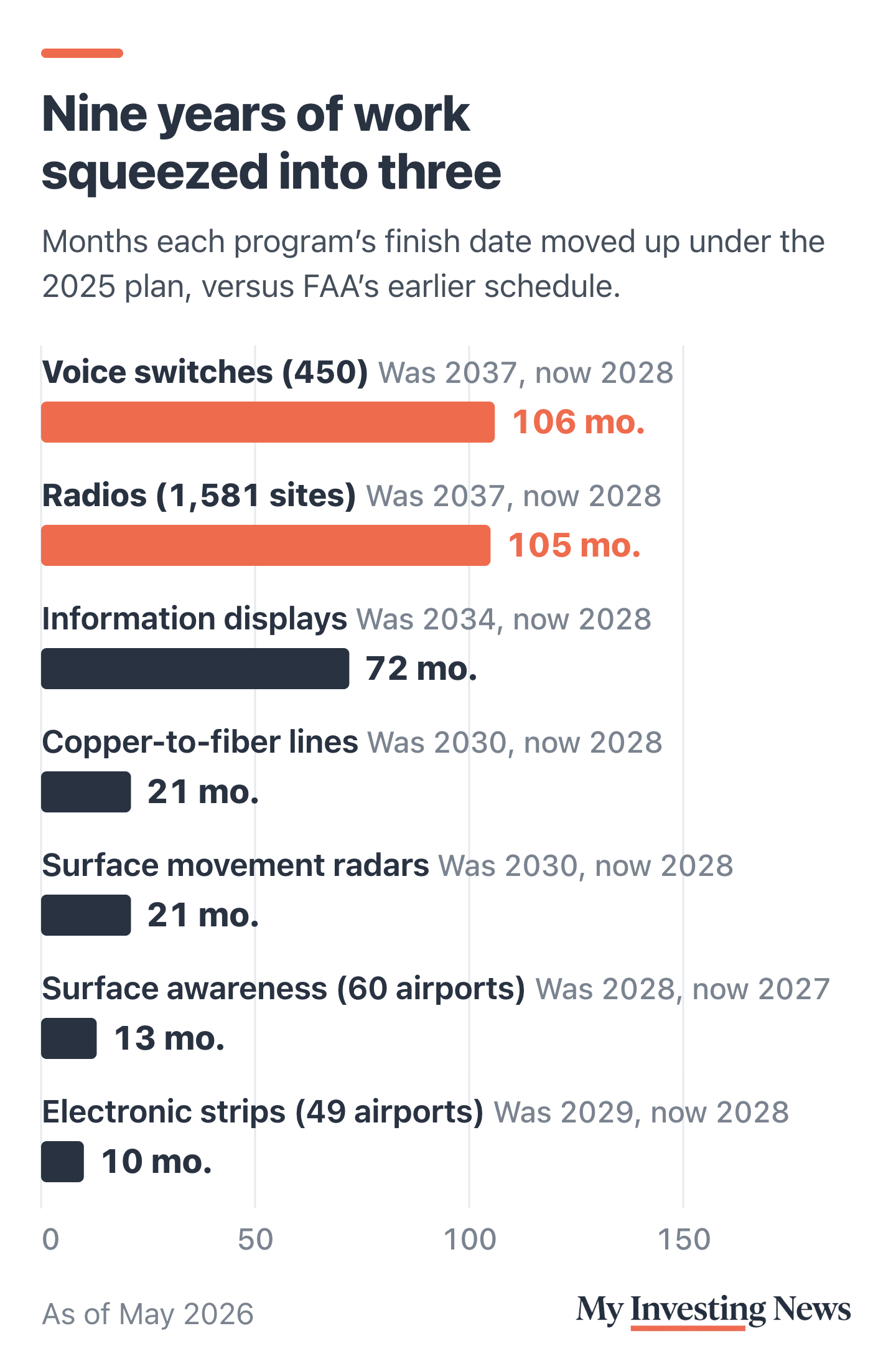
Most of phase 1 speeds up projects the FAA already had. Before the plan, the agency expected to finish replacing radios at 1,581 sites in 2037; now the target is December 2028, 105 months sooner. The 450 voice switches moved up 106 months and the information displays 72. Six of the 13 programs, including new electronics for 612 radars, had no earlier plan at all.
The early numbers show real progress and a long way to go. As of May 2026, the FAA had replaced 2,560 of its 5,170 aging copper lines with fiber and converted 17% of radio sites, GAO says. By March, it had committed $1.8 billion, or 20% of the money Congress provided. In June, it had 30 months left to finish everything else.
The phase 1 rebuild, per GAO (Sept. 14, 2026)
The FAA’s Record on Big Deadlines
GAO’s report recounts the history. In 1982, the FAA released its first comprehensive modernization plan, estimated at about $10 billion with full benefits by the late 1990s. By 1995 the estimated cost had “ballooned to $36 billion,” and GAO put the effort on its high-risk list, where it stayed until 2009. In 2003, GAO wrote that after two decades the work “had not met performance targets and was far from complete.”
NextGen, the FAA’s last big overhaul, was supposed to be finished by 2025. As of GAO’s November 2023 review, the FAA did not expect to finish until at least 2030, after spending more than $14 billion from fiscal 2007 through 2022. Even a recent piece of it, the electronic flight strip system, ran almost three years late and 20% over cost, and its rollout shrank from 89 airports to 49. Big technology deadlines slip elsewhere too: Elon Musk has set 13 robotaxi deadlines since 2019.
This time GAO found two familiar gaps. The FAA has no reliable lifecycle cost estimate, after a blanket waiver from its usual acquisition rules, and its 11,389 project schedules are not tied into one master schedule, so crews can end up working at the same sites again and again. “In essence, the FAA is buying delivery speed at the risk of cost uncertainty and potential disruptions,” GAO wrote. The Transportation Department partially agreed with both recommendations and said cost estimates for every phase 1 program are being built and updated.
What to Watch
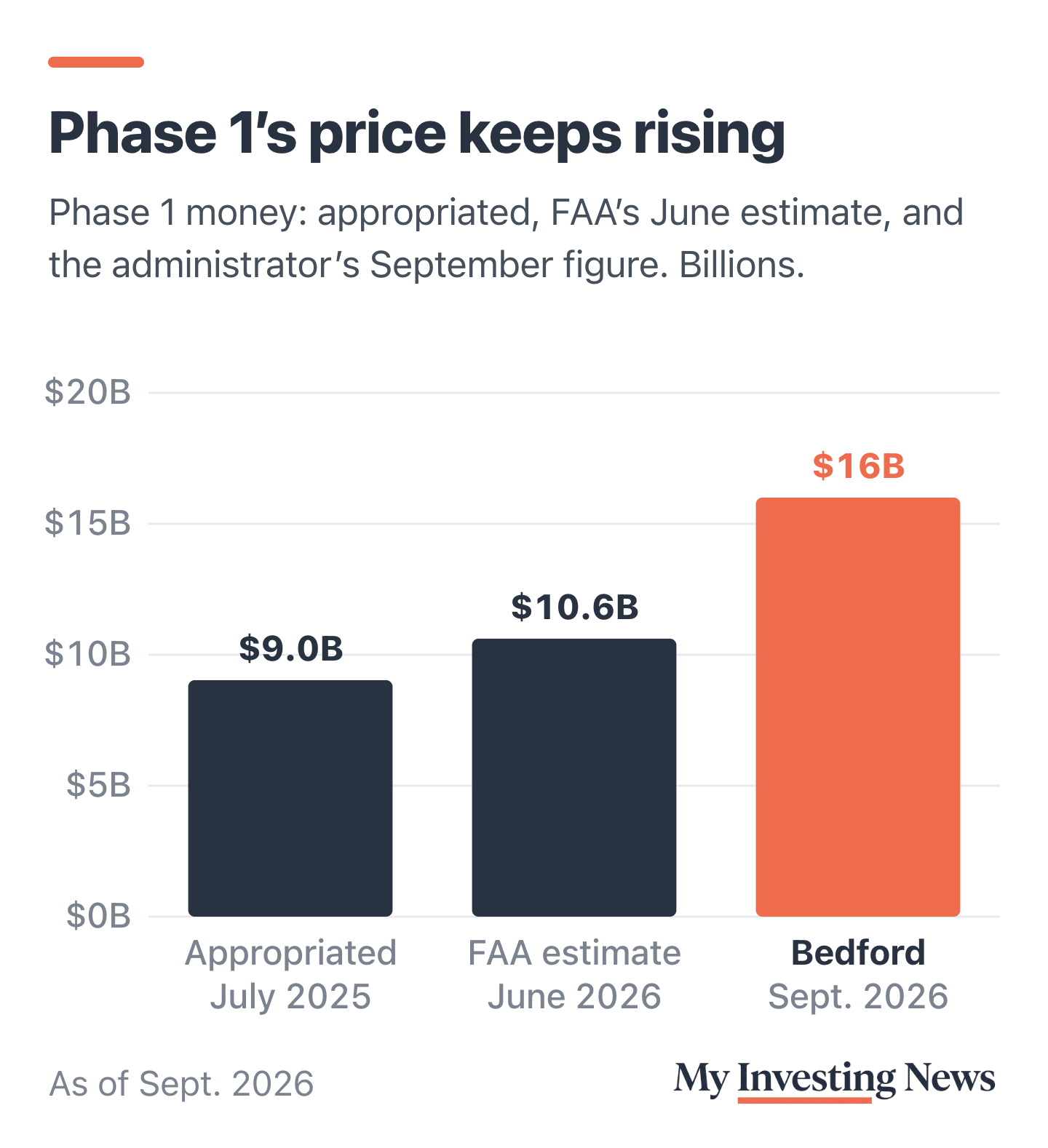
The money is the first test. The FAA’s June estimate put phase 1 at $10.6 billion, against $9.03 billion appropriated; the agency planned to cover $1.0 billion from its regular 2026 budget, leaving $574 million unfunded. GAO says even that estimate leaves out government costs and most operating costs. In September, FAA Administrator Bryan Bedford told a House appropriations panel, “It’s costing $16 billion to do phase one,” Reuters reported, and said the agency was covering the gap from its equipment budget. Whether the lame-duck Congress, or the new one in January, approves Duffy’s extra $30 billion will decide whether phase 2 ever gets a date.
The schedule is the second. FAA officials told GAO that the voice switches carry the highest risk of any phase 1 work, because old and new switches must run side by side for every controller at large towers. The surface awareness rollout to 220 airports is due first, by August 2027, and makes a useful early checkpoint. Delays ripple into airline costs at a time when a former United CEO says fuel costs leave airlines no choice but to raise fares.
Duffy’s end-of-2028 date matches the FAA’s schedule for phase 1, the radios, switches, fiber and radars, and the agency is about halfway through its copper lines. The new automation software has no date and no funding yet, and phase 1’s own price has climbed from $9 billion toward $16 billion. GAO’s warning is that the FAA has missed big modernization deadlines for four decades and is now moving faster without a full cost estimate or master schedule.