Where we heard itTesla’s third-quarter earnings call, Oct. 21, 2026, with CEO Elon Musk, and the Texas Department of Motor Vehicles’ automated motor vehicle lookup for Tesla Robotaxi, LLC, checked the evening of Oct. 27, 2026.
TeslaTSLA CEO Elon Musk has a new long-range target for the robotaxi business. On the company’s Oct. 21 earnings call, he said that unless governments stop it, Tesla will end up doing “a majority of all passenger miles on Earth,” and he made the same claim on X the next day.
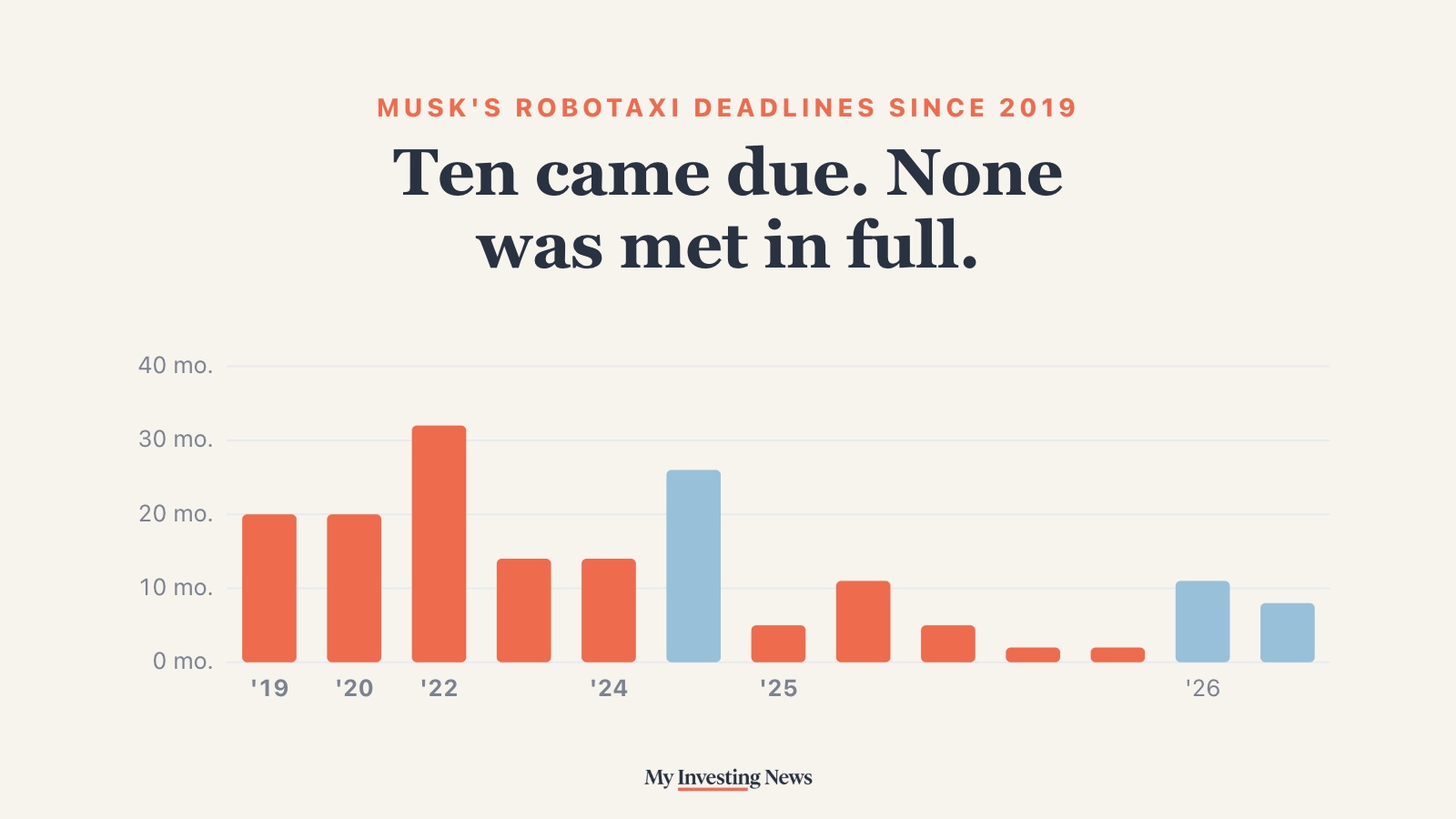
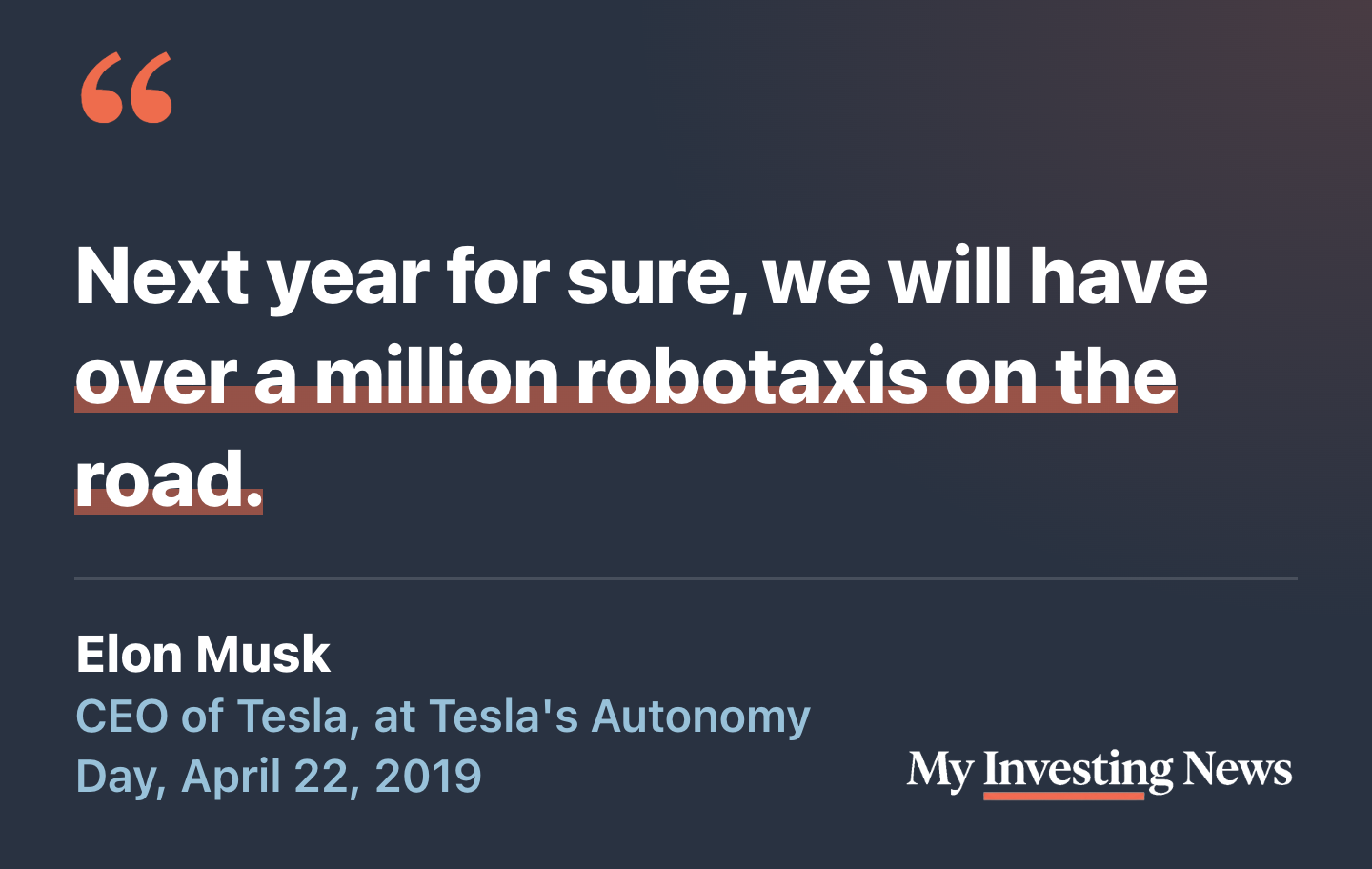
Musk has put dates on Tesla’s robotaxi plans many times before. We went back through his statements since 2019, mostly on Tesla’s own earnings calls, and counted 13 times he gave a date for robotaxi rides, driverless operation or robotaxi production. None of the 10 that have come due was met in full. The first was the biggest:

Thirteen Deadlines, One Pattern
Musk said it at Tesla’s Autonomy Day on April 22, 2019, and repeated the 2020 target on the earnings call two days later. Our count includes only dates Musk set himself. We left out restatements of a date he had already given, a hedged 2024 remark that unsupervised driving might arrive that year, and the dates two other Tesla executives gave on the October call. His 2016 promise of a coast-to-coast self-driving demonstration by the end of 2017 is left out too, because it wasn’t a robotaxi plan. It also never happened.
The early deadlines gave Tesla well over a year. In April 2020 he said a robotaxi network could run the next year. In April 2022 he said Tesla aimed for robotaxi volume production in 2024. In October 2022 he said he had no doubt driverless operation would come in 2023. The more recent ones were much closer. In October 2025, he gave Tesla about two months to remove safety drivers from large parts of Austin and to reach eight to 10 metro areas.
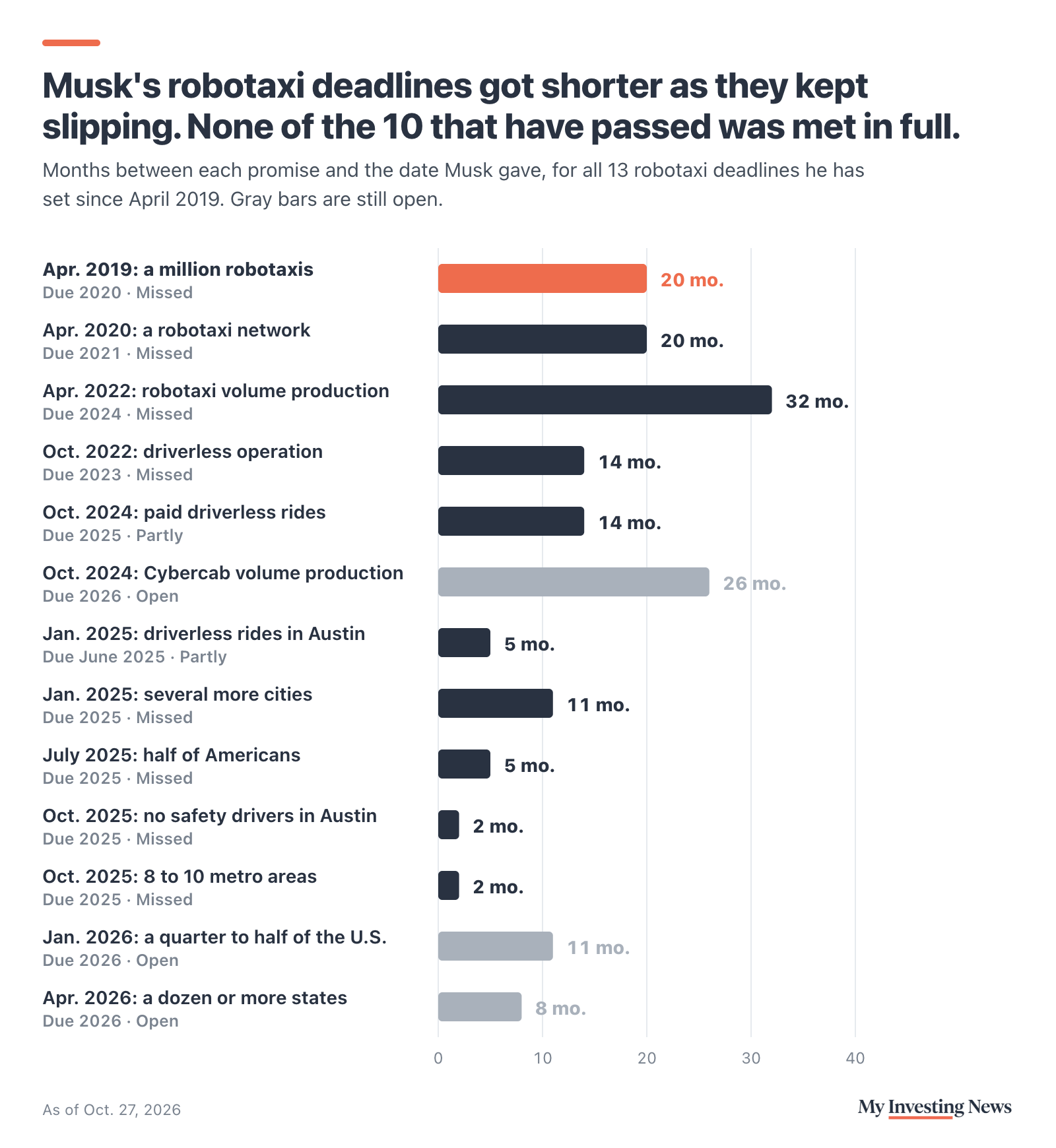
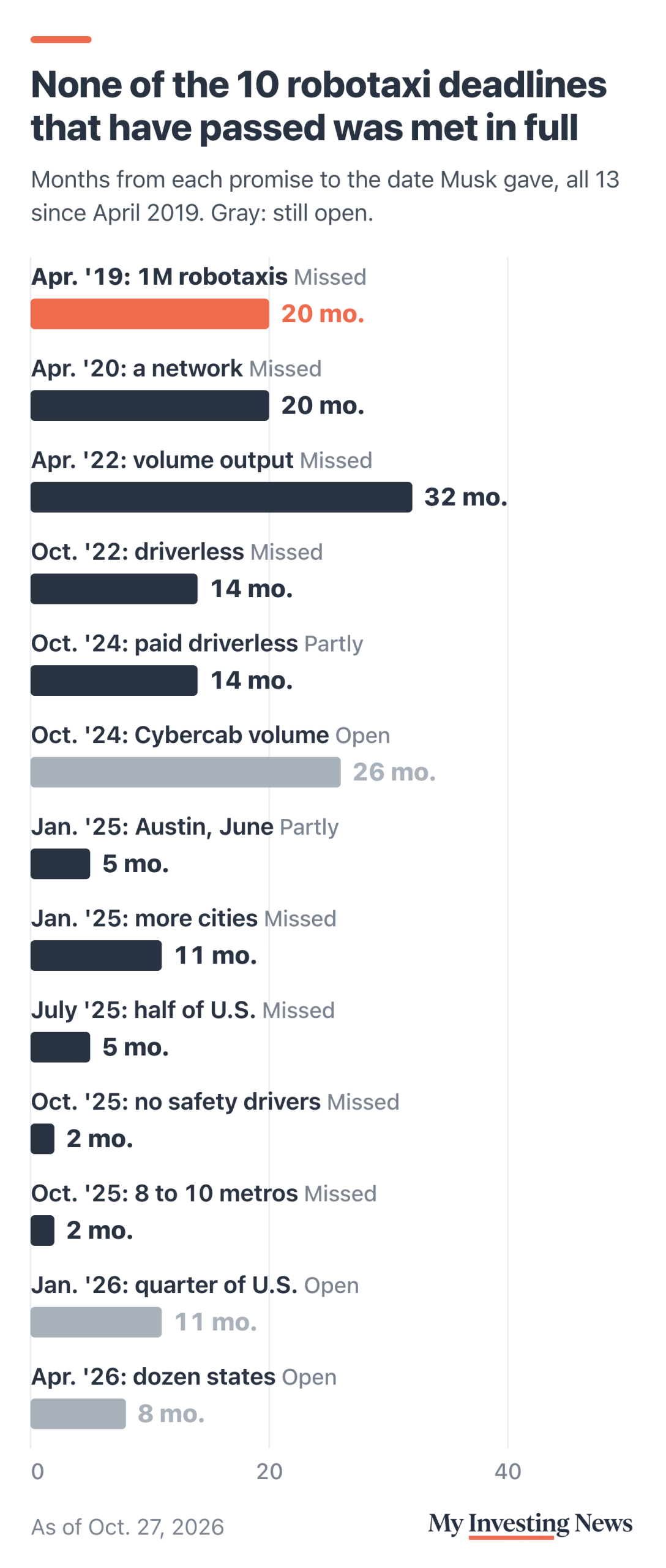
Tesla’s first paid robotaxi rides started in Austin on June 22, 2025, with a Tesla employee in the passenger seat. That met the month of Musk’s January 2025 promise, but not the “no one in the car” part, which arrived on Jan. 22, 2026, about three weeks after the end-of-2025 date he had given for removing safety drivers. At the end of 2025, Tesla ran service in Austin and the San Francisco Bay Area, two metro areas, the Bay Area with an employee in the driver’s seat. That leaves eight deadlines missed and two partly met. Paid rides in the Cybercab, the two-seater with no steering wheel, began in Austin on Sept. 3, 2026.
Musk has acknowledged the pattern. On the April 2020 call, he said timing was not his strength but that what he promises gets done in the end, even if late.
What Texas Shows
Texas began requiring a state authorization for commercial driverless vehicles this year, and Tesla Robotaxi, LLC received its authorization on May 14, 2026. Each company keeps a list of its vehicles on the state’s public lookup. On Oct. 27, Tesla-focused commentator Sawyer Merritt posted that the Cybercab had passed the Model Y in Tesla’s Texas robotaxi registrations, 544 to 507, for a total of 1,051.
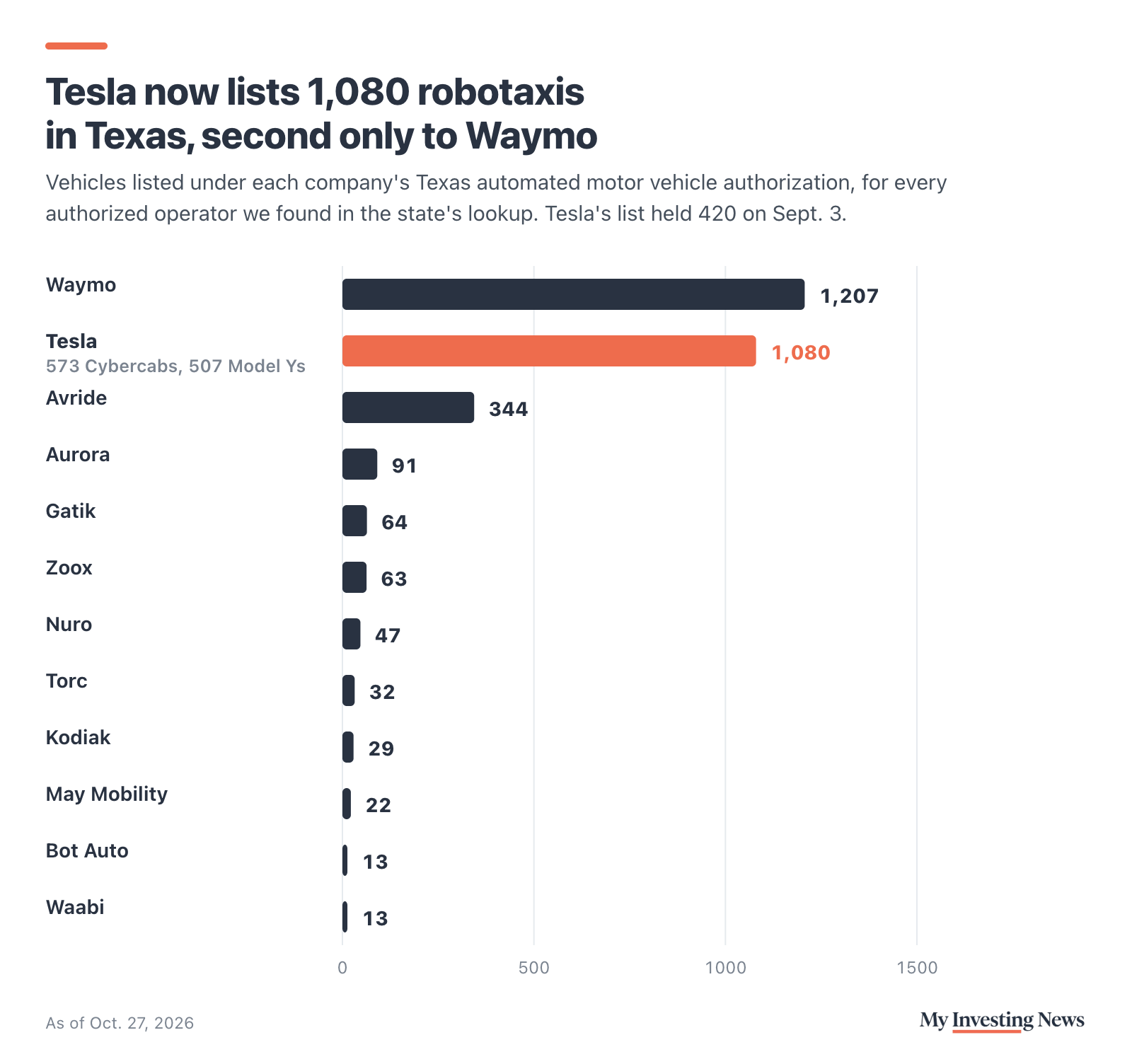
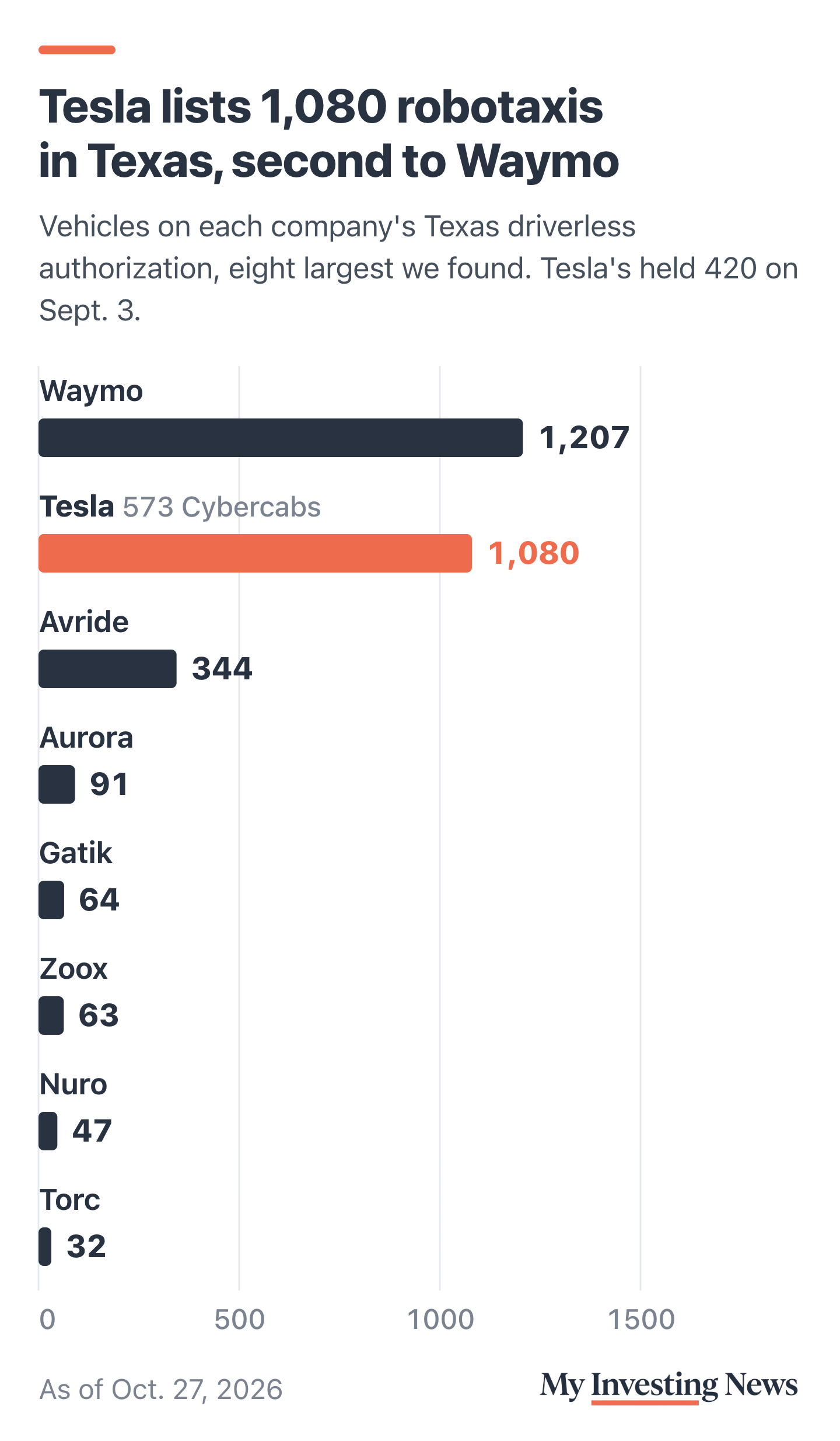
We pulled the full list from the state’s system that evening. It held 1,080 vehicles: 573 Cybercabs and 507 Model Ys. An archived copy of the same lookup from the evening of Sept. 3, the day Cybercab rides began, showed 420. A listing is not a car on the road, though. The state list doesn’t say how many of those vehicles are giving rides on a given day.
Musk’s robotaxi record, as of Oct. 27, 2026
Next to Waymo and the Rest
Among the authorized operators we found in the state’s lookup, Tesla’s list is now second-longest. Alphabet’s Waymo lists 1,207 vehicles. Avride lists 344, and Amazon’s Zoox lists 63. Self-driving truck companies such as Aurora and Kodiak hold smaller lists.
Tesla’s own numbers show the service growing fast from a small base. Its third-quarter update said the robotaxi fleet had driven nearly two million cumulative unsupervised miles by Sept. 30, eight times the total three months earlier. On the July call, Ashok Elluswamy, Tesla’s vice president of AI, said unsupervised rides ran in six cities in two states.
Analysts are watching the supervised side too. Gene Munster of Deepwater Asset Management, eyeballing a chart in Tesla’s update on CNBC’s “Fast Money” on Oct. 21, estimated that miles driven on Full Self-Driving (Supervised) rose about 190% from a year earlier in the September quarter. “This is an inflection point that’s going on,” he said.
The stock hasn’t waited for the dates. Tesla closed at $407.46 on Oct. 27, about 23 times its split-adjusted $17.52 close on Autonomy Day, though it is down 9.4% this year. Some holders are all in: one told CNBC he had borrowed $147,000 against his Tesla stock. Patience runs through Musk’s other big company too, where a fund manager adding to his SpaceX stake says he’s thinking 30 years out.
What to Watch
Three of Musk’s deadlines run to Dec. 31, 2026. In October 2024, he said the Cybercab would reach volume production this year, though Tesla dropped it from its 2026 volume-production list in July. In January, he said fully autonomous Teslas would reach a quarter to half of the U.S. by the end of the year, and in April he said unsupervised service would reach probably a dozen states or more. As of the July call, it was in two.
On the October call, Elluswamy said Tesla would launch in Dallas in November. The Texas list updates as Tesla adds vehicles, and it is the quickest public check on how fast the fleet is growing.
Musk has set 13 robotaxi deadlines since 2019, and none of the 10 that have come due was met in full, though the closest miss was about three weeks. Texas now lists 1,080 Tesla robotaxis, second only to Waymo. The risk for investors is the gap between a registry count and a fleet carrying riders across the country, which three open deadlines say should close by Dec. 31.