Where we heard itThe Ramsey Show, “Don’t Let Guilt Call The Shots On Your Finances,” Oct. 27, 2026. Speaker: George Kamel, co-host. Data: 2026 Social Security Trustees Report and every annual report since 1983.
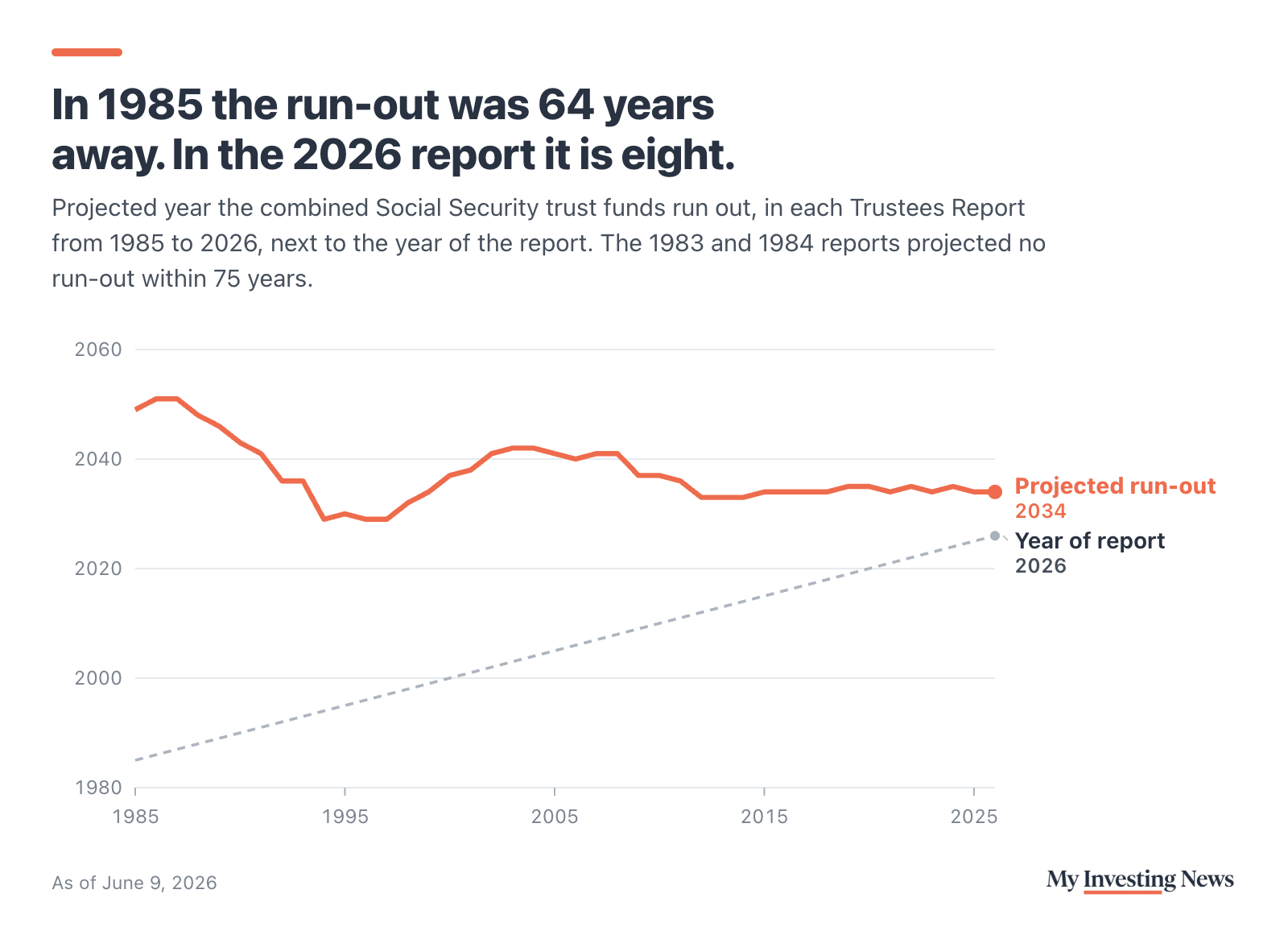
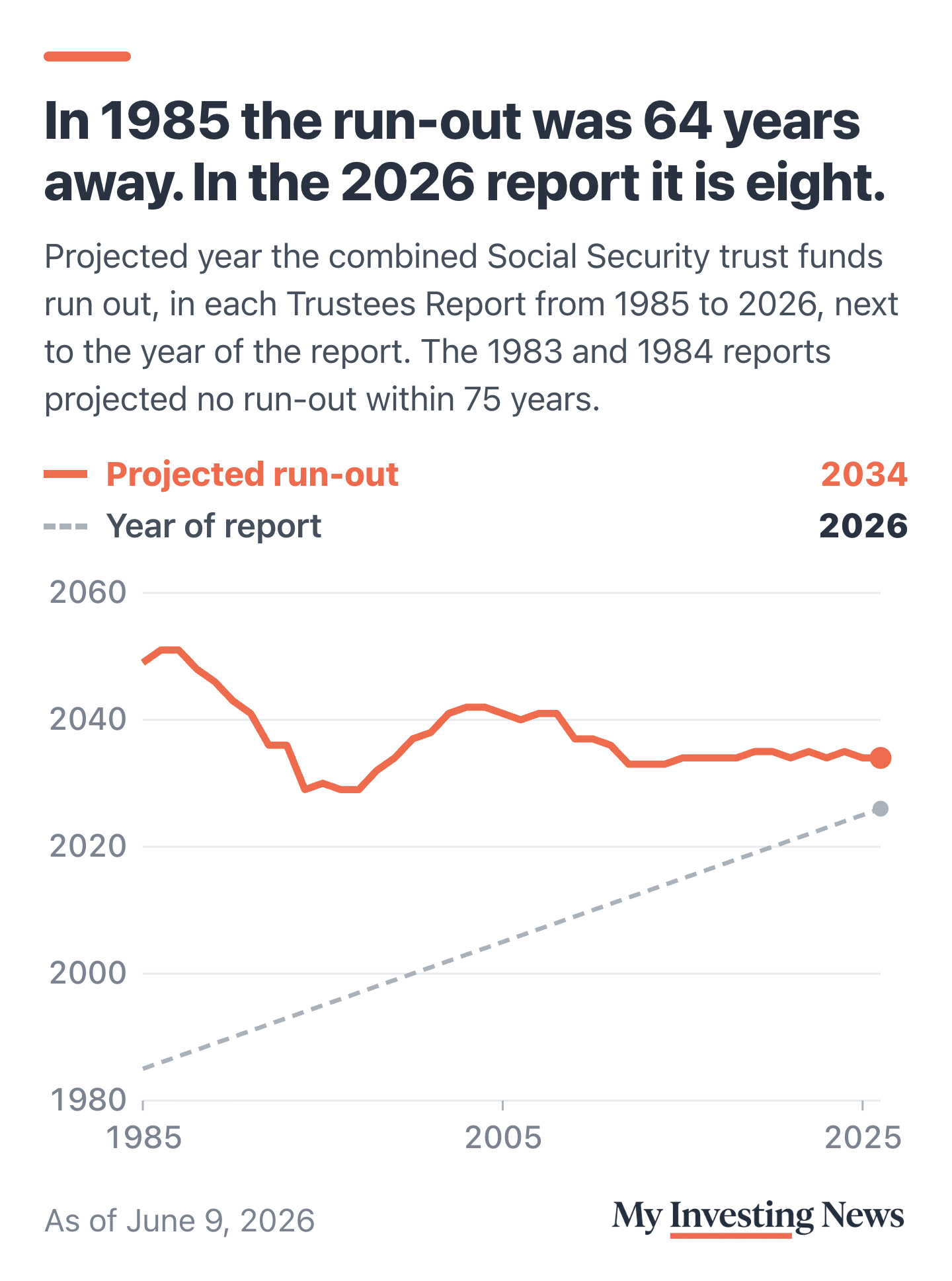
Every year, Social Security’s trustees publish a forecast of when the program’s trust funds will run dry. We pulled all 44 of them, from the 1983 report that followed that year’s rescue law through the 2026 report released June 9. The projected run-out year for the combined retirement and disability funds has changed 29 times. After its first date in 1985, it moved earlier 15 times and later 13 times, and it has ranged from 2029 to 2051.
The forecasts matter most to younger workers, who will pay in for decades before collecting. On the Oct. 27 episode of The Ramsey Show, co-host George Kamel gave them blunt advice.


Kamel said benefits “could be cut down by, I think, 2034 by about 22%.” Both numbers appear in the 2026 report, but for different funds. The combined funds run out in 2034, after which incoming taxes would cover 83% of scheduled benefits, a 17% cut. The retirement fund on its own runs out in late 2032, when it could pay 78%, a 22% cut.
Every Forecast Since 1983
The 1983 and 1984 reports projected that the funds would last the full 75 years they cover. In 1985, the trustees found a computational error in how they projected the ages of future immigrants, and the combined funds got a run-out date for the first time: 2049.
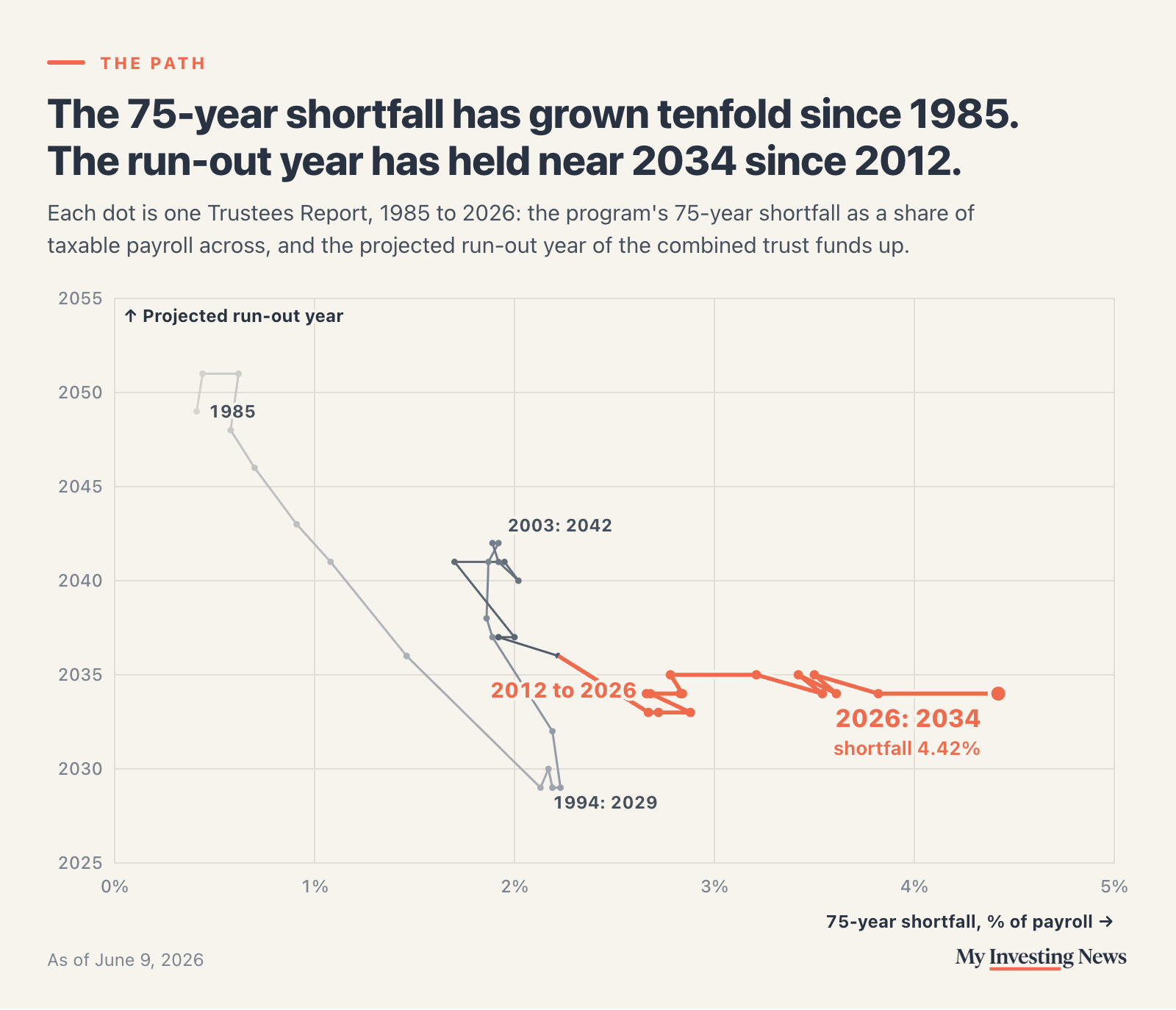
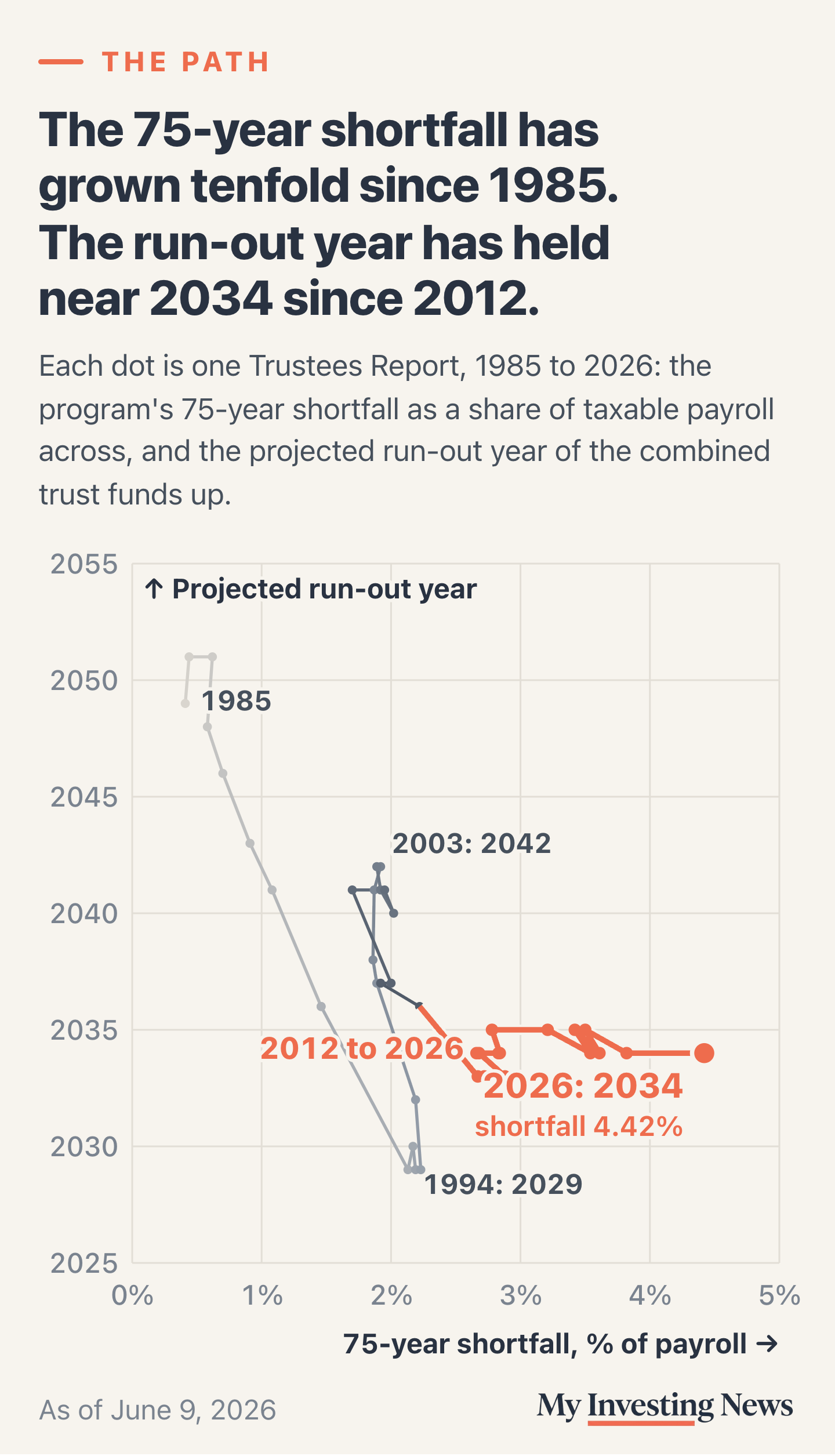
From there the date mostly slid closer through the early 1990s, with the biggest single drop in 1994, when updated data on new retirees’ earnings raised projected benefits and the trustees cut their long-run wage growth assumption. That report put the run-out at 2029. The late 1990s boom pushed it back out, to 2042 by 2003. The Great Recession pulled it in again, to 2037 in 2009 and 2033 by 2012.
Since 2012, the forecast has barely moved. All 15 reports from 2012 through 2026 put the run-out between 2033 and 2035, and from 2021 to 2025 it flipped between 2034 and 2035 every year. What has changed is the distance. In 1985 the run-out was 64 years away. In the 2026 report it is eight.
The Date Held. The Shortfall Did Not.
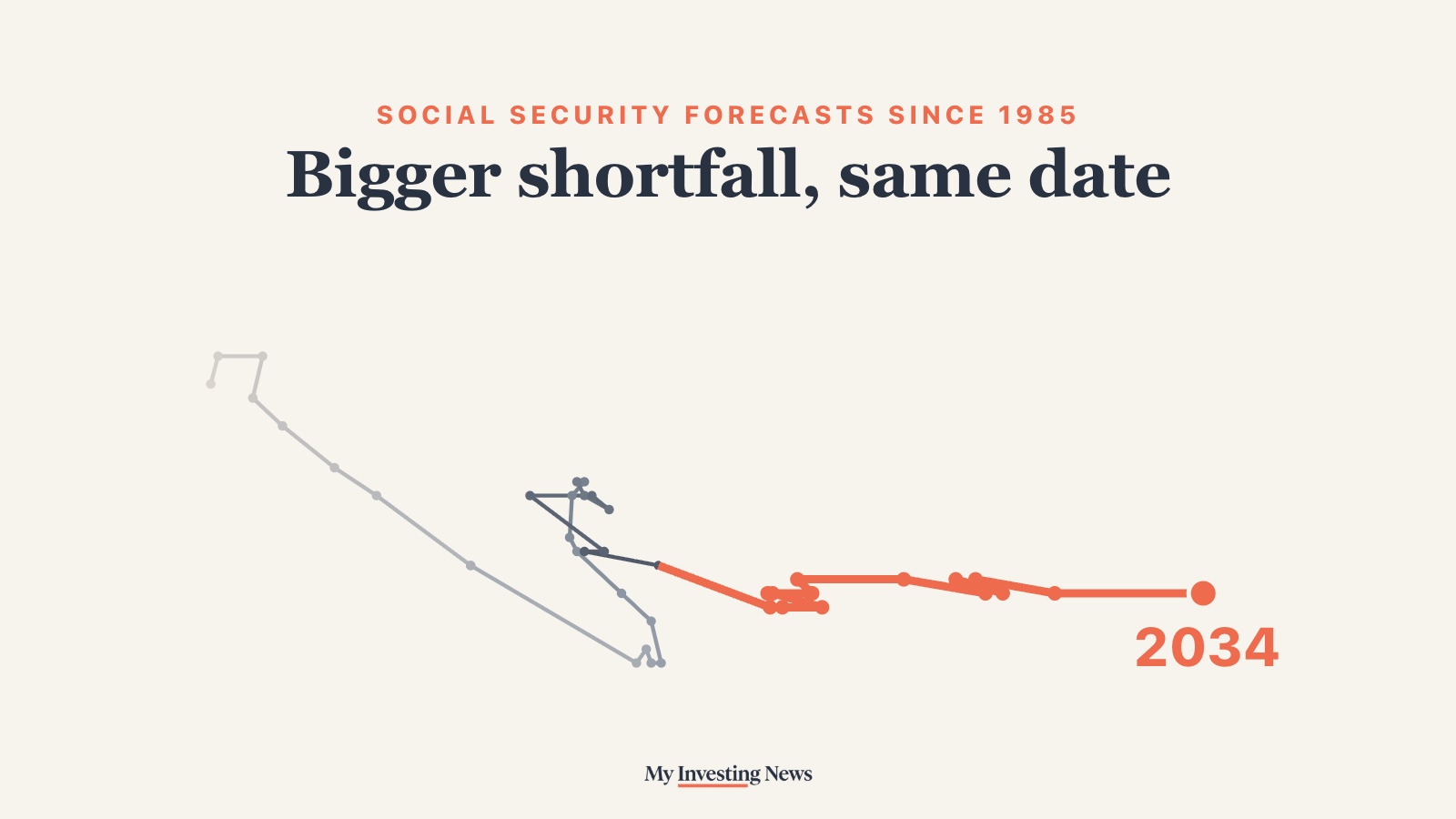
A steady date can hide a worsening long-term picture. The trustees also measure the program’s gap over the full 75 years as a share of taxable payroll. That shortfall was 0.41% in the 1985 report. In 2026 it is 4.42%, up from 3.82% a year earlier, the biggest one-year jump since 1994.
The 2026 report blamed mostly a lower assumed birth rate, cut from 1.90 to 1.75 children per woman, along with lower immigration and a new tax law that reduces income from taxing benefits. Fewer births hurt decades from now, which is why the near-term date stayed put. An SSA actuarial note from June traces about 56% of the growth in the shortfall since 1983 to the calendar itself: each new report drops a year of surplus from the front of its 75-year window and adds a year of deficit at the end.
What Workers Under 40 Can Count On
Running out of reserves does not mean checks stop. Payroll taxes keep coming in, and under current law benefits would be cut to what those taxes cover. The trustees say that is 83% of scheduled benefits in 2034, sliding to 65% by 2100.
For today’s younger workers, the report’s own figure data give a rough path. Someone who is 39 now turns 67 in 2054, when incoming taxes would cover roughly three-quarters of scheduled benefits. A 25-year-old turns 67 in 2068, when the share is roughly 70%. Those figures assume Congress does nothing. It has stepped in before: the 1983 rescue law passed when the combined reserves covered 14% of a year’s costs, and a 2015 budget law shifted payroll tax to keep the disability fund paying in full.
Social Security’s finances in the 2026 Trustees Report
The reserves themselves are draining fast. At the start of 2025, the combined funds held enough to pay 169% of a year’s costs, down from a peak of 358% in 2008. Kamel’s warning goes further than the trustees’ math, which points to a cut of roughly a quarter or more for today’s younger workers if nothing changes, not a zero. That leaves more of retirement riding on personal savings, at a time when Americans are saving less of what they earn and lower earners got raises and still got poorer.
What to Watch
The next Trustees Report is due in 2027. Two things to watch: whether the run-out year finally breaks out of the 2033 to 2035 range it has held since 2012, and whether Congress moves on taxes, benefits or both before the retirement fund’s late-2032 deadline. Meanwhile, the 3.6% cost-of-living raise lifts the average retired worker’s monthly check from an estimated $2,095 to $2,170 in January.
The trustees have moved Social Security’s run-out date 29 times in 44 reports, from as late as 2051 to as early as 2029, and it has sat near 2034 for 15 years. Without a fix, workers under 40 would still be paid roughly 70% to 75% of scheduled benefits, far more than Kamel’s advice to “pretend like it doesn’t exist” implies. The risk is that the 75-year shortfall keeps growing even when the date holds.