Where we heard itBarron’s Streetwise podcast, “Does Show Business Work?” Released Oct. 23, 2026. Speaker: Barron’s writer Jack Hough. Listen at Barron’s
Does regular show business still work? Barron’s writer Jack Hough asked that question on the Barron’s Streetwise podcast episode “Does Show Business Work?” released October 23, 2026. He opened with the viral, user-generated “comments videos” spreading online, then offered an example from his own home: his preteen son “overwhelmingly prefers YouTube videos.”
That puts NetflixNFLX ahead of legacy Hollywood. It also acknowledges that AppleAAPL, AmazonAMZN and AlphabetGOOGL play by different rules.
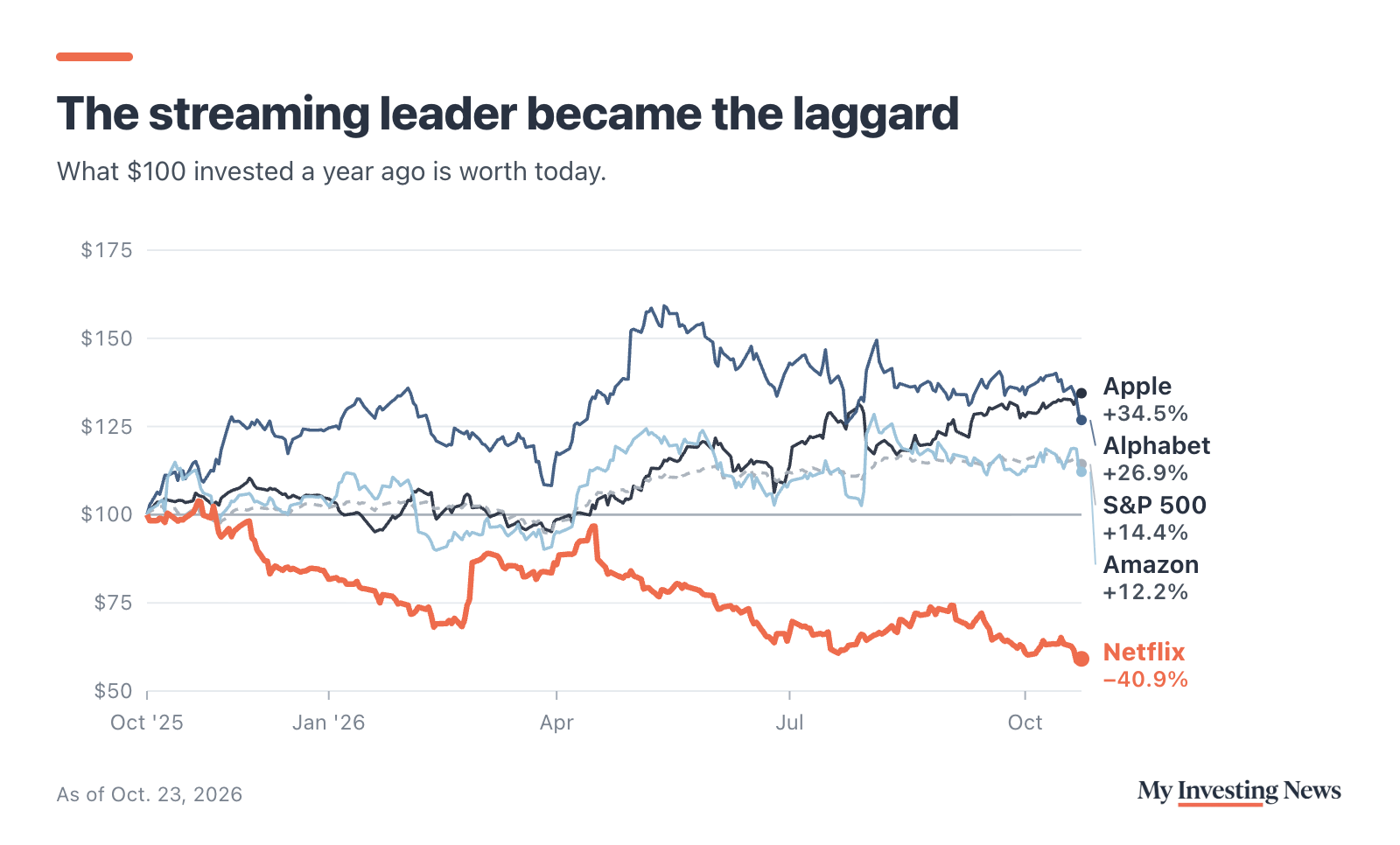
A Painful Year for Netflix Shares
Jack Hough noted that “Netflix stock was recently down 29% for the year.” The big tech trio has done better. A former Netflix insider has pointed to internal challenges as the stock slid to a two-year low.
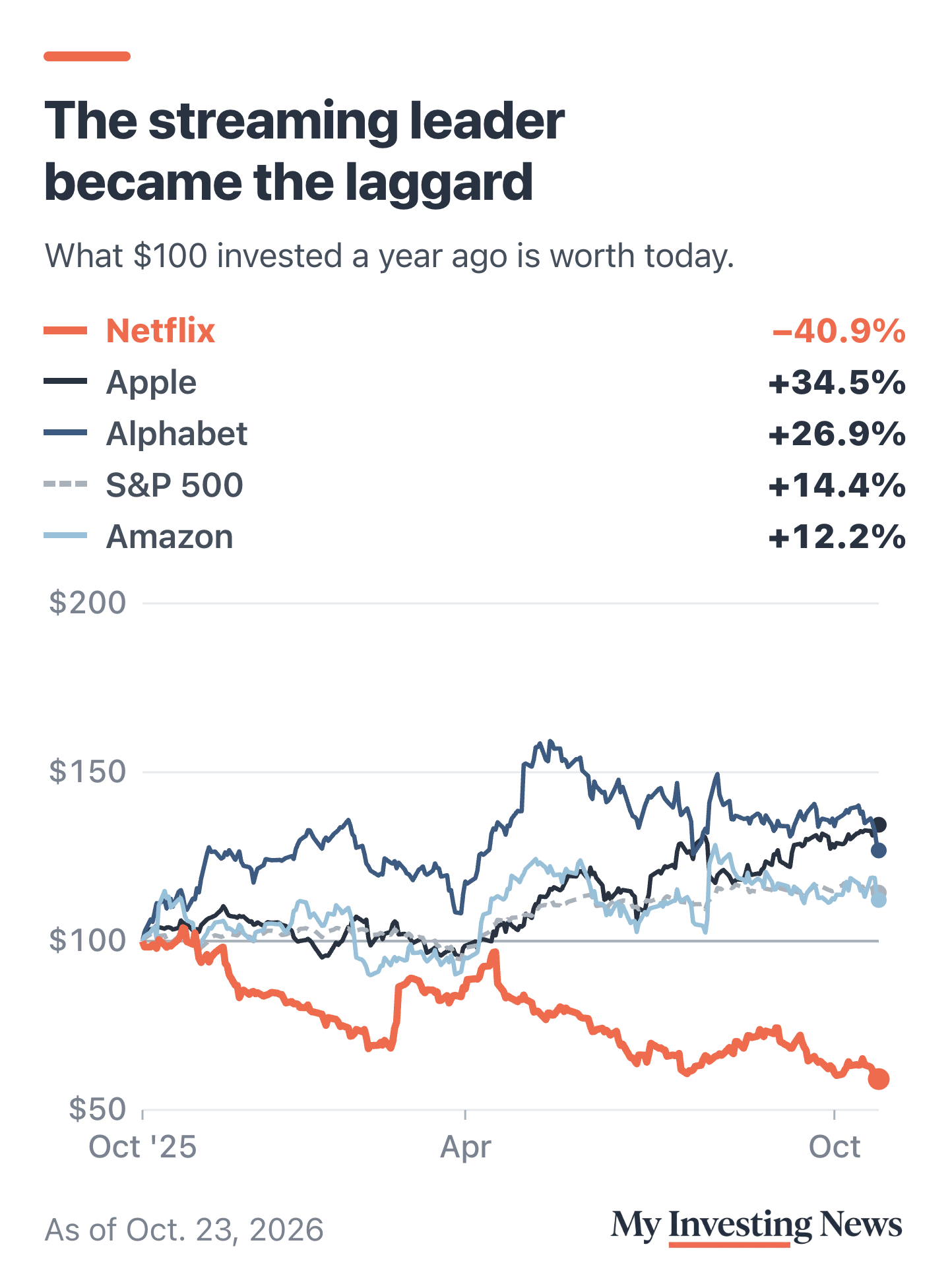
Netflix’s third-quarter shareholder letter did little to change the mood. Revenue of $12.87 billion was roughly in line with expectations, while earnings per share of $0.87 beat the $0.82 consensus estimate. Management trimmed its 2026 advertising revenue outlook to roughly $2.7 billion from about $3 billion, citing a slower-than-expected rollout of some ad product features.
Profit Margins Legacy Hollywood Can’t Match
Jack Hough said “Netflix’s 31% operating margin is more than 10 points higher than Disney’s. That’s even counting those lucrative theme parks.” He added that “Netflix’s profitability recalls the golden age of cable television.” DisneyDIS and other legacy operators, by his account, are trading cable subscribers for streaming ones at “single-digit margins.”
Operating margin measures how much of each sales dollar is left after paying for content, staff and marketing. Netflix’s third-quarter margin expanded to 34.6% from 28.2% a year earlier, and the company forecasts 31.5% for the full year. Disney’s filings back up Hough’s gap: its total segment operating margin was 19.3% for the first nine months of its fiscal year.
Third quarter at a glance
One Platform, One Budget
By Jack Hough’s count, Netflix’s $17 billion to $18 billion content budget funds a single platform. Rivals spread similar or bigger amounts across several services, sports deals and theatrical releases.
Company filings put some rivals’ spending higher than Hough’s round numbers. Amazon reported $22.4 billion in video and music expense for 2025, and YouTube says it has paid creators, artists and media companies more than $100 billion over the past four years.
Netflix’s focus shows up in free cash flow, the cash left over after operating costs and capital spending. Hough cited Wall Street estimates of about $12 billion this year, in line with Netflix’s own forecast, which it trimmed from $12.5 billion on Oct. 20, rising to $21 billion by the end of the decade. Netflix bought back 63.9 million shares for $4.8 billion last quarter, its largest quarter of buybacks ever.
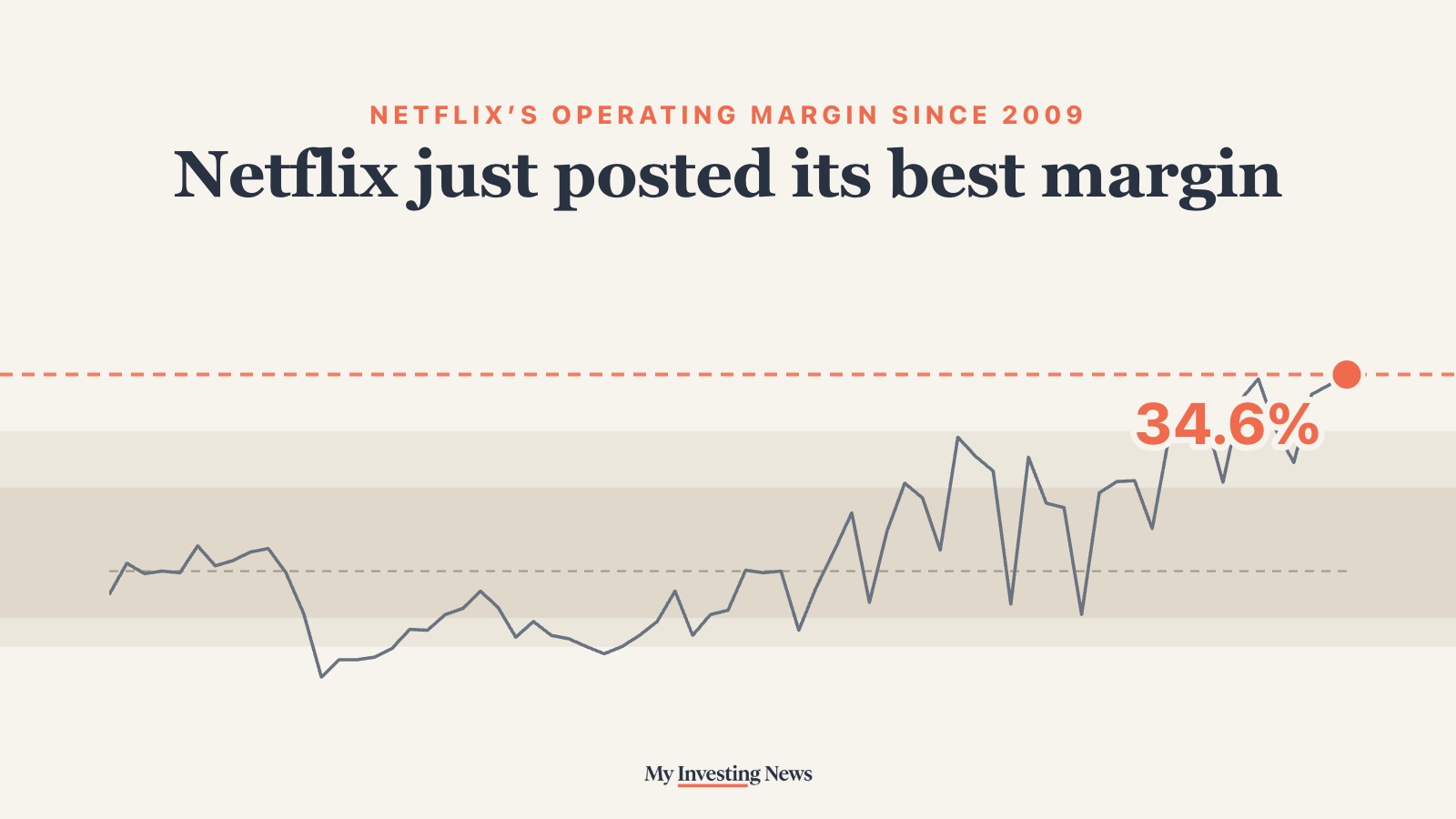
Netflix’s high margins are also fairly new. The company kept less than 5 cents of each sales dollar as operating profit in 2015 and 2016, according to its SEC filings. The third quarter’s 34.6% was its highest for any quarter since at least 2009.
Netflix’s 34.6% third-quarter margin was its highest since at least 2009
Netflix’s operating margin, the share of revenue left after operating costs, every quarter since 2009. The shaded bands hold the middle half and the middle 80% of all 71 quarters.
Big Tech Treats Entertainment as a Perk
Hough said big tech "does show business as a side perk for its bundled services subscribers." According to Jack Hough, YouTube spends roughly $18 billion a year on revenue sharing. Under that model, creators get paid a cut after their videos earn ad money. YouTube never pays upfront for a show that flops, so its costs move in step with its revenue.
Jack Hough put Amazon’s content spending above $15 billion and pointed to its "growing appetite for sports." On Amazon’s most recent earnings call, CEO Andy Jassy said ad inventory on Thursday Night Football, NBA, WNBA and NASCAR was "all sold out." Hough added that "Apple has a total content budget of close to $10 billion, and it cleans up on awards." On Apple’s July earnings call, then-CEO Tim Cook cited a record 89 Emmy nominations.
What Investors Should Weigh
On trailing earnings, Netflix trades at about 19 times, compared with roughly 16 for Alphabet, 20 for Amazon and 40 for Apple. Those multiples need context: Netflix’s recent earnings include a $2.8 billion breakup fee from its abandoned Warner Bros. deal, and Alphabet’s and Amazon’s include large one-time gains on investments. Each rival also has a growth engine outside entertainment. Google Cloud revenue rose 82% last quarter, and AWS grew 37%. That gives them room to spend on video without needing it to pay off on its own.
Netflix gets almost all of its money from entertainment. Its next tests are the ad tier’s expansion to 15 new countries in 2027, starting with 12 in March, and whether margins hold up while it pays for live sports.
Best-Positioned, With One Big Caveat
Hough’s view is that Netflix is the strongest pure entertainment company, with profits legacy studios can’t touch. His concern is that its hardest competitors don’t need entertainment to make money, and that pressure is likely to stay.