Where we heard itMad Money with Jim Cramer, CNBC, Nov. 5, 2026: Affirm founder and CEO Max Levchin, interviewed the evening the company reported its fiscal first-quarter results.
Max Levchin has a short theory of consumer credit. When Jim Cramer told him on Nov. 5 that he saw nothing standing in the way of a strong holiday season, the founder and CEO of Affirm AFRM agreed. “I don’t have a reason to believe there’s going to be weakness in the economy,” Levchin said. “And by the way, the economy is fully employed. That is the alpha and omega of what we care about as a lender.”
The interview came hours after Affirm reported that its volume rose 34% to $14.4 billion in the quarter that ended in September, while the share of its monthly installment loans 30 or more days late (excluding Peloton) rose 9 basis points from a year earlier to 2.9%.
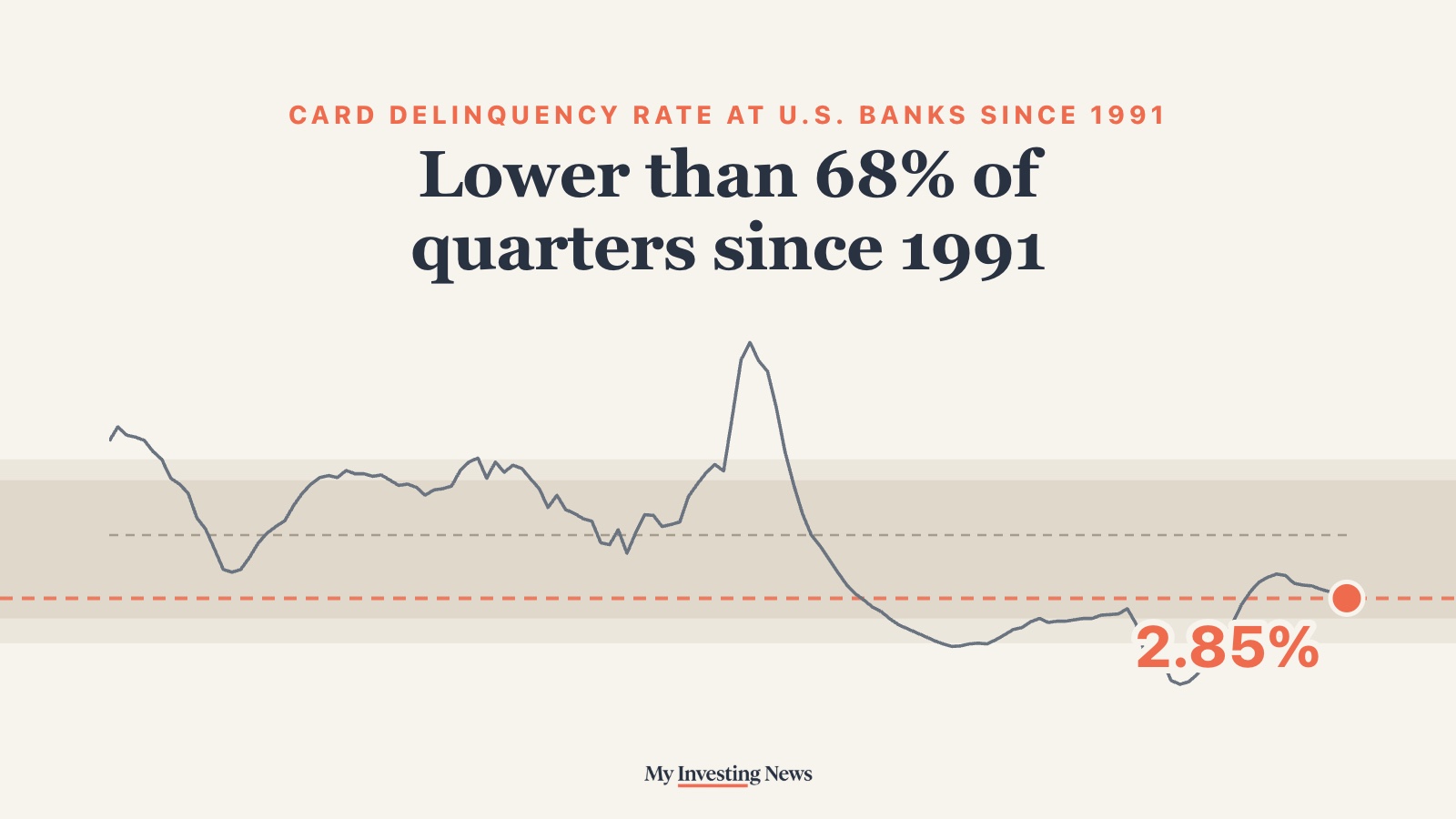
Both halves of the claim look good right now. The unemployment rate was 4.1% in October, and payrolls rose 165,000. Card borrowers are paying better, too. The share of credit card balances at U.S. commercial banks 30 or more days past due fell to 2.85% in the second quarter, Federal Reserve data show. That was the eighth straight quarterly decline from a peak of 3.22% in mid-2024, the longest run of improvement since a 23-quarter stretch that ended in early 2015. The rate is lower than in 68% of quarters since 1991.
Testing the Alpha and Omega
If jobs were everything for card lenders, the two lines would move together. Since 1991, they mostly haven’t. We compared every four-quarter stretch since 1992 in which both measures moved. Card delinquencies and the unemployment rate went the same direction 58% of the time, a bit better than a coin flip.

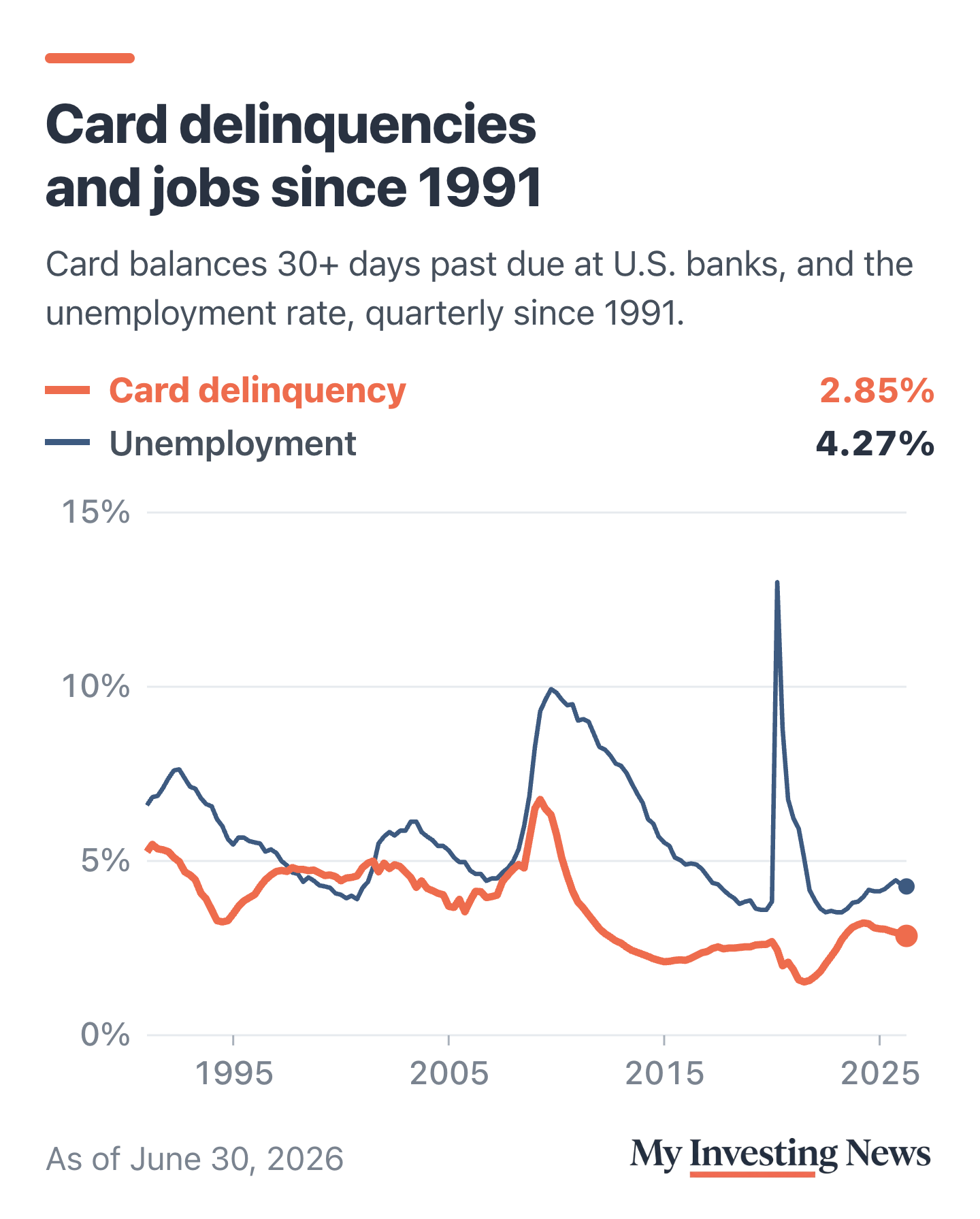
The link held in the 2008 recession, with delinquencies out in front. The card rate peaked at 6.77% in the second quarter of 2009, the highest since the series began in 1991, while unemployment kept climbing to 10% that October. Delinquencies then fell for 23 straight quarters, even though unemployment stayed at 9% or higher through September 2011.
Since then, the two have split twice. In 2020, unemployment jumped to 14.8% in April, and card delinquencies fell anyway, to 1.53% by the third quarter of 2021, the lowest on record since 1991, while pandemic relief money was reaching households. From there the card rate more than doubled, to 3.22% by mid-2024, while unemployment never rose above 4.1%. That pattern isn’t new. In the late 1990s, delinquencies climbed from 3.25% in mid-1994 to 4.81% at the end of 1997 as unemployment fell from 5.9% to 4.7%.
The latest improvement didn’t wait for jobs, either. Unemployment rose from 4.1% in June 2024 to 4.5% in November 2025 while card delinquencies kept falling. Only this year have both moved down together.
Card delinquencies climbed while jobs were plentiful, then fell as unemployment rose
Each dot is one quarter from mid-2021 to mid-2026: the unemployment rate (quarterly average) across, and the share of card balances at U.S. banks 30 or more days past due up.
A Second Gauge Shows Card Trouble Holding Steady
The New York Fed measures card trouble from credit reports, and its gauge hasn’t improved the way the bank data has. In its household debt report released in August, the share of card balances newly sliding 90 or more days behind ran at an annualized 6.97% in the second quarter, against 6.93% a year earlier. It has stayed between 6.86% and 7.18% every quarter since early 2024.
The report’s headline figure, 12.9% of card balances seriously delinquent, sounds far worse. New York Fed researchers wrote in August that the rise in that number comes mostly from charged-off debts that lenders now keep reporting for longer. About 80% of charged-off debts were still on credit reports a year later by 2024, double the share from 2004 to 2012. By the flow measures, they wrote, “the pace of credit card delinquency is elevated but has been largely stable since 2024.”
Card credit and jobs, as of Nov. 10, 2026
Where Buy Now, Pay Later Fits
Affirm’s loans are a smaller slice of household borrowing, and the Fed’s annual survey of household finances, taken in October 2025, shows how widely they are used. Sixteen percent of adults had used buy now, pay later in the prior year, up a point, and 11% of users had a payment trigger an overdraft or insufficient-funds fee at their bank. The same survey found that 42% of adults called finding or keeping a job a concern, up from 37% a year earlier. Strain shows up elsewhere, too: FINRA found a record share of Americans spending more than they earn. Lenders are still growing into it. SoFi raised its 2026 revenue target again in October.
What to Watch
The Fed’s bank figures for the third quarter are next. The second-quarter numbers were posted Aug. 25, so the update should land in late November. The November jobs report is due Dec. 4. Black Friday falls on Nov. 27, the day Levchin called “our Super Bowl.” If unemployment keeps easing and the card rate falls a ninth straight quarter, his rule of thumb will look right for now. A recession would be the real test. In the last recession, card delinquencies peaked and started falling months before the jobless rate did.
Levchin is right that jobs are plentiful and card borrowers are paying better: bank card delinquencies fell for eight straight quarters to 2.85%. But over four-quarter stretches since 1992, the two have moved the same way only 58% of the time, and the latest improvement came while unemployment was rising. The New York Fed’s flow measure has barely moved since 2024, a reminder that the clean-up has been slower than the bank data suggest.