Where we heard itThe Pomp Podcast, “Everyone Is Bearish And That’s Exactly Why You Should Buy,” Oct. 27, 2026. Speaker: Ryan Detrick, chief market strategist at Carson Group.
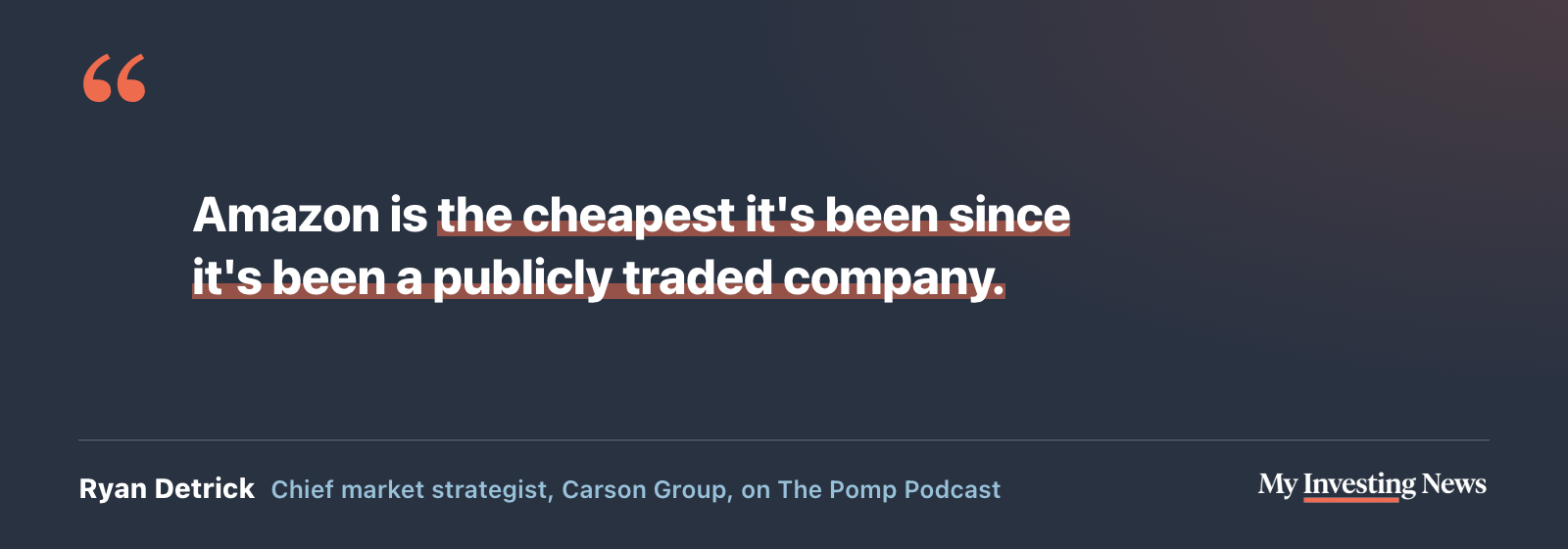
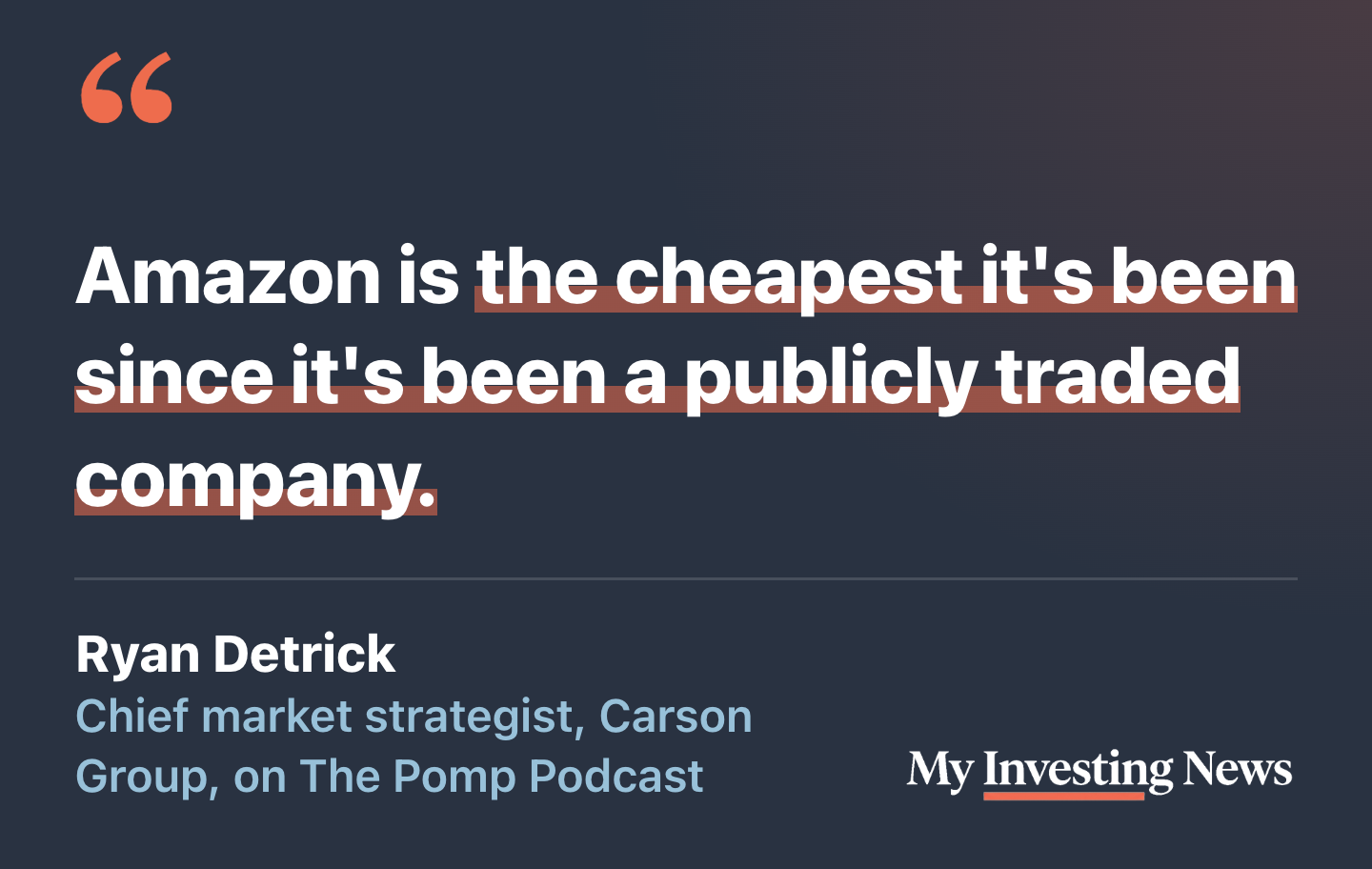
Ryan Detrick does not usually lead with valuations. “I’m not a huge valuations guy,” the Carson Group chief market strategist told Anthony Pompliano on The Pomp Podcast on Oct. 27. Then he made a big one: “Nvidia is the cheapest it’s been in a long time. Amazon is the cheapest it’s been since it’s been a publicly traded company.”
He added that there are “some really nice valuations on some companies that make a lot of money” and are still growing fast. That is a claim about history, so we checked AmazonAMZN against its own record on three common yardsticks, back to 2005. Two of them back him up. The third says the opposite.
How We Tested “Cheapest Ever”
We took Amazon’s value at every month-end from February 2005 through the Oct. 27 close of $253.10, 261 readings in all, and compared it with the company’s results over its four most recently reported quarters. For 2005 through 2009 the results come from Amazon’s quarterly earnings releases; from 2010 on, from the data it files with the SEC. Each quarter counts only from the day Amazon published it, so no month uses numbers investors had not seen yet.
The three yardsticks are price to earnings, price to operating cash flow and enterprise value to sales. Enterprise value adds Amazon’s long-term debt to its market value and subtracts its cash and marketable securities. Amazon listed in 1997 and did not post a full-year profit until 2003, so no earnings test can reach all the way back to the IPO.
On Earnings, Detrick Is Right, With a Catch
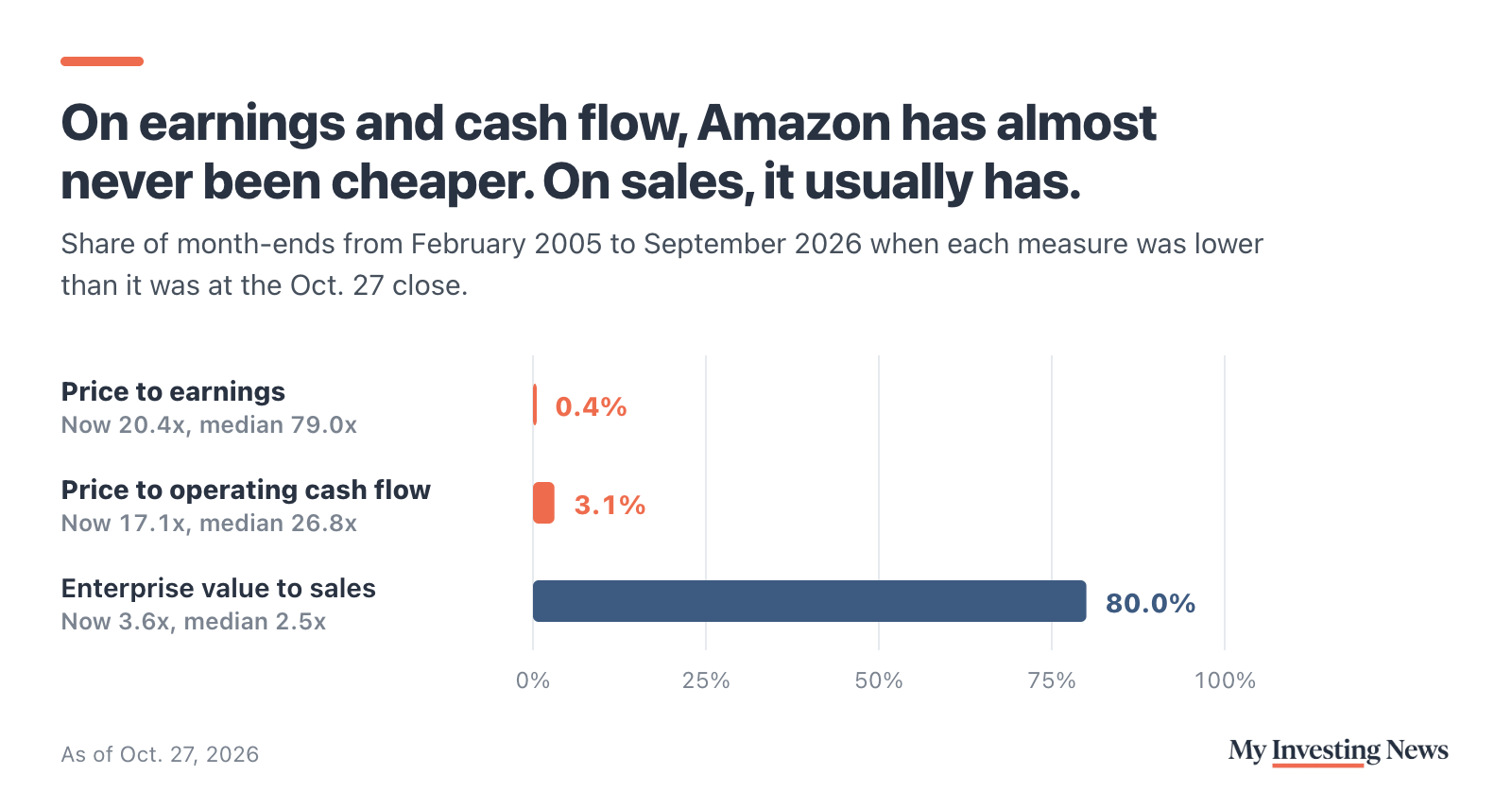
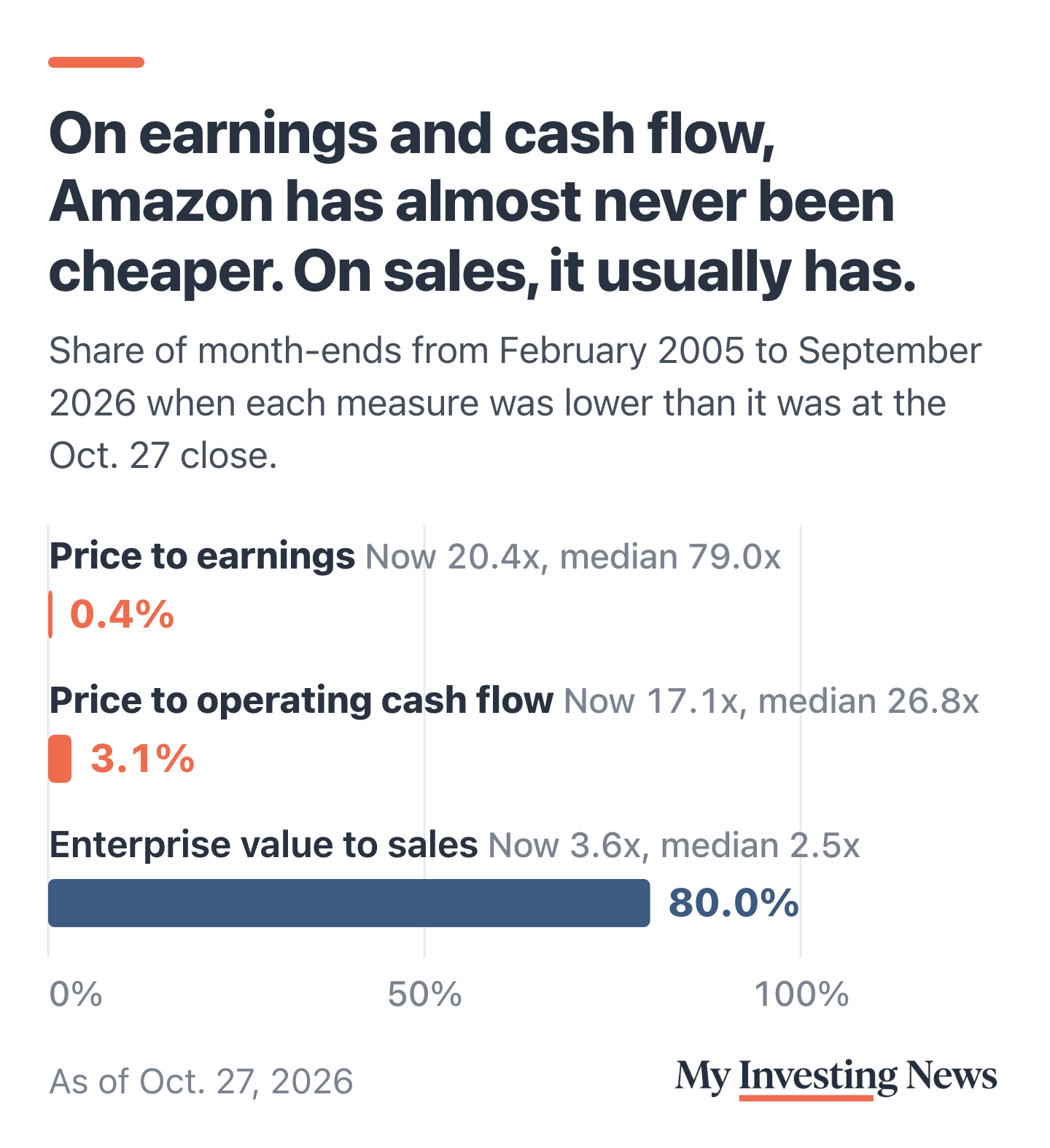
Amazon traded at 20.4 times its past four quarters of net income on Oct. 27. Of the 260 earlier month-ends, only Sept. 30, 2026, at 20.1 times, came in lower. In 23 of those months Amazon had lost money over the prior year, so it had no price-to-earnings ratio at all. The 10-year median was 79.9 times.
The catch is where the earnings came from. Second-quarter net income was $62.6 billion, and Amazon’s second-quarter release says that included “non-operating pre-tax other income of $53.4 billion, primarily from our investments in Anthropic.” Over the four quarters through June, Amazon reported $135.3 billion in net income but $93.7 billion in operating income, the profit from its stores, ads and cloud business. Zacks, which compiles the earnings figures analysts compare against, counts $7.34 a share for those quarters, against the $12.43 Amazon reported. On the Zacks figure, the multiple is about 34.5 times, still well under the 10-year median.
Amazon’s three yardsticks at the Oct. 27 close
On Cash Flow, He Is Close
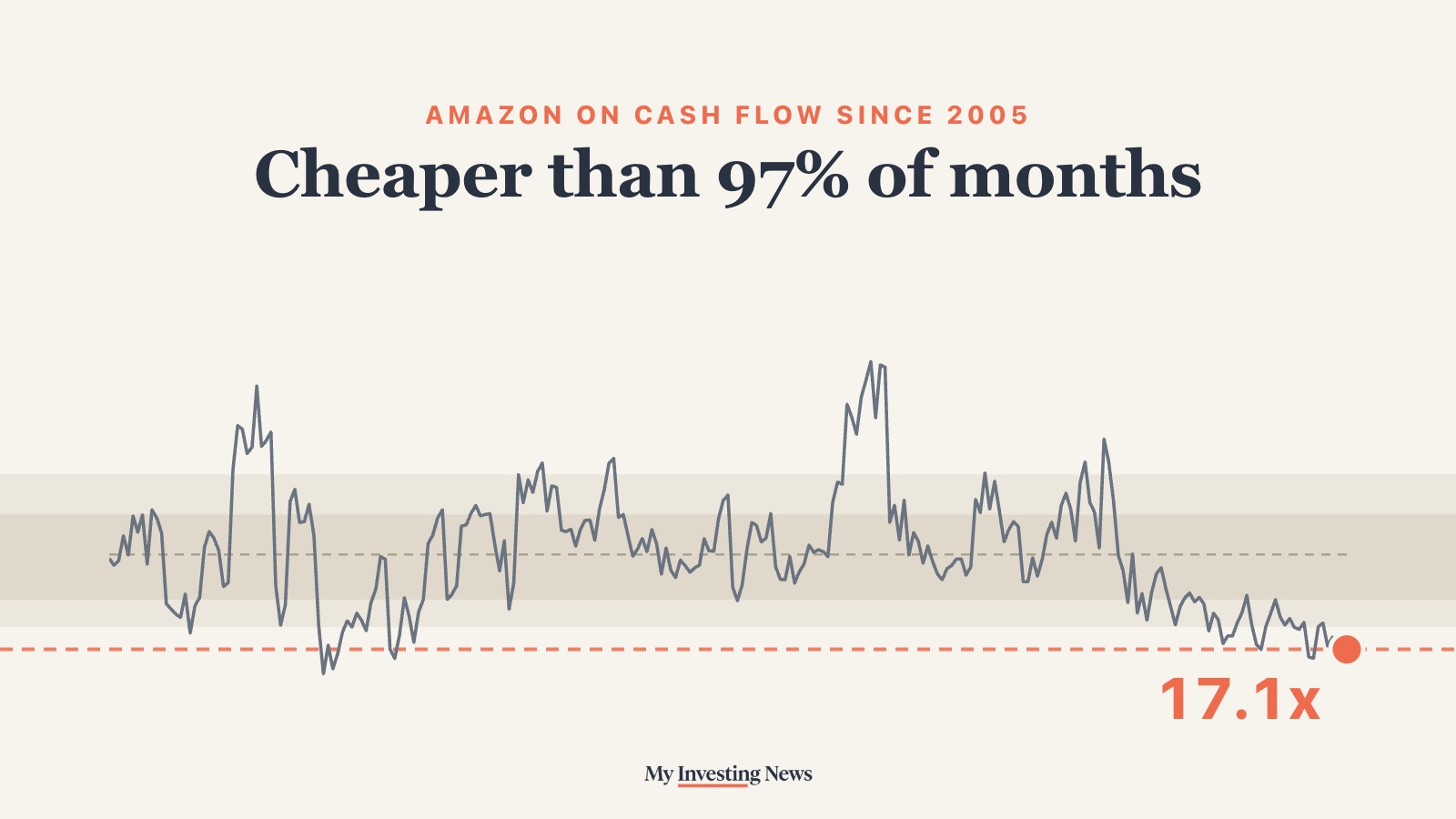
Operating cash flow leaves out investment gains. Amazon generated $161.4 billion of it over the four quarters through June, and the stock traded at 17.1 times that figure. Only 8 of 260 earlier month-ends were cheaper: November 2008 and January and February 2009, during the financial crisis; February 2010; April 2025; February and March of this year; and Sept. 30.
Amazon trades at 17.1 times its cash flow. Only eight month-ends since 2005 were cheaper.
Amazon’s market value divided by its operating cash flow over the prior four reported quarters, at every month-end since February 2005. Shaded bands hold the middle half and the middle 80% of all 261 readings.
Cash flow has its own catch. It comes before spending on data centers and equipment. Amazon’s free cash flow, which subtracts that spending, was an outflow of $7.6 billion over the same four quarters, as purchases of property and equipment rose $66.1 billion from a year earlier, mostly for AI. Ken Griffin has warned that GPU rental prices could collapse if supply outruns demand.
On Sales, the Record Says No
Enterprise value to sales tells a different story. At 3.57 times its past four quarters of revenue, Amazon was more expensive than at 208 of 260 earlier month-ends, and above its median of 2.53 times since 2005. Each dollar of sales now carries more profit than it used to: operating income was 12.1% of revenue over the four quarters through June, against 4.1% in 2010 and 2.1% in 2015, per Amazon’s filings. That is why the earnings and cash flow multiples can sit near record lows while the sales multiple does not.
The Verdict, and Detrick’s Recent Calls
Detrick’s claim holds on trailing earnings, where only one month-end since 2005 was cheaper, though Anthropic gains do much of the work. It nearly holds on operating cash flow. It fails on sales. Amazon’s third-quarter report, scheduled for after the close on Oct. 29, will reset all three.
His market reads have held up this month. On the podcast, he put the S&P 500 “ballpark up 12 or 13%” for the year, and the index was up 12.8% through Oct. 27. On Oct. 16, he called the chip selloff healthy rotation; the S&P 500 has gained 0.8% since that day’s close. Other strategists, including Intelligent Alpha’s Doug Clinton, have described the AI selloff as a routine drawdown.
Detrick says Amazon is the cheapest it has been as a public company. On trailing earnings, Amazon’s record since 2005 agrees, and on operating cash flow only eight month-ends were cheaper. On enterprise value to sales, it is pricier than in 80% of months. The risk is that much of the past year’s profit came from Anthropic gains, and free cash flow has turned negative as AI spending climbs.