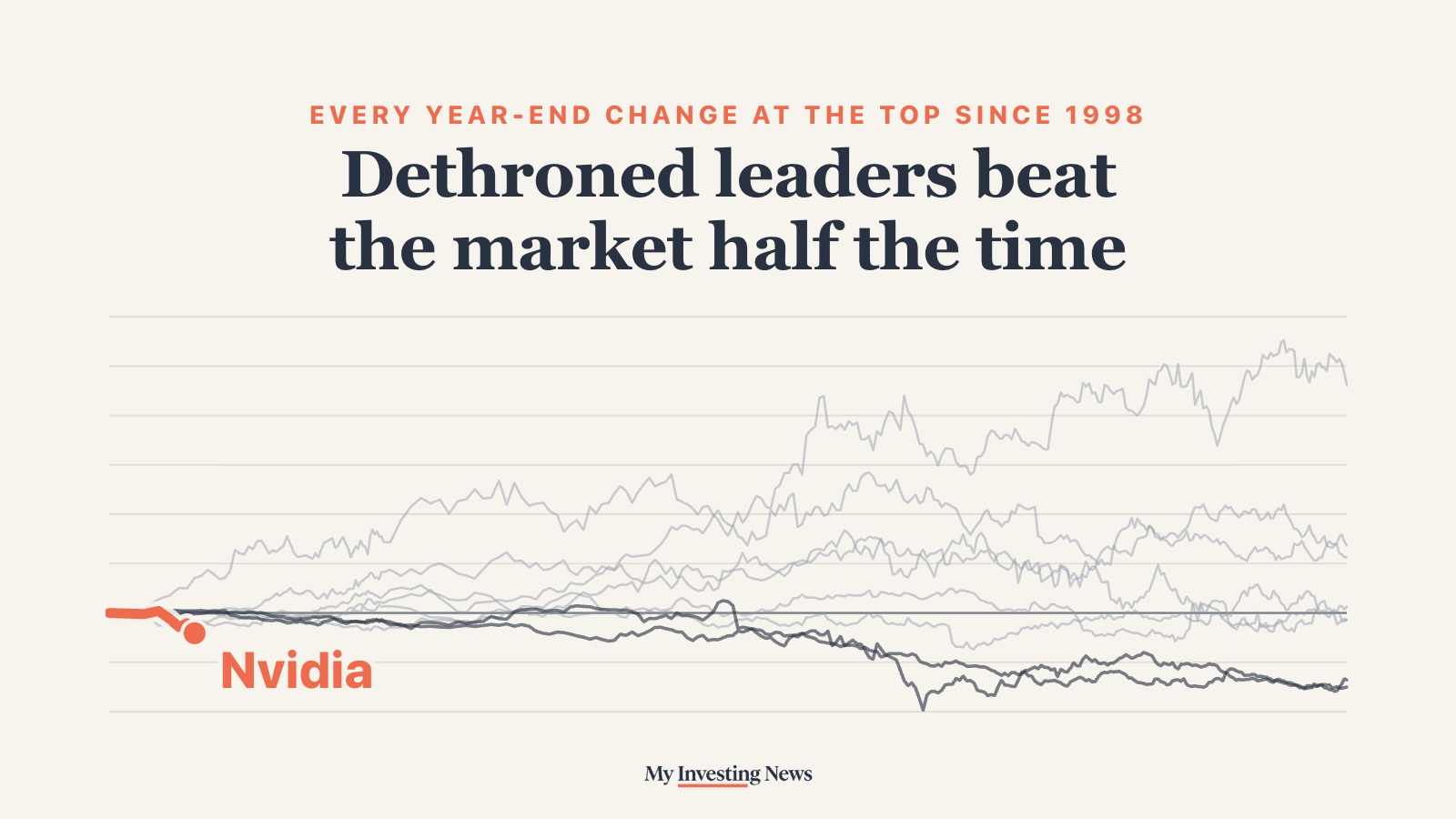
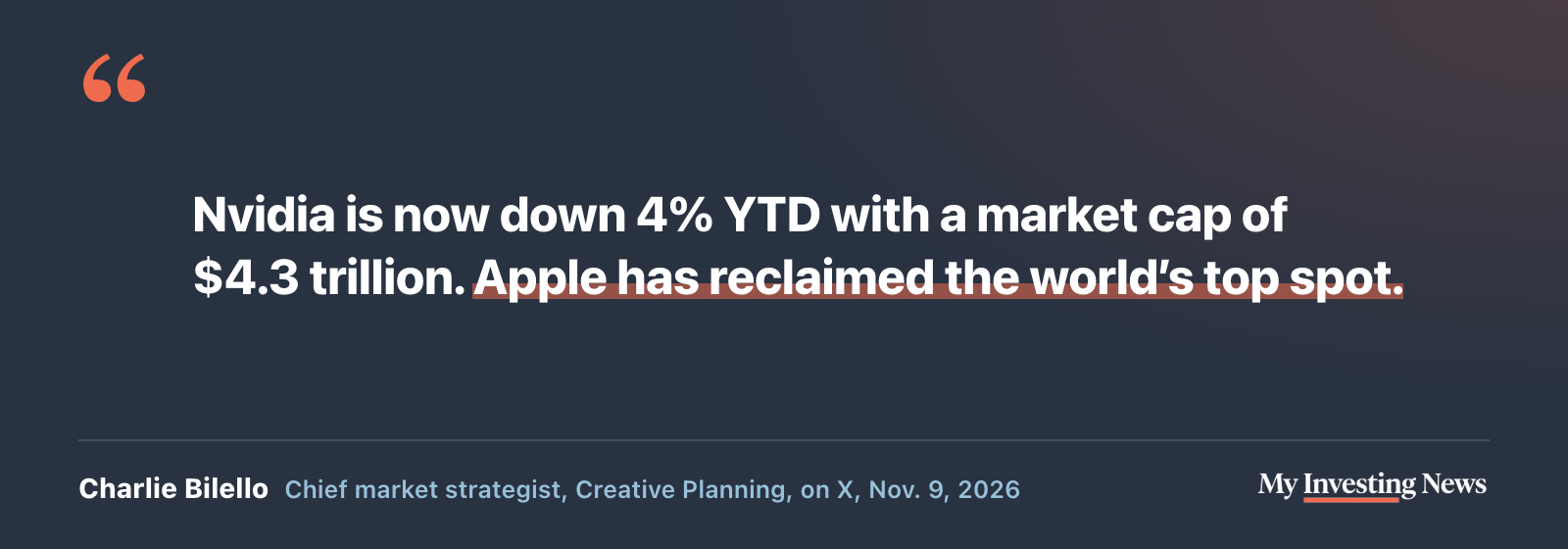
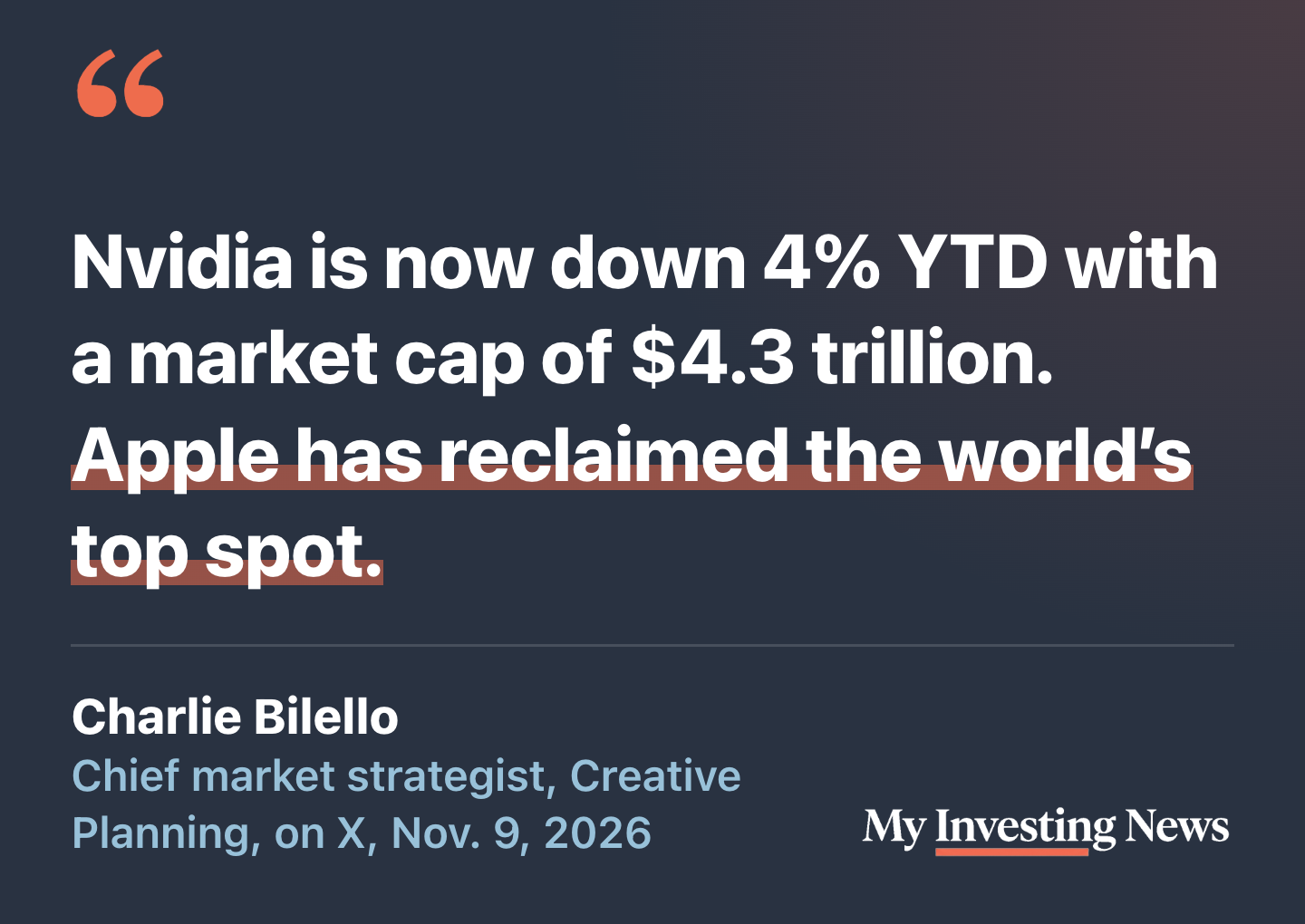
Where we heard itA post on X by Charlie Bilello, chief market strategist at Creative Planning, late on Nov. 9, 2026.
Five weeks ago, Nvidia closed at a record. On Oct. 6 it was up 28% for the year and worth about $5.77 trillion. Charlie Bilello, chief market strategist at Creative Planning, marked how fast that changed in a post late on Nov. 9: after a 25% drop, Nvidia was down 4% for the year and Apple was on top again.
His numbers check out. Nvidia closed Nov. 9 at $178.67, 25% below its Oct. 6 record and 4.2% below where it started the year. Multiplying each day’s close by the share count each company last reported to the Securities and Exchange Commission, Nvidia was worth $4.31 trillion, about $1.5 trillion less than on Oct. 6. Apple, at a record close of $350.69, was worth $5.10 trillion, about $790 billion more.
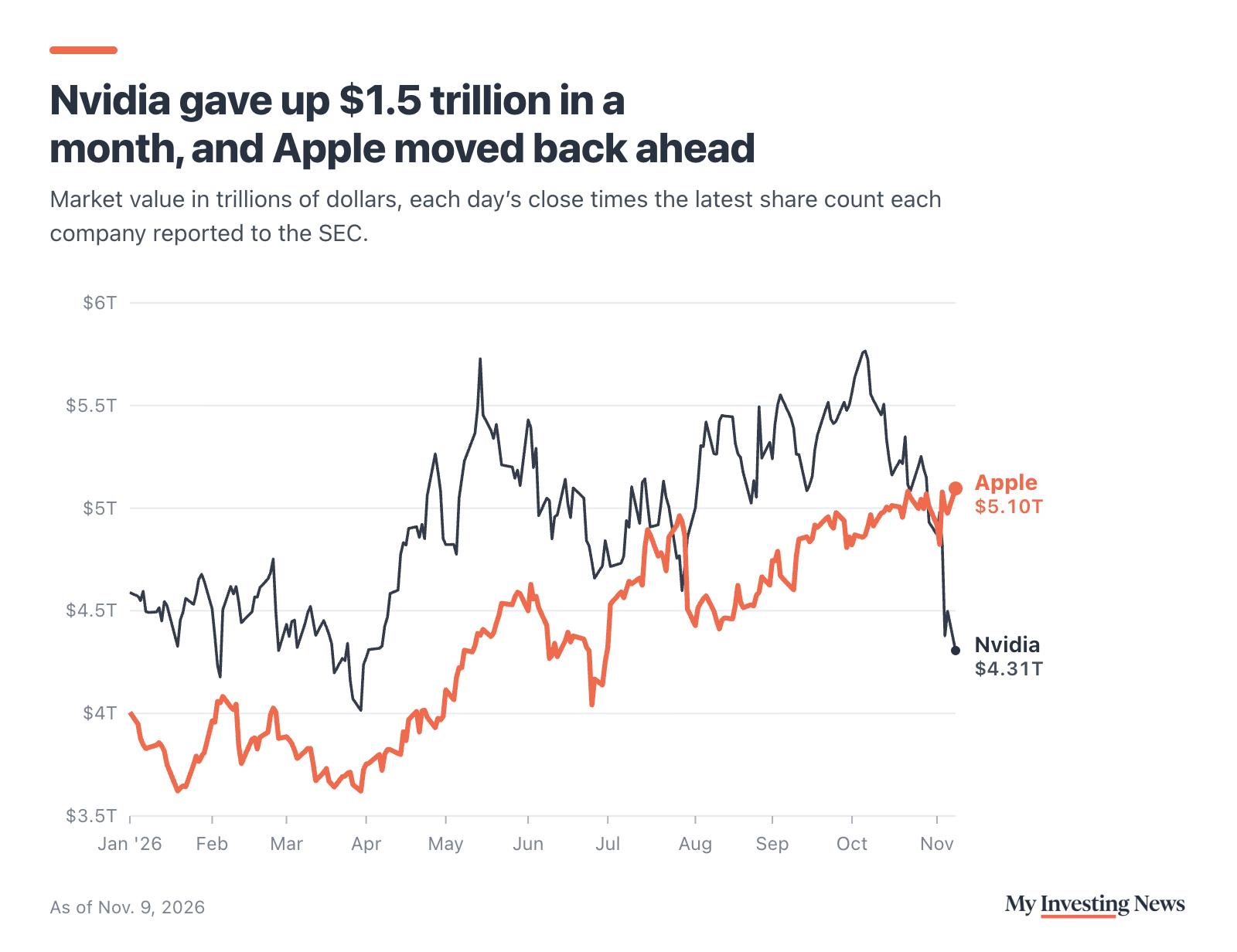
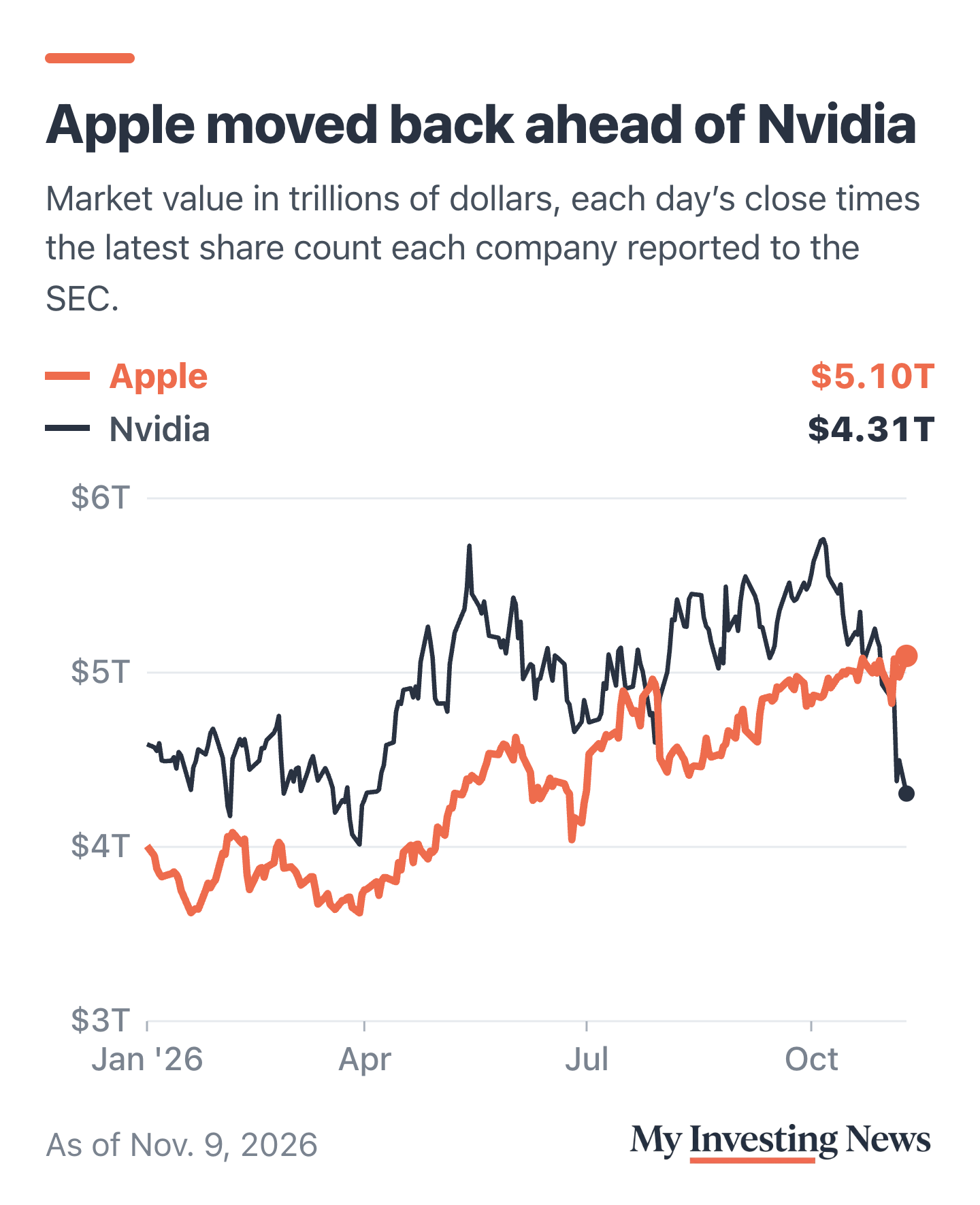
The handoff was not clean. By our count of daily closes, the lead has changed hands five times since late July: Apple moved ahead on July 27 and lost it four days later, took it back on Oct. 30, gave it up on Nov. 3 and regained it on Nov. 4, the day after the election. Swaps like these are why we use a stricter test for the history below.
Every Change at the Top Since 1998
We rebuilt the market value of the biggest U.S. companies at every month-end since 1994, from Yahoo Finance closing prices and the share counts on the cover of each quarterly and annual SEC filing. Six companies held the top spot at a month-end since 1995: General Electric, Microsoft, Exxon Mobil, Apple, Amazon and Nvidia. The leader changed 33 times, often for a month or two. Amazon’s turn lasted one month, January 2019. Cisco passed Microsoft briefly in March 2000 but never held the title at a month-end.
To cut through the back-and-forth, we counted the leader at each year-end. By that test the title changed hands 9 times, starting with Microsoft passing GE at the end of 1998. Eight of those changes are old enough to show five years of results. In 4 of the 8, the company that lost the top spot beat the S&P 500 over the next five years, counting dividends.
The crown, as of the Nov. 9, 2026 close
The Ones That Never Came Back
The worst results came when the title passed to a company in a different business. GE lost it to Exxon Mobil at the end of 2006 and fell 42% over the next five years, through the financial crisis, while the S&P 500 was about flat. Exxon lost it to Apple at the end of 2012 and returned 15% over five years as the index more than doubled. Neither has held the top spot at a year-end since.
Companies that stayed in the race did better. Apple lost to Microsoft at the end of 2018, took the title back a year later and returned 387% over five years, against 104% for the index. Microsoft, after losing to Apple at the end of 2019, returned 181%. Even Microsoft in 2000, which lost the title in the dot-com crash and an antitrust fight, beat the index over the next five years, 42% to 6%. GE and Microsoft traded the title four times from 1998 to 2003. The loser beat the index in two of those cases and trailed it by about 4% to 5% in the other two.
4 of the 8 companies that lost the top spot since 1998 beat the S&P 500 over the next five years
Each line is a company that lost the title of most valuable U.S. company at a year-end, from that Dec. 31 close: how far ahead of or behind the S&P 500 it ran, both with dividends. Nvidia, coral, since it lost the top spot on Oct. 30, 2026.
The latest year-end change is too new to score. Apple lost the title to Nvidia at the end of 2025 and has returned 29% since, against 11% for the S&P 500. Nvidia has run 12% behind the index since it slipped to second at the Oct. 30 close.
What to Watch
The year-end test settles on Dec. 31. If Apple still leads at that close, it will have won back the title a year after losing it, as it did after Microsoft passed it at the end of 2018. Bilello has tracked Apple’s shift before: its link to the Nasdaq 100 turned negative this fall for the first time since 1985. On Nvidia, the comparison investors reach for is Cisco, which traded at 219 times earnings when the 2000 bubble peaked. Josh Brown has argued Nvidia, at 15.3 times forward earnings, is far from that.
Bilello’s numbers hold: Nvidia lost about $1.5 trillion in five weeks, and Apple led by about $790 billion at the Nov. 9 close. History offers no single verdict for the loser. Since 1998, 4 of 8 dethroned leaders beat the S&P 500 over five years, and the two that lagged most, GE and Exxon, lost the title to a different industry.