Where we heard itMarketplace Morning Report, “Interest rates come for everyone, even tech,” Oct. 22, 2026. Diane Swonk, chief economist at KPMG (episode).
Diane Swonk thinks the stock market has a cushion. She also thinks it has a breaking point. The chief economist at KPMG told Marketplace Morning Report on Oct. 22 that “the markets look very frothy,” and that her team had been modeling what a prolonged bear market would do to the economy.
“Now remember, the S&P 500 has more than doubled since October of 2022. That’s an enormous cushion,” she said. (Through the Oct. 27 close the index was up 116% from its Oct. 12, 2022, low.) Then she laid out the scenario:
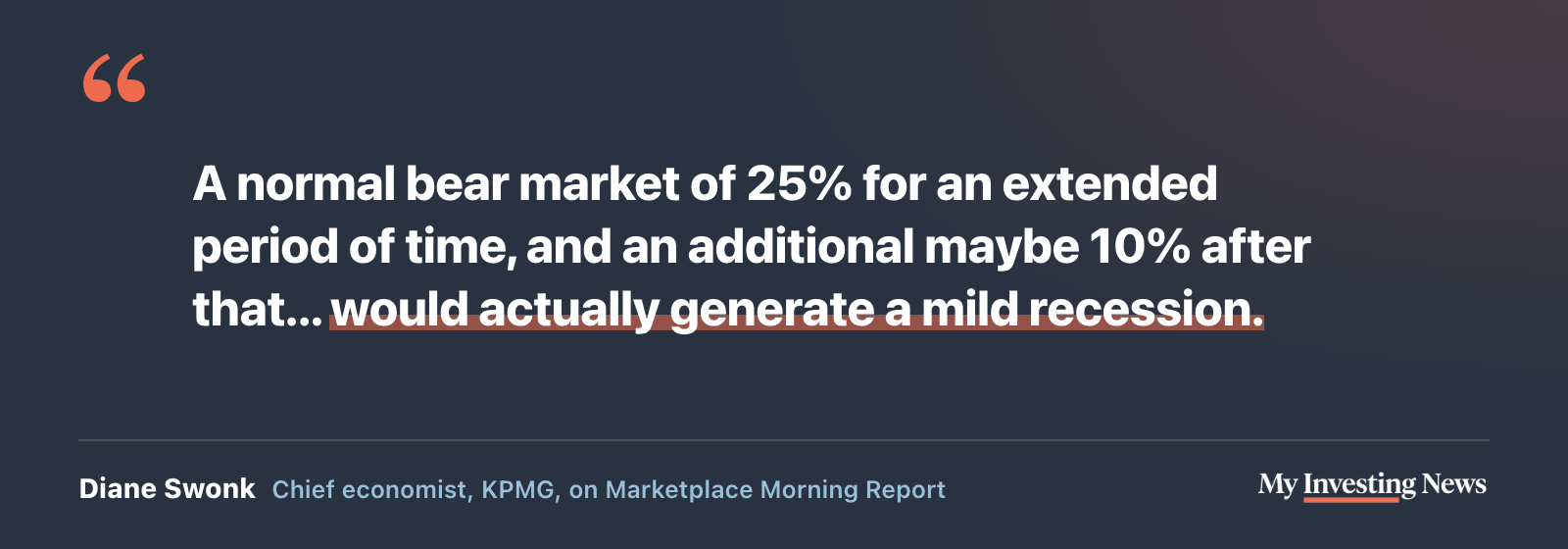
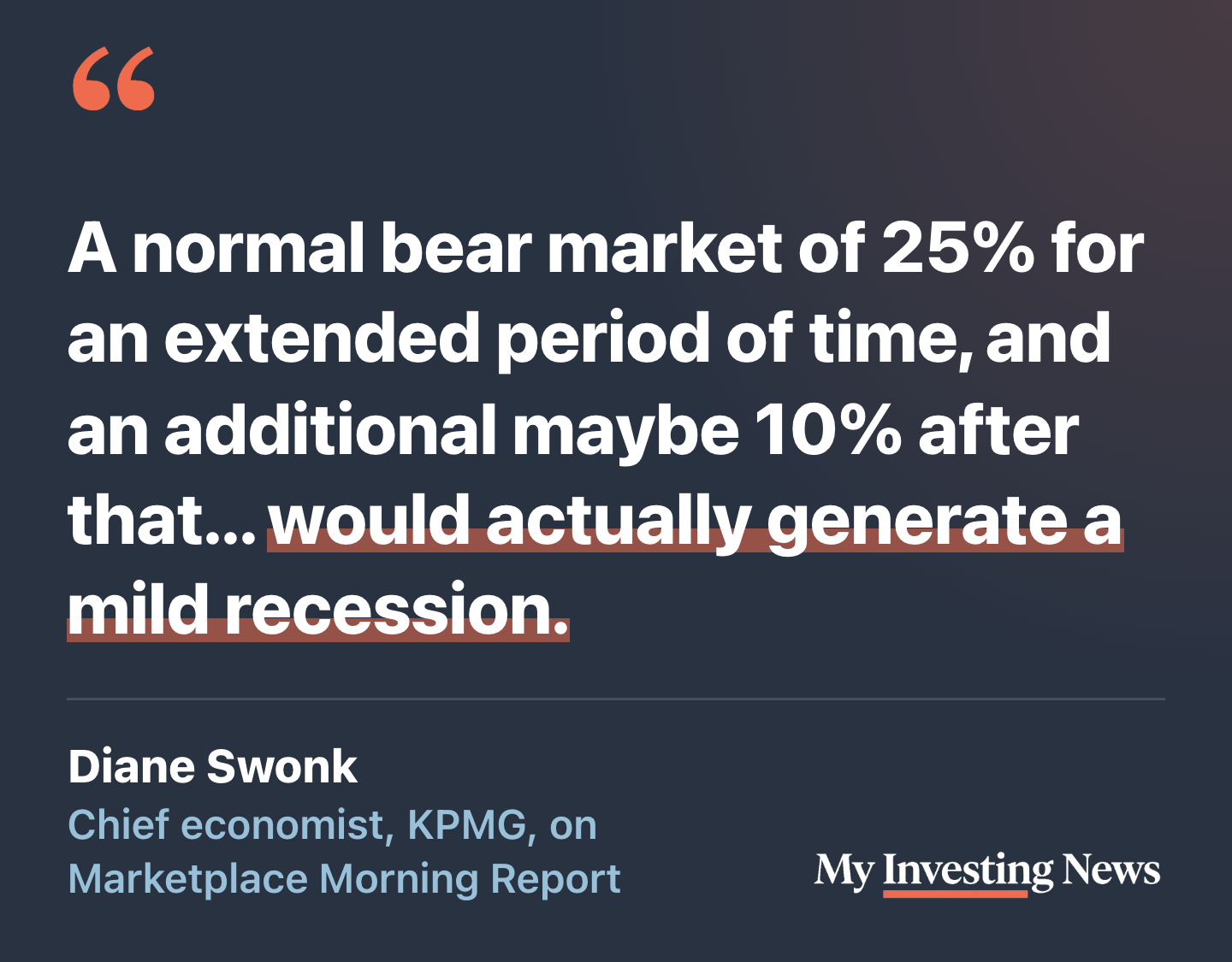
She added a caveat of her own: “recessions are never mild to those people who lose their jobs.” The mechanism she points to is the wealth effect. When stock portfolios shrink, households feel poorer and spend less, and consumer spending drives most of the U.S. economy.
Testing Her Scenario Against Every Bear Market Since 1950
We checked the claim against the S&P 500’s own record. Using daily closes from Yahoo Finance, we found every decline of 20% or more from a record close since 1950. There were 11. We then checked each against the National Bureau of Economic Research’s recession dates, counting a recession if one began during the decline or within a year after the low.
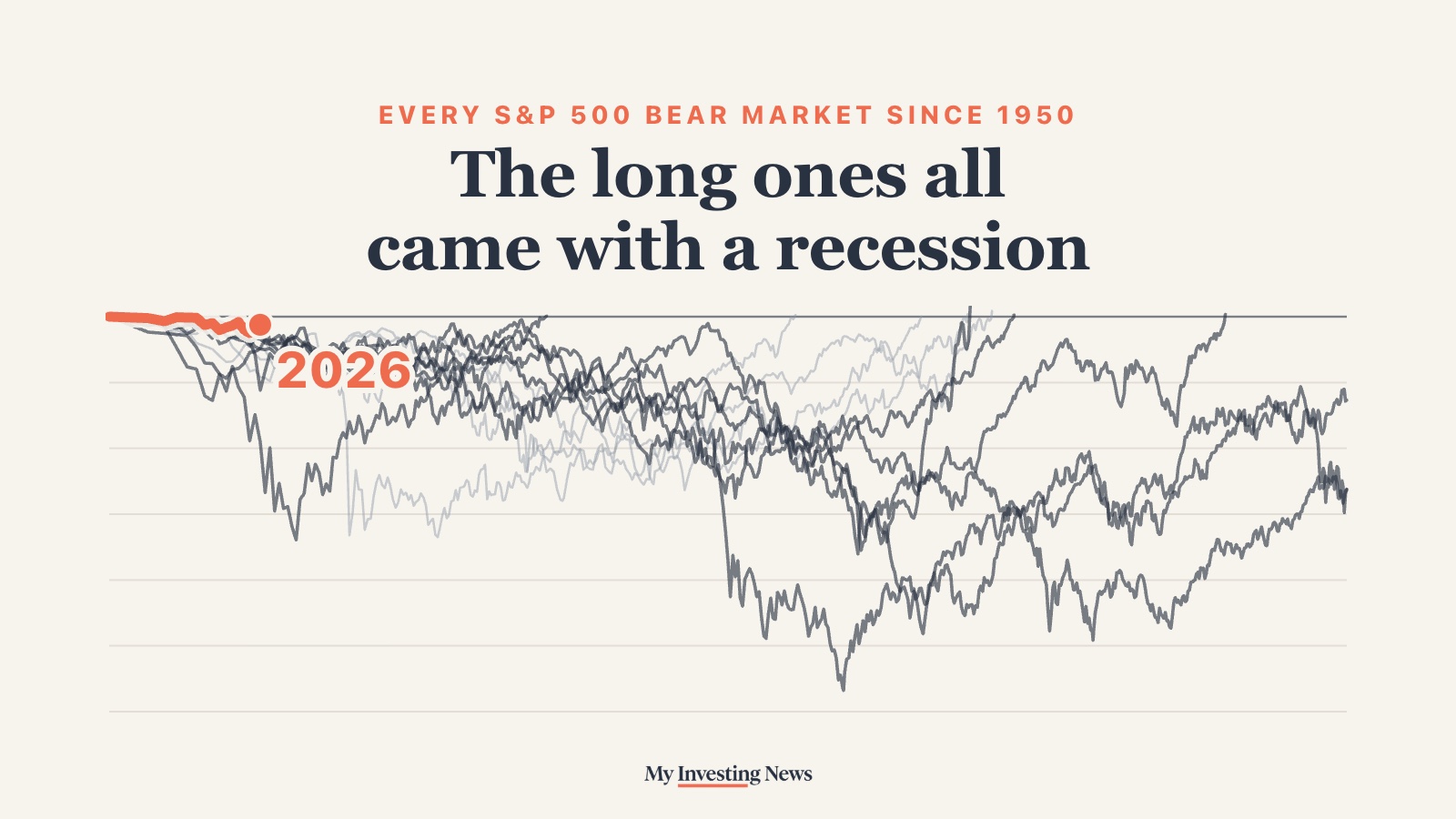
Seven of the 11 came with a recession. The four that did not were 1961-62, 1966, 1987 and 2022. The depth of the drop mattered: of the six bear markets that fell a third or more, five came with a recession. The exception was the 1987 crash, which took the index down 33.5% in a little over three months and then passed without one.
All 6 S&P 500 bear markets that fell for more than a year came with a recession
All 11 declines of 20% or more from a record close since 1950, drawn from the record until the index got back to it (first four years shown). Dark lines came with a recession, gray ones did not. 2026 is coral.
Swonk’s key word is “extended,” and on that point the record lines up with her. All 6 bear markets in which the S&P 500 kept falling for more than a year came with a recession: the ones that began in 1956, 1968, 1973, 1980, 2000 and 2007. Of the five that hit bottom within a year, only the 2020 crash did, and that recession came from pandemic shutdowns.
The record can’t settle which way the cause runs. In six of the seven cases, stocks peaked months before the economy did, which fits Swonk’s view that falling stocks drag on spending. It also fits the plainer reading that markets sniff out a downturn early. And recessions can arrive without a bear market: four of the 11 since 1950, including 1990-91, came with declines that stopped short of 20%.
Stocks and recessions, by the numbers
Households Have Never Had More Riding on Stocks
If the wealth effect is the channel, the size of household stock holdings matters. On Oct. 27, The Kobeissi Letter posted that U.S. households own about 42% of the U.S. stock market, the most since the late 1990s. The Federal Reserve’s financial accounts back that up: households and nonprofits held 42.1% of all U.S. corporate equities at the end of June, the highest share since the end of 1998.
A sharper gauge for Swonk’s argument is how big those holdings are next to income. Counting stocks owned directly and through mutual funds, pensions and retirement accounts, households held about $74 trillion at the end of June. That is 3.1 times a year of after-tax income, the highest in Fed data that go back to 1945. Before the 2022 bear market it was 2.6 times; before the 2000 crash, 1.8 times.
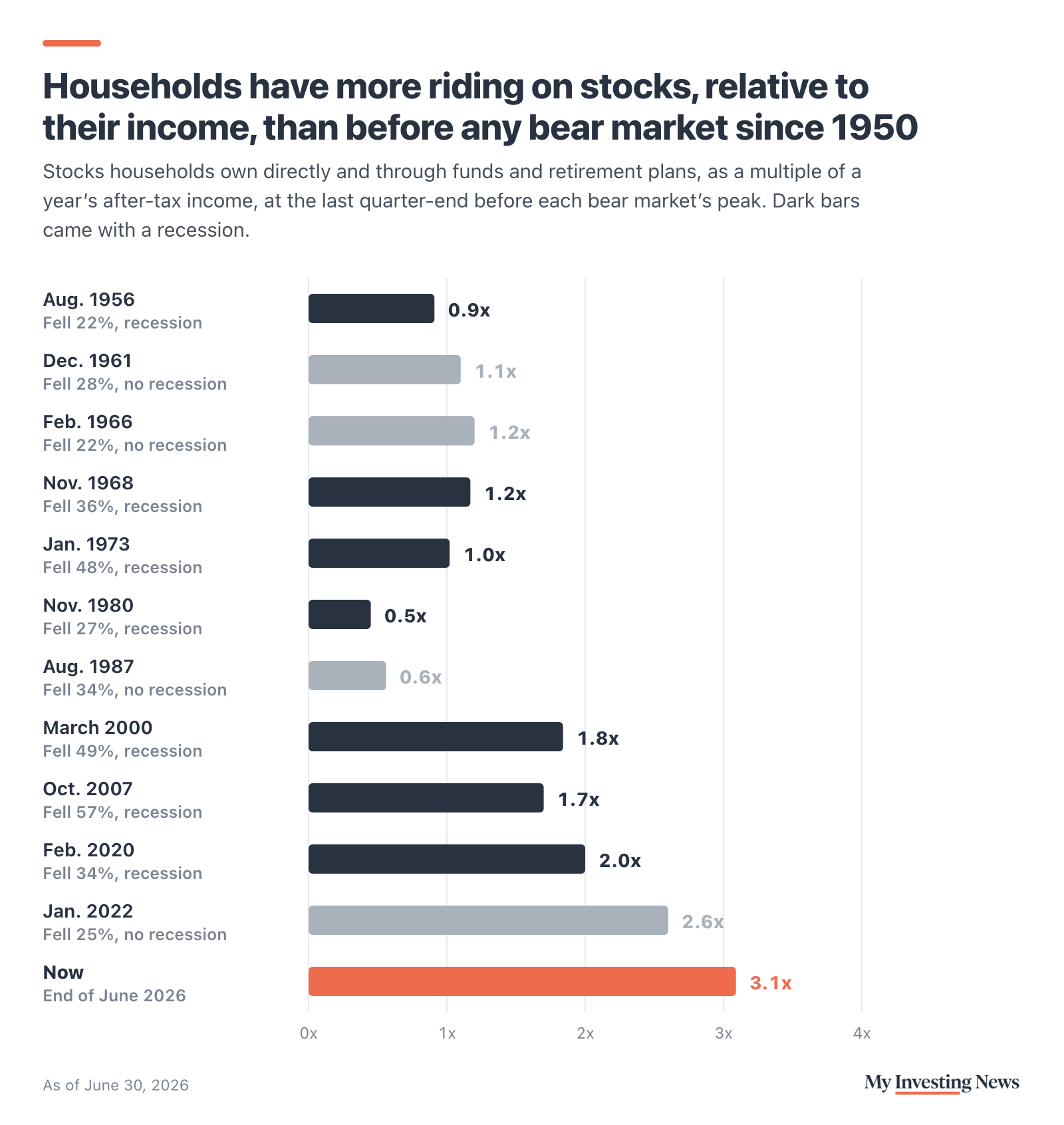
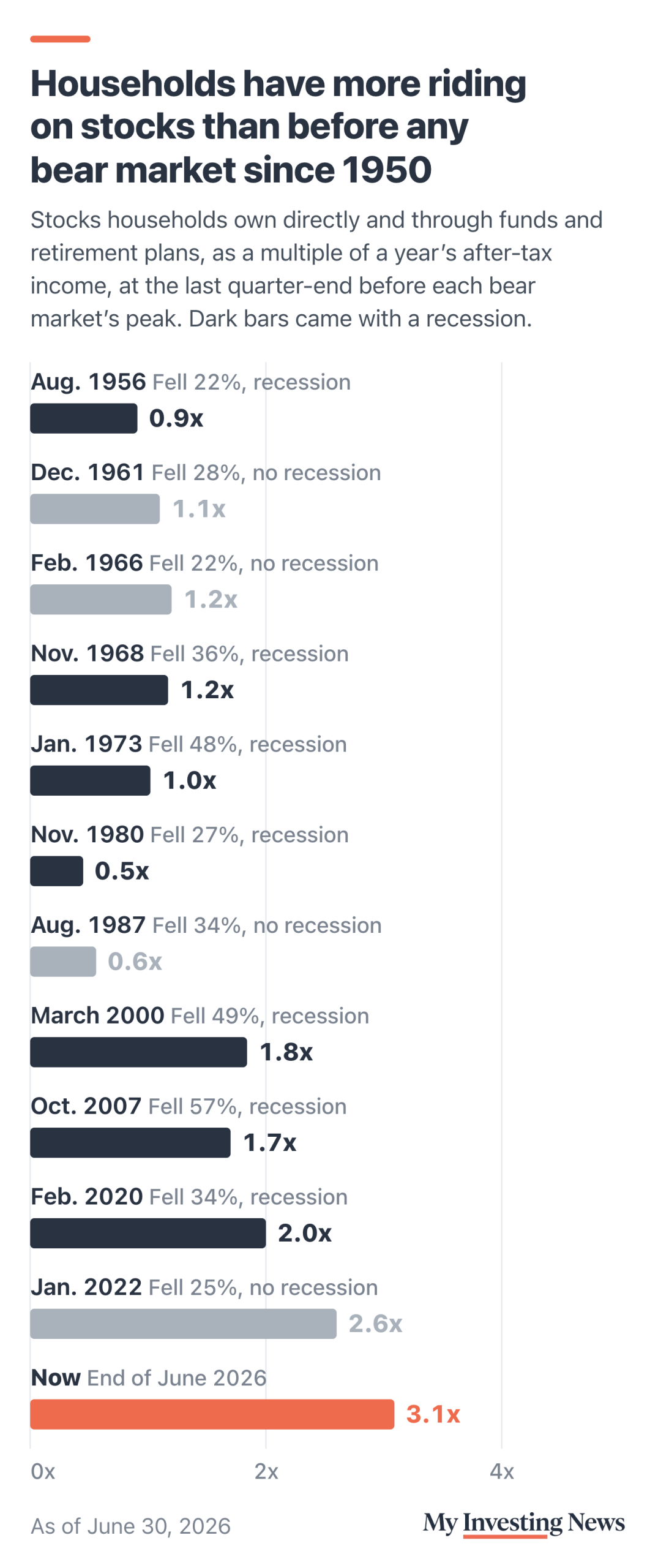
Higher exposure hasn’t meant a worse outcome in the past, though. The 2022 bear market began with households holding more stock relative to income than any before it, and it passed without a recession. The 1980 bear market began with the least and came with one. What has changed is the cushion around the stock holdings. Apollo’s Torsten Slok says the savings glut is over, FINRA found a record share of Americans spending more than they earn, and margin debt hit a record $1.5 trillion this fall.
What to Watch
The index is nowhere near Swonk’s scenario yet. The S&P 500 closed at 7,722.60 on Oct. 27, 1.2% below its Oct. 6 record, and its deepest close since that record was 2.5% below it. Her scenario needs a decline of a quarter that lasts, then more on top.
Betting markets aren’t braced for a downturn. On Polymarket, traders put the odds of a U.S. recession by the end of 2026 at 7.5% as of Oct. 27 (market). That market pays out on two straight quarters of falling GDP or an NBER call made in time. The Fed’s next read on household holdings, for the third quarter, has usually come out in December.
Swonk says a long, deep bear market could tip the economy into a mild recession, and history mostly agrees: 7 of the 11 S&P 500 bear markets since 1950 came with one, including every one that fell for more than a year. Households now hold more stock relative to their income than ever, so a long slide would hit spending harder. The risk to her view runs the other way too: the 1987 and 2022 drops were deep and the economy kept growing.