Where we heard itAll-In podcast, “Midterm Blood Bath, $4T AI Sell Off, Data Center Freeze, What’s Next for Trump”, released Nov. 7, 2026. Speaker: David Sacks, with co-host Jason Calacanis.
David Sacks didn’t soften it. Asked on the All-In podcast released Nov. 7 what went wrong for Republicans in the midterms, the investor and co-host said: “This was a schlacking. This was a blowout. It was, I believe, the biggest midterm loss since the Watergate midterm loss.” He blamed the war and what followed it: gas that went from about $3 to more than $4, higher diesel and fertilizer costs, and the rate cuts markets had expected in January that never came.
Others reached for the same year. Sen. Ted Cruz called the result a “Watergate-level repudiation” in a Nov. 4 statement, and Morgan Stanley’s Andrew Sheets said on the bank’s Thoughts on the Market podcast on Nov. 6 that “Democrats enjoyed the largest vote share of any party in almost 50 years.” We checked all three against every midterm since 1946, using the Associated Press count as of Nov. 7.


Where the Count Stood
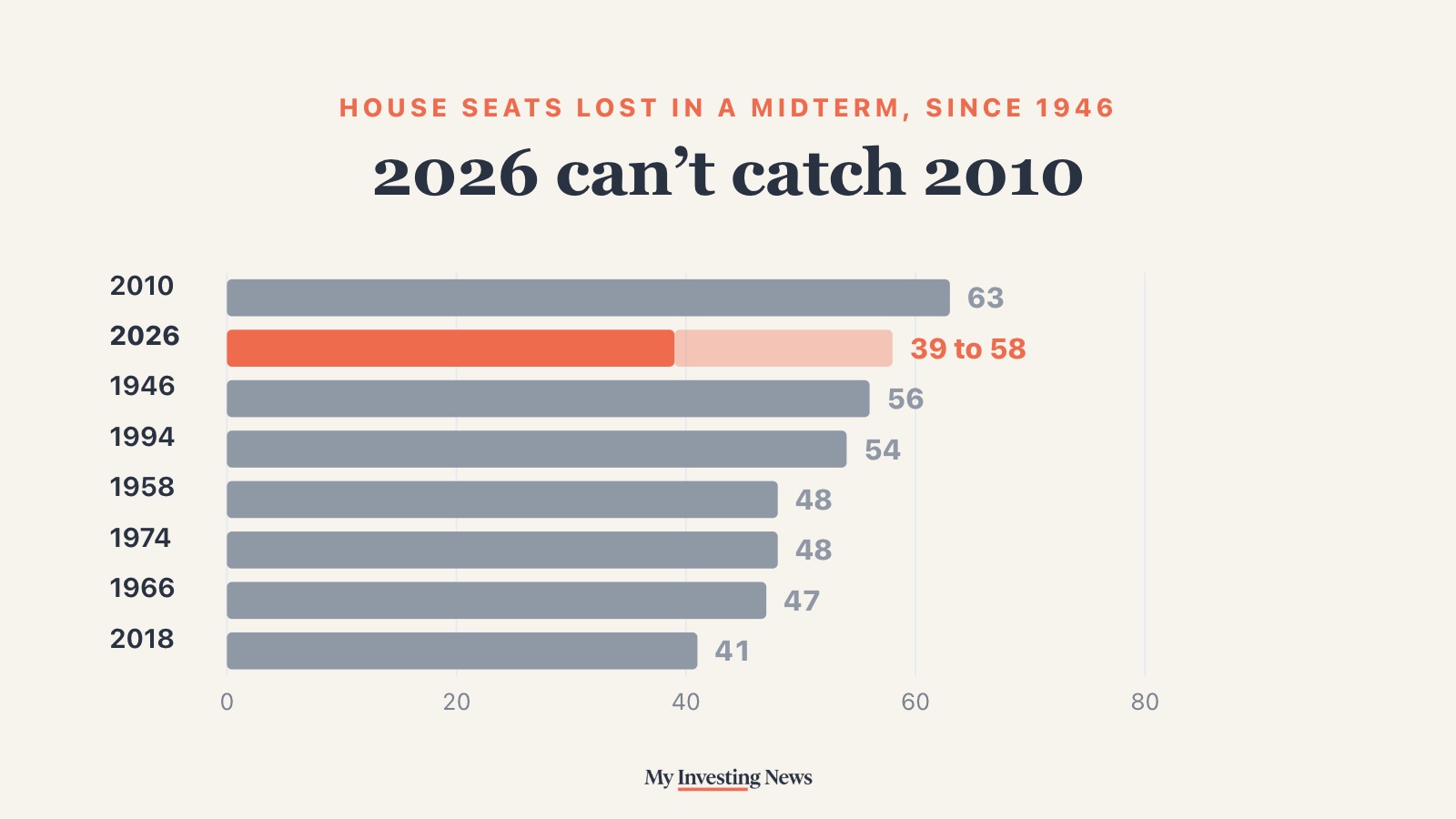
In the AP count reported Nov. 7, Democrats had won 254 House seats and Republicans 162, with 19 races still uncalled. Republicans won 220 seats in 2024. Even if they take every uncalled race, they finish with 181, a loss of 39. If they win none, the loss is 58.
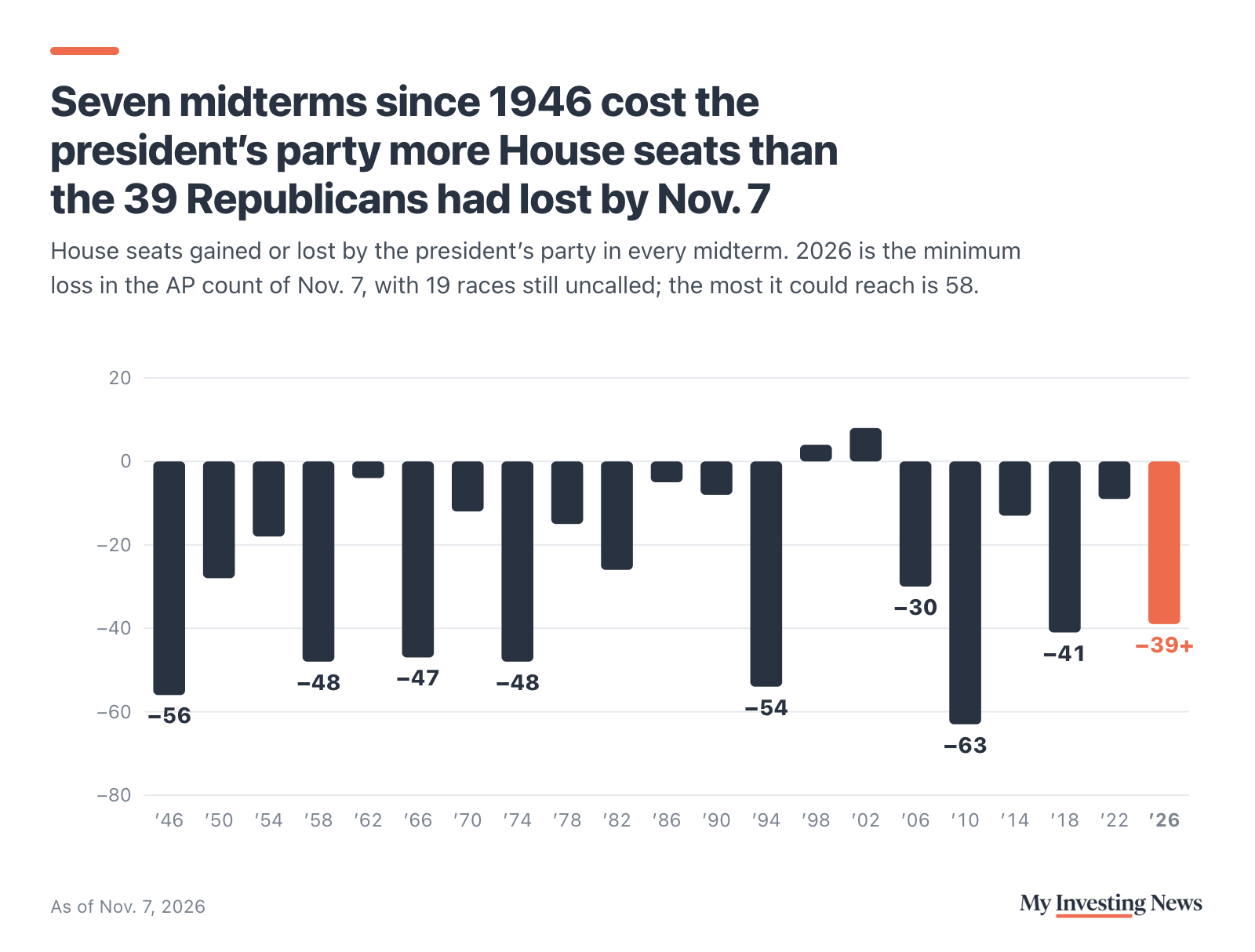
Watergate set a high bar. In 1974, three months after Richard Nixon resigned, Republicans under Gerald Ford lost 48 House seats and five Senate seats, according to the American Presidency Project’s tally of every midterm. Only six midterms since 1946 have cost the president’s party more than 45 House seats.
1994 and 2010 Were Bigger
Sacks’s claim runs into two elections. Democrats lost 54 House seats in 1994, Bill Clinton’s first midterm, and 63 in 2010 under Barack Obama, the biggest loss of the postwar era. The 2026 count can’t reach 2010: Republicans would top out at 58 even if Democrats swept every open race. To pass 1994, Republicans would have to lose 16 of the 19.
Read as a statement about Republicans, the claim is closer. The party’s worst midterm since 1974 was 2018, when it lost 41 seats in Donald Trump’s first term. Republicans pass that if they lose 3 or more of the uncalled races, and they pass Watergate itself if they lose 10. Before the election, our count of this year’s maps found that a 2018-size swing would flip only 25 Republican seats, so a loss near 40 suggests a bigger swing than 2018’s.
The 2026 midterm against the record, as of Nov. 7
The Senate and the Popular Vote Point the Same Way
The Senate result already beats Watergate. Republicans held 53 seats going in and had won 44 in the AP count, with Alaska and Mississippi still open, so they lost at least 7. That is the most for a president’s party since Democrats lost nine in 2014, and more than the five Republicans lost in 1974. Markets had seen the Senate tilting this way: in early October, they gave Republicans a 36% chance of keeping control.
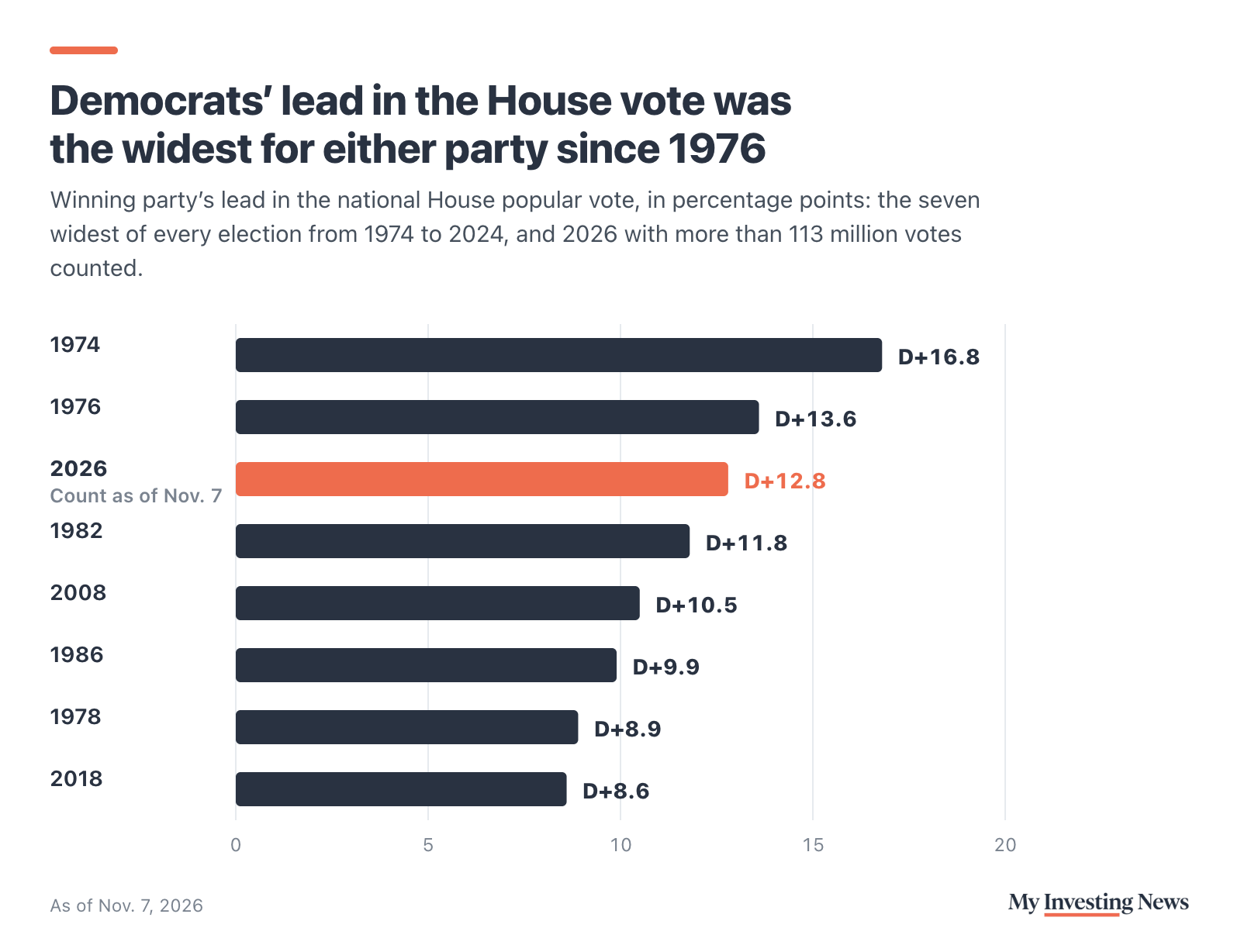
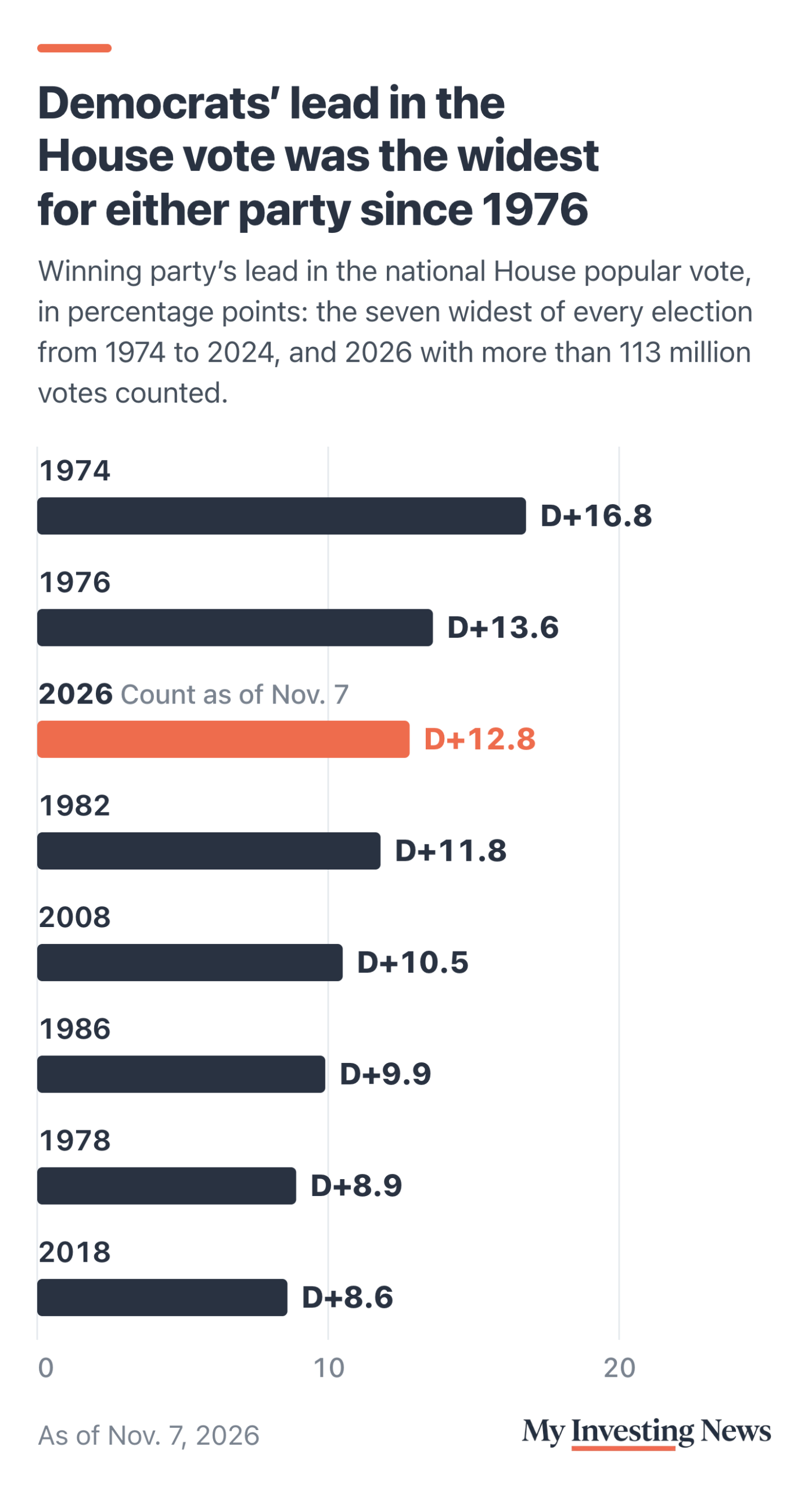
Sheets’s vote claim holds up too. With more than 113 million votes counted, Democrats led the national House vote by 12.8 percentage points on Nov. 7, according to Cook Political Report’s tracker as cited by Yahoo News. In the Clerk of the House’s results since 1974, only two elections were wider, both Democratic: 1974, at 16.8 points, and 1976, at 13.6. Democrats took 55.9% of the vote in 1976, 50 years ago, the benchmark the final 2026 share has to beat.
Big midterm losses haven’t been bad news for stocks. After the four largest since 1950, the S&P 500 was higher a year later every time: up 3.7% after 2010, 27.1% after 1994, 11.1% after 1958 and 18.7% after 1974, measured from the close on or before Election Day. That fits the wider record we laid out in October: stocks were higher a year after every midterm since 1950.
What to Watch
- The last 19 House races: Republicans need to lose 3 of them to make this their worst midterm since 1974, and 10 to pass 1974. Colorado’s 4th District, where Democrat Eileen Laubacher led Rep. Lauren Boebert by about 3,200 votes, is one; counties there have until Nov. 13 to finish counting.
- Alaska and Mississippi: the two Senate calls decide whether the Republican loss ends at seven, eight or nine seats.
- The final vote share: Democrats need to finish above 55.9% to top 1976 and make Sheets’s “almost 50 years” exact.
David Sacks is right that 2026 was a blowout, and in the Senate it beat Watergate. In the House, the AP count as of Nov. 7 puts the Republican loss at 39 to 58 seats, short of Democrats’ 54 in 1994 and out of reach of their 63 in 2010. Whether it passes 1974’s 48 depends on 19 races still being counted.