Where we heard itBloomberg’s “Balance of Power” podcast, “Instant Reaction: Democrats Sweep to Control of Congress in Rebuke of Trump,” released early Nov. 4, 2026, with Ron Brownstein, Bloomberg Opinion columnist, and hosts David Gura and Kailey Leinz.
Hours after Democrats won control of the House and the Senate on Nov. 3, Ron Brownstein was already looking at 2028. The Bloomberg Opinion columnist told Bloomberg’s Balance of Power that even a midterm win this big doesn’t guarantee the party out of power the White House two years later. Then he offered a rule from history.
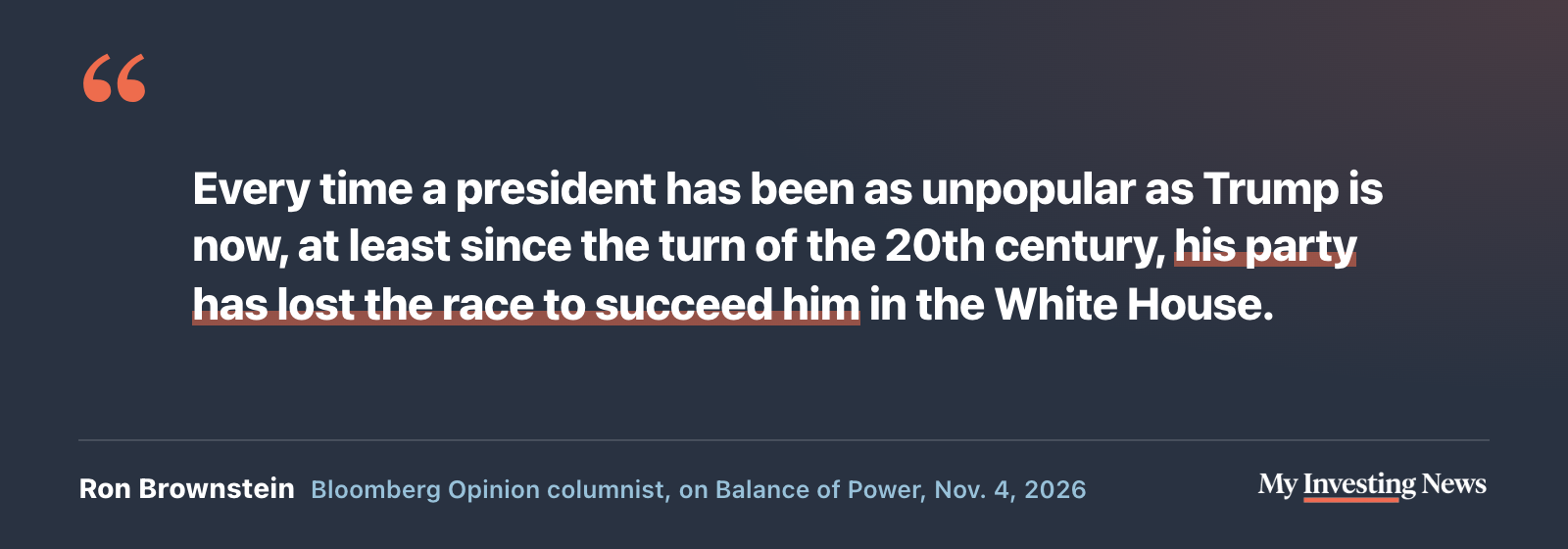
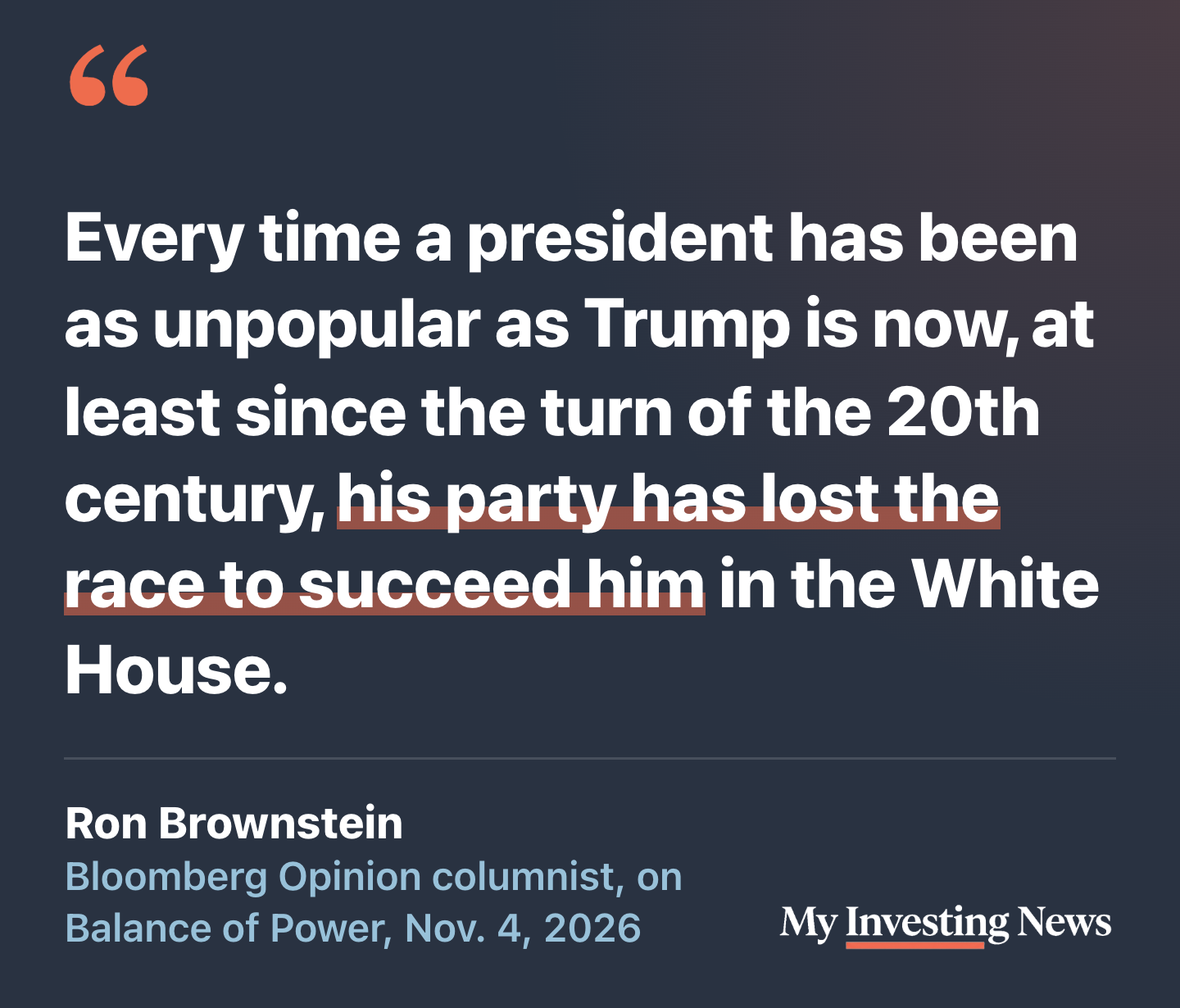
He named Woodrow Wilson in 1920, Harry Truman in 1952, Lyndon Johnson in 1968, George W. Bush in 2008 and Joe Biden in 2024. “If he remains this unpopular in 2028, the possession arrow will point toward the Democrats,” Brownstein said. “Doesn’t guarantee they’re going to win, but I think they will have to be favored.”
How Unpopular Is Trump Now?
The usual yardstick is gone. Gallup, which had asked Americans about the president’s job performance since the late 1930s, said in February that it would stop. Its last reading, from Dec. 1 to 15, 2025, put Trump at 36%. The American Presidency Project at UC Santa Barbara, which keeps the Gallup record, now lists other pollsters’ surveys of all adults. The 7 it lists from October put Trump’s approval between 29% and 35%, an average of 32%. On election night, Brownstein pointed to the networks’ voter poll, which found 62% of voters disapproved of Trump’s performance.
At a Midterm, Only Truman Was This Low
We took Gallup’s last poll before each of the 20 midterms from 1946 to 2022 and checked which party won the White House two years later. Only one president was as unpopular as Trump is now: Truman, at 33% in September 1946. That holds against Gallup’s own last reading of Trump, too. The next lowest were George W. Bush at 38% in 2006 and Truman again at 39% in 1950.
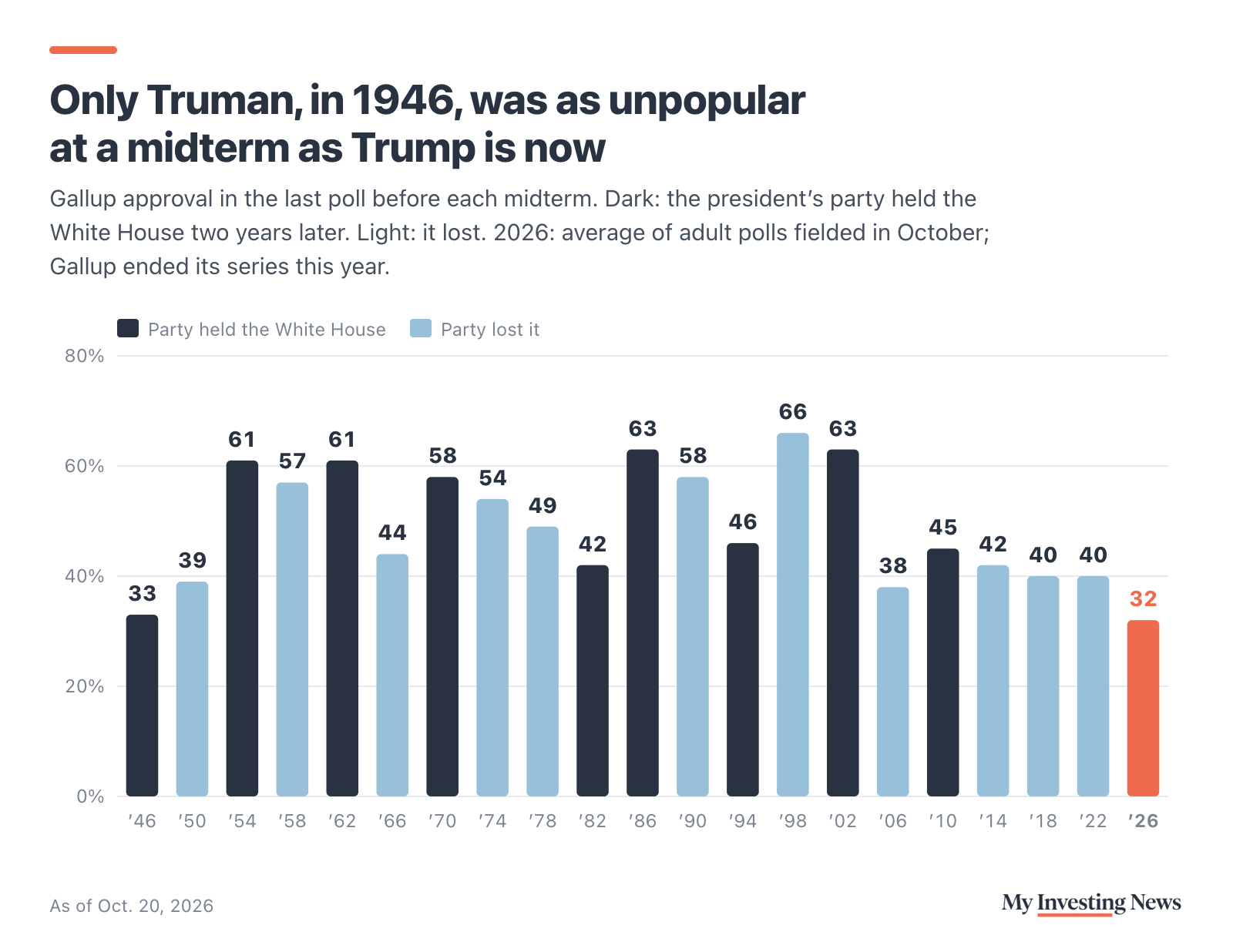
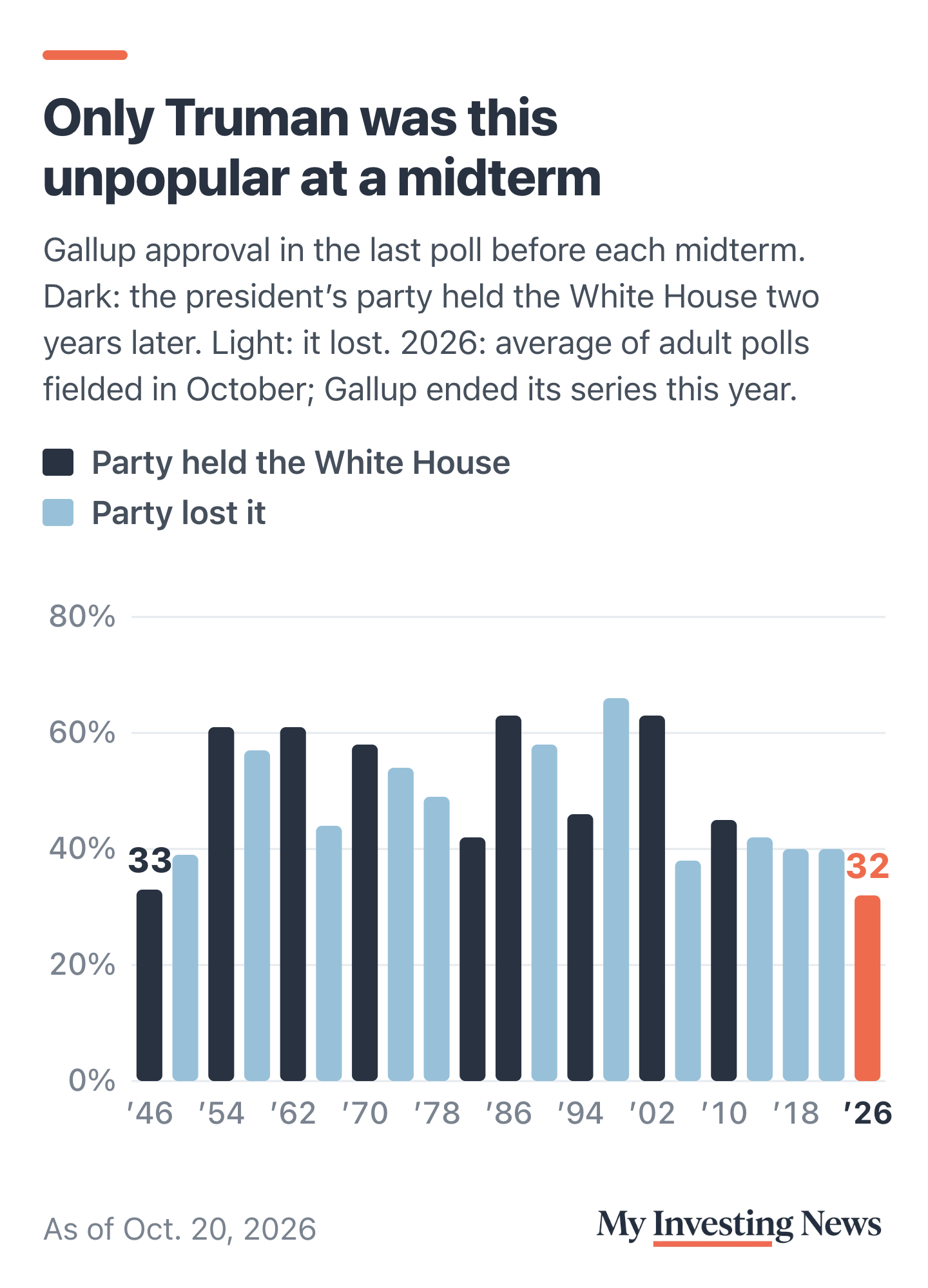
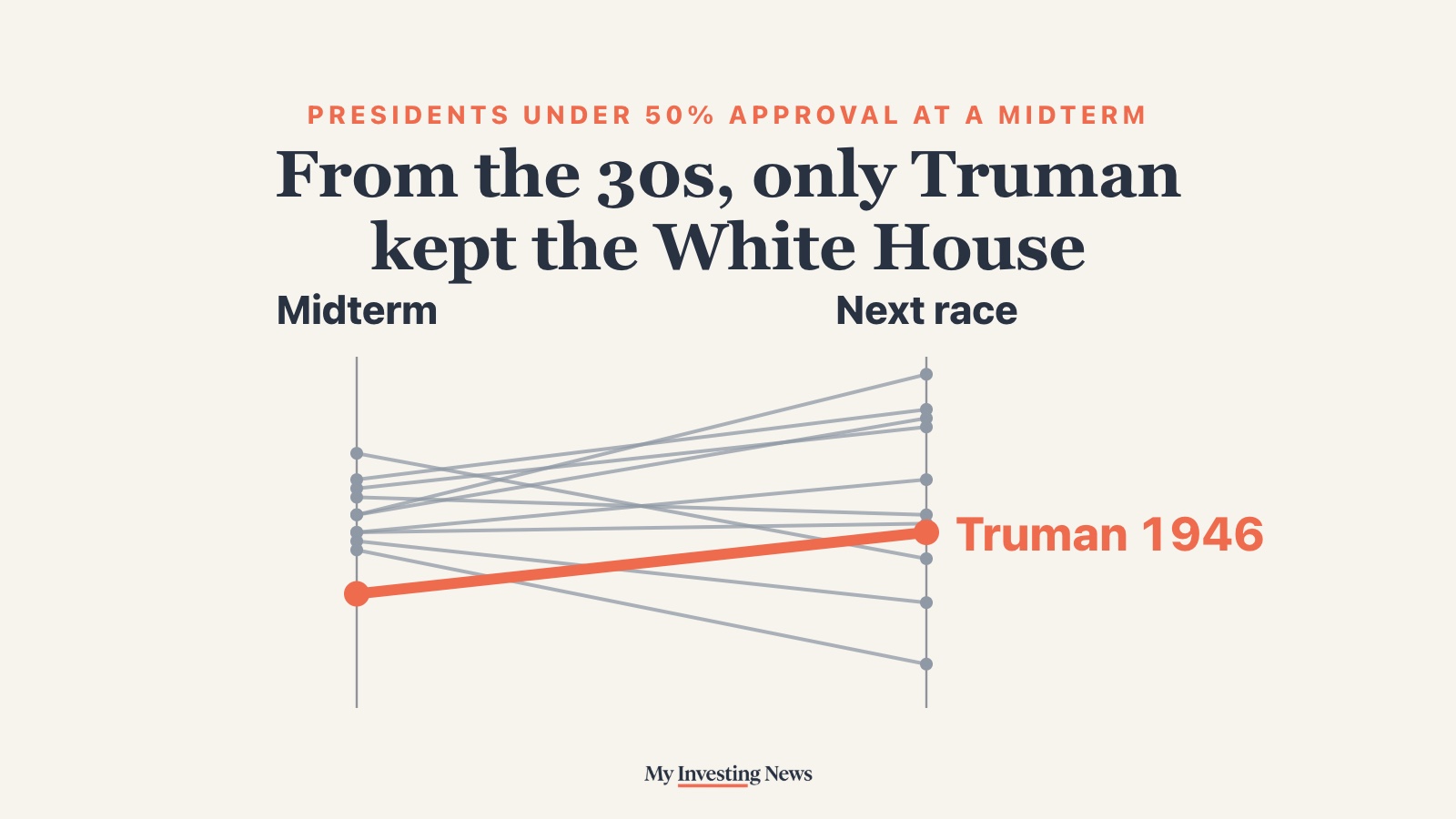
Five presidents were at 40% or lower at a midterm: Truman twice, Bush in 2006, Trump in 2018 and Biden in 2022. Four of their parties lost the next presidential race. The exception is the one closest to Trump’s rating today. Truman’s Democrats lost their House majority in 1946, and two years later he beat Thomas Dewey.
Approval and the next presidential race, since 1946
Where Brownstein’s Rule Holds
His rule is about how unpopular a president is when his term runs out. Measured that way, it holds. In Gallup’s last poll before each presidential election since 1948, four presidents were under 40%: Truman in 1952 (32%), Jimmy Carter in 1980 (37%), George H.W. Bush in 1992 (34%) and George W. Bush in 2008 (25%). All four parties lost. Two of his examples sat just above that line, Johnson at 42% in 1968 and Biden at 41% in 2024, and their parties lost too.
The close call is Truman in 1948. Gallup’s last reading that year, in June, had him at 40%, and he won. A good rating doesn’t guarantee a win, either. Dwight Eisenhower was at 58% in 1960, Bill Clinton at 57% in 2000 and Barack Obama at 53% in 2016, and each saw his party lose. In every example Brownstein named, the president wasn’t on the ballot. Trump can’t run for a third term, so 2028 will be the same kind of race.
What Two Years Can Change
The catch is timing. Brownstein’s “now” is a midterm, and ratings move a lot in two years. Of the 11 presidents under 50% at a midterm, 4 saw their party keep the White House. Ronald Reagan went from 42% in October 1982 to 58% before his 1984 landslide. Clinton rose from 46% to 54%, and Obama from 45% to 52%. Others slid: Bush fell from 38% in 2006 to 25% in 2008, and Truman from 39% in 1950 to 32% in 1952.
Under 50% at a midterm, 4 of 11 presidents saw their party keep the White House. Of the 3 in the 30s, only Truman did
Gallup approval in the last poll before the midterm and the last before the next presidential election. Coral: the president’s party held the White House. Gray: it lost. Truman’s 1948 reading is from June, Gallup’s last that year.
Before polls, there is no direct way to measure “this unpopular,” and that covers part of Brownstein’s “at least since the turn of the 20th century.” House seats lost at a midterm are a rough stand-in. From 1902 to 1938, the president’s party took its four biggest losses in 1922 (77 seats), 1938 (72), 1914 (61) and 1910 (57). Two years later, it held the White House three times; only William Howard Taft’s Republicans lost, in 1912. Wilson’s Democrats, Brownstein’s 1920 example, had lost 22 seats in 1918. Seat losses track more than popularity, including how districts are drawn (a 2018-size swing would flip fewer House seats on today’s maps), so this is a weak test.
What to Watch
Bettors on Polymarket put the Democrats’ chances of winning the White House in 2028 at 67.5% as of Nov. 10, up from 64.5% on Nov. 1 and 52.5% on Jan. 1. Markets that far out have a mixed record; in 2022, bettors’ Senate favorites won 14 of 18 races with Election Day weeks away, not years.
The number to follow is Trump’s approval through 2027 and into 2028. If it stays near the low 30s, his party would be in the company of Truman in 1952 and Bush in 2008. If it climbs toward the mid-40s or higher, as Reagan’s, Clinton’s and Obama’s did, the record says much less.
Brownstein says unpopular presidents’ parties lose the race to succeed them, and he expects Democrats to be favored in 2028 if Trump stays this unpopular. Gallup’s record backs the rule near Election Day: every president under 40% then saw his party lose. Two years out, it is less certain. The only president as unpopular as Trump at a midterm, Truman in 1946, won in 1948.