Where we heard itBloomberg Businessweek Weekend, Oct. 24, 2026, with hosts Carol Massar and Tim Stenovec. Patrick McGee, author of Apple in China. Quotes checked against the audio; numbers checked against Apple’s annual reports, the National Archives and Bureau of Labor Statistics price data.
Patrick McGee says Apple made the biggest overseas investment promise he has ever seen from a company. On Bloomberg Businessweek, the author of Apple in China said Apple’s own study in 2016 found it was putting $55 billion a year into Chinese factories, counting the machinery it bought for suppliers’ production lines and the wages of “up to 3 million people per year” in its supply chain. Then, he said, Tim Cook and his operating chief, Jeff Williams, went to Zhongnanhai, the Beijing compound of China’s leadership, in May 2016. “They promise to invest $275 billion into Chinese factories,” McGee said, five years of that $55 billion.
The figure first surfaced in a December 2021 report by The Information, which said Cook signed an agreement with Chinese officials estimated to be worth more than $275 billion over five years. Apple hasn’t published the figure in its filings, and McGee said he doesn’t think Apple tallies it internally. So the pledge itself can’t be checked against a filing. What can be checked is the comparison he hangs it on, and how the promise stacks up against Apple’s own books.
Testing the Marshall Plan Comparison
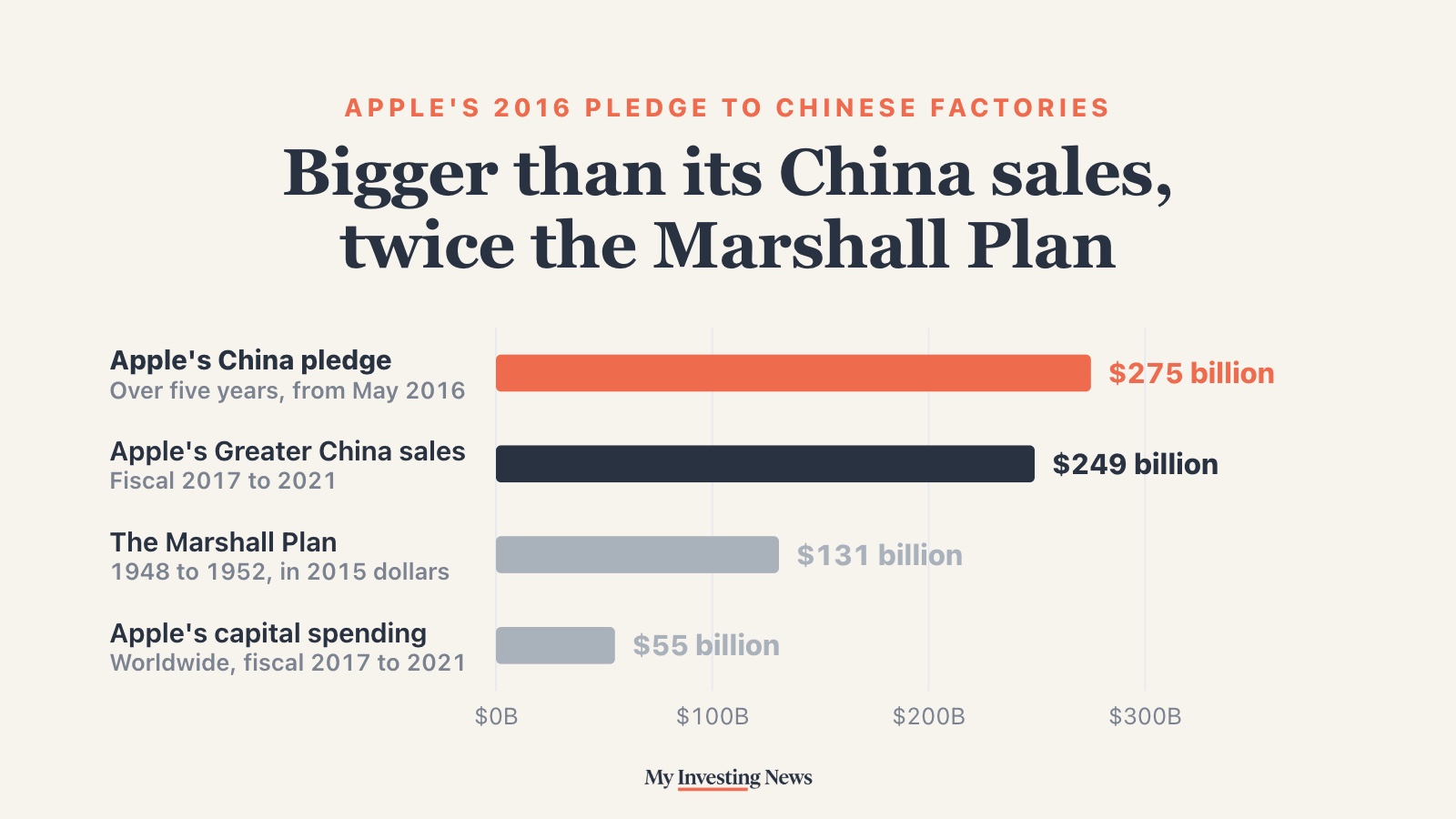
McGee called it “the Cook Plan” and set it next to the Marshall Plan, America’s rebuilding aid to Western Europe after World War II. “In 2015 dollars, that was $131 billion invested in four years,” he said. “So the Cook Plan, if you will, was double the amount in a similar time period.”
His math holds. According to the National Archives, Congress appropriated $13.3 billion for the Marshall Plan over four years starting in 1948. Adjusted from 1948 prices with the government’s consumer price index, that is $131 billion in 2015 dollars. Apple’s $275 billion was spent in later, pricier years, so we also put it in 2015 dollars, spreading $55 billion a year over 2016 to 2020. That comes to about $261 billion, still about twice the Marshall Plan.
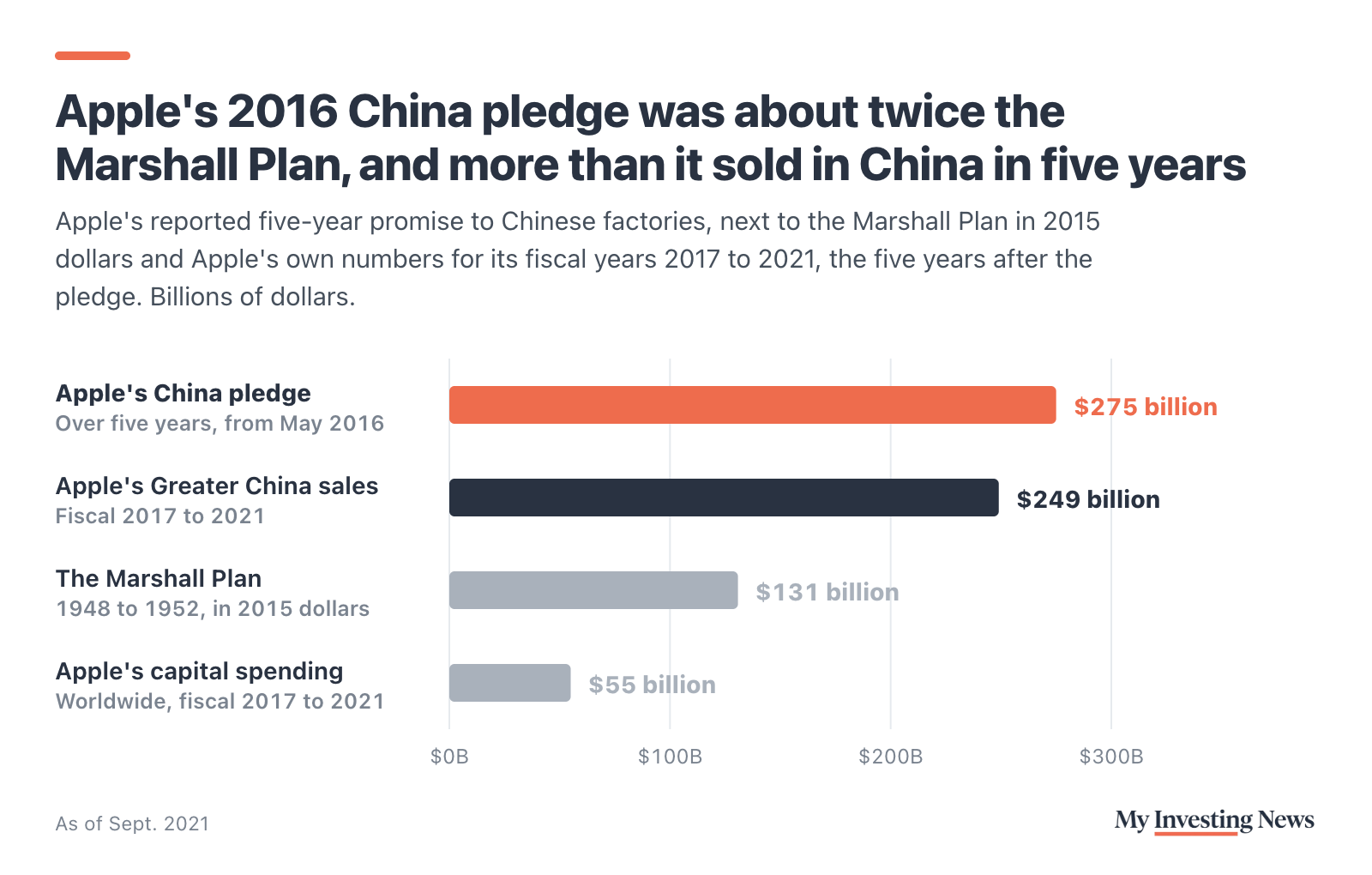
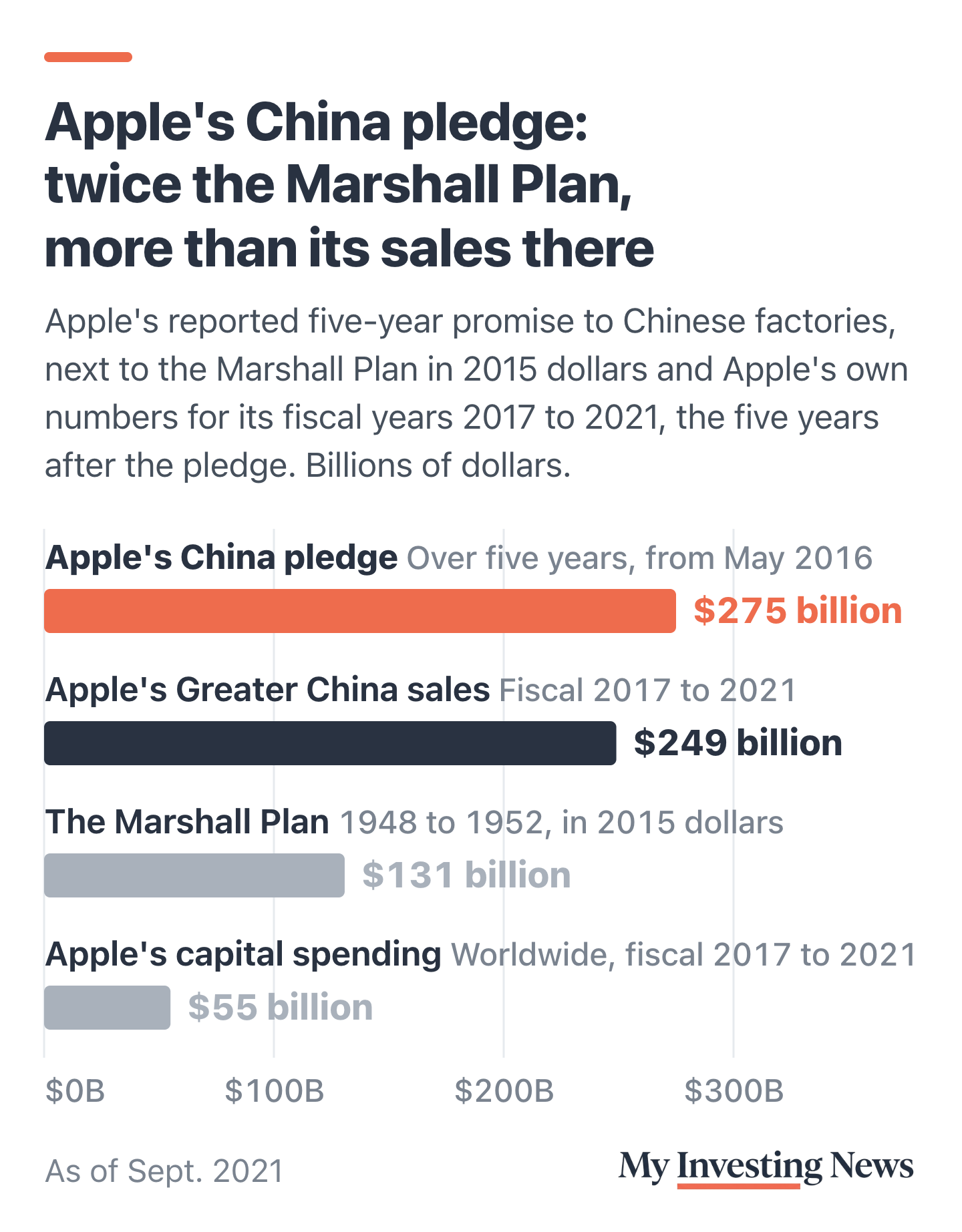
Against Apple’s own numbers, the promise looks even bigger. In fiscal 2017 through 2021, the five years after the pledge, Apple’s sales in Greater China (mainland China, Hong Kong and Taiwan) totaled $249 billion, less than it promised to invest in Chinese factories. The pledge equals 20% of Apple’s worldwide sales in those years and about a third of its cost of sales. It is 5 times the $55 billion Apple reported for its own capital spending over the same stretch, because most of the money McGee describes went into suppliers’ factories and payrolls. By comparison, the Marshall Plan cost about 1.1% of U.S. economic output from 1948 through 1951.
The Cook Plan vs. the Marshall Plan
China Matters Less as a Market
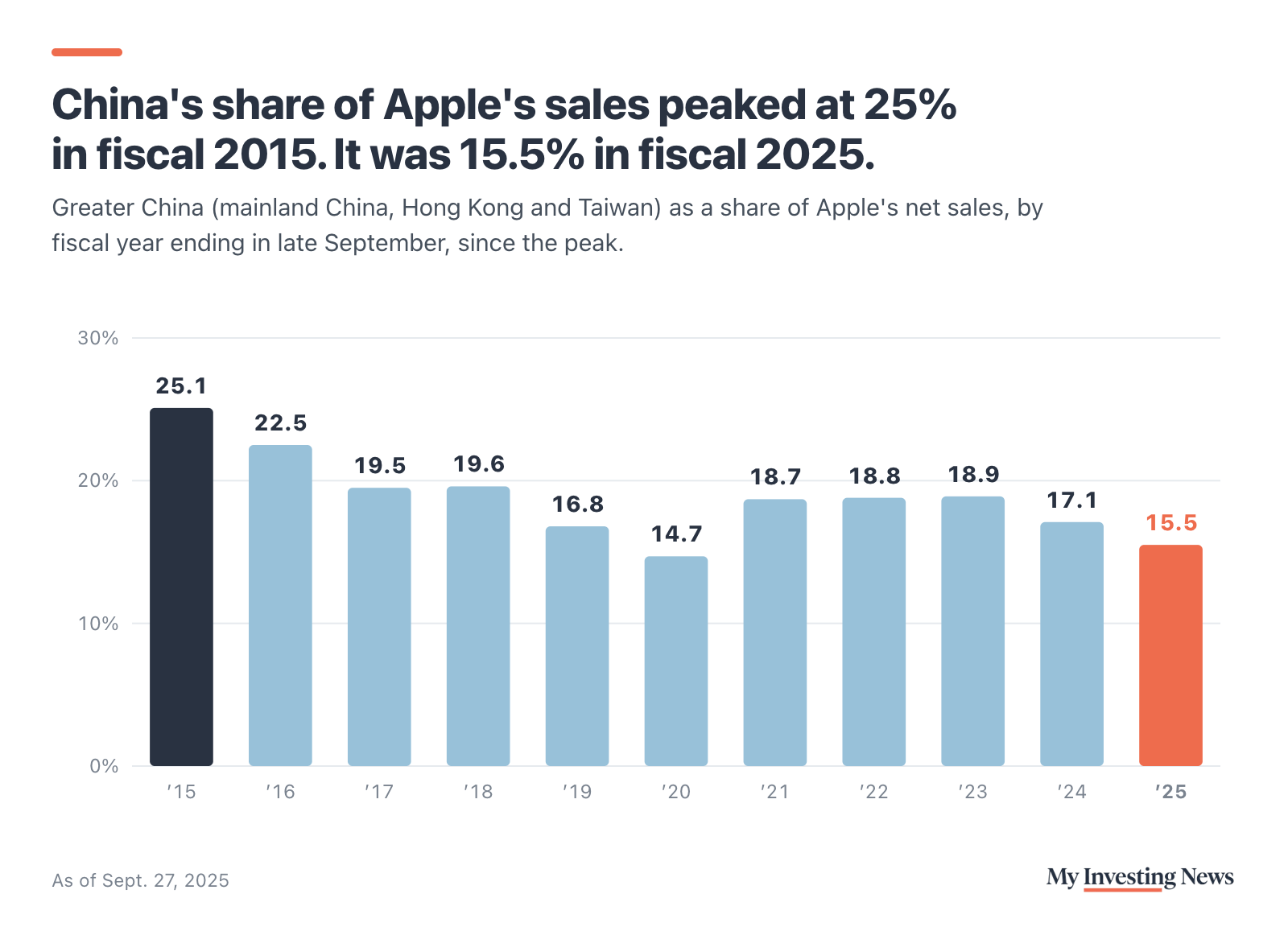
The money bought production more than customers. In McGee’s words, Apple realized it was “the biggest contributor of Made in China 2025,” Beijing’s plan to build up its own manufacturing, and that “millions upon millions of people were trained at the behest of Apple.” As a place to sell iPhones, China has shrunk in Apple’s results. Greater China made up 25.1% of Apple’s net sales in fiscal 2015, the peak, up from 15.8% two years earlier. In fiscal 2025 it was 15.5%, or $64 billion, down from a dollar peak of $74 billion in fiscal 2022.
Apple’s factory footprint is harder to measure, since it doesn’t report where its products are built. That is the gap McGee’s book tries to fill.
The Pledge Apple Talks About Now
Apple’s public promises now point home. In August 2025 it raised its U.S. commitment to $600 billion over four years, more than twice the China figure, and it has steered part of that to suppliers such as a Pennsylvania titanium maker. Corning’s finance chief said in October that by the end of 2026, all iPhone cover glass sold worldwide will come from its Kentucky plant. The U.S. pledge counts a wider mix of spending than McGee’s factory figure, so the two aren’t like for like.
McGee isn’t convinced the shift is real. “There’s a big reindustrialization narrative taking place in America,” he said. “I think there’s substantially no evidence for that.” He said an iPhone whose final assembly, testing and packing happen in India gets a “made in India” stamp, though in his view it is still mostly made in China. Cook, who made the 2016 promise, handed the chief executive job to John Ternus on Sept. 1 and stayed on as executive chair.
What to Watch
Apple’s fiscal 2026 results, released Nov. 2, add another year to the China record above, which stood at 15.5% of sales in fiscal 2025. The supply chain is under strain again: shipping estimates for the new iPhone Duo slipped to late January within half an hour of preorders opening. And McGee pointed to a forecast from the United Nations that China is on a trajectory to make 45% of the world’s manufacturing output by 2030, a projection he noted was made before AI.
McGee’s Marshall Plan math checks out: in 2015 dollars, Apple’s reported $275 billion China pledge is about twice the postwar aid to Europe. It was also more than Apple sold in Greater China in the five fiscal years that followed. The open question is how much of that dependence Apple’s $600 billion U.S. pledge actually changes.