Where we heard itCNBC, Fast Money, Nov. 6, 2026. Speaker: Carter Worth, founder of Worth Charting, on a panel with host Melissa Lee. Also quoted: Lou Miller, global head of custom basket trading at Goldman Sachs, on the firm’s The Markets podcast, released Nov. 6, 2026.
Carter Worth thinks the safe trade has run out of room. On CNBC’s Fast Money on Nov. 6, the founder of Worth Charting said a month of money rushing out of chip and machinery stocks had poured into companies like Home Depot and McDonald’s, which he called “dry sponges.” “But the sponges are now full,” he said. “Things like Procter & Gamble trading at 25 times, 26 times, higher than Nvidia, with revenue growth of 2% and earnings growth of 4.”
It sounds like a mistake: a soap and diaper maker priced above the company at the center of the AI build-out. We checked it against both companies’ filings. As of the Nov. 6 close, it was true by two common measures, and it had not happened on trailing earnings since June 2020. Before that week, it hadn’t happened since the 2018 chip slump without an accounting charge helping it along.
The Claim Checks Out, Barely
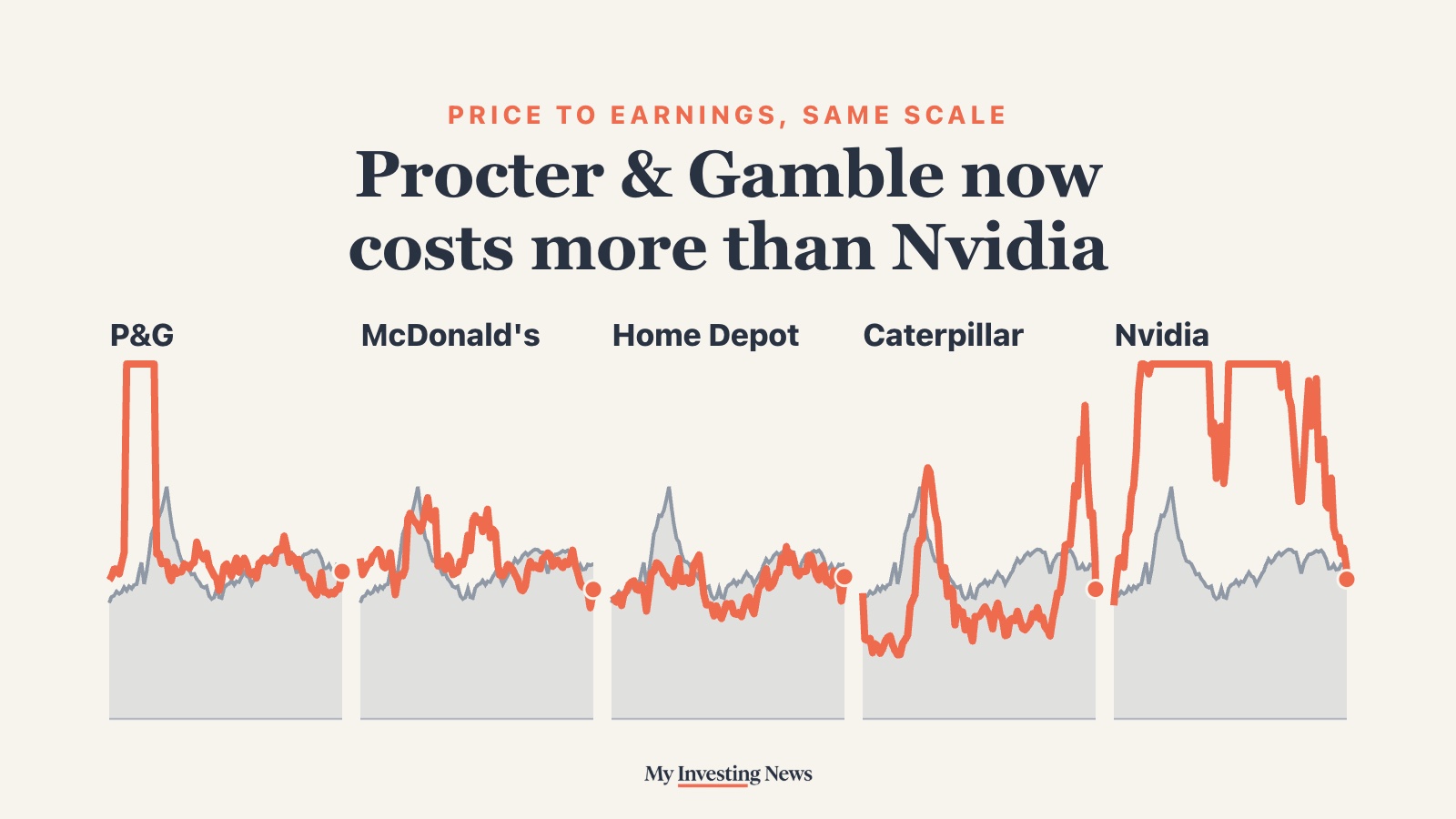
Procter & GamblePG closed at $165.40 on Nov. 6. Its last four quarters of diluted earnings add up to $6.64 a share, which puts the stock at 24.9 times trailing earnings. NvidiaNVDA closed at $186.64, or 23.6 times its $7.91 of trailing earnings. P&G passed Nvidia on that measure on Nov. 5, the day the S&P 500 fell 4.4%. A day earlier the two were tied at about 25 times.
The gap is wider on next year’s profits. Wall Street’s consensus calls for $9.30 a share at Nvidia for the fiscal year ending in January and $15.75 the year after, according to Zacks estimates published by Nasdaq. That puts Nvidia at 20.1 times this fiscal year and 11.9 times next. P&G trades at 23.7 times the $6.99 analysts expect for its year ending in June, close to the 23.6 times implied by the company’s own $7.00 midpoint.
Worth’s growth figures are close to P&G’s own outlook. In its Oct. 22 earnings release, the company kept its forecast for organic sales growth of 1% to 3% this fiscal year and core earnings growth of zero to 3%. The first quarter ran a little hotter, with sales up 4% and core earnings per share up 1%.
The Sponges and the Casualties Now Cost the Same
Worth’s one-month numbers hold up too. From the Oct. 6 close, when the S&P 500 set its record, to Nov. 6, Home Depot rose 19.8% and McDonald’s rose 19.0%, while Caterpillar fell 35.3% and the PHLX Semiconductor index fell 29.0%. P&G gained 11.4%, less than the 20% Worth grouped it with. The S&P 500 ended the stretch 5.7% below its record.
The result is a market where the winners and losers of that month now carry nearly the same price tag. All five stocks Worth named traded between 22 and 25 times trailing earnings on Nov. 6, a little under the S&P 500’s multiple of about 26 in October. Caterpillar was at 53 times in June. Nvidia’s multiple topped 200 in 2023 and is now lower than at any month-end since February 2019. A JPMorgan strategist argued in October that the chip group was still cheap on expected earnings.
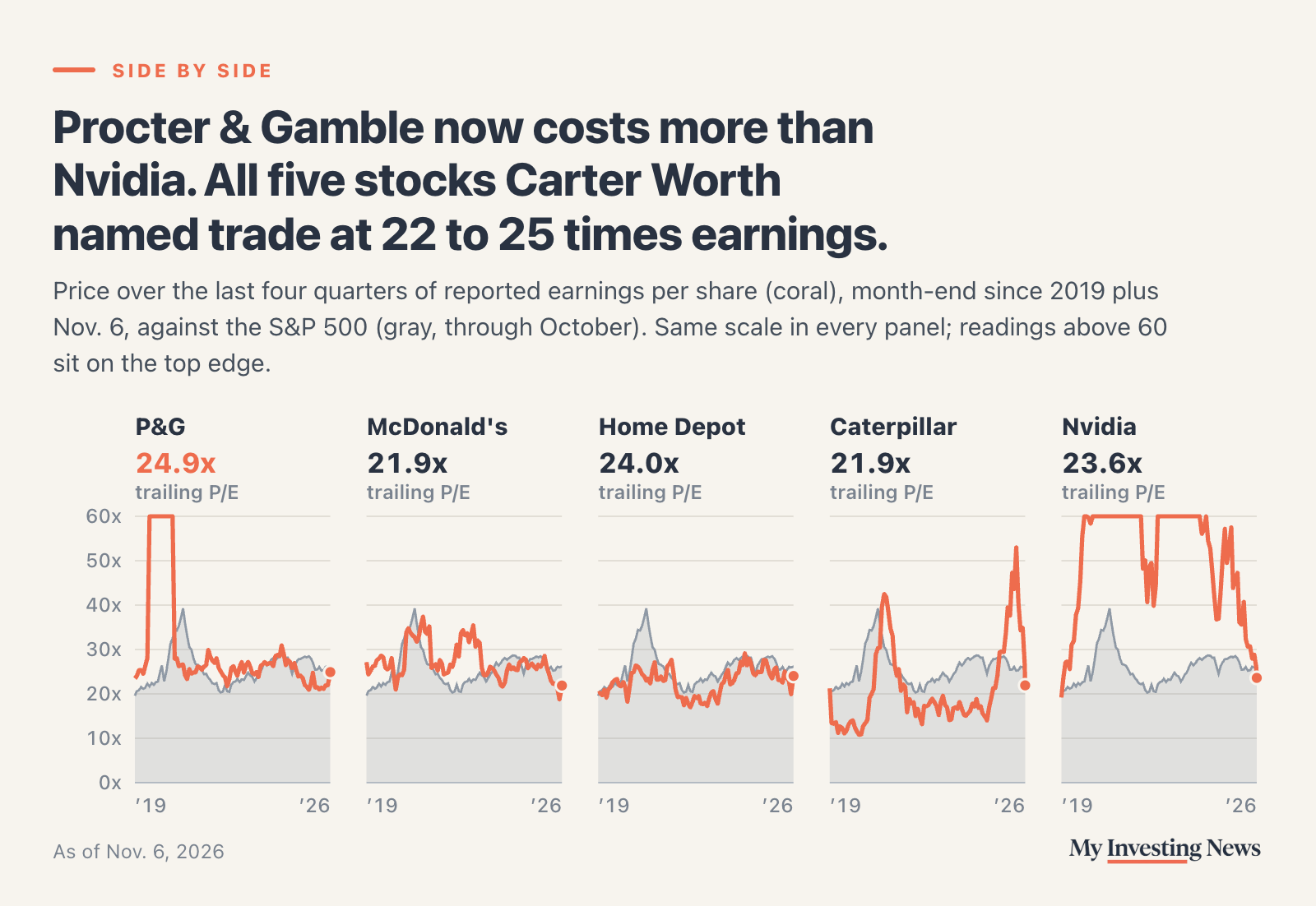
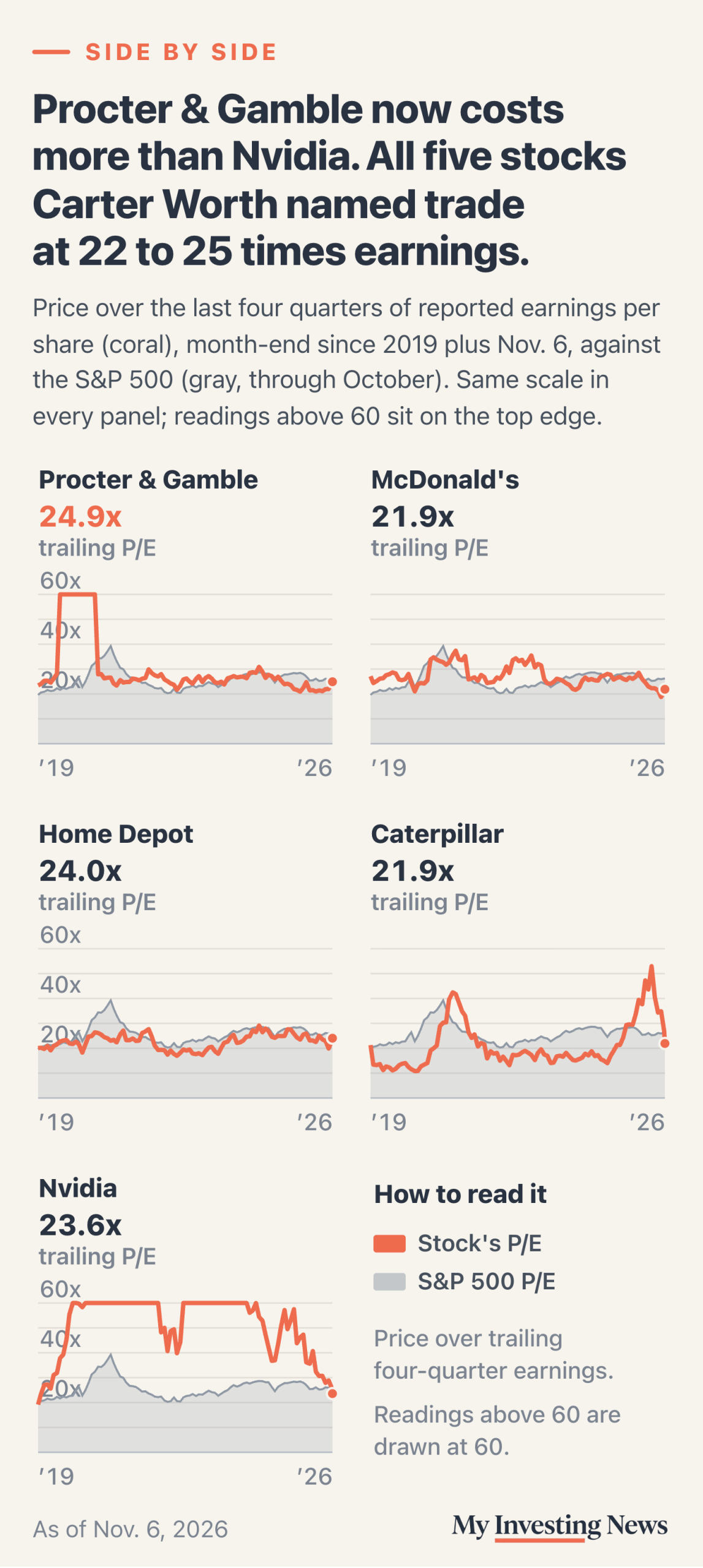
The last time P&G traded above Nvidia, the comparison flattered P&G. From August 2019 to June 2020, a writedown of its Gillette shaving business shrank P&G’s trailing earnings and pushed its multiple as high as 91. Before that, the last clean stretch came in late 2018 and early 2019, when a crypto-mining hangover sent Nvidia’s shares down by half. Since August 2010, P&G has been the pricier stock at 55 month-ends, most of them before 2016, when Nvidia was still mainly a maker of gaming chips.
Procter & Gamble vs. Nvidia, as of the Nov. 6 close
Staples Yield Half the 10-Year, a 2007 Level
Lou Miller, global head of custom basket trading at Goldman Sachs, made a related point on the firm’s The Markets podcast, recorded Nov. 5 and released Nov. 6. “Expensive defensives, I don’t think are defensive,” he said. “The dividend yield of staples is half of the 10-year Treasury yield. To me, that’s not a good deal for investors.” He said he would rather own reasonably priced, cash-rich companies outside the AI trade than “pay 25 times earnings for some, you know, boring consumer product.”
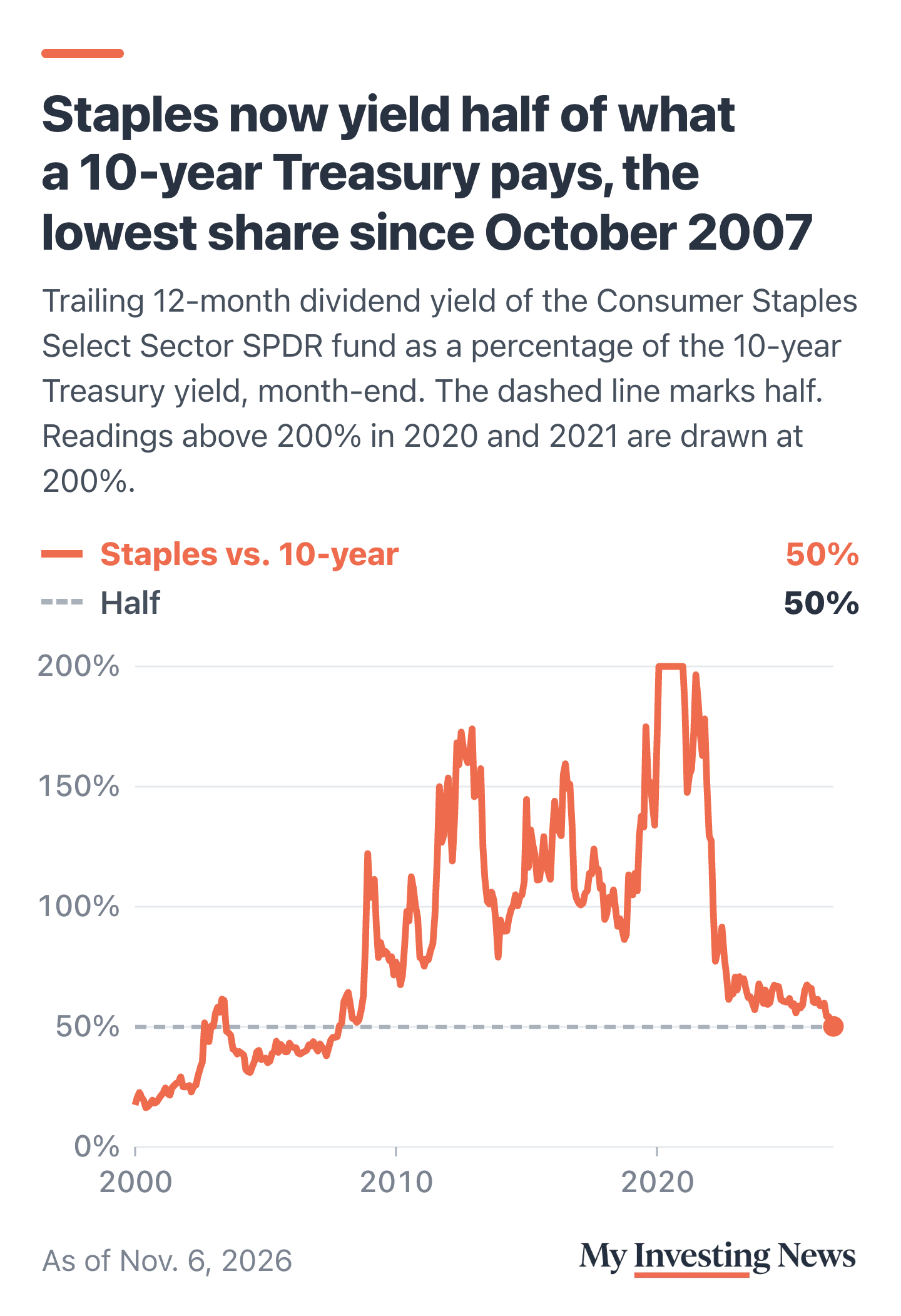
His math holds. The Consumer Staples Select Sector SPDR fundXLP paid $2.20 a share in dividends over the past year, a 2.44% yield at its Nov. 6 close. The 10-year Treasury yielded 4.86%. That makes the staples yield 50% of the bond yield. At the end of October it was 50%, the lowest month-end reading since October 2007.
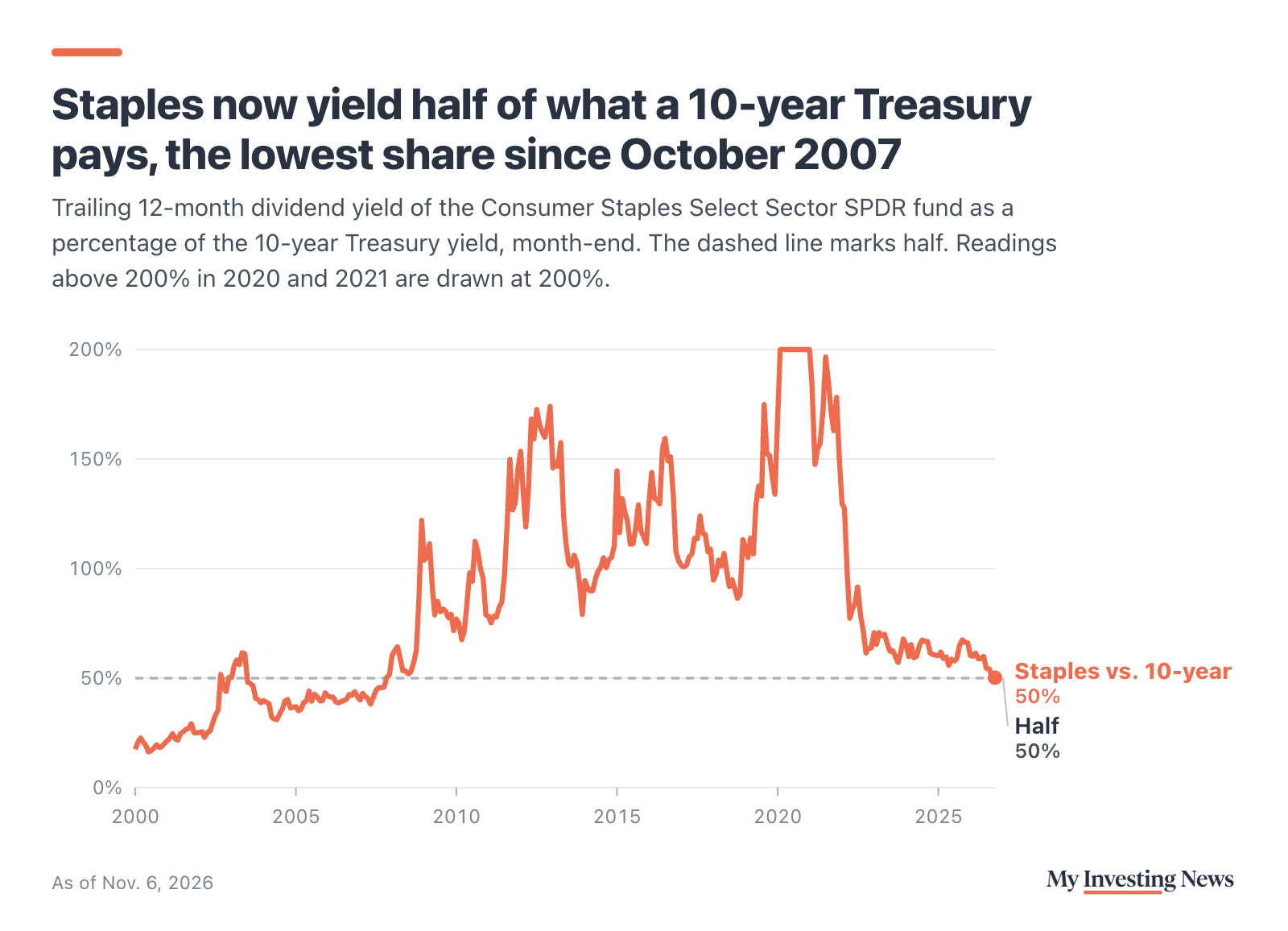
Half was normal before the financial crisis. From 2000 through 2007, staples yielded 36% of the 10-year on average, and the fund still earned a median 5.2% total return in the 12 months after the 86 month-ends when the ratio was at or below half. That was about half the 10.9% median after the other 224 months. Staples beat the S&P 500 in 50% of the low-ratio cases, helped by the 2001 and 2002 bear market. Almost all of those cases come from one eight-year stretch, so treat the history as a rough guide.
What to Watch
- Nvidia’s next report: Its third-quarter results, expected later in November, replace a quarter in its trailing earnings. Analysts expect earnings to keep growing, which would lower its trailing multiple at the Nov. 6 price.
- The 10-year yield: a fall in bond yields would make staples’ dividends look better next to Treasurys, the comparison Miller says no longer works.
- Breadth: Worth’s point was that the index held up while its parts got worse. Schwab’s Liz Ann Sonders flagged the same split in October, when fewer than half of S&P 500 stocks were above their 200-day averages.
Josh Brown called Nvidia an anti-bubble at the end of October, when it traded at 15.3 times forward earnings. At 23.6 times trailing earnings, it now trades below a consumer staple.
Carter Worth’s comparison is right: on Nov. 6 Procter & Gamble traded at 24.9 times trailing earnings and Nvidia at 23.6, the first time since 2020 that P&G was the pricier stock on that measure. Staples also yield half what the 10-year Treasury pays, the lowest share since 2007. The counterargument is that investors may keep paying more for P&G’s steady profits than for Nvidia’s swings, so the gap could last.