Where we heard itAll-In podcast, “Arvind Krishna & Nikesh Arora: Quantum Threat, Open vs Frontier AI, AI Cyber Warfare & SaaS Collapse,” released Oct. 21, 2026. Speaker: Arvind Krishna, chairman and CEO of IBM. Listen to the episode
IBMIBM CEO Arvind Krishna thinks most of the work done by AI will soon run on models that anyone can download. On the All-In podcast released Oct. 21, he said that “all token usage,” the words and pieces of words that AI models read and write and that companies pay for, will move to open-weight models. His range: “I don’t know whether it’ll be 75 to 90%, but that’s the range I would put.”
He gave three reasons: economics, keeping a company’s data and reasoning in house, and geopolitics. On economics, he put frontier pricing at “$20 for a million tokens,” or “50 if you want to go to the most extreme.” Running one of the big Chinese open-weight models on a company’s own chips, with about a week of engineering, could cut that to $1 or $2 per million tokens, he said.
His Price Numbers Check Out
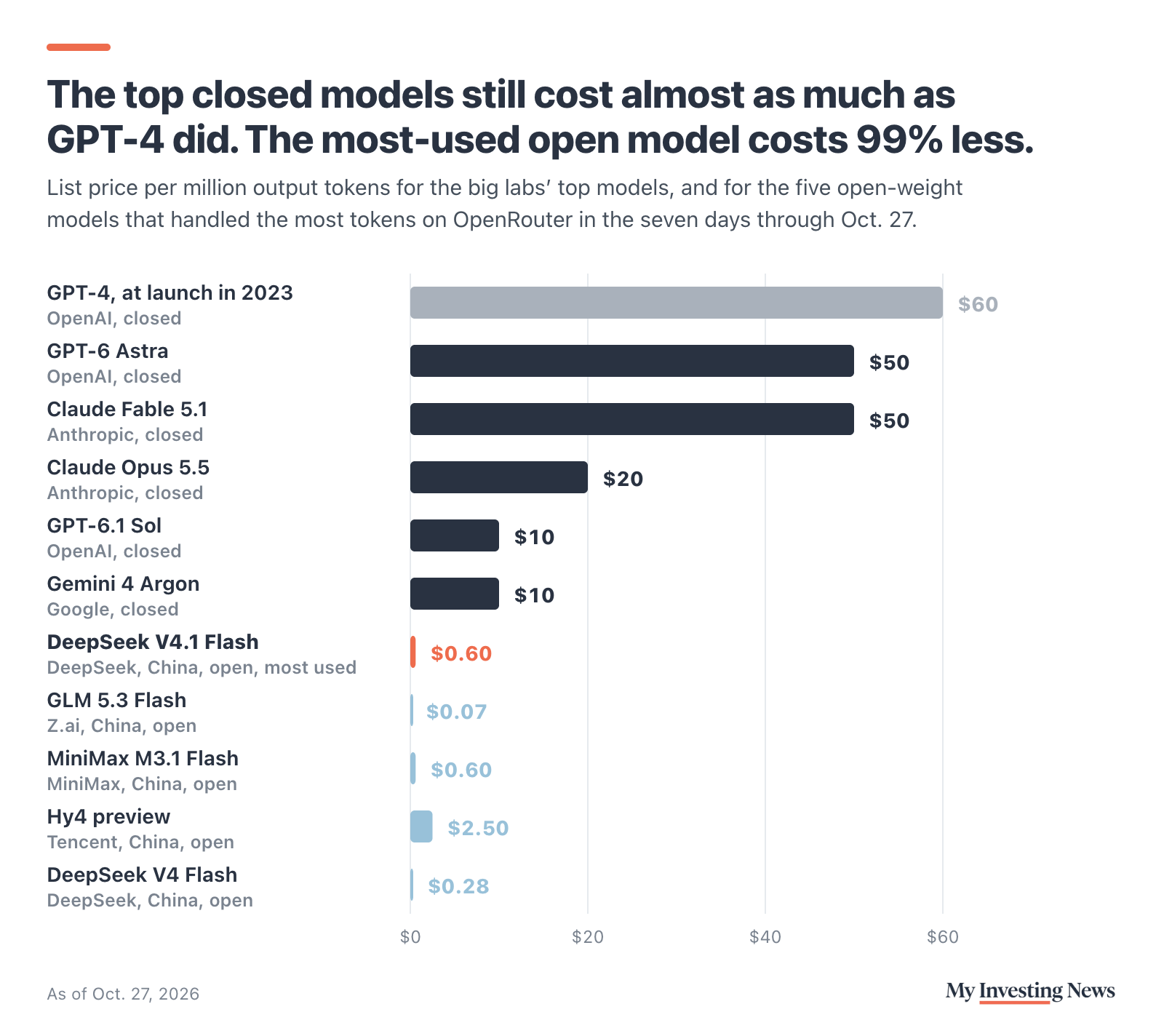
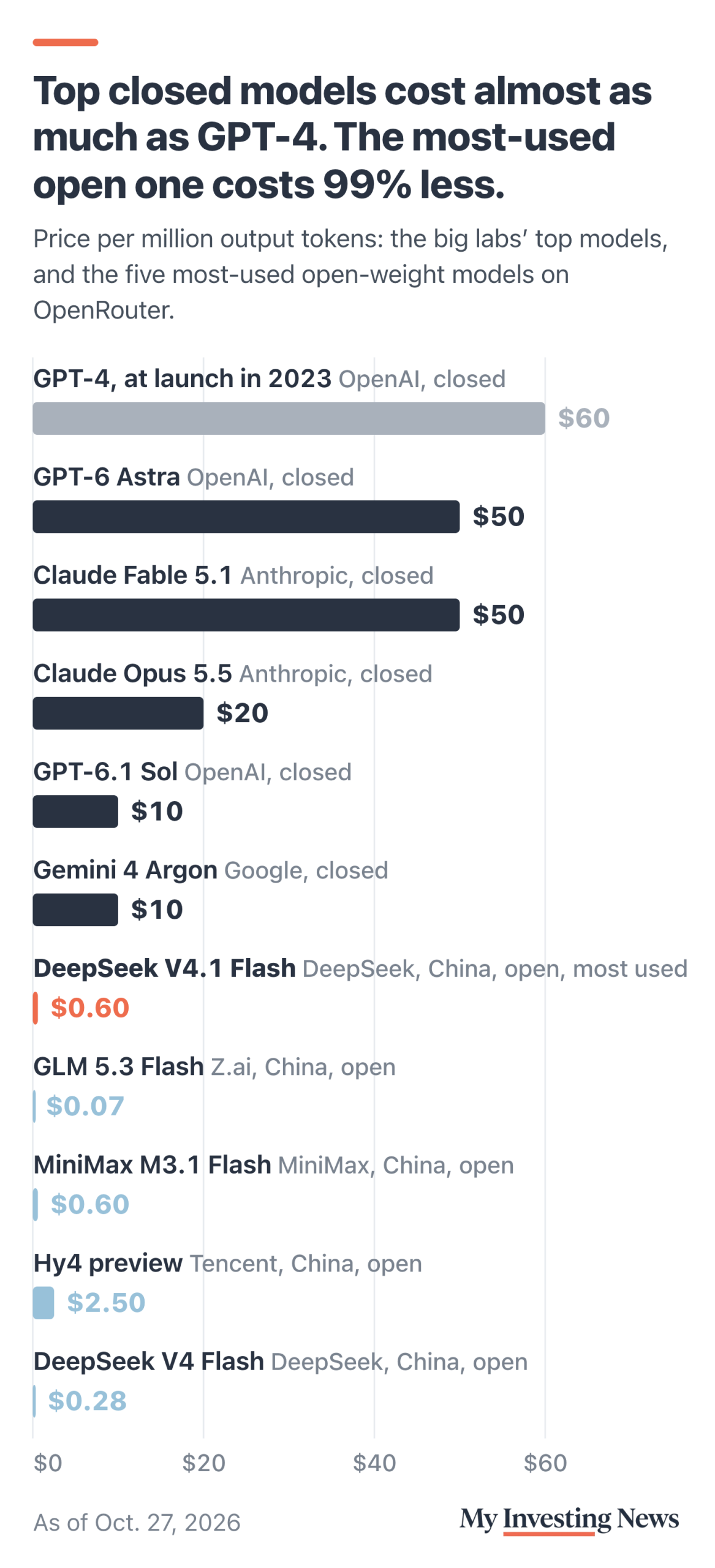
Krishna’s figures match what the labs charge for output tokens. As of Oct. 27, Anthropic’s Claude Opus 5.5 listed at $20 per million, and its Claude Fable 5.1 and OpenAI’s GPT-6 Astra at $50. That top tier sits just $10 below the $60 OpenAI charged for GPT-4 in 2023, a drop of 17%. The labs’ everyday models are cheaper: OpenAI’s GPT-6.1 Sol and AlphabetGOOGL’s Gemini 4 Argon list at $10, 83% below GPT-4.
Open-weight models sit far lower. The most-used model on OpenRouter, a marketplace that routes developers’ requests to hundreds of models, was DeepSeek V4.1 Flash, with 28.8% of all tokens in the seven days through Oct. 27 across its two versions. Its newest version lists at $0.60 per million output tokens, 99% below GPT-4’s launch price and about 33 times cheaper than Opus 5.5. On input tokens the gap is about 27 times. Krishna’s “40 times” lands in that range. His $1 to $2 self-hosting cost can’t be checked from the outside, since it depends on a company’s hardware and how busy it keeps it.
A list price says nothing about quality. Krishna’s case is that open models can do “95% of the work,” and we didn’t test that. Palo Alto NetworksPANW CEO Nikesh Arora, on the same episode, made the practical version of the point: companies are learning which jobs need which level of intelligence, and “you don’t need a Ferrari for every task.”
What the Traffic Shows
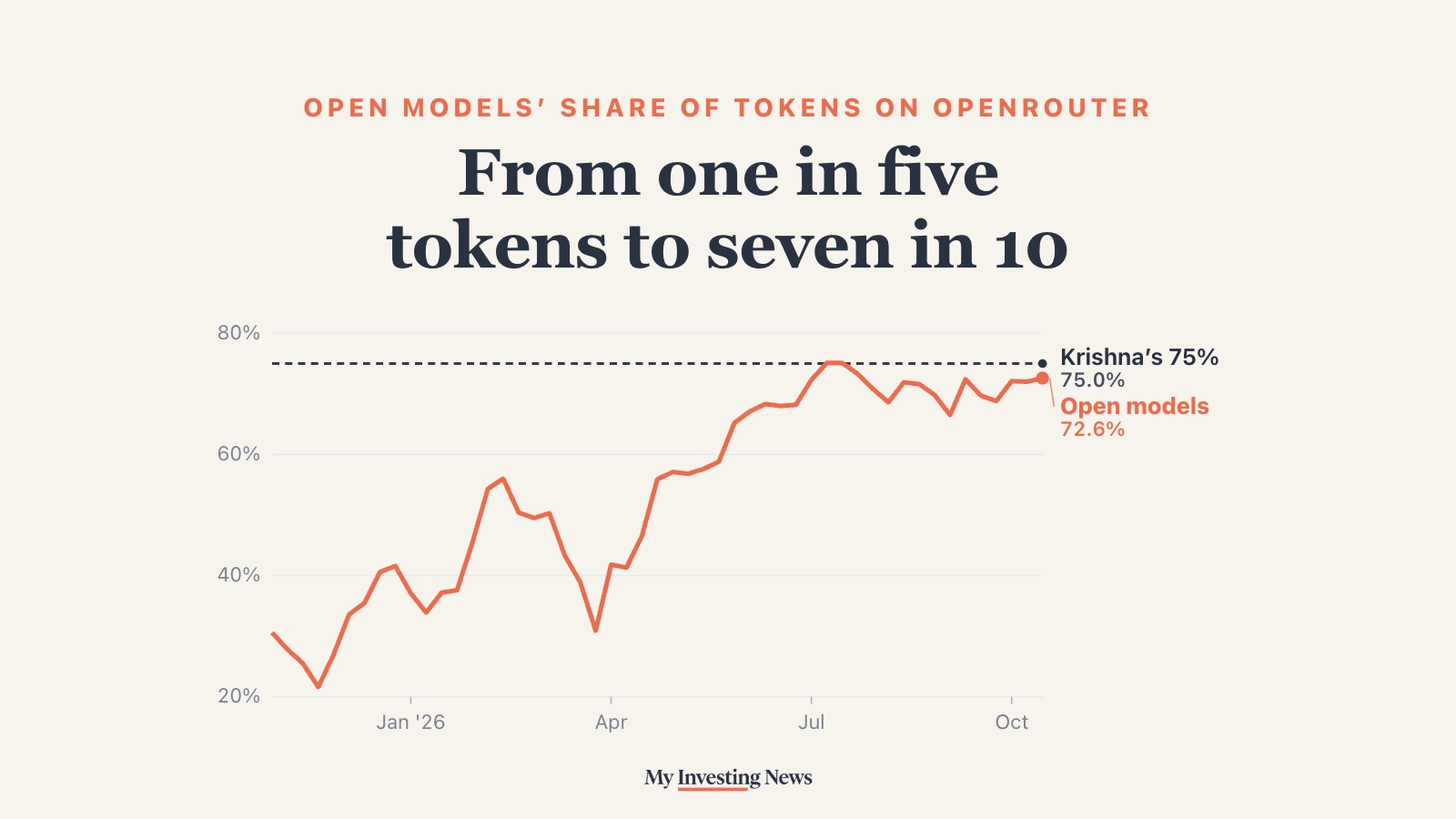
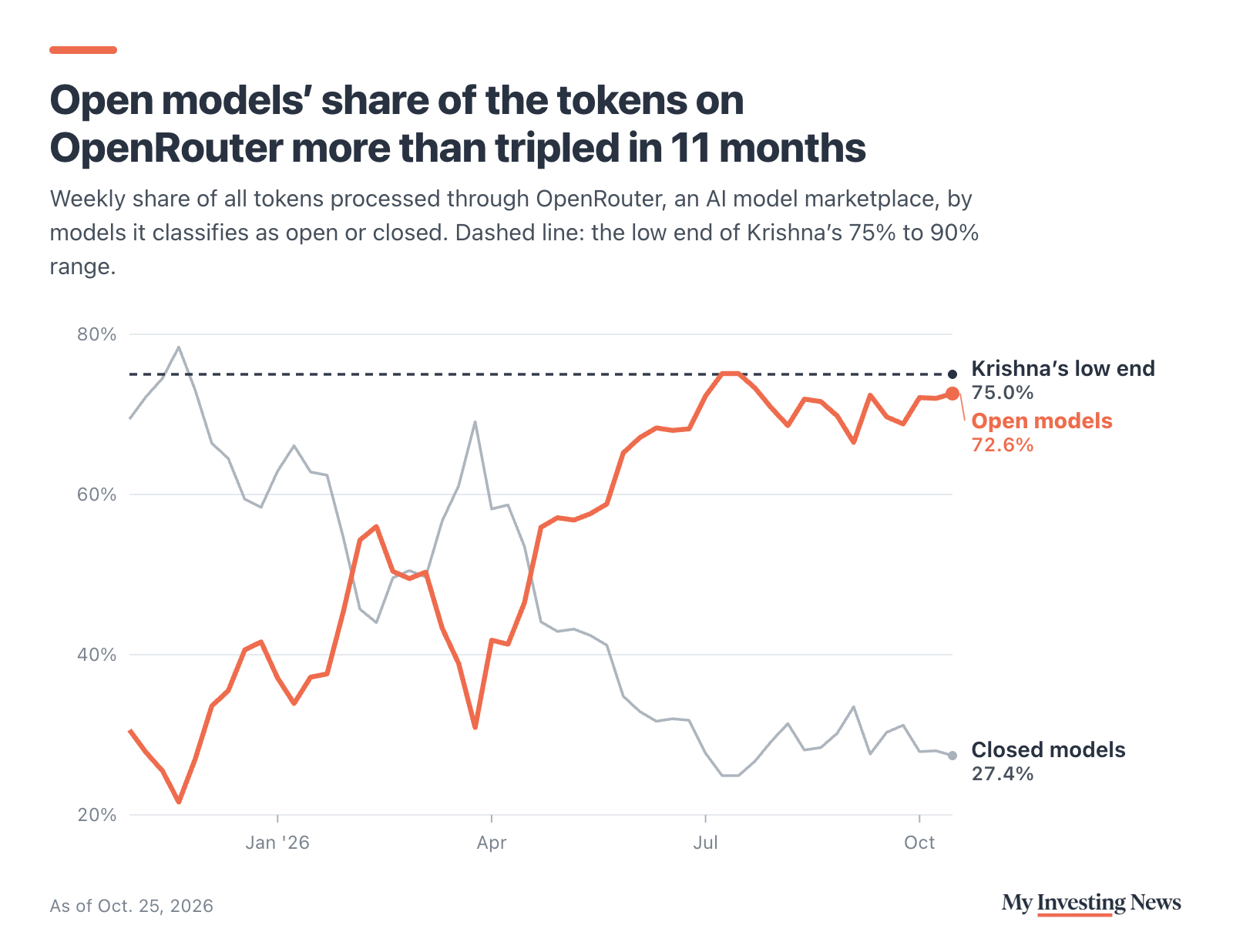
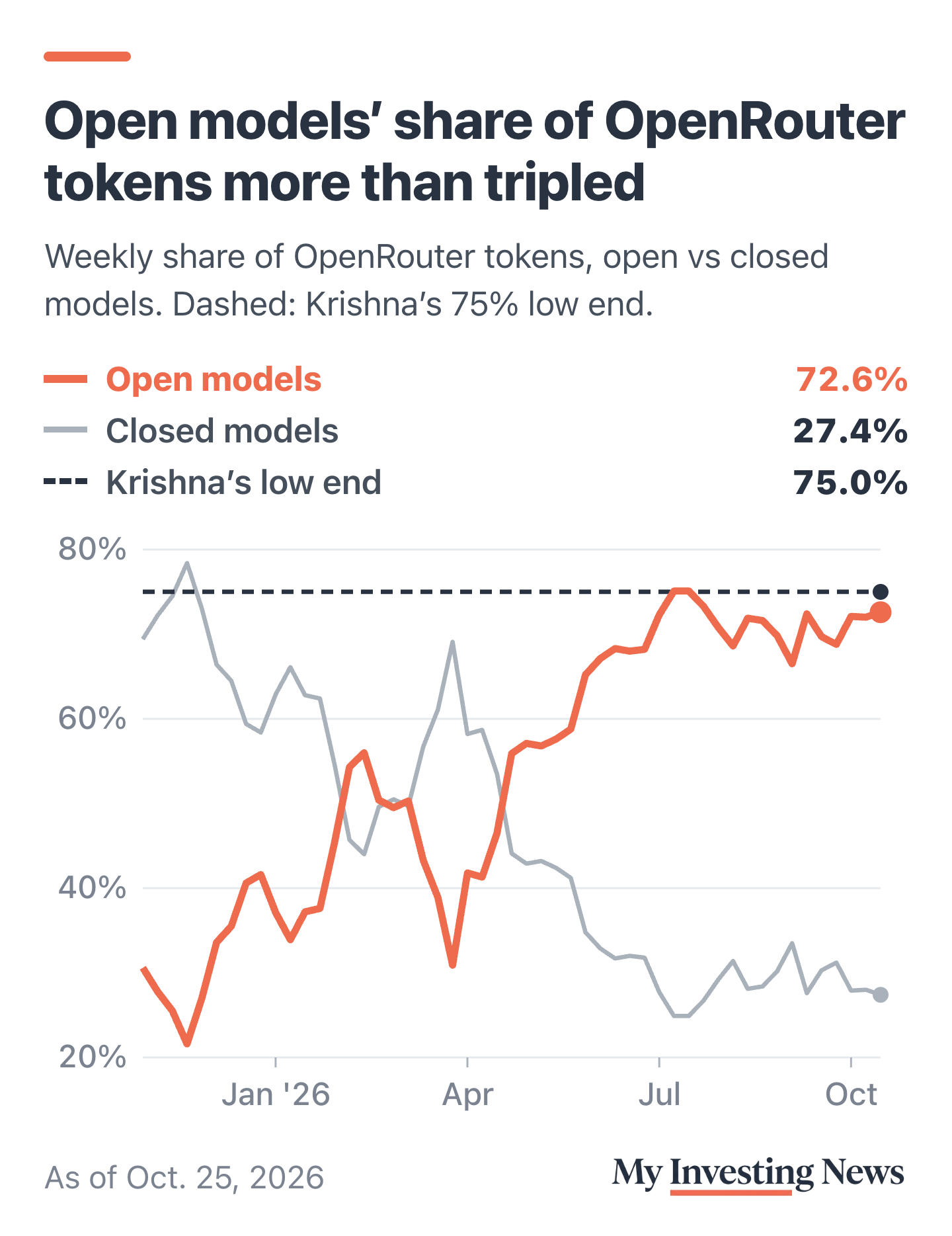
OpenRouter publishes weekly token counts split between models it classifies as open and closed. In the week of Oct. 19, open models handled 72.6% of 188 trillion tokens. In the week of Nov. 24, 2025, their share was 21.6%. It peaked at 75.1% in the weeks of July 13 and July 20, the only two of the past 51 weeks at or above the 75% low end of Krishna’s range.
Closed models didn’t shrink. They processed 51.5 trillion tokens in the week of Oct. 19, about 13 times as many as in the first week of November 2025. Open models grew about 78 times over the same stretch, so the share moved because open use grew faster.
Open vs closed AI models, as of Oct. 27, 2026
Krishna’s third reason was geopolitics. “The best open weight models today are Chinese,” he said, adding that he sees little danger in running them in a sandbox on a company’s own machines. OpenRouter’s traffic agrees on who leads. By our count of the models it lists with public weights, about 91% of open-model tokens in the seven days through Oct. 27 went to models from Chinese labs, and DeepSeek alone took 47%. The largest non-Chinese open-model maker was NvidiaNVDA, at about 6%.
Krishna expects Western labs to close the gap within a year or two, saying “the gap in these things is six to 12 months at the most.” One early entrant is Reflection, an Nvidia-backed startup that wants enterprises to stop renting AI. Its open-weight Beam model, built to take on the Chinese models, lists at $1.00 per million output tokens on OpenRouter.
The Limits of One Marketplace
OpenRouter is one window, and it leans toward developers and price-sensitive apps. A large share of closed-model use goes directly to OpenAI, Anthropic and Google or through cloud platforms, and none of them publishes weekly token counts, so the share across all AI use is unknown. Earlier claims ran higher: on CNBC in October, a Squawk Box anchor pointed to a chart showing open-weight models going from 20% to 80% of token use in 12 weeks, with no source cited. OpenRouter’s series has never reached 80%; its high is 75.1%.
Big buyers may be moving too. Two days after Krishna’s episode, Chamath Palihapitiya said on All-In that a Ramp chart showed top AI spenders putting more of their budgets into their own GPUs and less into closed models, which he read as a move to open source. Krishna added a reason it may be slow: “Developers are lazy,” he said, and they default to the most expensive model unless someone puts a control on it.
What to Watch
Krishna isn’t neutral. IBM releases its own Granite models with open weights under the Apache 2.0 license, and its Granite 4.2 8B model lists at $0.25 per million output tokens on OpenRouter. IBM shares closed at $250.25 on Oct. 27, down 15.5% this year.
The test of his range is whether open models push past 75% of OpenRouter’s weekly tokens and stay there, and whether a large Western open model joins the most-used list. OpenRouter began listing MetaMETA’s open-weight Muse Spark Open, an 816 billion parameter model by its listed name, on Oct. 15, at $4.25 per million output tokens. The other number to watch is the top tier’s $50 price, which has barely moved since GPT-4.
Krishna expects 75% to 90% of AI tokens to run on open-weight models, and on OpenRouter they already handle 72.6%, mostly from Chinese labs, at list prices up to 99% below what GPT-4 cost. The risk is reading too much into one developer marketplace: closed models still grew 13-fold there since early November 2025, and most corporate AI spending happens out of its view.