Where we heard itNate Silver on Bloomberg’s Odd Lots Election Day special, Nov. 3, 2026, and Brad Loftus, managing director and senior partner at Boston Consulting Group, on Bloomberg Businessweek, Nov. 7, 2026.
Americans keep telling the University of Michigan they feel terrible about the economy. They keep shopping anyway. On Bloomberg Businessweek on Nov. 7, Brad Loftus, who leads Boston Consulting Group’s retail work in North America, said the consumer, despite “near record levels of gloominess,” has “continued to spend solidly through the year.” Host Tim Stenovec called it “the disconnect between sentiment and spend.”
Four days earlier, on Bloomberg’s Odd Lots podcast, the election forecaster Nate Silver offered an explanation for at least part of that gap. He blamed the survey itself:
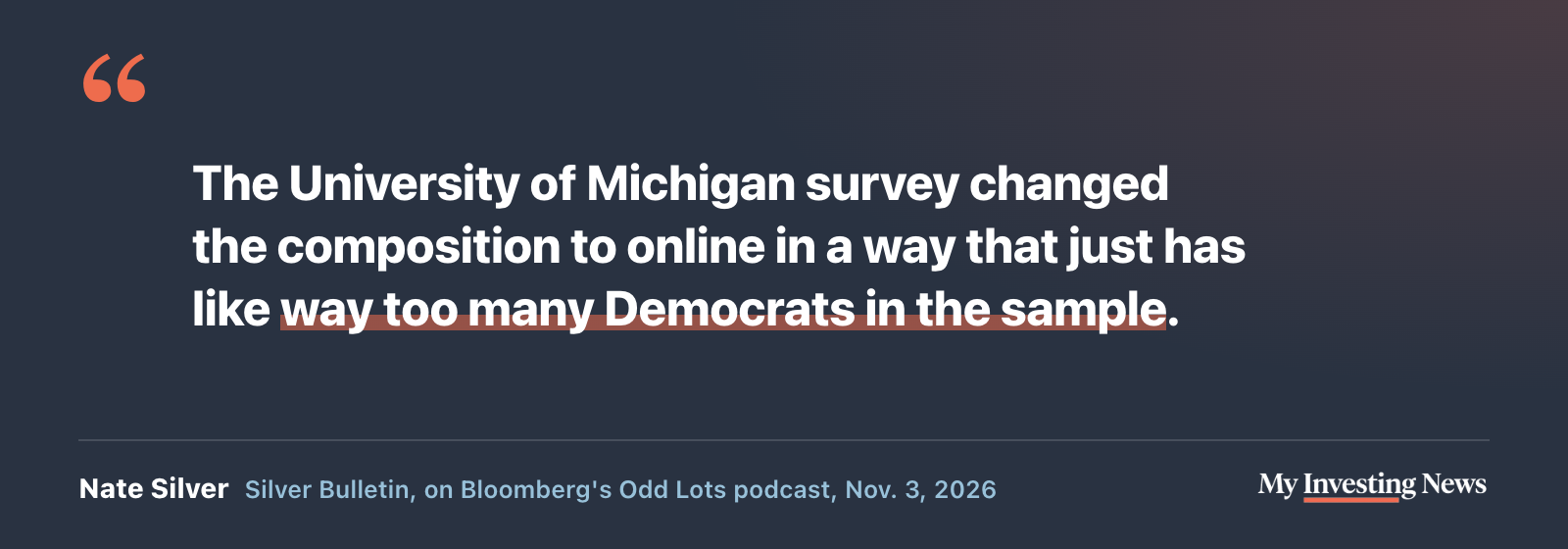
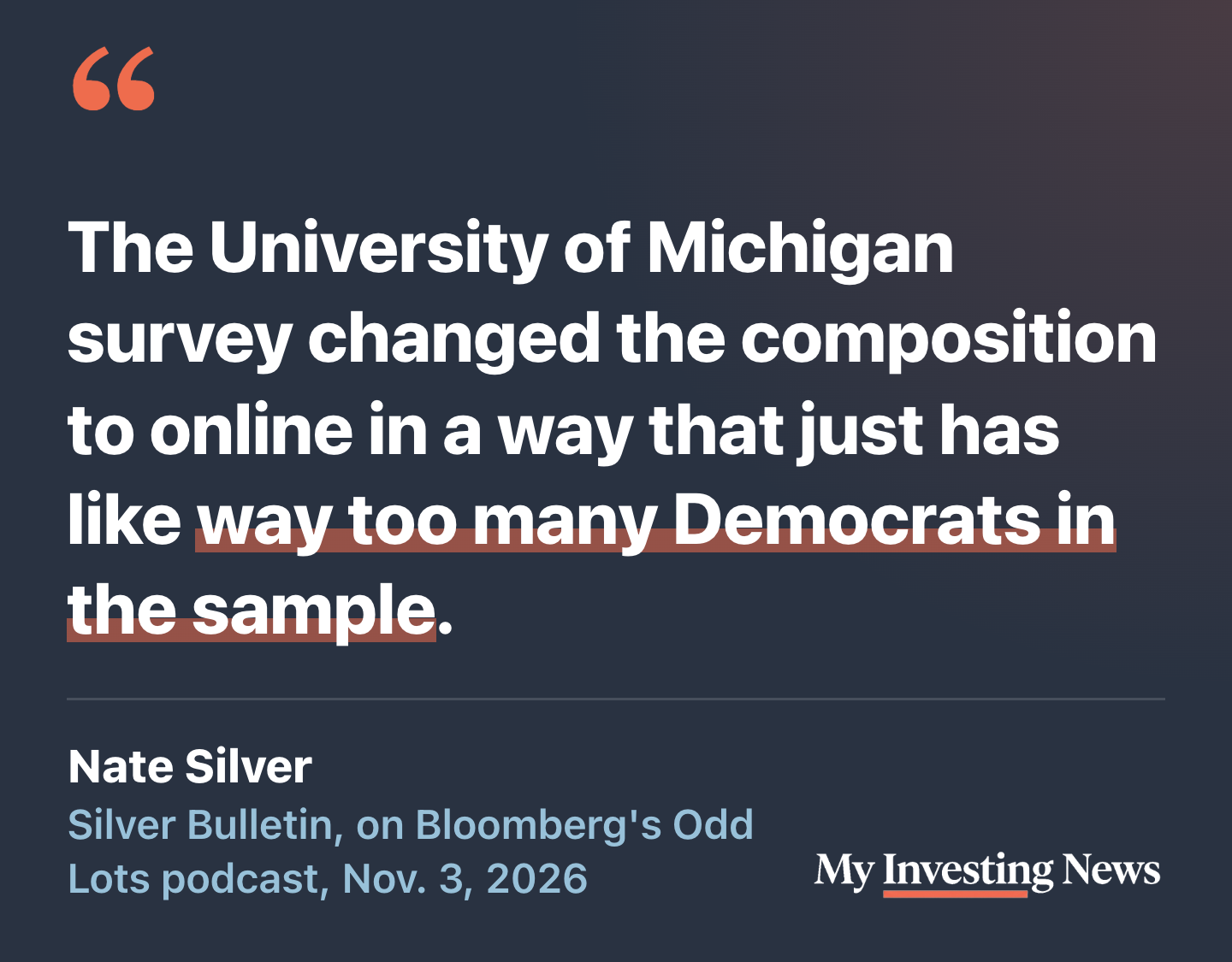
Both claims can be checked. Michigan publishes its index back to 1952 and splits it by party every month, and the Census Bureau tracks what people actually spend. The gloom is real and close to a record. Spending has held up. Michigan’s own party data cut against Silver’s explanation, though the gap did widen after the survey moved online.
Near the Bottom of a 48-Year Record
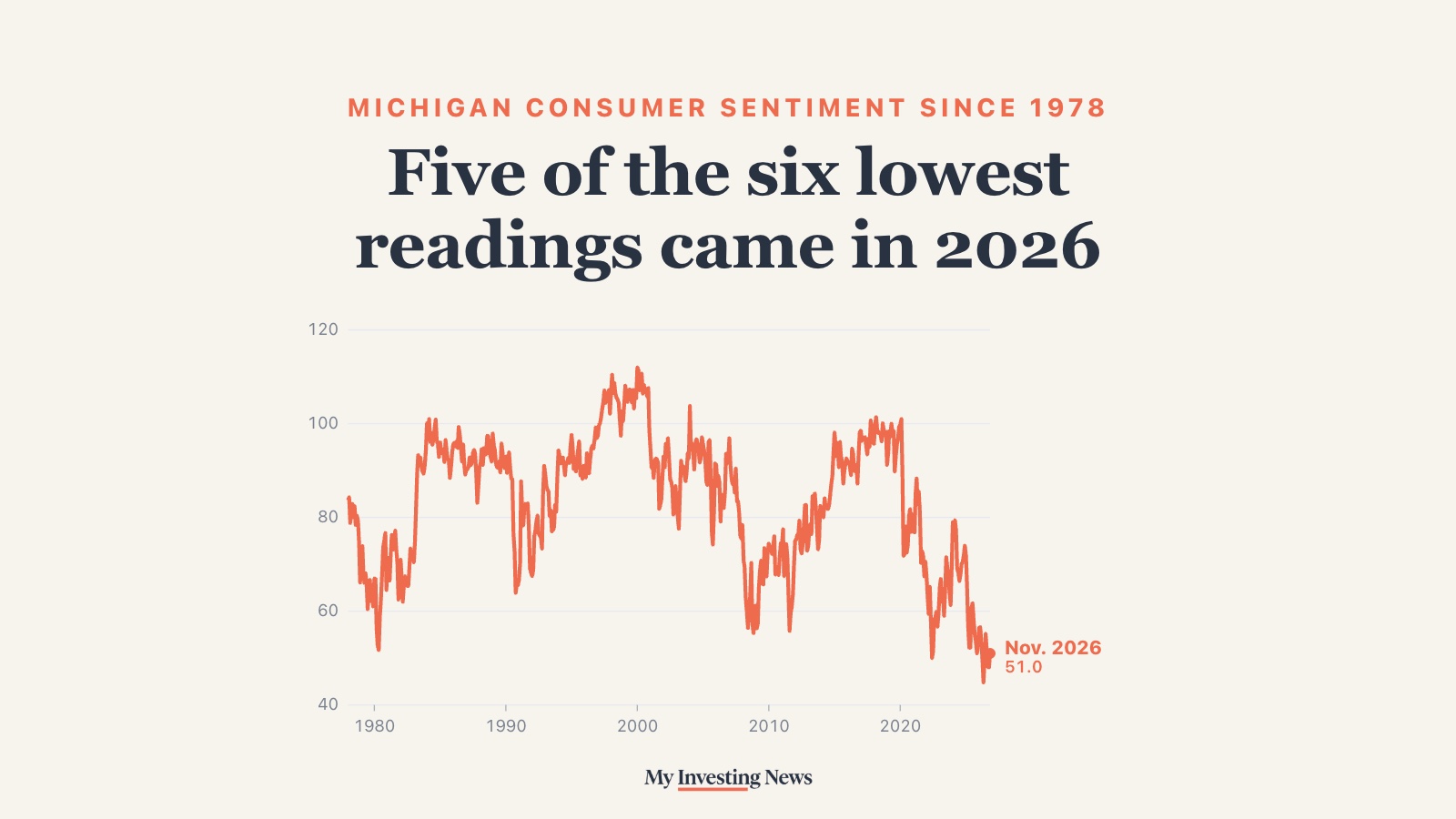
The preliminary November reading, released Nov. 6, came in at 51.0, up from 48.0 in October. Interviews ran from Oct. 20 to Nov. 2, so none of them came after the midterm vote. In the monthly series that starts in January 1978, only six readings were lower, and five of those came this year. The record low was 44.8 in May. The only other month below November’s level was June 2022, at 50.0, when inflation peaked.
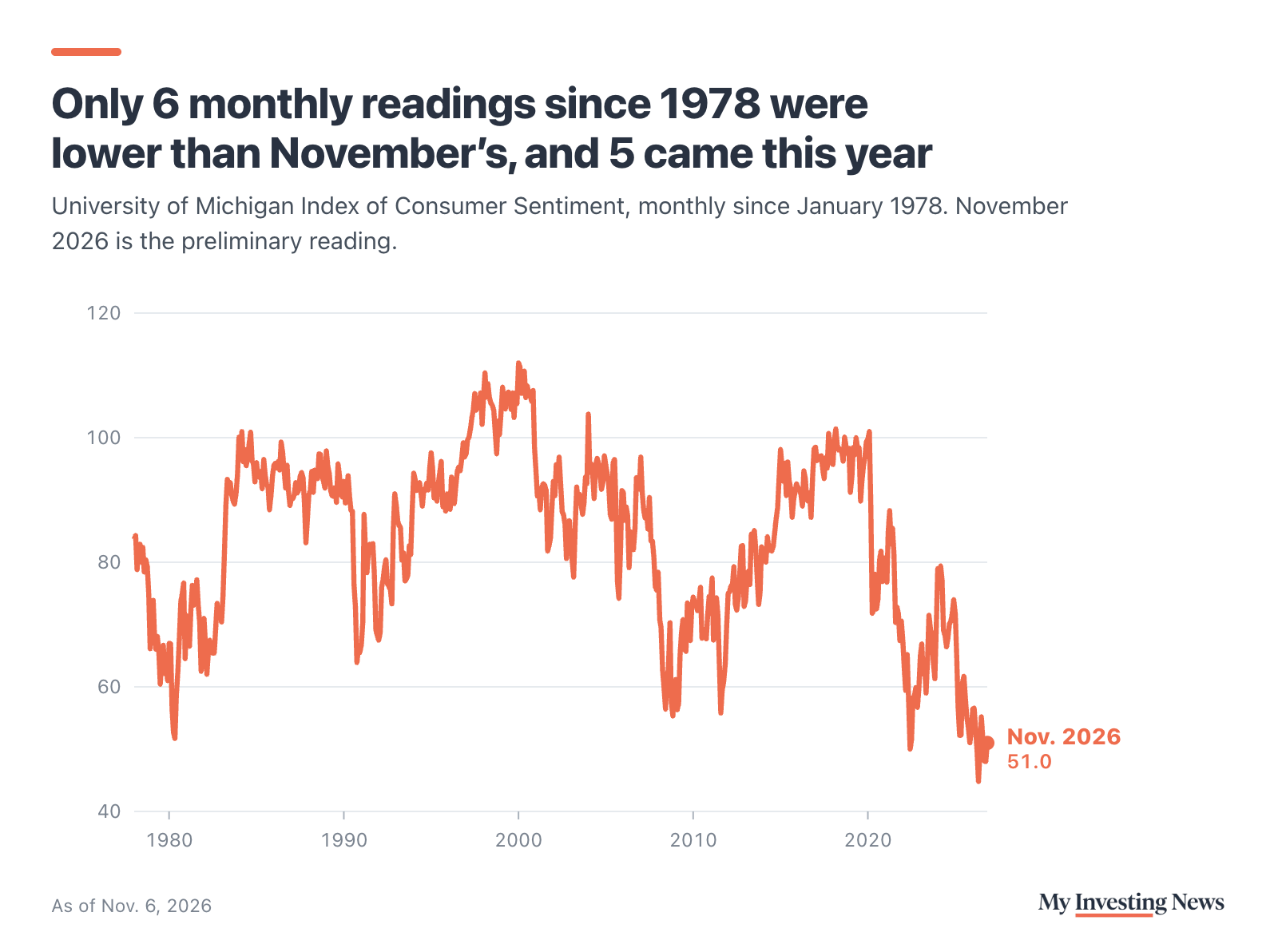
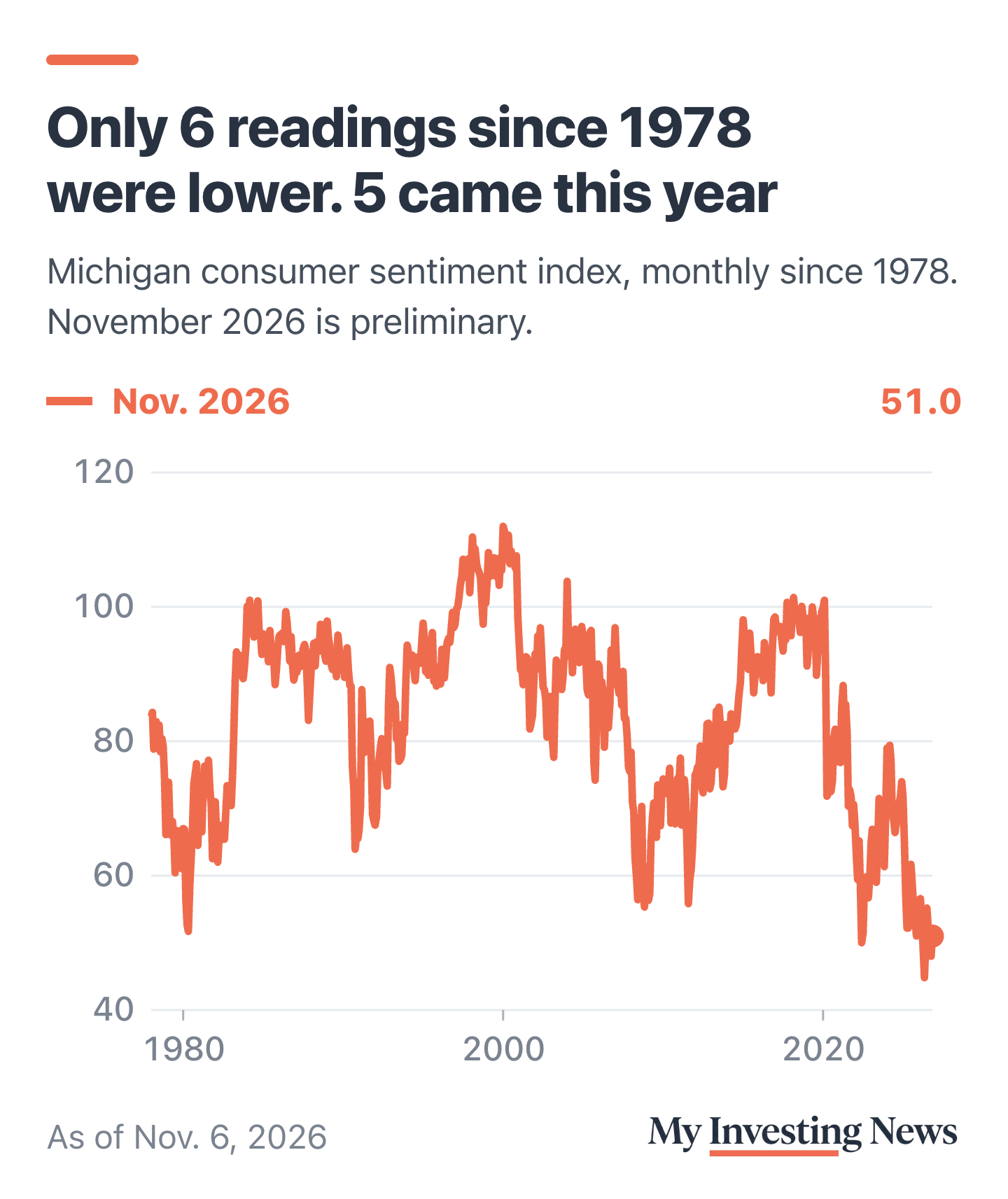
Michigan’s director, Joanne Hsu, wrote in the release that “cost of living concerns” remain at the forefront and that about 57% of consumers volunteered that high prices had eroded their living standards, the most since May.
Spending Hasn’t Followed the Mood
Loftus put retail spending up 6%. Census data back him up: retail and food service sales in September were 6.3% higher than a year earlier. Part of that is prices, as Loftus said on air, but he added that “the spend was higher than inflation.” That checks out too. Adjusted for inflation, retail sales were up 2.5% from a year earlier. Loftus also cited back-to-school spending up 14%; we couldn’t trace the source of that figure, so it stays his.
How unusual is that mix? We looked at every month since 1993 in which inflation-adjusted retail sales grew 2% or more from a year earlier. Before 2025 there were 213 of them. Sentiment in those months had a median of 91, and its lowest reading was 55.8 in August 2011, during the debt ceiling standoff and the U.S. credit downgrade. Since 2025, sentiment has fallen below that floor in five months while real sales grew at least 2%, including May, June, August and September of this year.
Mood versus spending, as of Nov. 6, 2026
Does the Sample Have Too Many Democrats?
Silver’s argument is that Michigan’s switch from phone to web interviews, which ran from April to June 2024, pulled in too many Democrats, who are gloomy under a Republican president. The partisan split is huge. In the preliminary November survey, Republicans scored 80.9 and Democrats 35.9, a 45 point gap. Independents came in at 52.1.
Michigan took up the question directly in a July 10 special report. It found the share of self-identified Republicans in its sample stayed inside its historical range after the web switch and only fell below it in March 2025, after the presidential transition. It ran web interviews alongside phone interviews from 2017, and the two tracked closely. It also found that respondents from red and blue counties now match the U.S. population more closely than they did under phone interviewing.
Party data offer a simpler test. If too many Democrats were pulling the index down, the national number would sit below independents, who belong to neither camp. It doesn’t. Since July 2024, when web interviews took over, the all-consumer index has run above independents in 28 of 29 months, by 4.1 points on average. In October, independents were at 42.4, below the national 48.0.
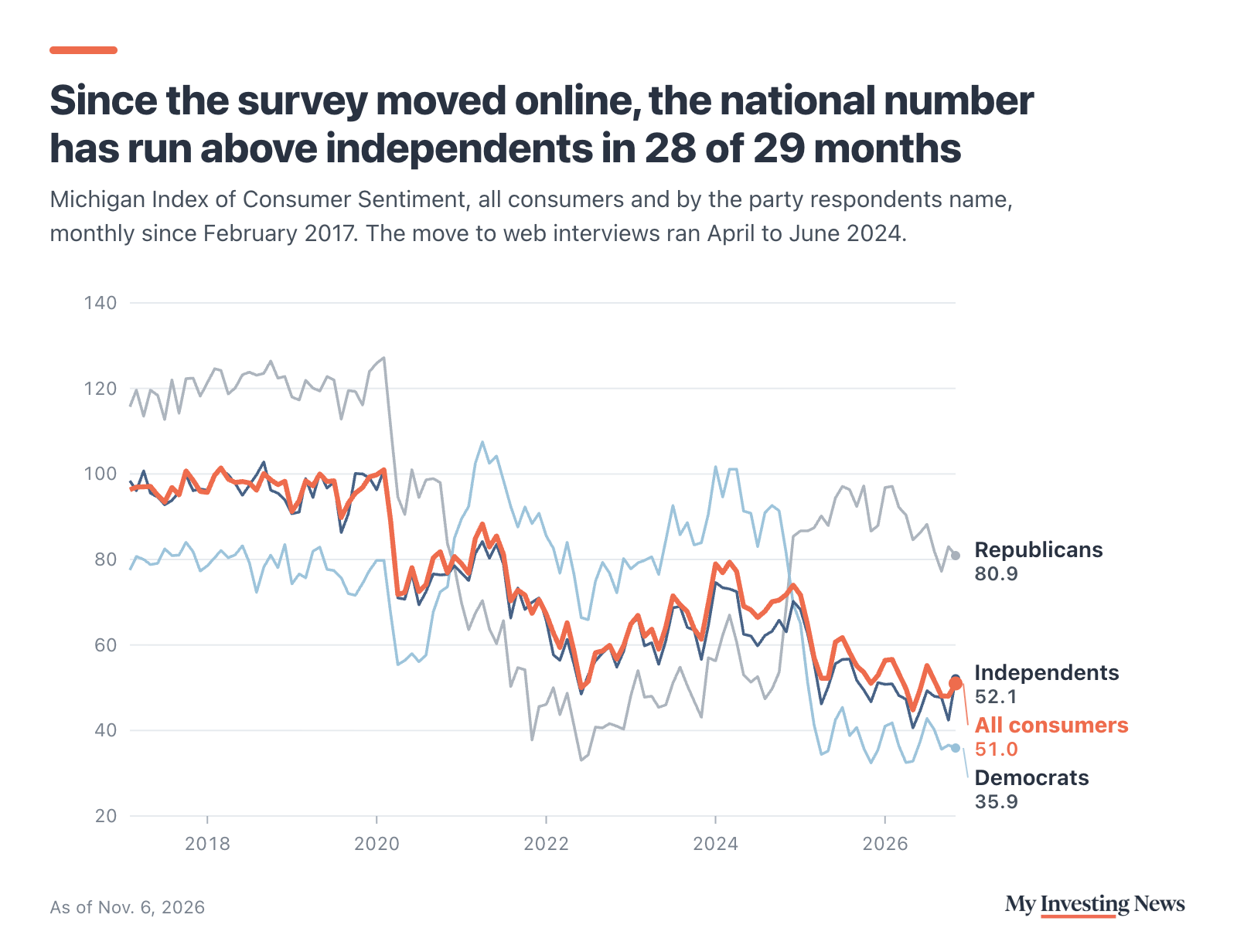
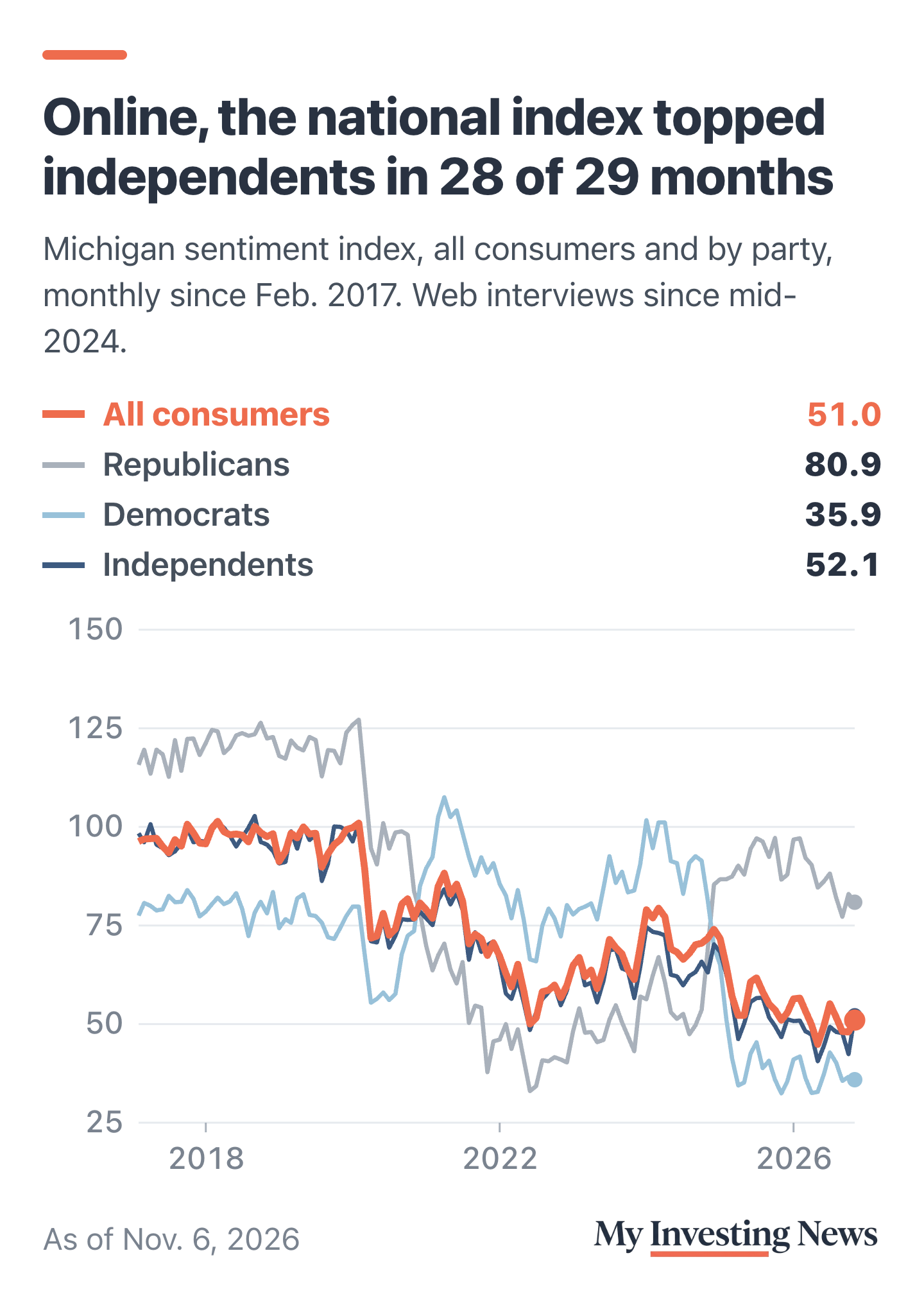
Silver isn’t entirely wrong that something changed. Michigan’s side-by-side data put the June 2022 low at 46.3 on the web versus 50.0 by phone, so web readings can run a few points lower. And the gap between mood and spending widened. Using the 1993 to 2019 link between sentiment and real retail sales growth, sentiment ran about 19 points below where spending would put it from 2022 to early 2024, while interviews were still by phone, and about 27 points below since the move online. The gap opened before the switch, and it got wider after.
Other data point the same way: FINRA found a record share of Americans spending more than they earn, and lower earners got raises and still got poorer in the Fed’s latest survey. Kroger’s CEO has called shoppers resilient but more intentional.
What to Watch
The final November reading comes out Nov. 20 and will include interviews from after the election, in which Democrats won both the House and the Senate. Michigan’s data show partisan sentiment flips when the White House changes hands. Past House flips moved it far less. After Democrats won the House in 2018, their sentiment went from 81.0 in October to 83.5 in December. After Republicans won it in 2022, theirs went from 41.6 to 40.3 over the same months.
If Democrats’ sentiment, at 35.9 in the preliminary read, jumps this time, that shows how much of the national gloom is partisan. If it stays flat while spending holds up, the gap is about prices, which is what consumers keep telling Michigan.
Loftus is right that consumers are near record gloom and still spending: sentiment sits at 51.0 while retail sales are up 6.3% from a year ago, 2.5% after inflation. Silver’s explanation fits less well, since Michigan’s national index has run above independents almost every month since the web switch. The risk for anyone reading the survey is that the gloom is about prices and lasts longer than the spending.