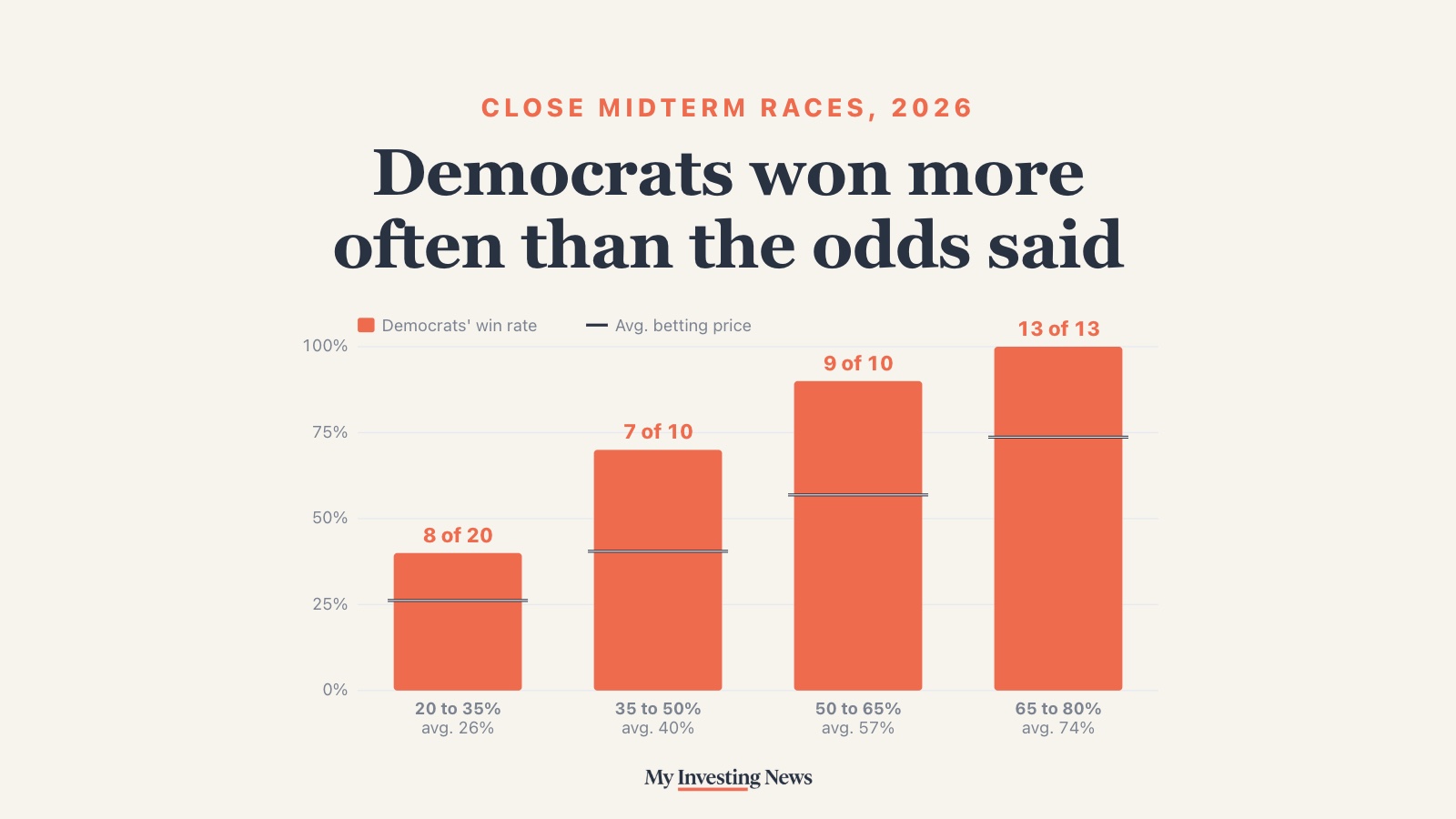
Where we heard itNate Silver, founder of Silver Bulletin, on Bloomberg’s Odd Lots Election Day special, Nov. 3, 2026.
On the morning Americans voted in the midterms, the election forecaster Nate Silver went on Bloomberg’s Odd Lots podcast and was asked whether prediction markets just copy the polls. He said they reflect polling “plus sentiment,” and then he made a claim about the people doing the betting:
Earlier in the same episode he made a second point, about polls. In every election of the Trump era where Trump is not on the ballot, he said, polls have not had the error that underestimated Republicans, and in New Jersey and Virginia last year “you had a massive underestimation of Democrats in governor’s races.”
A week later, both claims can be checked. We took Polymarket’s price for the Democrat in 498 Senate, governor and House races at 7 a.m. Eastern on Nov. 3, before any polls closed, and compared it with the winners NBC News had projected by the morning of Nov. 10, using the Associated Press vote count. The prices did lean right. So did the polls.
Democrats Won the Close Ones
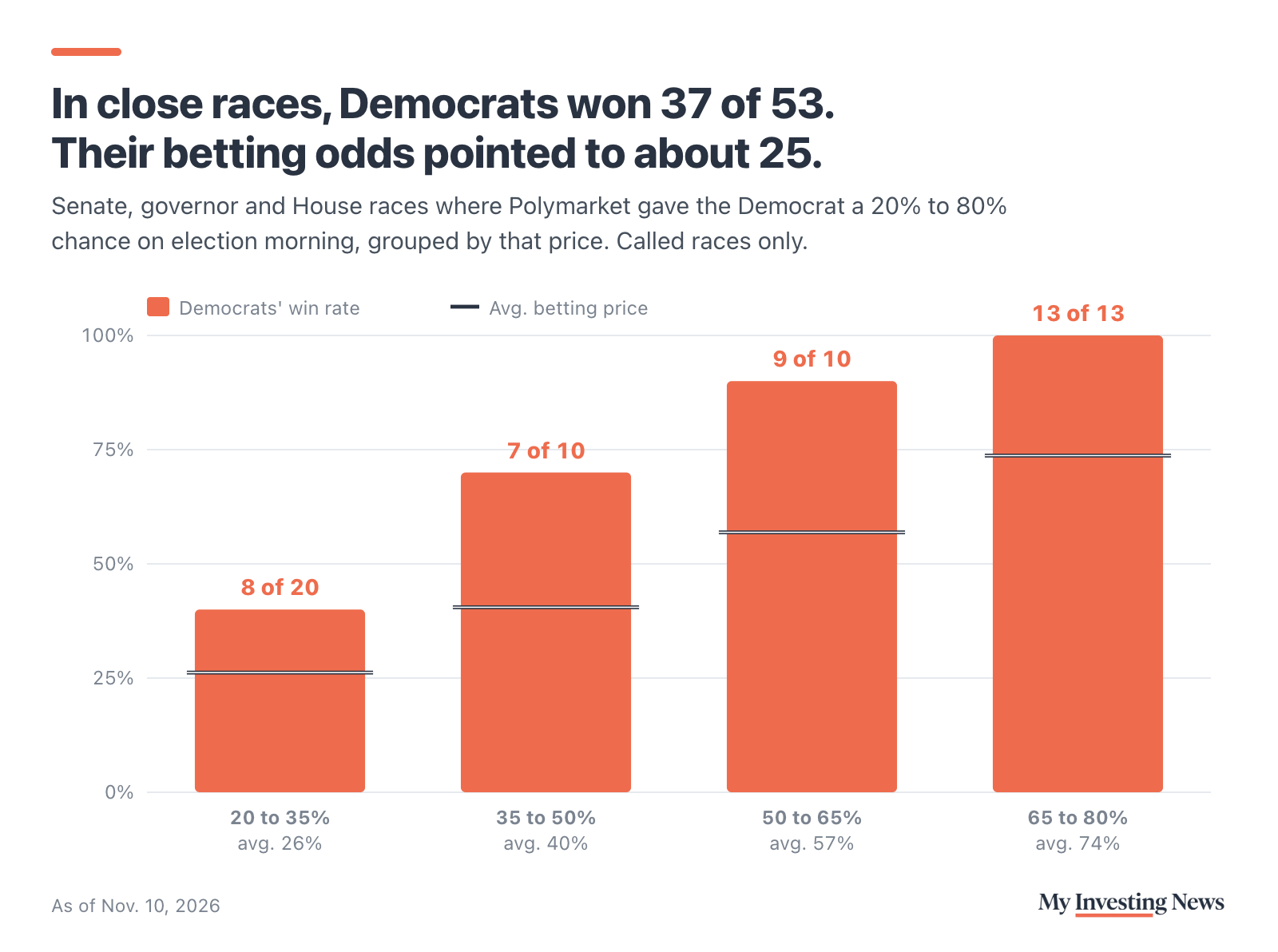
Call a race close if bettors gave the Democrat a 20% to 80% chance. There were 63 of them, and 53 had been called by Nov. 10. Democrats won 37. If the prices had been right, they would have won about 25: add up the chances and you get 24.6.
The tilt ran through every price range in the chart below. Democratic underdogs, priced under 50%, won 15 of 30 races. Republican underdogs won 1 of 23, Colorado’s 3rd District, where Rep. Jeff Hurd held on. Democrats won all 6 close Senate races, including South Carolina, where Annie Andrews started the day with a 30.5% chance. They won 3 of 5 close governor’s races and 28 of 42 close House races.
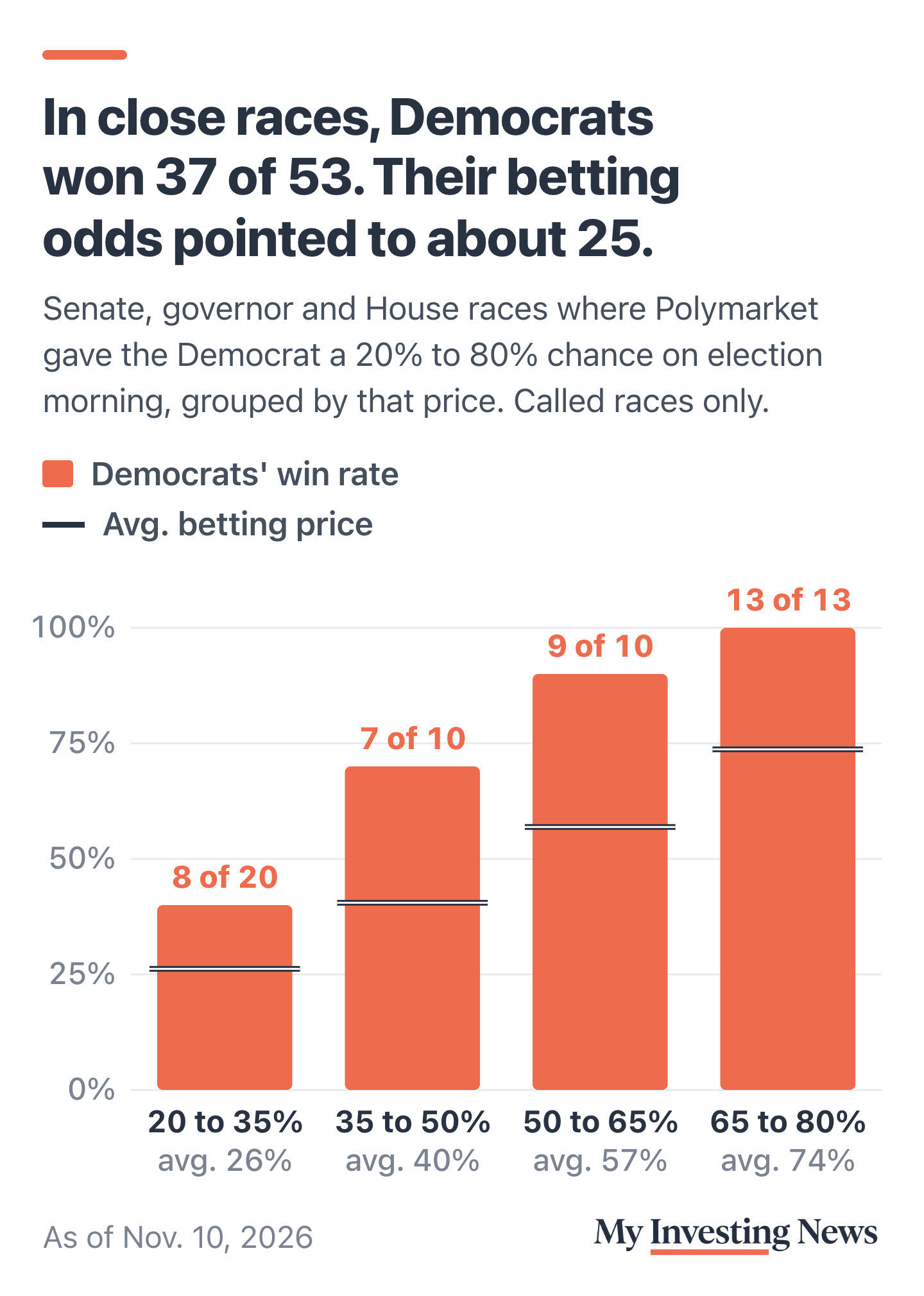
Outside the close range the pattern held. No Republican won a settled race in which Democrats were priced above 80%. The biggest Democratic upset so far came in North Carolina’s 6th District, where Cyril Jefferson won after trading at 13.5% on election morning.
The Polls Missed the Same Way
That doesn’t make the betting crowd the main culprit. Silver himself said on the show that his model was “literally like 0.995 correlated with Polymarket on individual states.” If markets mostly price the polls, they inherit the polls’ errors.
The polls had a big one. We compared 270toWin’s final polling averages with the AP vote count in the 36 statewide races that had at least three polls and a called result. The Democrat beat the final average in 32 of them, by 4.6 points on average. In Texas, the polls had James Talarico up 3.2 points for the Senate; he won by 12.1. They had Gov. Greg Abbott ahead by 2.1, and Gina Hinojosa won by 7.1. Georgia’s governor’s race was tied in the averages, and Keisha Lance Bottoms won by 8.6.
Bettors and pollsters vs. the results, as of Nov. 10, 2026
Bettors Missed Big in 2022 and 2026
If the betting crowd simply leaned Republican, the miss would show up every cycle. It hasn’t. We ran the same close-race test on Senate races back to 2018, using the prices from our earlier check of how good the bettors are. In 2022, Democrats won all 5 close Senate races when prices implied about 2. In 2018, 2020 and 2024, the prices were close to the results. That 2018 midterm also had no Trump on the ballot, and bettors were about right.
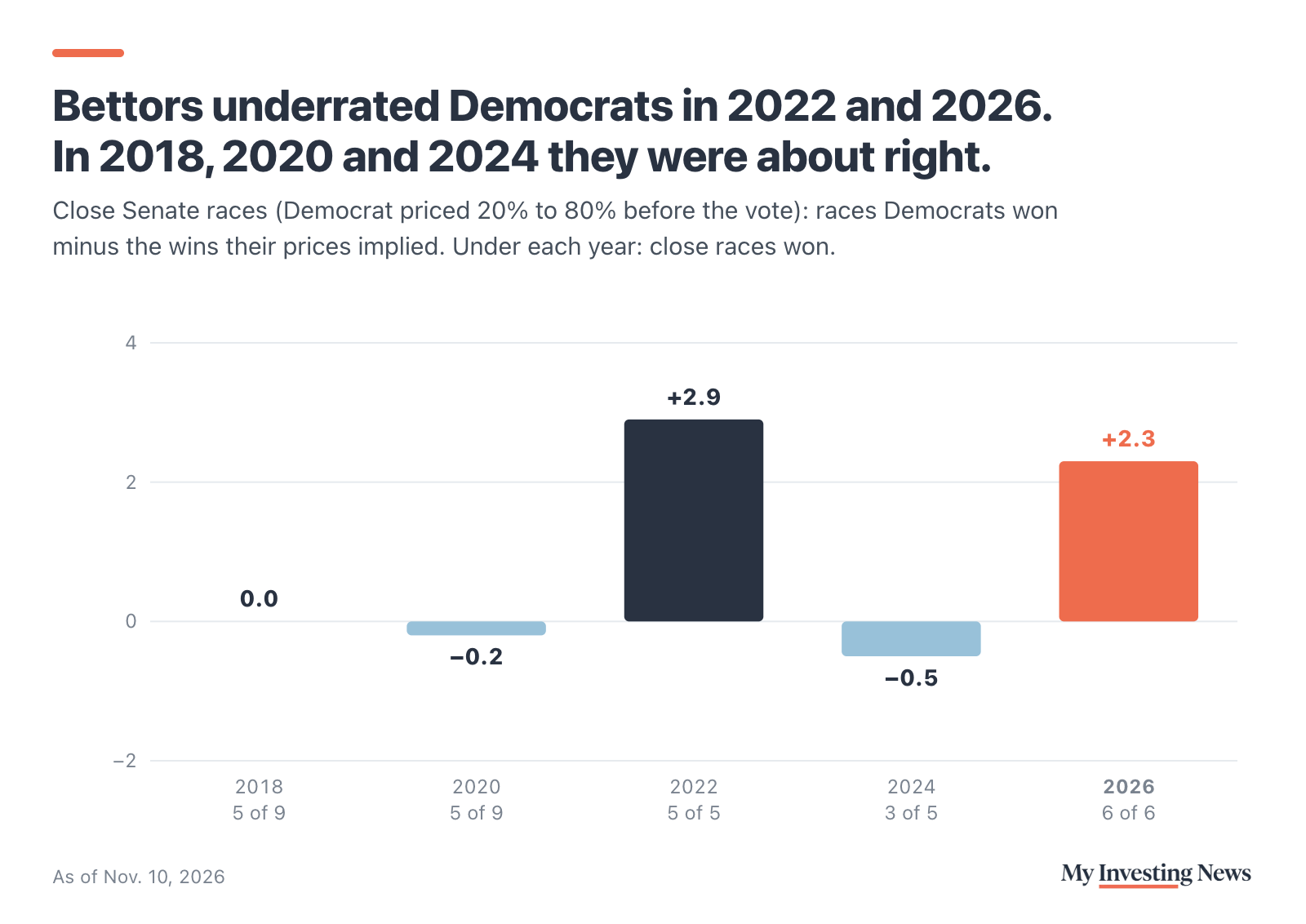
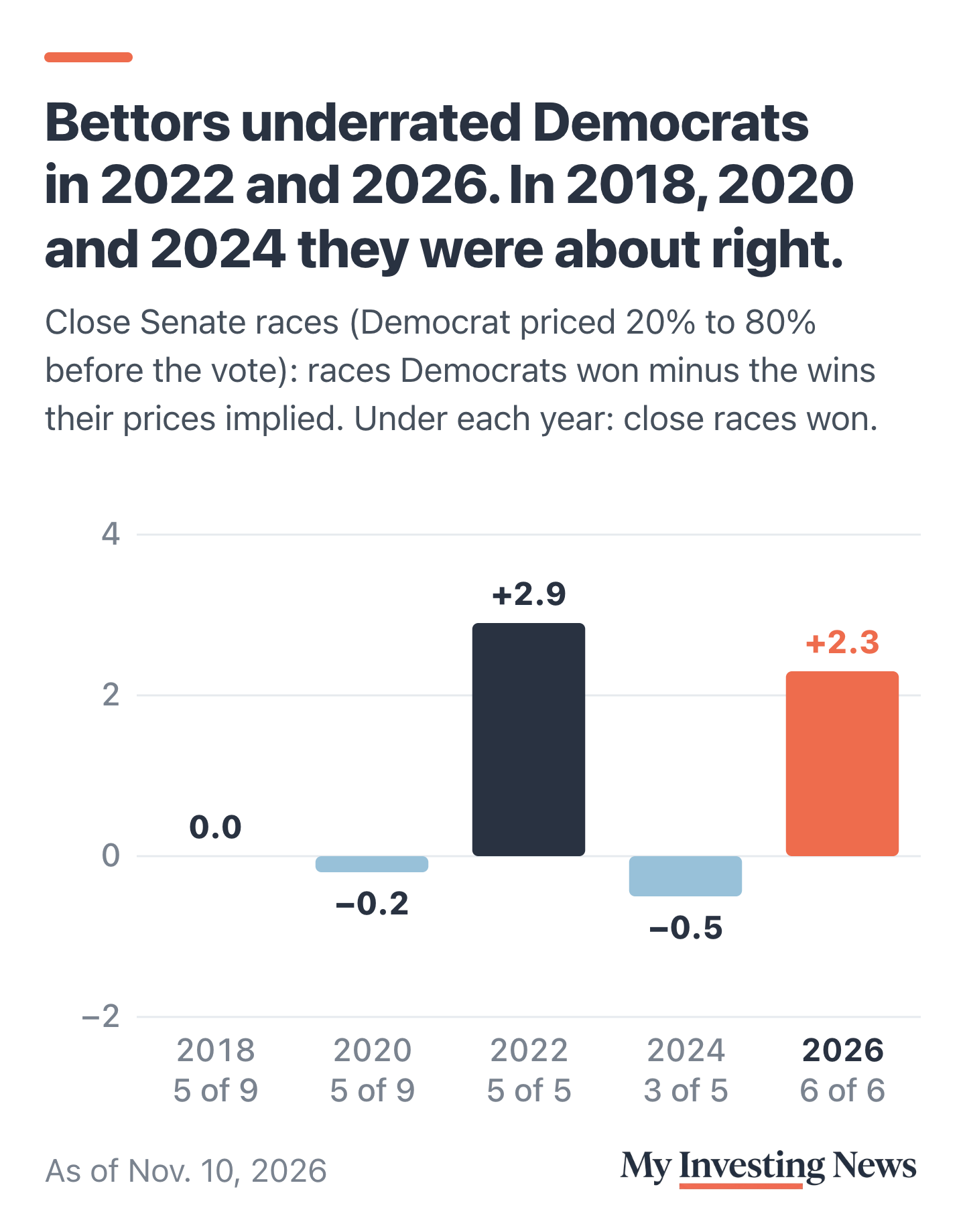
The samples are small, from 5 to 9 races a year, and the 2018 to 2022 prices come from PredictIt, a different market with a different crowd. Back in October, markets gave Republicans a 36% shot at holding the Senate, and Bloomberg’s Josh Wingrove argued that a 2018-size swing would flip fewer House seats than it did then. The wave turned out bigger than bettors priced on election morning, and the polls missed it in the same direction.
What to Watch
Ten close races were still uncalled on Nov. 10, and Democrats led in 5 of them, including the Alaska Senate race and Kansas governor’s race. Three long shots matter more for the score. In Tennessee’s 4th District, Democrat Victoria Broderick traded at 1.9% on election morning and led 48.9% to 48.7% with 99% of the expected vote counted. In Mississippi, Scott Colom was priced at 14% and led Sen. Cindy Hyde-Smith 49.1% to 48.8%. North Carolina’s 5th District was tied at 48.7%.
Silver’s point about the clientele can’t be checked directly, since Polymarket doesn’t report who its traders vote for. What the record shows is that this year the betting prices and the polls both underrated Democrats, and that bettors also underrated them in the 2022 midterms.
Silver’s hunch fits this year’s results: Democrats won 37 of 53 close races when Polymarket’s prices pointed to about 25. But the polls missed by 4.6 points in the same direction, and bettors were about right in 2018, 2020 and 2024. The risk in reading markets as a check on polls is that both can lean on the same numbers.