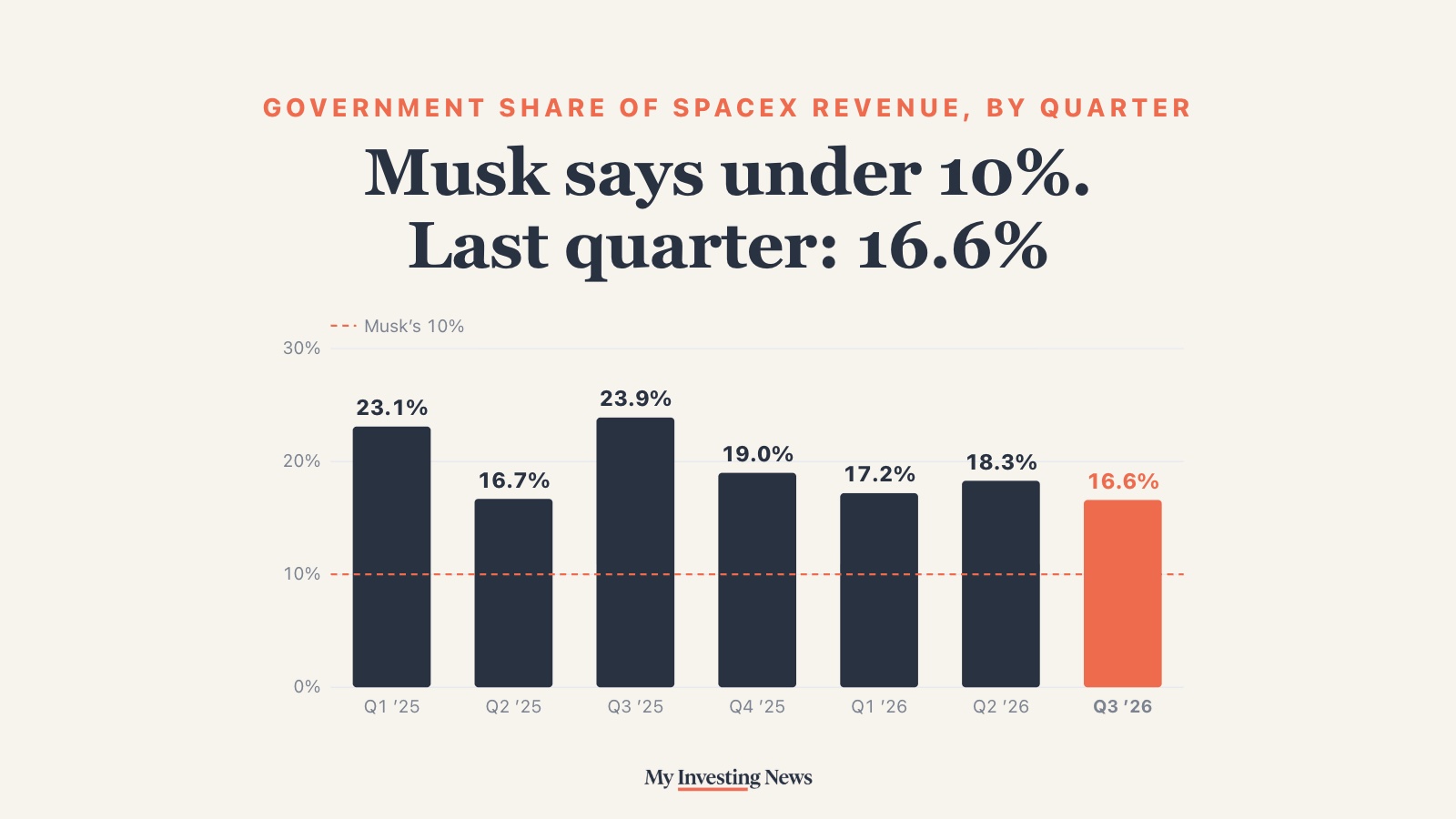
Where we heard itElon Musk, CEO of SpaceX, in a post on X on Nov. 6, 2026, replying to a suggestion that he offer to cancel SpaceX’s federal contracts.
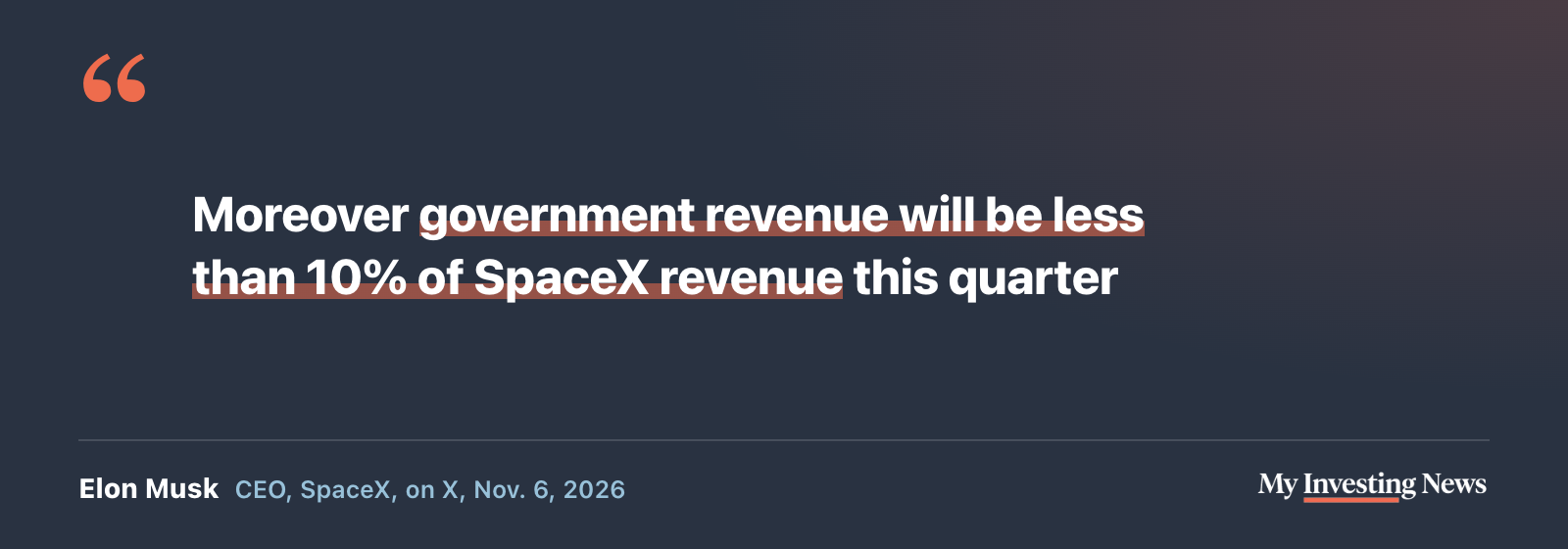
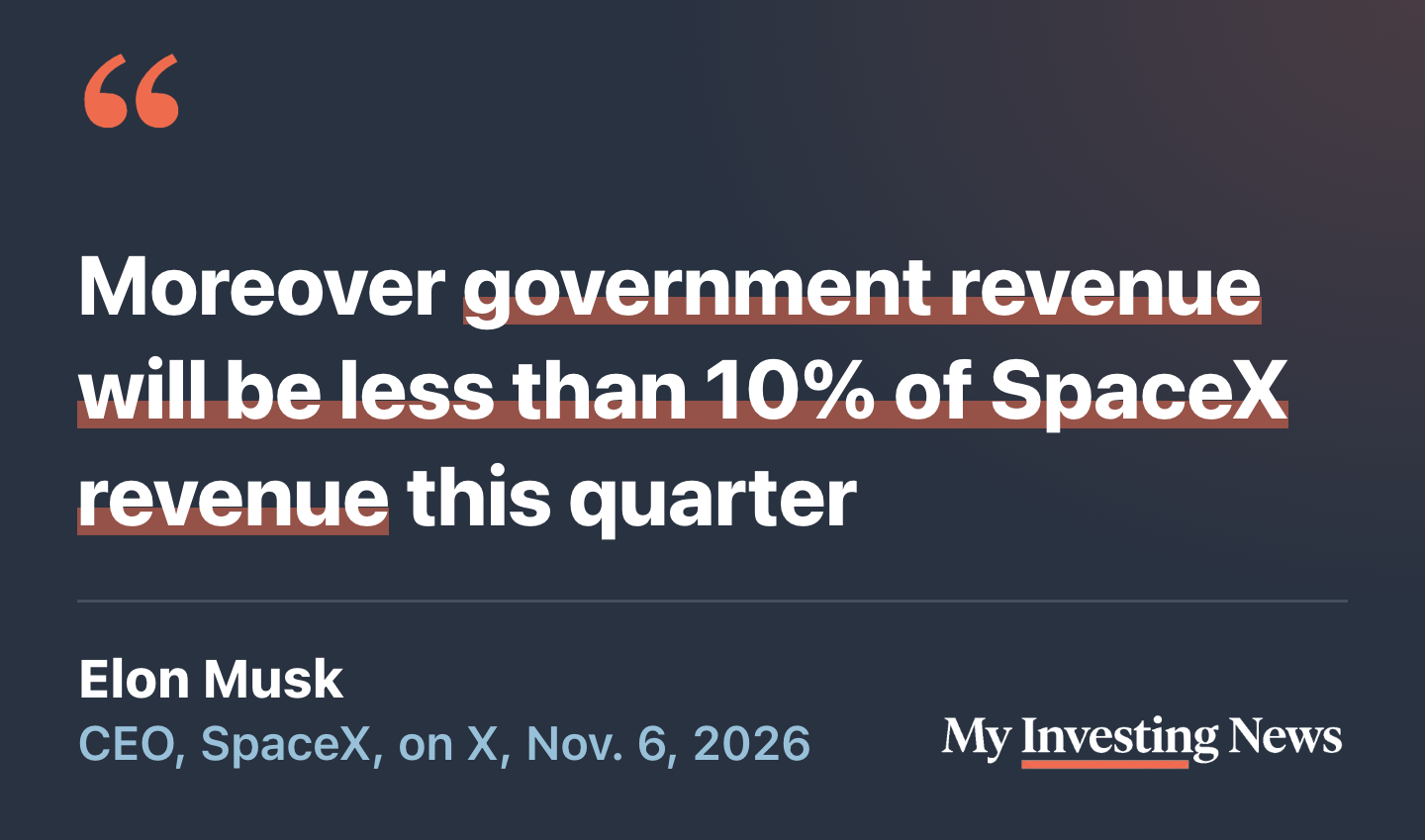
Elon Musk’s reply to Democrats who want to go after SpaceX’s government business is that the business is a shrinking slice of his company. “SpaceX contracts with the government are BOTH the best product AND the lowest price!” he posted on X on Nov. 6, three days after Democrats won control of Congress. “Moreover government revenue will be less than 10% of SpaceX revenue this quarter and less then 5% a year from now.” He added: “Happy to cancel any that the government doesn’t want. Just say the word!”
The fourth quarter ends Dec. 31, so the claim can’t be scored yet. But SpaceX has been public since June, and its filings show where the share stood going in. We checked them, and federal spending records, against the 10% line.
Last Quarter, the Government Was 16.6% of Revenue
SpaceX doesn’t report government revenue every quarter. It does report its largest customer, which it calls Customer A. Its IPO prospectus said “approximately one-fifth” of 2025 revenue came from U.S. federal agencies, and Customer A was 20.9% of 2025 revenue, buying from all three of SpaceX’s segments. Accounting rules treat the federal government as one customer, and Customer A was the only customer above 10% that year, so the numbers point to Washington.
In the third quarter, Customer A was 16.6% of SpaceX’s $14.6 billion in revenue, down from 23.9% a year earlier. It was 25.2% in 2023 and 24.2% in 2024. So the share is falling, and 16.6% is the lowest of the seven quarters we can measure. It is still well above 10%.
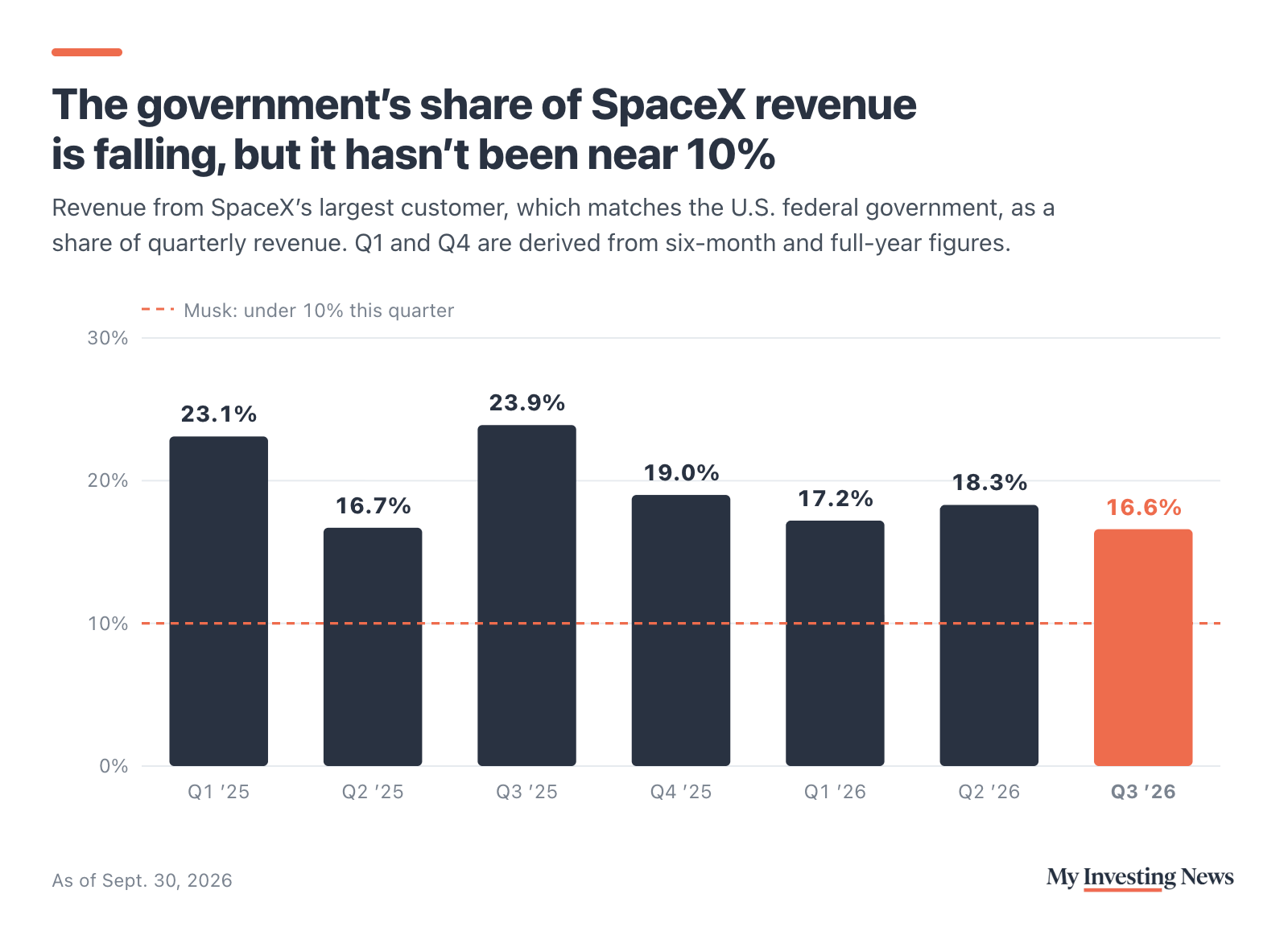
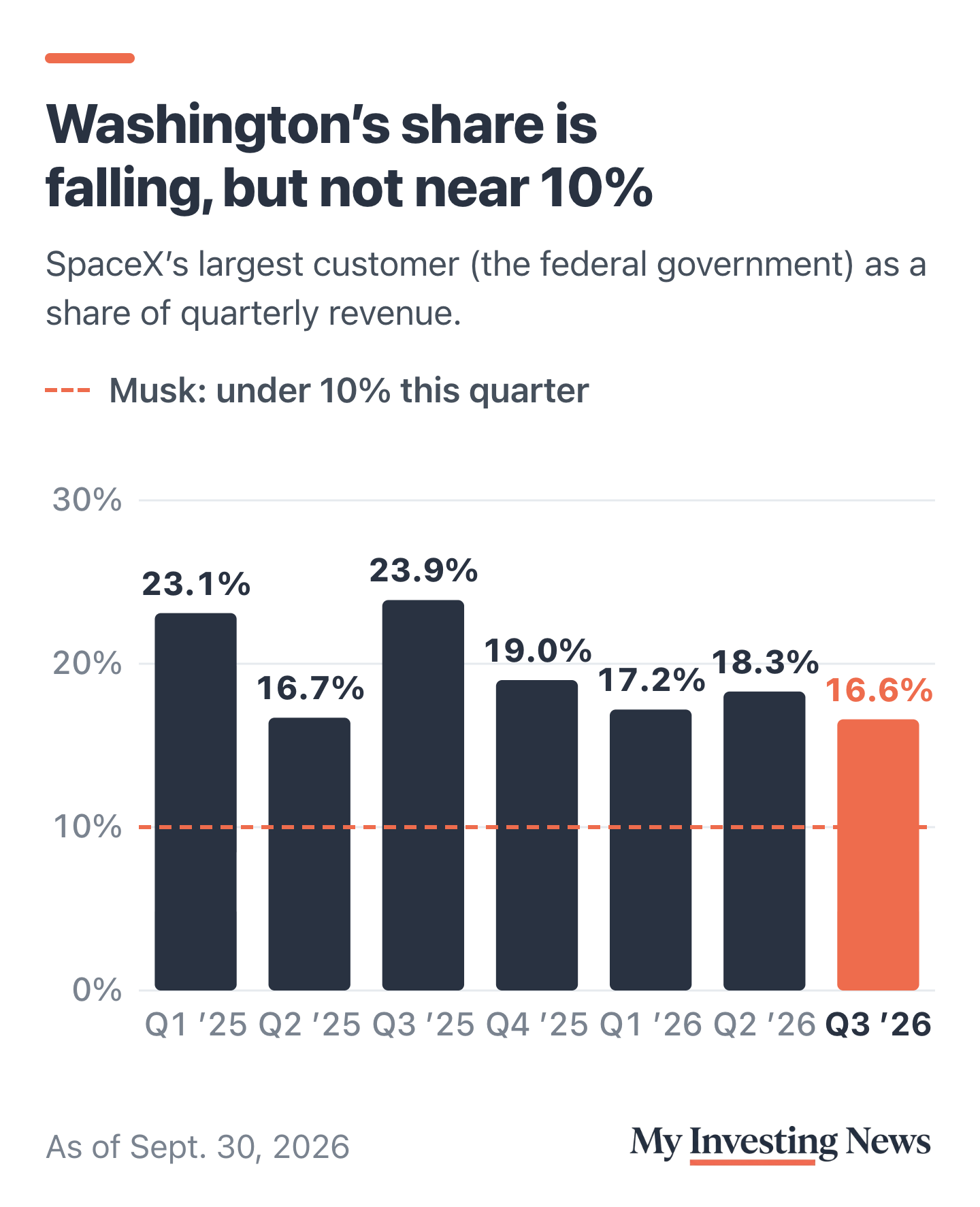
The government didn’t shrink. Customer A’s revenue was about $2.4 billion in the third quarter, up 82% from $1.3 billion a year earlier. The share fell because everything else grew faster: total revenue rose 161%. Revenue in SpaceX’s AI segment, now called Super Intelligence, jumped to $7.6 billion from $0.8 billion, and a second customer, Customer B, buying from that segment, made up 34.5% of the quarter.
What It Would Take to Get Under 10%
For the government to be under 10% this quarter, SpaceX needs revenue of more than 10 times what the government pays it. If federal revenue holds at the third quarter’s $2.4 billion, that means more than $24.2 billion in fourth-quarter revenue, 66% above the third quarter. If it falls back to the second quarter’s $1.4 billion, about $14.3 billion would do it, roughly what SpaceX booked in the third quarter. Government revenue swings from quarter to quarter with launch schedules and contract milestones, so both cases are plausible.
The growth Musk is counting on is already signed. In its IPO filing updated Nov. 10, Anthropic said it agreed to spend up to $120.5 billion on computing from SpaceX’s AI unit through 2029, “approximately $3.1 billion in the aggregate per month once all capacity has been delivered, which we expect in December 2026.” That is about $37 billion a year from one customer once it is fully running, roughly 10 times the federal obligations to SpaceX in fiscal 2026. It also helps explain Musk’s second claim, under 5% a year from now: by then that one contract would be running at full speed for a whole year.
SpaceX and the federal government
Federal Records Show $3.6 Billion in Fiscal 2026
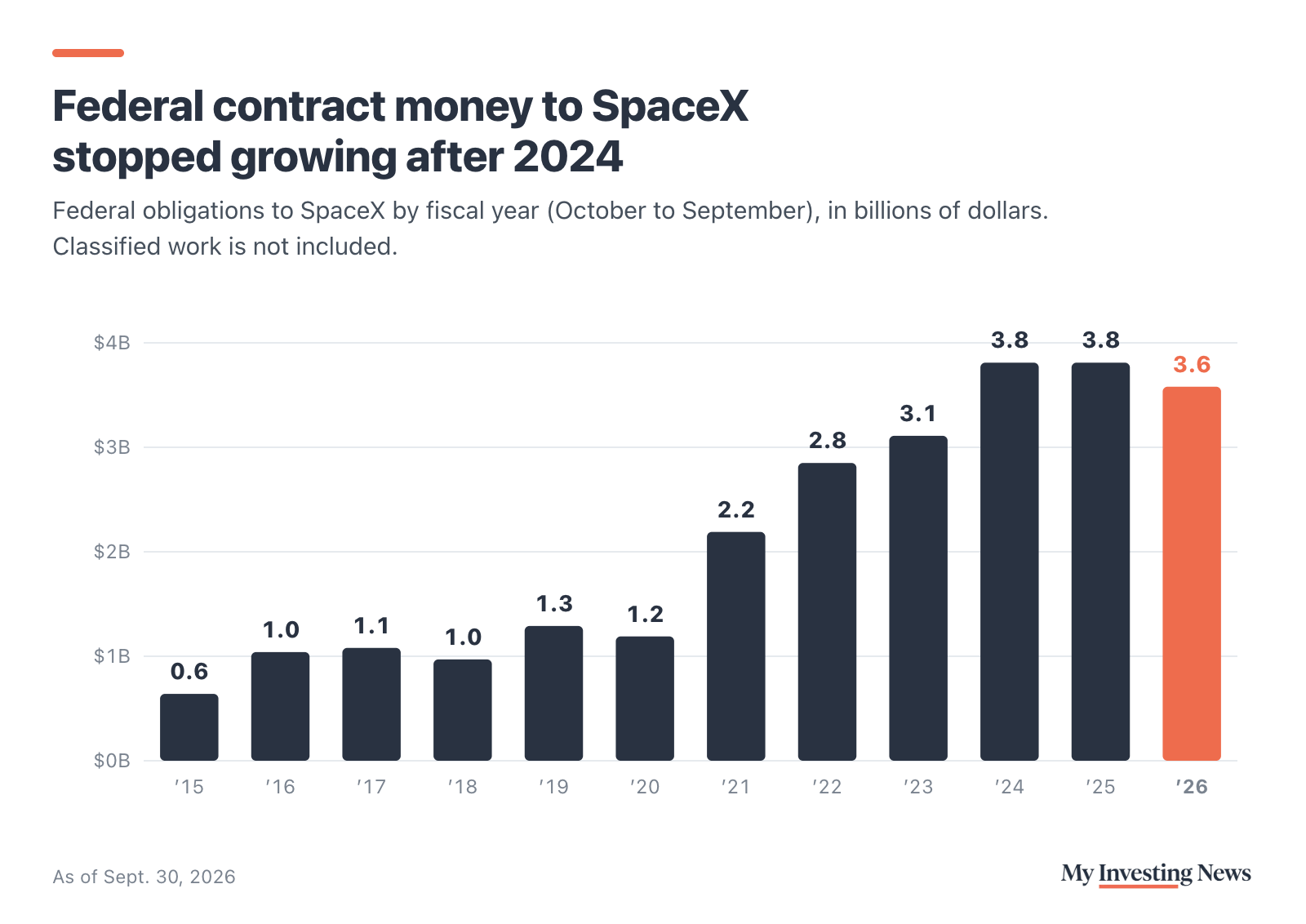
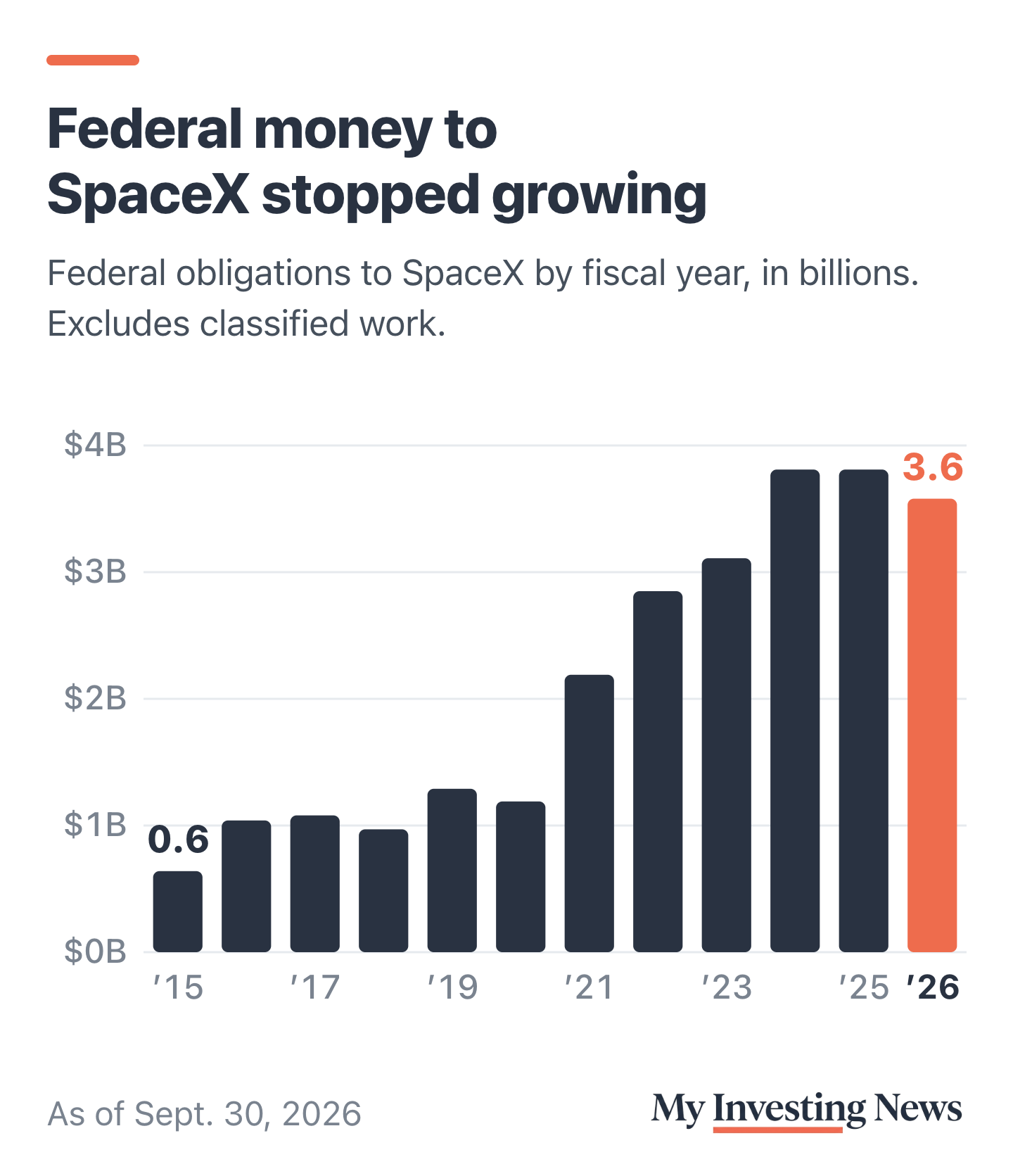
Federal spending records tell the same story from the other side. USAspending.gov shows $3.6 billion in obligations to SpaceX in fiscal 2026, which ended Sept. 30. That is down from $3.8 billion in each of the two prior years. The Department of the Air Force, which buys launches for the Space Force, obligated $2.2 billion, and NASA $1.3 billion, down from $2.1 billion a year earlier. The Pentagon passed NASA as SpaceX’s biggest federal buyer this year.
Obligations aren’t revenue. They are money committed when a contract or order is signed, and SpaceX books revenue as it does the work. Classified work, such as work for the National Reconnaissance Office, isn’t in the public data. Over a full year the two measures line up closely, though: obligations were $3.8 billion in fiscal 2025, and Customer A revenue was about $3.9 billion in calendar 2025.
What to Watch
SpaceX’s fourth-quarter report, due early next year, will settle the claim. The number to find is Customer A’s share in the concentration-of-risk note. Watch the new Congress too. Bloomberg Businessweek’s Max Chafkin, who tracked Musk’s record midterm giving, said on Nov. 7: “Yes, AI is becoming a bigger part of their revenue mix, but the federal government is still a major customer.” And watch how the market values the mix. Musk’s companies may grow closer: Dan Ives puts the odds of a Tesla-SpaceX merger at 80% to 90%, and Starlink is still SpaceX’s profit engine.
Musk’s direction is right: the government’s share of SpaceX revenue fell to 16.6% in the third quarter from 23.9% a year earlier, because AI revenue is soaring. Under 10% this quarter would take more than $24.2 billion in revenue if federal sales hold steady, or a dip in those sales. Federal revenue is still growing in dollars, and the fourth-quarter report will show whether the share crossed the line.