Where we heard itBarron’s Streetwise, “America’s Debt Reckoning: 5 Paths Forward,” Nov. 6, 2026. Host Jack Hough with Kent Smetters, director of the Penn Wharton Budget Model, and Maya MacGuineas, president of the Committee for a Responsible Federal Budget.
A common hope for Social Security is that artificial intelligence will make workers so productive that the economy grows its way out of the program’s shortfall. Kent Smetters, the Wharton economist who runs the Penn Wharton Budget Model, says the law itself gets in the way. On Barron’s Streetwise on Nov. 6, he noted that AI gains are already in his group’s baseline. “But suppose that we’re wrong,” he said. “Suppose that we actually double the impact of AI on productivity.” The catch, he explained, is that Social Security’s initial benefit calculation “doesn’t just account for inflation over your lifetime, it actually accounts for wage growth as well.” So when productivity lifts pay, “the tax base gets bigger, we’re all excited about that,” and the starting benefit is “also going to get bigger as well.”
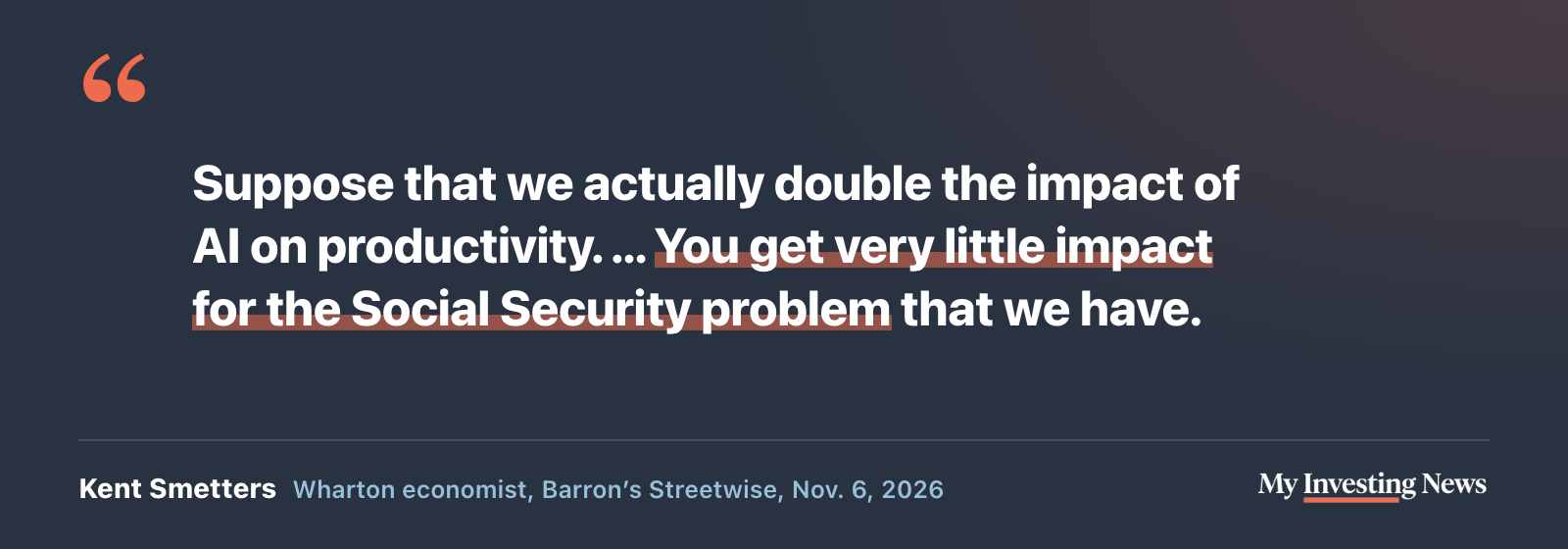
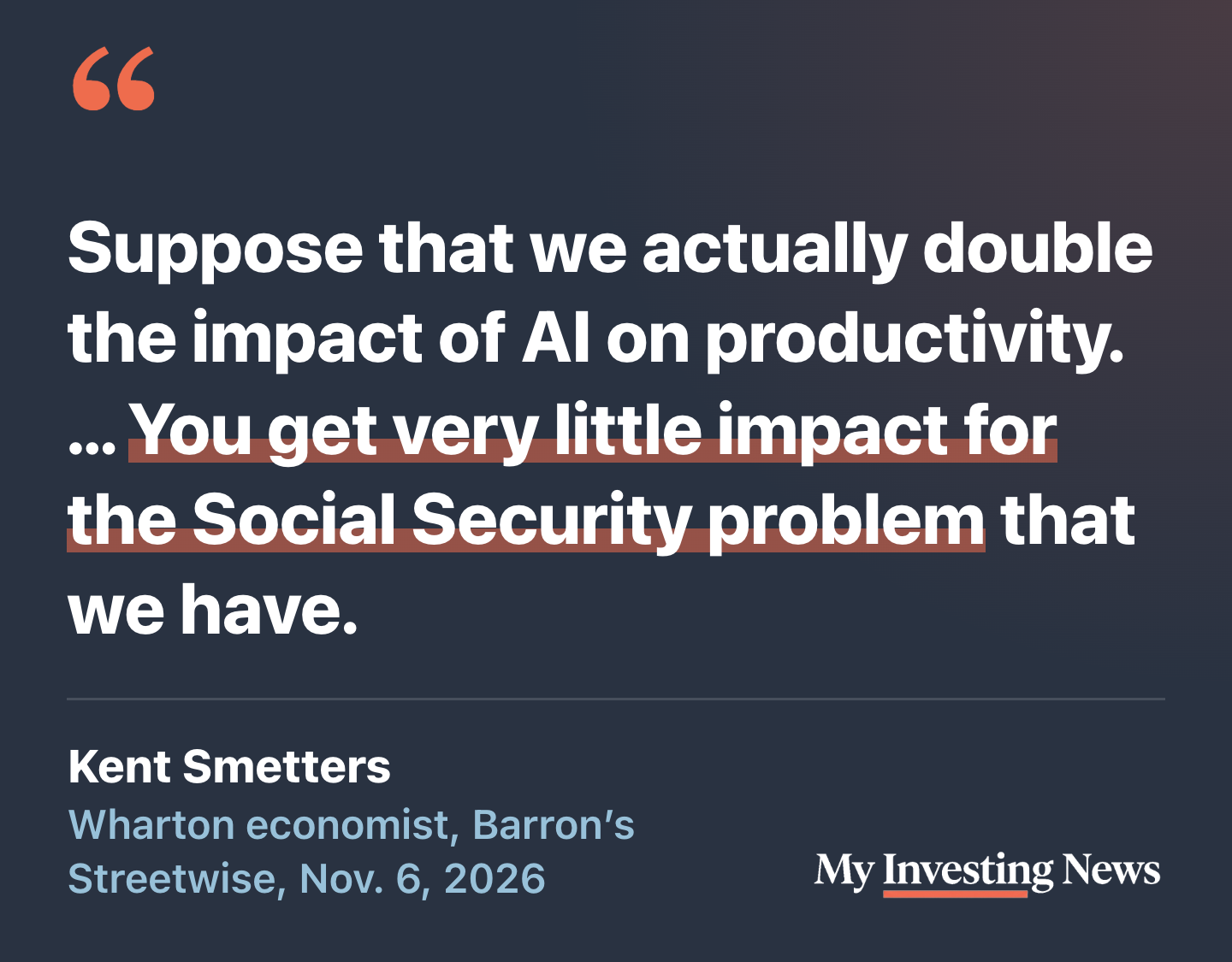
His conclusion: “Your ability to grow out of the problem for Social Security, it’s actually written in the law.” Smetters also said Penn Wharton and Social Security’s actuaries agree the trust fund runs dry in about six to seven years, leaving about 85 cents of every scheduled dollar. The 2026 Trustees Report puts the retirement fund’s depletion in the fourth quarter of 2032, with 78% of benefits payable after that, and the combined retirement and disability funds in the third quarter of 2034, with 83% payable. We tested his growth argument against the Trustees’ own numbers, which show what faster wage growth would do.
Why Higher Pay Raises Benefits Too
Smetters is describing a real feature of the benefit formula. When someone first claims, Social Security adjusts their past earnings for the growth in average wages across the economy, so a generation that earns more also starts with bigger checks. Only after that first check do raises follow prices, through the yearly cost-of-living adjustment.
The Trustees spell out the same mechanism, with a twist that cuts against him a little. “Higher wages increase taxable payroll immediately,” the report says, “but they increase benefit levels only gradually as new beneficiaries become entitled.” Retirees already collecting get price raises, not wage raises. So faster wage growth helps, just not by enough to close the gap. (Faster pay growth on paper doesn’t always reach every household, as the Fed’s latest survey of lower earners showed.)
The Trustees’ Own Test: A Quarter of the Gap
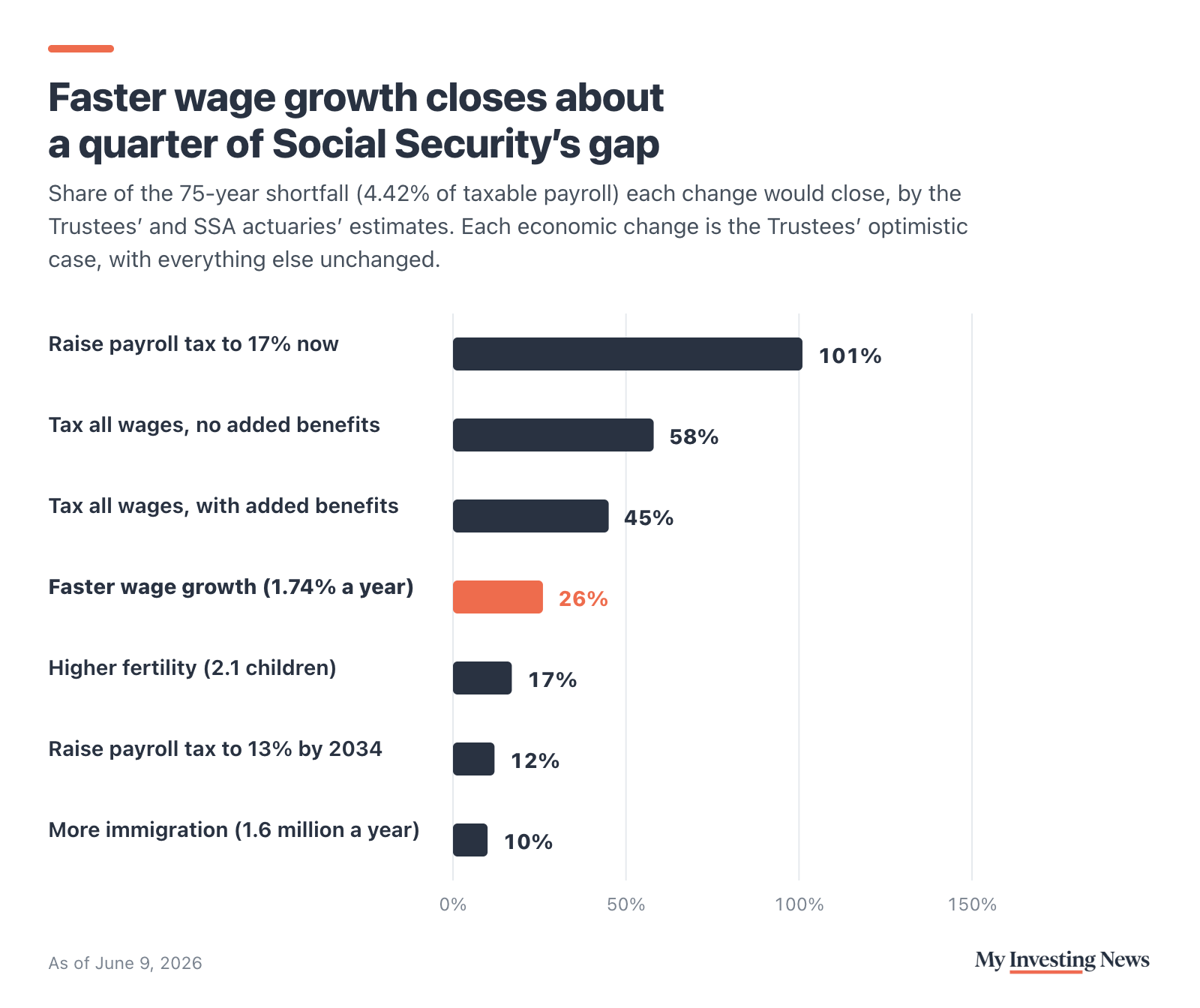
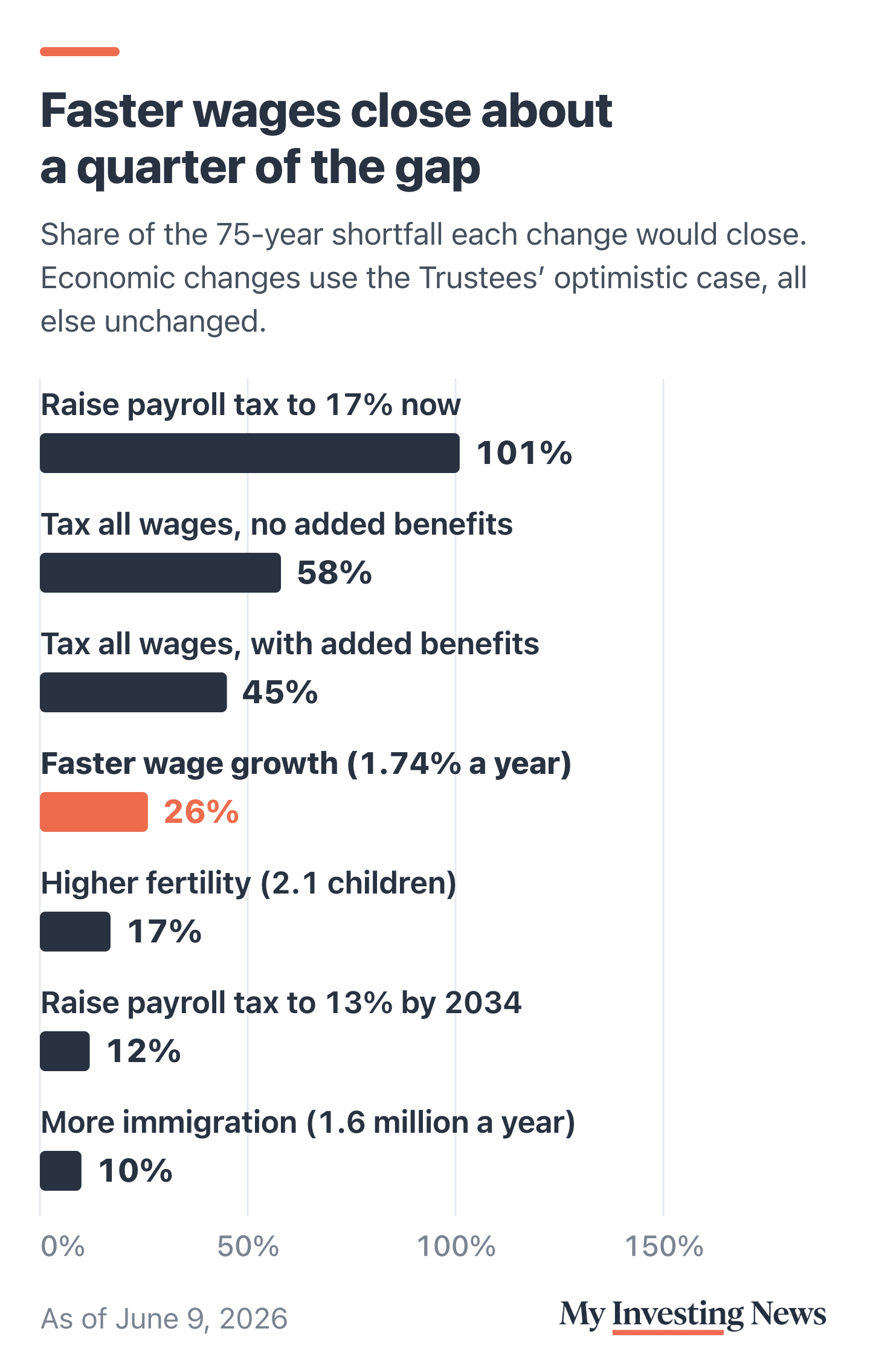
The report’s sensitivity analysis changes one assumption at a time. Under the middle forecast, average real wages grow 1.14% a year from 2035 on. In the optimistic case, 1.74% a year, about half again as fast, Social Security’s 75-year shortfall shrinks from 4.42% of taxable payroll to 3.27%. That closes 26% of the gap. The combined funds would last until 2035, one year longer than in the middle forecast. The Trustees’ rule of thumb: every extra tenth of a point of real wage growth improves the balance by about 0.19% of payroll.
Smetters’ doubling scenario goes beyond anything the Trustees test. Their middle forecast assumes productivity grows 1.63% a year, close to the 1.60% average from 1969 to 2019, and their optimistic case assumes 1.93%. Productivity has averaged 1.80% since 2019. On the near-term question he raised, the date, the Trustees agree with him: faster wages barely move it. On the 75-year gap, they help more than “very little,” though most of the hole remains.
What Moves the Gap More
Social Security’s Office of the Chief Actuary prices dozens of policy changes against the same baseline. Raising the 12.4% payroll tax to 17% starting in 2027 would close 101% of the 75-year gap. A gentler path, to 13% by 2034, closes 12%. Taxing all wages above the cap, which is $184,500 this year and $192,300 in 2027, would close 58% if those earnings earned no extra benefits and 45% if they did.
Social Security’s 75-year shortfall, 2026 Trustees Report
Smetters called legal immigration the closest thing to “a free lunch,” saying immigrants “pay way more in taxes than they collect in benefits.” In the Trustees’ numbers, raising average net immigration from about 1.18 million to 1.62 million a year closes 10% of the gap, with each extra 100,000 people a year worth about 0.10% of payroll. He was also talking about the wider federal budget, which this test doesn’t cover. Higher birth rates, 2.1 children per woman instead of 1.75, would close 17%.
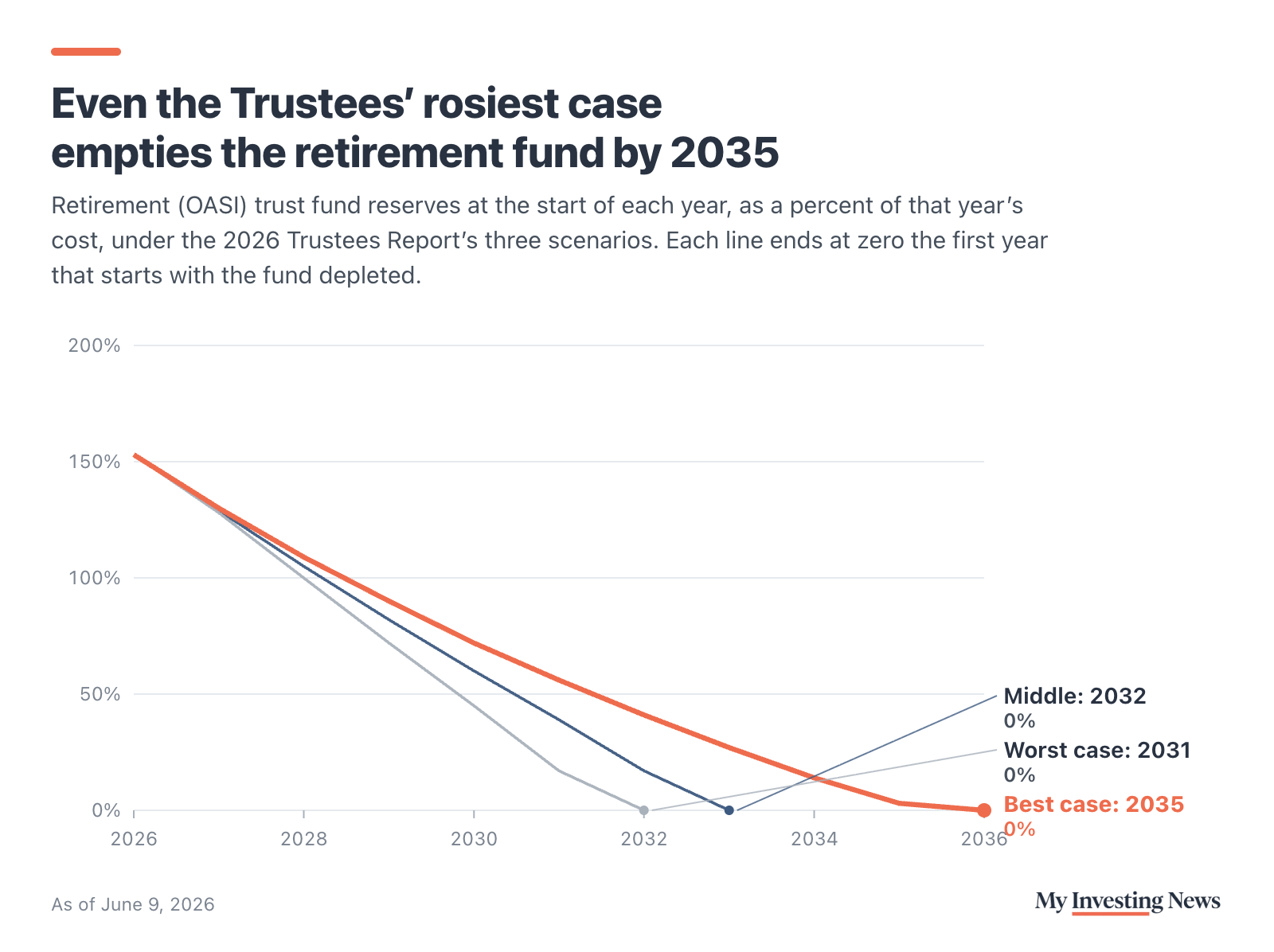
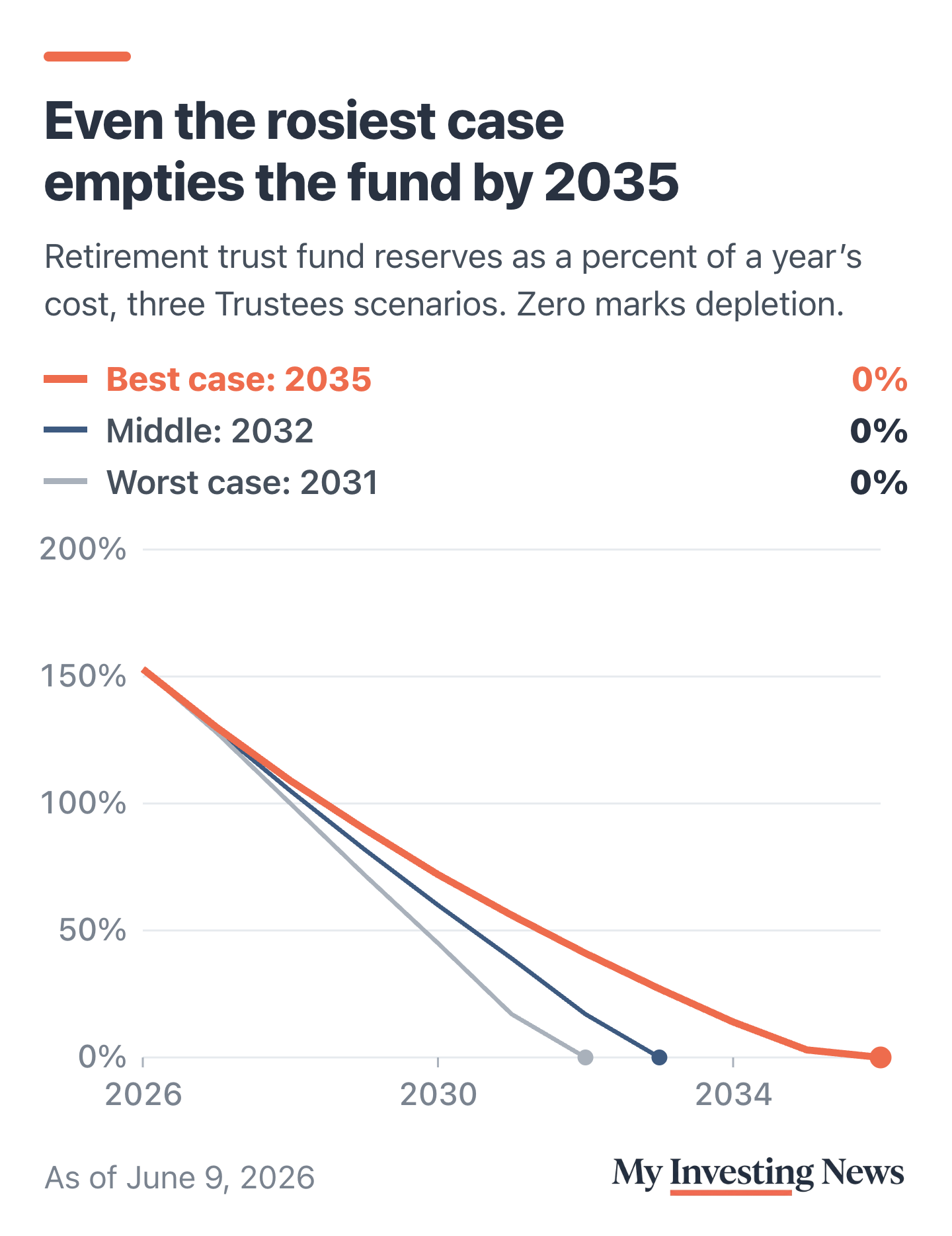
Put all of the optimistic assumptions together, including 1.93% productivity growth, more immigration and higher fertility, and the retirement fund still runs dry in 2035, three years after the middle forecast, with 89% of benefits payable. In the pessimistic case it empties in 2031.
What to Watch
The Trustees’ next report, due in 2027, will be the first full test of whether stronger wage data change the date. This year’s report already credited faster near-term earnings growth, and the combined funds’ date still didn’t budge. The depletion year has moved many times before, as every Trustees forecast since 1983 shows. MacGuineas, on the same episode, argued that a commission “could actually be part of the solution,” because “there will be many, many more political attack ads than there will be appreciation for fixing the system.” For households, the practical point is the same either way: how much a retirement portfolio can safely pay out matters more if checks are cut.
Smetters is right that Social Security can’t simply grow its way out: because benefits rise with wages, the Trustees’ optimistic wage case moves the depletion date by one year and closes 26% of the 75-year gap. Taxes do more of the work in the actuaries’ estimates, with an uncapped payroll tax closing 45% to 58%. The risk to his view is an AI boom far bigger than anything the Trustees test.