Where we heard itAriana Salvatore, Morgan Stanley’s head of public policy research, on the firm’s Thoughts on the Market podcast, Nov. 4, 2026, in the episode “Midterm Election Results: Three Key Takeaways.”
Democrats won control of the House and Senate on Nov. 3, and the next morning Morgan Stanley’s Ariana Salvatore told listeners what she thinks that does to dealmaking: not much. “We don’t think the election fundamentally changes the direction of several executive-led policy areas, including deregulation,” she said. Then she restated the firm’s call:
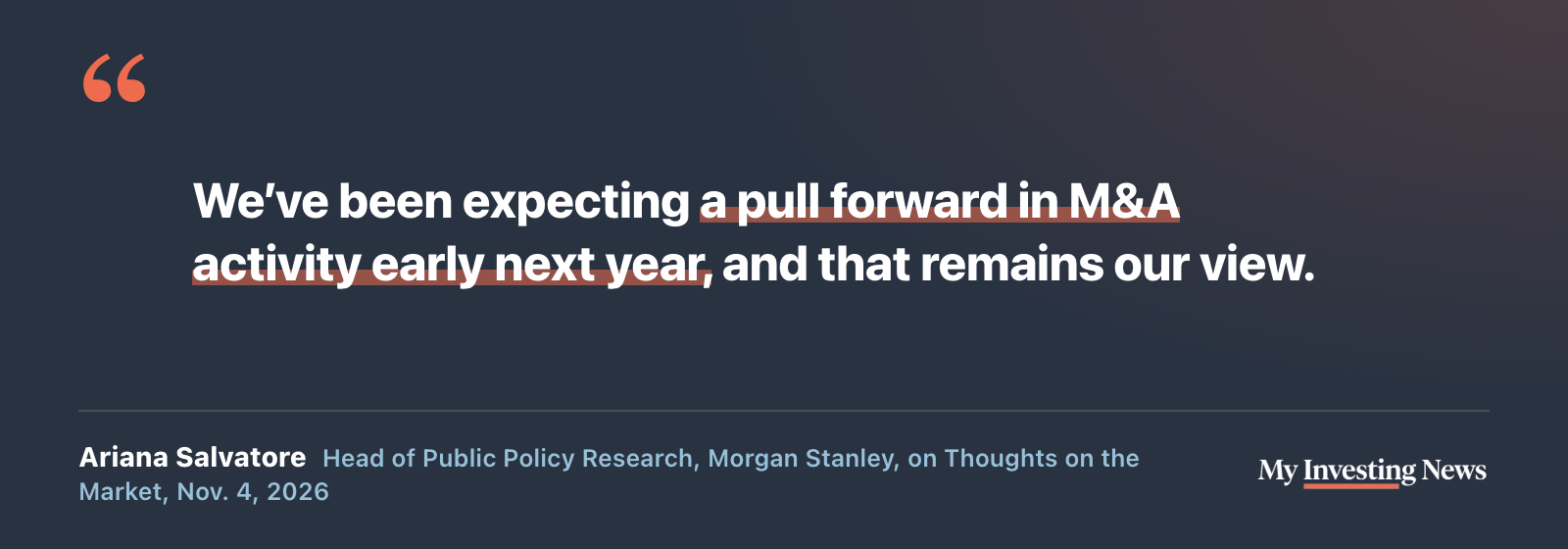
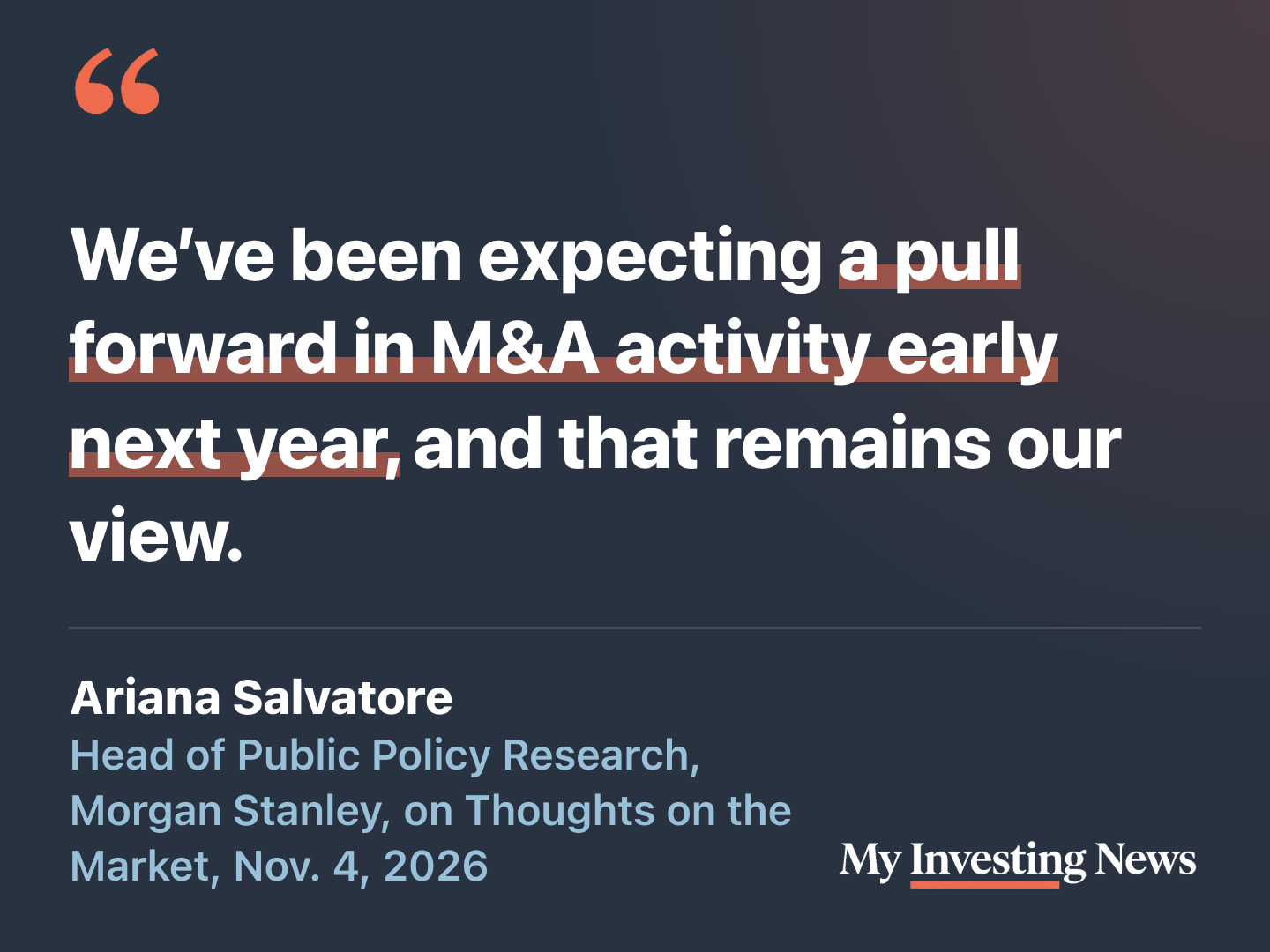
Her reasoning is about who holds the pen. Congress can hold hearings and open investigations, but “ultimately, the agencies still drive merger approvals and financial sector deregulation,” she said, and the Trump administration “continues to be perceived as favorable toward deal-making.” That view rests on an idea most investors take for granted: that merger review is looser now than it was under Joe Biden. We checked it against the government’s own records.
What the Merger Filings Show
Every deal above a size threshold has to be reported to the Federal Trade Commission and the Justice Department under the Hart-Scott-Rodino Act before it closes. The agencies’ latest annual report, released July 2, 2026, covers fiscal 2025, the year that ran from Oct. 1, 2024, to Sept. 30, 2025. That year spans the last four months of the Biden administration and the first eight of the second Trump term.
Companies reported 2,006 deals in fiscal 2025, about the same as the 2,031 a year earlier, and 31.8% were worth more than $1 billion. The agencies sent a second request, the demand for documents that opens an in-depth investigation, in 41 of them (20 from the FTC and 21 from Justice). That is 2.1% of the deals they could have questioned, down from 59, or 3.0%, in fiscal 2024. The two agencies took 18 merger enforcement actions, against 32 the year before.
Looser Than Under Biden? The 30-Year Record
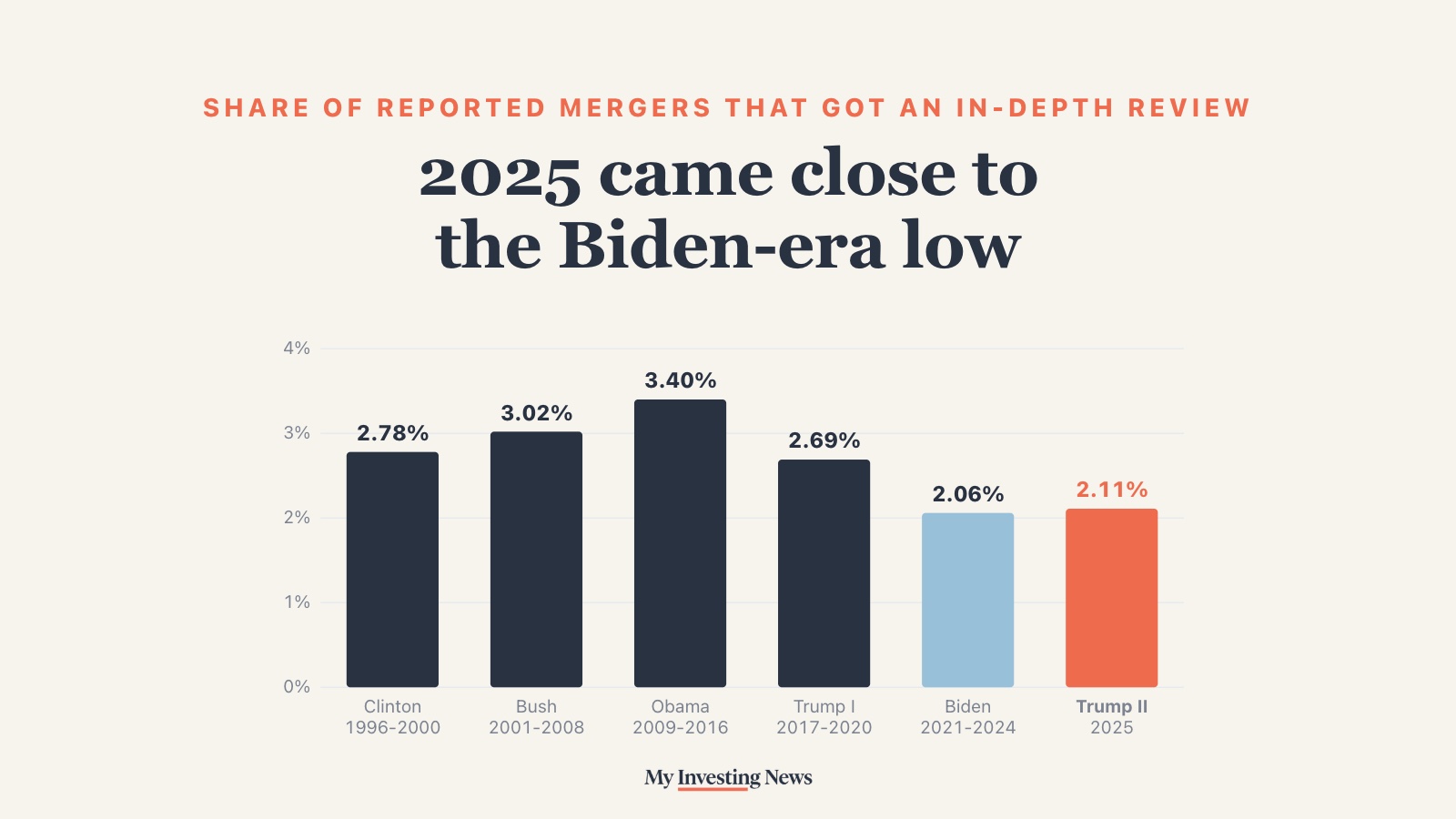
A one-year drop says little on its own, so we lined up every annual report from fiscal 1996 to 2025 and grouped the years by president. Each fiscal year counts for the president in office for at least eight of its months. By that measure, the lowest rate of in-depth reviews came under Biden, at 2.06% of deals from fiscal 2021 to 2024. Fiscal 2025 came in just above it, at 2.11%. Every earlier administration ran between 2.69% (Trump’s first term) and 3.40% (Obama).
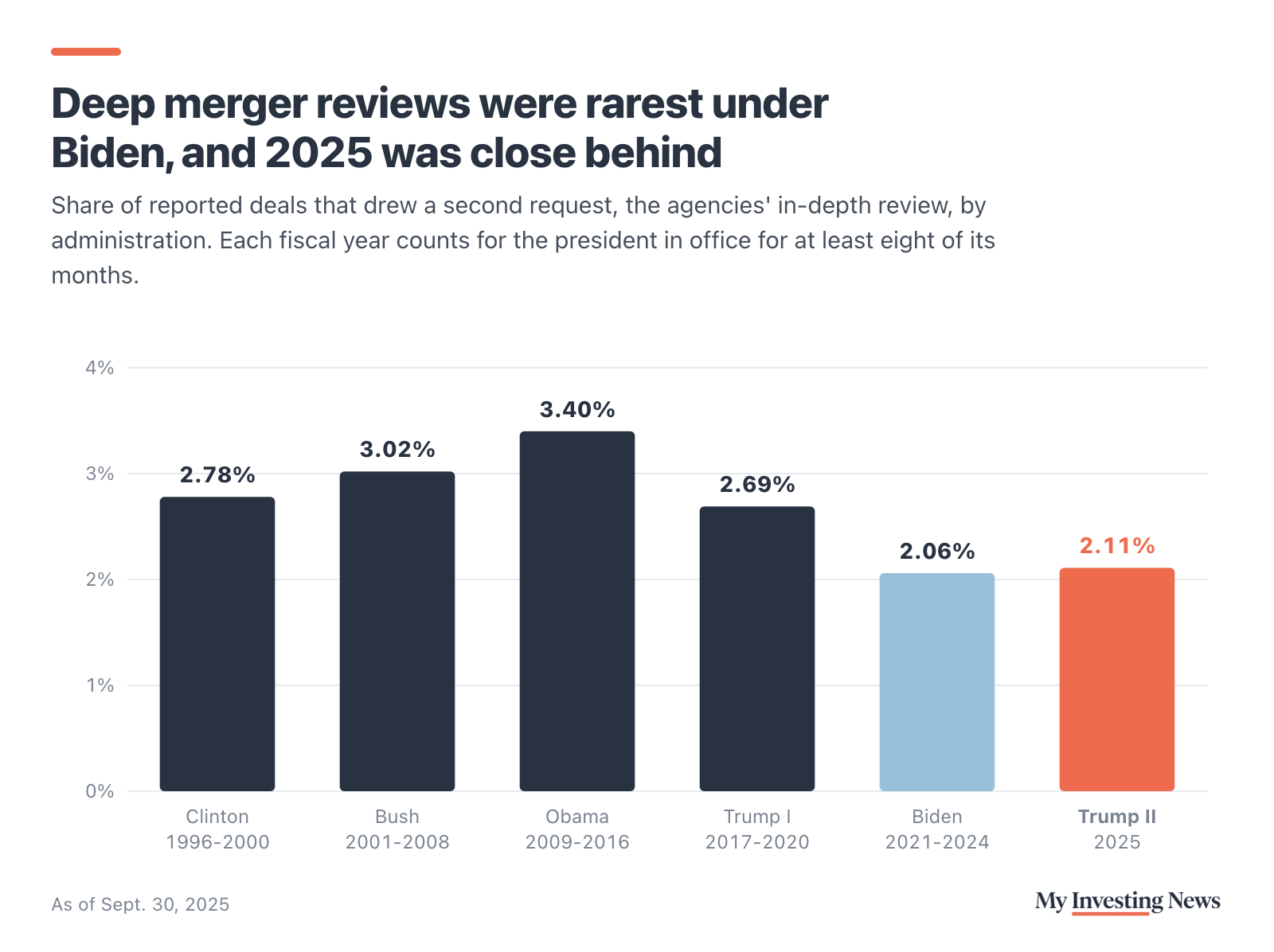
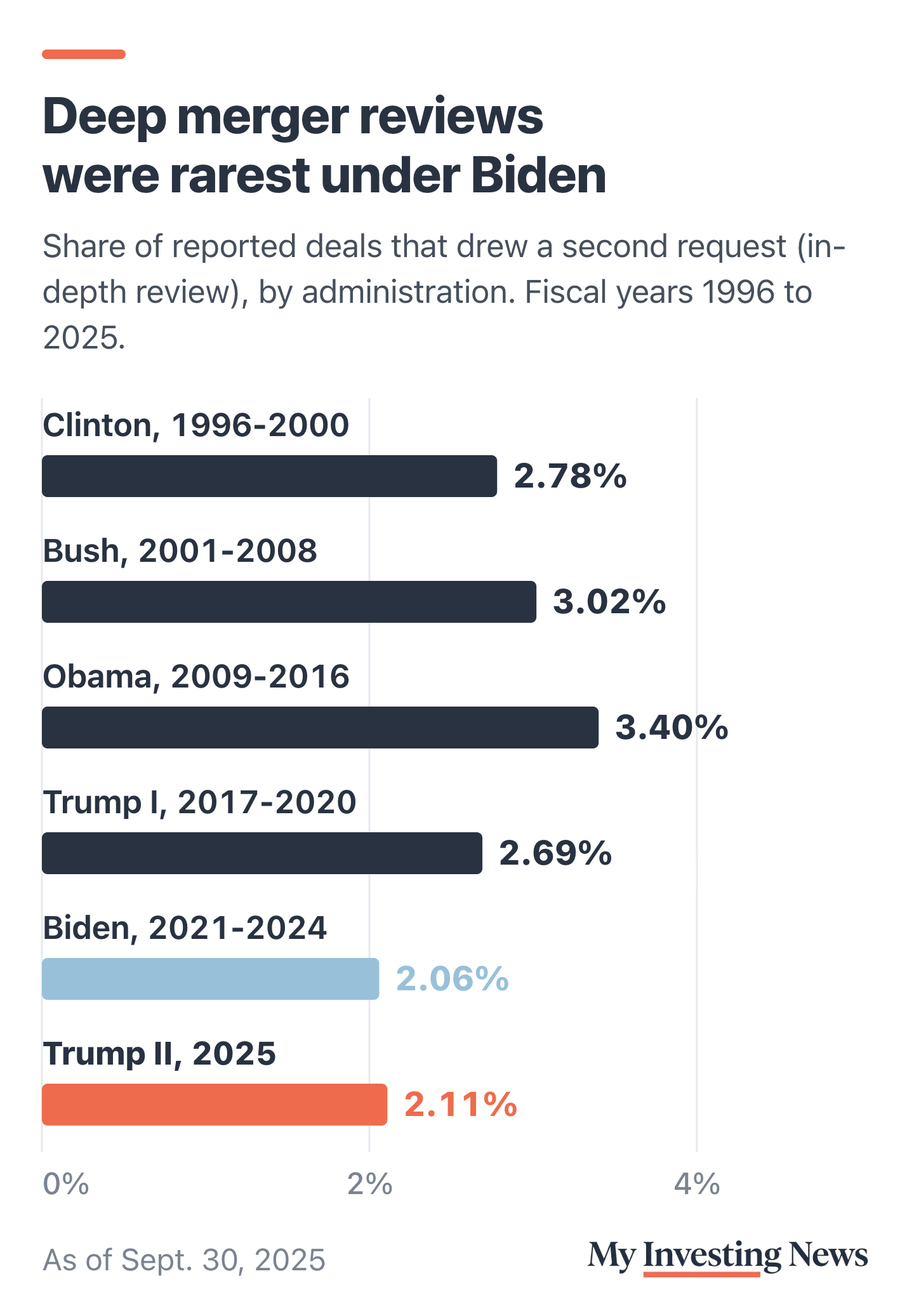
The single lowest year in the 30 was fiscal 2022, at 1.55%. Fiscal 2025 ranks fourth from the bottom. The rate is a blunt gauge, though. When filings jumped to 3,520 in fiscal 2021, the most since Congress raised the reporting threshold in 2001, the agencies issued 66 second requests, the most since fiscal 2001, yet that was only 1.9% of the pile. It counts how many deals get a hard look, and it says nothing about how those reviews end.
Merger review in fiscal 2025
Where the Rules Did Change
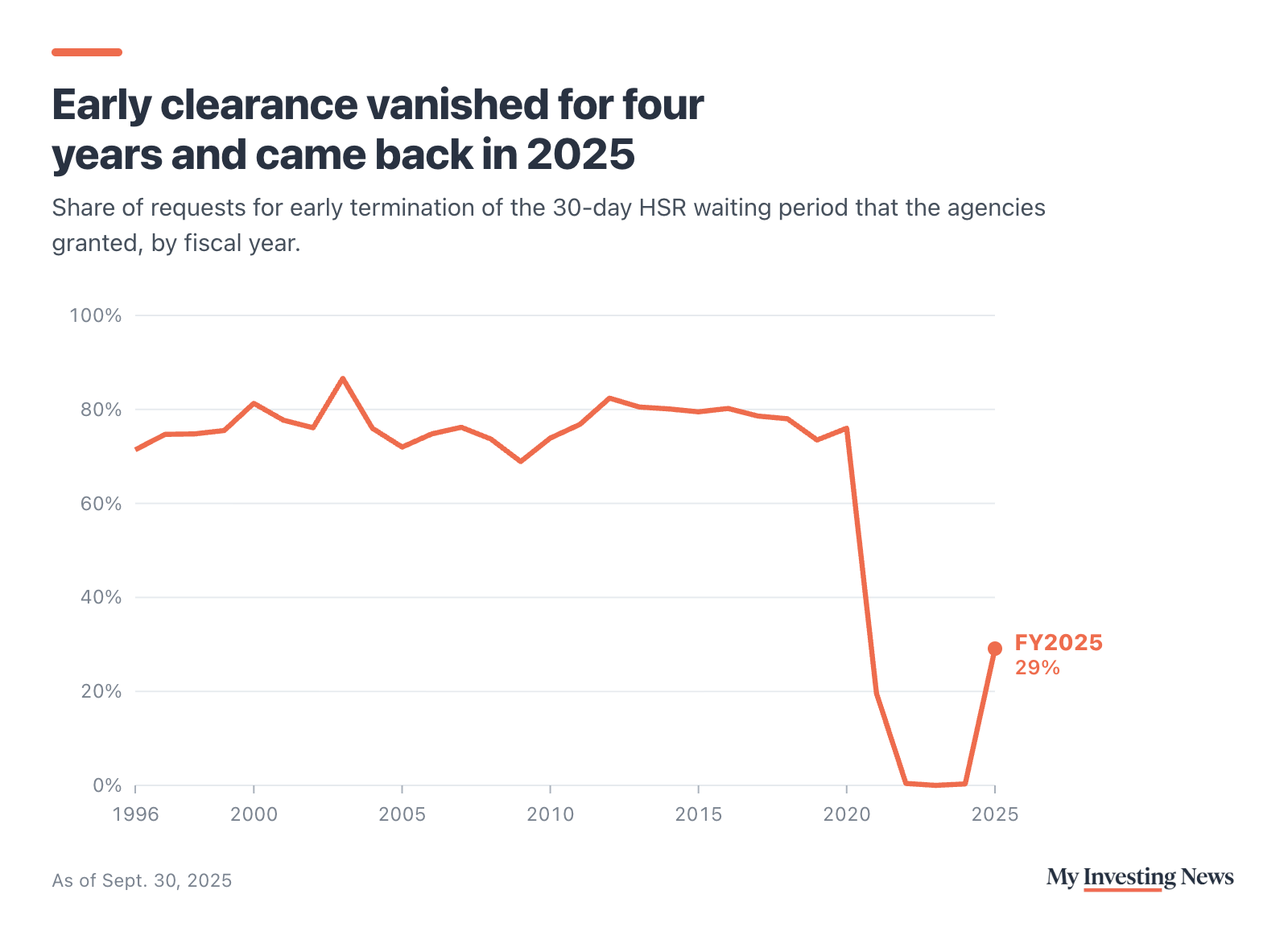
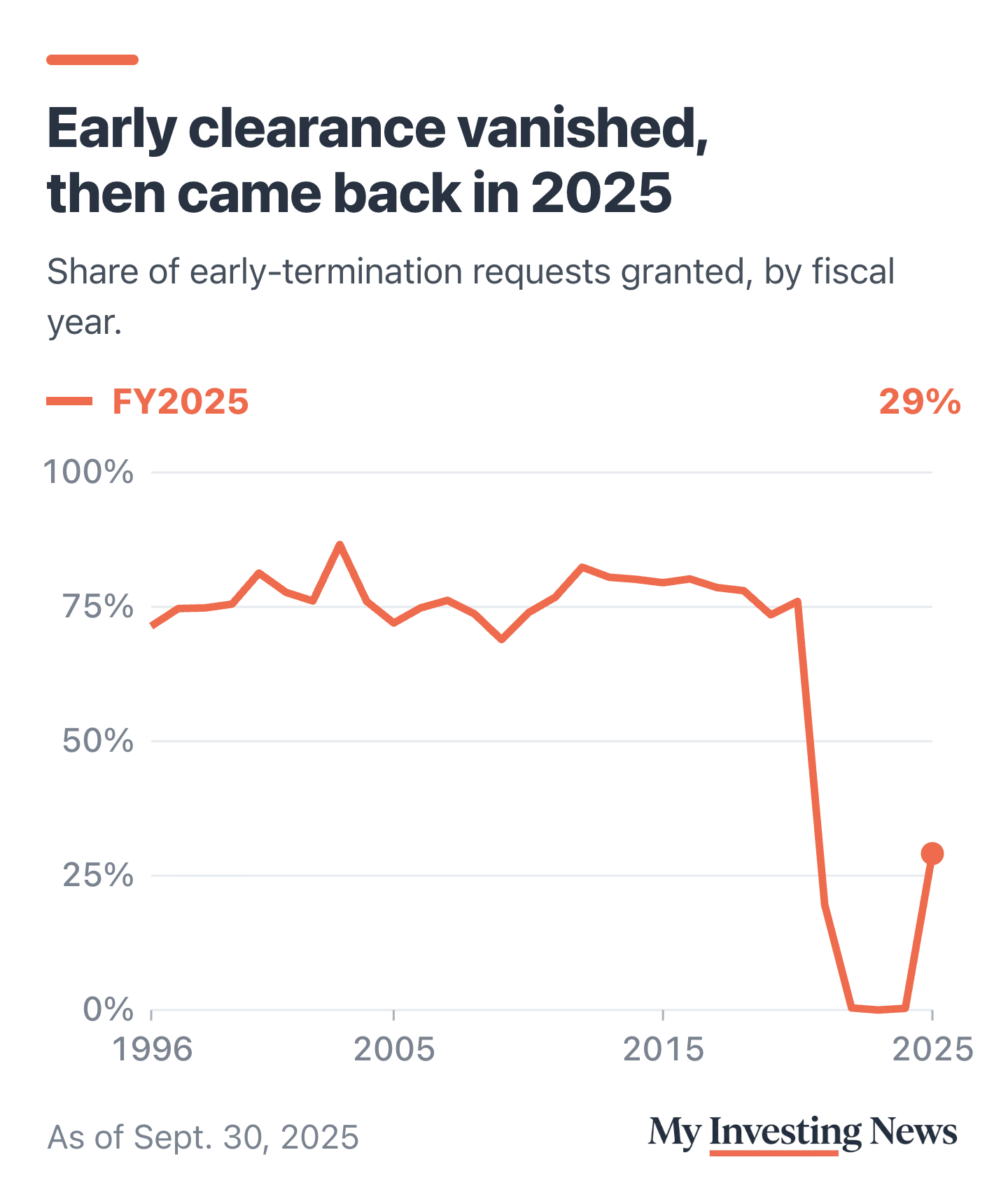
The clearest shift is in early termination, which lets a deal close before the 30-day waiting period runs out. From fiscal 1996 to 2020 the agencies granted 69% to 87% of requests. The agencies suspended the program in February 2021, and grants fell to nearly zero from fiscal 2022 to 2024. The FTC said in October 2024, while Lina Khan was still its chair, that early termination would return with a new filing form, which took effect in February 2025. In fiscal 2025 the agencies granted 265 of 911 requests, or 29%.
That new form didn’t last. A federal court threw it out on Feb. 12, 2026, and filers went back to the old one; the agencies asked for public comment in March on a possible new version. Enforcement hasn’t stopped, either. Sen. Elizabeth Warren posted on Nov. 1 that “Trump’s DOJ let” UnitedHealth buy Amedisys for $3.3 billion. The Justice Department sued to block that deal in November 2024, under Biden, and settled it with a consent decree that the court approved in December 2025. The settlement made the companies sell at least 164 home health and hospice locations in 19 states, which the agencies’ report calls “the largest divestiture of outpatient healthcare services ever to resolve a merger challenge.”
What to Watch
Salvatore expects “a greater degree of congressional oversight” from the new Congress, which can mean hearings and headlines without changing who approves deals. The next scorecard is the fiscal 2026 HSR report, the first to cover a full year of the second Trump term. If it follows this year’s timing, it will arrive around July 2027. Until then, watch the agencies’ early-termination notices and whether big pending combinations, such as DoorDash’s reported talks to buy Instacart, draw second requests. Dan Ives has also put 80% to 90% odds on a Tesla and SpaceX merger, a deal that would face the same review.
Salvatore expects agencies, not Congress, to set the pace for deals, and Morgan Stanley still sees a pull forward in M&A early next year. The government’s records show fewer in-depth reviews in fiscal 2025 (2.1% of deals), but the Biden years ran slightly lower, so the bigger change was faster early clearance. The risk to the call: one year of data is thin, and Salvatore herself expects more congressional scrutiny.