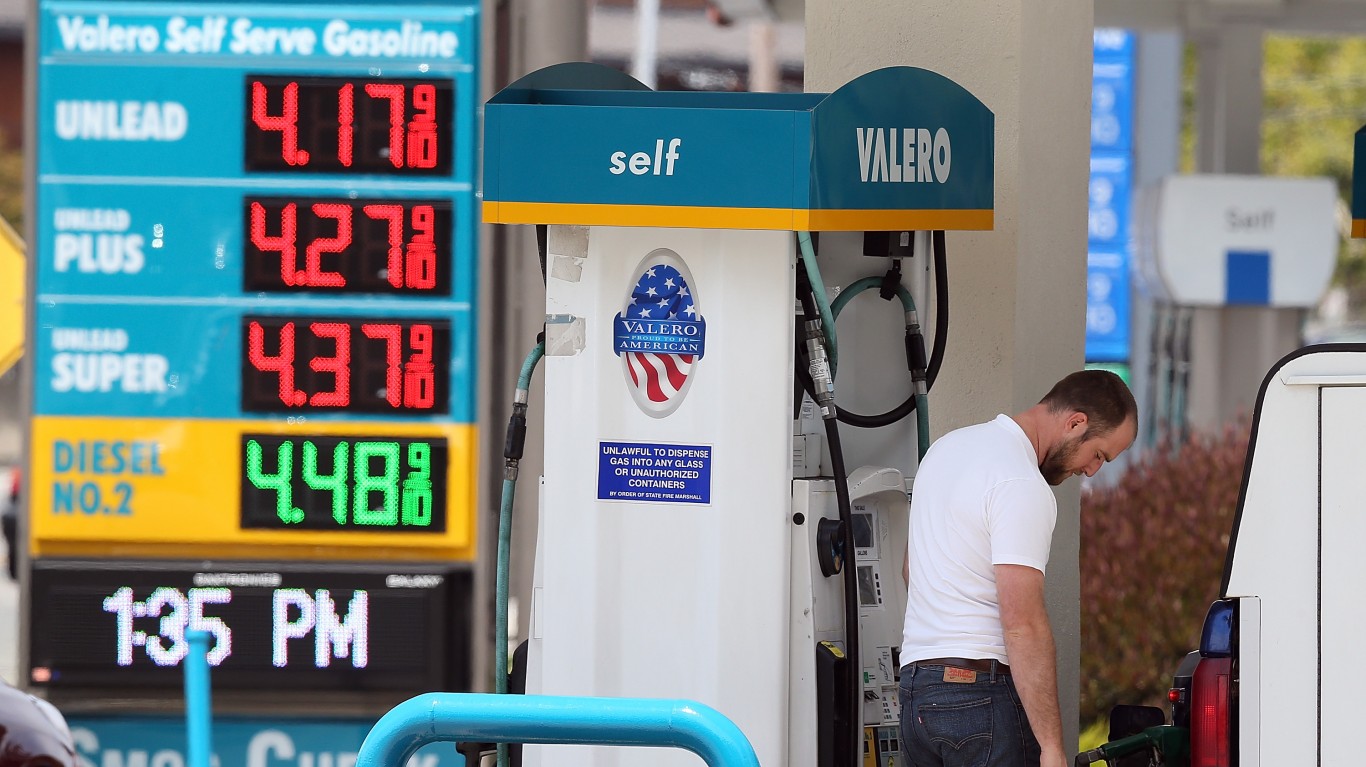
The national average price of regular gasoline was $4.35 a gallon for the week ending Oct. 5, 2026. That figure comes from weekly Energy Information Administration data published through FRED, and it is up $0.28 from a month ago.
Over the past year, the price bottomed at $2.779 for the week of Jan. 12, 2026 and peaked at $4.50 for the week of May 11, 2026. The current price sits in the 86.5th percentile of the past year’s weekly levels. A percentile rank shows how a value compares with the rest of the data set, so a high rank means most of the past year’s weekly prices came in lower. There is some relief at the margin, though: the price was down $0.11 from a week ago.
What Small Business Owners Told NFIB in September
CNBC senior economics reporter Steve Liesman said on air that the NFIB Small Business Optimism Index fell 0.8 points to 97.9 in September. Liesman said small business optimism was “ticking down for the second month in a row in September amid rising energy and interest rate costs.” We could not independently verify the NFIB figures in this article. Each one comes from Liesman’s account of the release.
Liesman reported that 31% of small business owners raised prices in September, per NFIB. “That’s double the long run average for that series,” he said.
Liesman also said 26% of owners named labor quality as their single most important problem, per NFIB. That levels is “up three points from August and up eight points from last year.”
Liesman summed it up: “What I’m hearing and seeing in this report is not yet necessarily a plan to pull back, but more a plan to stand still.” A firm that stands still keeps its current staff and puts off the new hire, the second location and the equipment upgrade. Standing still avoids downsizing, but it also gives up the expansion that drives hiring.
Why Treasury Yields Hit Small Firms Harder
On Oct. 9, the three-month Treasury yield stood at 4.25%, the five-year at 5.02% and the ten-year at 5.24%, according to the US Treasury daily yield curve.
How a Fuel Price Becomes a Household Problem
When fuel costs rise, it costs a small business more to receive goods and to deliver them. Owners who cannot absorb that cost raise prices, and Liesman’s figure says nearly a third did so in September.
A third data set covers households. CNBC reported that the FINRA Foundation’s National Financial Capability Study found that the share of US adults spending more than their income rose to 26% from 19% in 2021, an all-time high for the survey. Two-thirds said higher food costs had made them cut back on other spending. Those findings come from the 2024 wave, which was published in 2025, so they precede the period discussed here.
These three sources measure three different things over three different periods, and none of them shows a causal chain. Still, they describe the same squeeze from three angles: suppliers, sellers and households.
What Small Business Sentiment Actually Signals
Small business sentiment is a leading indicator. It tracks hiring and expansion plans, and those show up in employment data months later. It says little about where market prices stand today.
When many small firms turn defensive at once, the labor market feels it more than any single company’s earnings do.
Reasons to Weigh This Data Carefully
- Every NFIB figure here is Liesman’s account of a survey release.
- Sentiment surveys measure how people feel. Michelle Meyer, chief economist at the Mastercard Economics Institute, said on CNBC this week that “the sentiment data have been somewhat misleading, frankly, for the last few years.” We covered her comments separately. Her point and the survey’s message pull in different directions, and that tension remains.
- Gasoline fell from the prior week, so the fuel pressure is uneven.
- We could not confirm whether the index sits near its long-run average.
- Two months of survey movement fall short of a trend.
Hiring Plans Matter More Than Next Month’s Reading
The signal to track is whether the hiring plans inside the index start showing up in employment data.